
If you have encountered the claim that the Mahabharata knew the cause of ocean tides, you probably want to know how much the text really says. Is this a genuine ancient observation, or has a poetic description been stretched into a modern scientific claim?
The careful answer preserves what is remarkable without adding what is absent. The Mahabharata connects the ocean’s swelling with the Moon. It also describes wind disturbing the water. That is an intelligent observation of nature, but it is not a mathematical theory of gravity or a method for predicting local tides.
Where the lunar-ocean connection appears
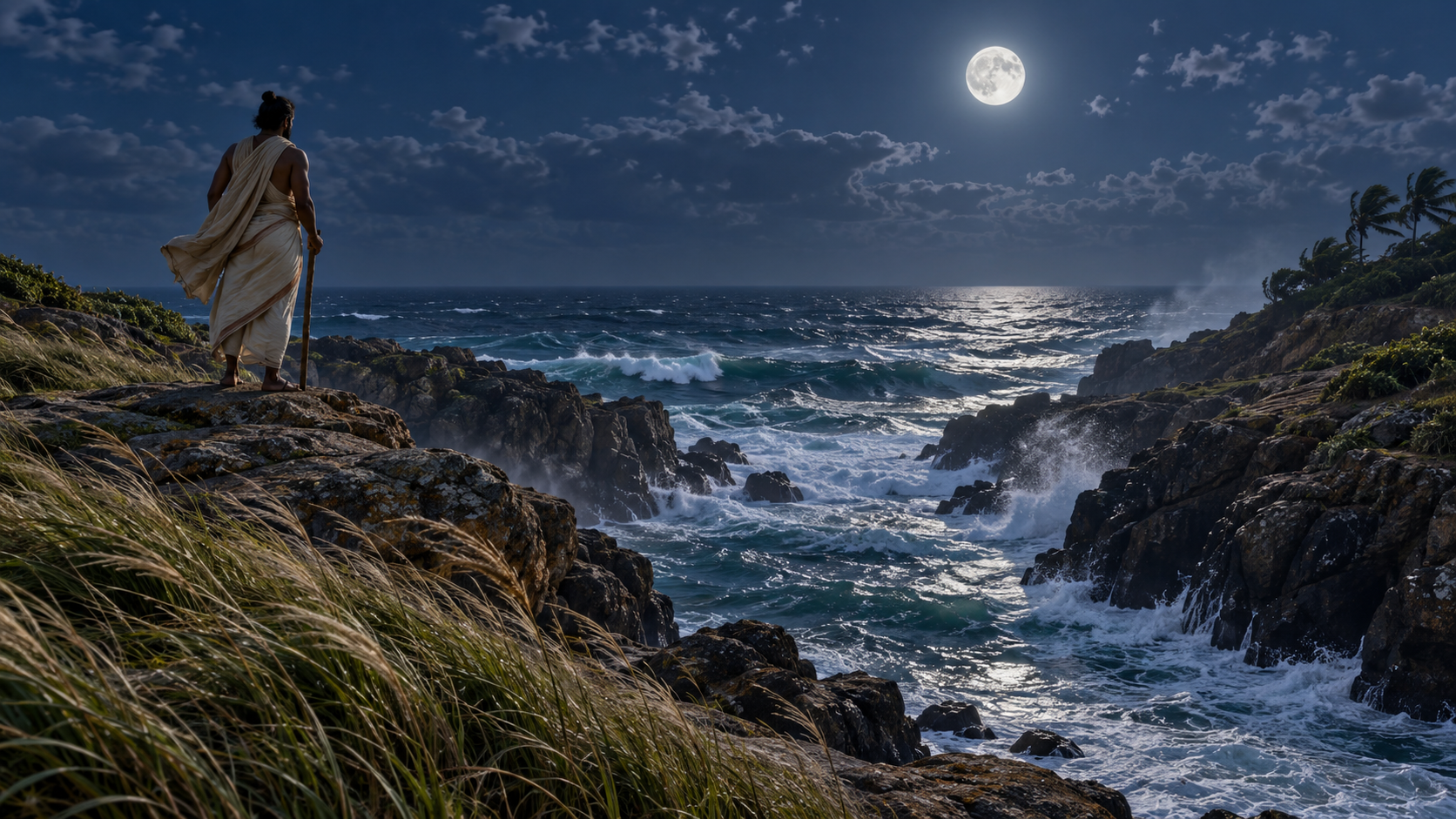
The relevant scene occurs in the Astika Parva, which belongs to the Adi Parva of the Mahabharata. Kadru and Vinata are travelling to see the divine horse Uchaishravas. They intend to settle their dispute about whether its tail is black. On their way, the narrative pauses to describe the immense ocean.
The ocean appears as a vast storehouse of water. Its surface is agitated by winds, while its volume or swelling is associated with the rising Moon. In one compact image, the passage places two familiar marine movements beside each other: water stirred by wind and water increasing in relation to the Moon. The lunar connection occurs inside this description of the sea, not in a separate discourse on astronomy.
That narrative setting matters. You should not cite the passage as though a sage were presenting equations or explaining a physical force. The Mahabharata is describing the world through which its characters move. The observation is incidental to the plot, yet precise enough to preserve a recognised relationship between the Moon and the ocean.
This is also why dismissing the line merely because it is poetic would be a mistake. Poetry can carry close observation. At the same time, poetic accuracy in one detail does not automatically establish a complete scientific system behind it. Genre neither erases the observation nor enlarges it.
What the passage supports, and what it does not
Discussions of ancient Indian knowledge often fail at one of two extremes. One side treats any resemblance to modern science as proof that the entire modern explanation was already known. The other assumes that an observation has no intellectual value unless it comes with equations. Neither approach reads the Mahabharata on its own terms.
| Claim | Assessment | Reason |
|---|---|---|
| The Mahabharata associates the Moon with the swelling of the ocean. | Supported | That relationship is part of the Astika Parva’s description of the sea. |
| The passage can reasonably be discussed as an observation of lunar tides. | Supported with care | It recognises the relevant Moon-ocean relationship, though it does not analyse the full tidal cycle. |
| The Mahabharata explains Newtonian gravitation. | Not supported by this passage | Recognising a recurring relationship is not the same as defining the force or calculating its effects. |
| The passage provides tide heights, times, or a predictive method. | Not supported | No quantitative procedure appears in the material under discussion. |
| The poetic setting makes the observation scientifically meaningless. | Too dismissive | A literary description can preserve an accurate natural association even when scientific explanation is not its purpose. |
The safest description is therefore a narrow one: the Mahabharata preserves an early literary recognition that the ocean swells in connection with the Moon. That statement gives the passage its due. It does not turn recognition into gravitational theory, or a qualitative observation into quantitative oceanography.
You should be especially cautious with the word pull. Modern readers know that lunar gravity is central to tides, so pull is a natural explanatory paraphrase. But unless the translation you are quoting explicitly uses causal language of that kind, do not place it inside quotation marks or present it as the Mahabharata’s technical term. Keep the ancient description and the modern explanation visibly distinct.
How the ancient observation relates to modern tidal science
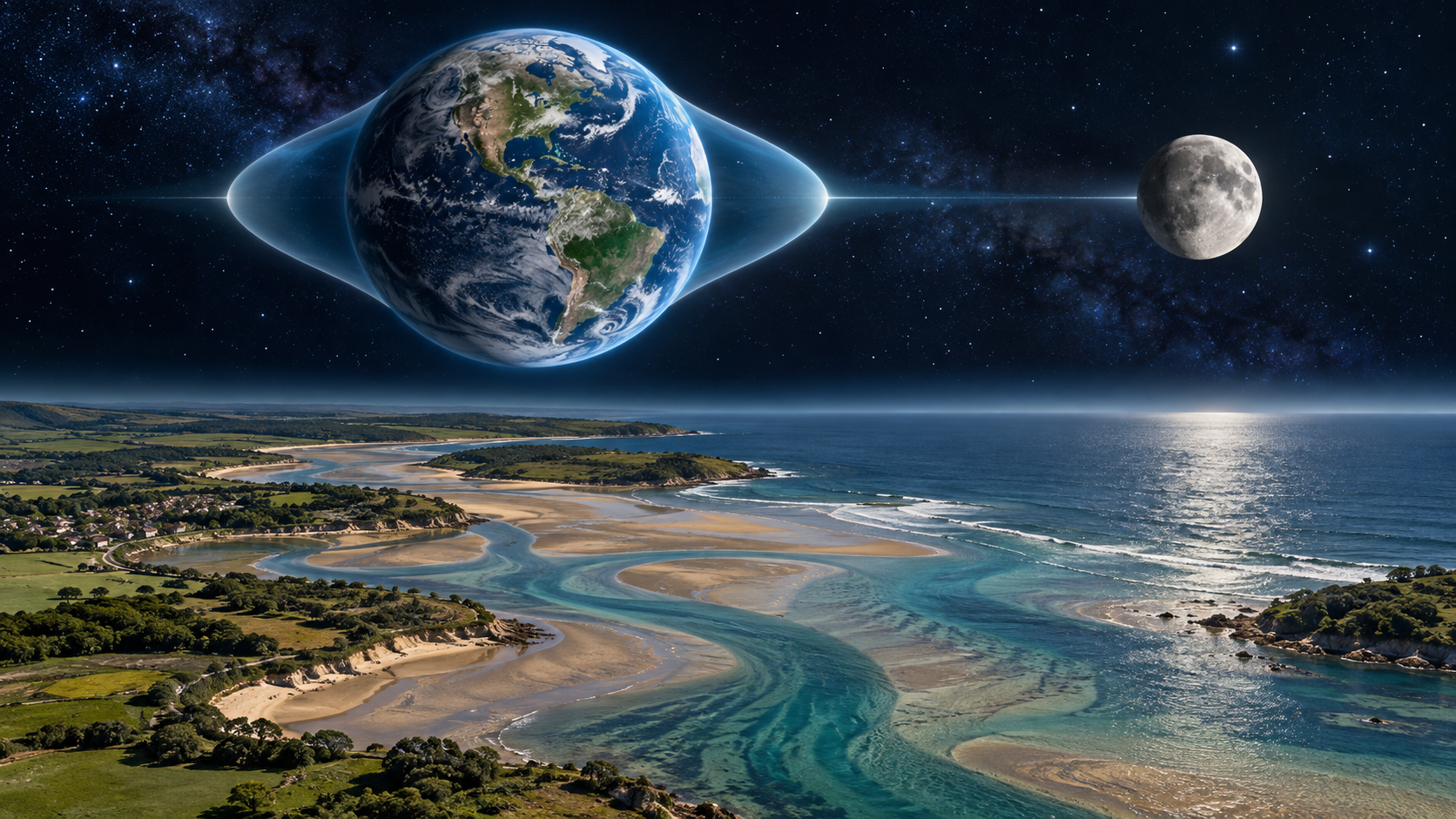
A tide is the broad, periodic rise and fall of water level. It is not the same thing as the individual waves you watch breaking on a shore. Wind chiefly produces those shorter surface waves. The Moon’s gravity, together with the Sun’s gravitational contribution, drives the larger tidal pattern.
The physical explanation depends on differential gravity: the Moon’s influence is not identical across the whole Earth. The Earth-Moon system consequently develops tidal bulges, and Earth’s rotation carries different regions through the resulting pattern. The Sun can reinforce or partly offset the lunar effect, while coastlines, sea depth, basin shape, and local geography alter what a particular shore experiences.
This distinction helps you read the Mahabharata’s imagery accurately. The wind-beaten ocean corresponds to one kind of motion; the Moon-associated swelling corresponds to another. The passage does not formally classify them, but it does not collapse all movement of the sea into one undifferentiated phenomenon either.
There is one important limit to remember. A high tide does not occur everywhere at the instant the Moon becomes visible above the horizon. Local tidal timing can lag, and different coasts respond differently. If your chosen translation speaks of the Moon rising, treat that language as a qualitative association. Do not convert it into the claim that moonrise universally marks the local time of high tide.
The correspondence is strongest at the level the verse itself occupies: the Moon and the ocean’s increase are related. Modern science supplies a mechanism, additional influences, local variation, and predictive calculation. Those later layers illuminate the observation; they should not be retroactively inserted into its wording.
How to cite the passage without weakening your case
If you want to discuss this example in an essay, lecture, classroom, or social-media exchange, accuracy will make the Dharmic case stronger. Use the following sequence:
- Name the location. Identify the Astika Parva within the Adi Parva rather than referring vaguely to an ancient Hindu scripture.
- Give the narrative context. Explain that the ocean is described while Kadru and Vinata travel to inspect Uchaishravas. This prevents the description from being mistaken for a scientific treatise.
- Use one translation consistently. Quote the exact wording from the edition in front of you. Do not silently combine an ancient phrase with modern terms such as gravity, tidal bulge, or differential force.
- State the supported claim first. Say that the description associates the swelling of the ocean with the Moon.
- Add the limitation yourself. Make clear that the passage does not provide the modern physical mechanism, measurements, equations, or a tide table.
- Avoid unsupported priority claims. This passage demonstrates a preserved observation. Establishing who first discovered a phenomenon would require dated texts, textual history, and comparisons not supplied by this line alone.
A defensible formulation you can use is this: In the Astika Parva of the Adi Parva, the Mahabharata poetically describes the ocean as disturbed by wind and swelling in relation to the Moon. This preserves a perceptive observation of nature, though it does not set out the mathematical or gravitational theory of tides.
That wording is not timid. It is exact. Inflating the passage gives a critic an easy target, because the extra claims cannot be demonstrated from the text. Precision keeps attention on what is genuinely significant: a Moon-ocean relationship appears naturally within the Mahabharata’s vision of the world.
Key takeaways
- The lunar-ocean description occurs in the Astika Parva of the Adi Parva during Kadru and Vinata’s journey to see Uchaishravas.
- The sea is presented as disturbed by wind and swelling in association with the Moon.
- Calling this a qualitative recognition of lunar tides is reasonable.
- Calling it a complete theory of gravity, a quantitative tide model, or proof of scientific priority goes beyond the passage.
- When you cite it, identify the location, preserve the narrative context, and separate the ancient observation from the modern mechanism.
Read the line in a complete translation of the Astika Parva before sharing it, and reproduce that translation exactly. The Mahabharata does not need an imported equation to make this moment valuable. Its value lies in the disciplined attention to nature that the description itself preserves.
References

Leave a Reply
You must be logged in to post a comment.