
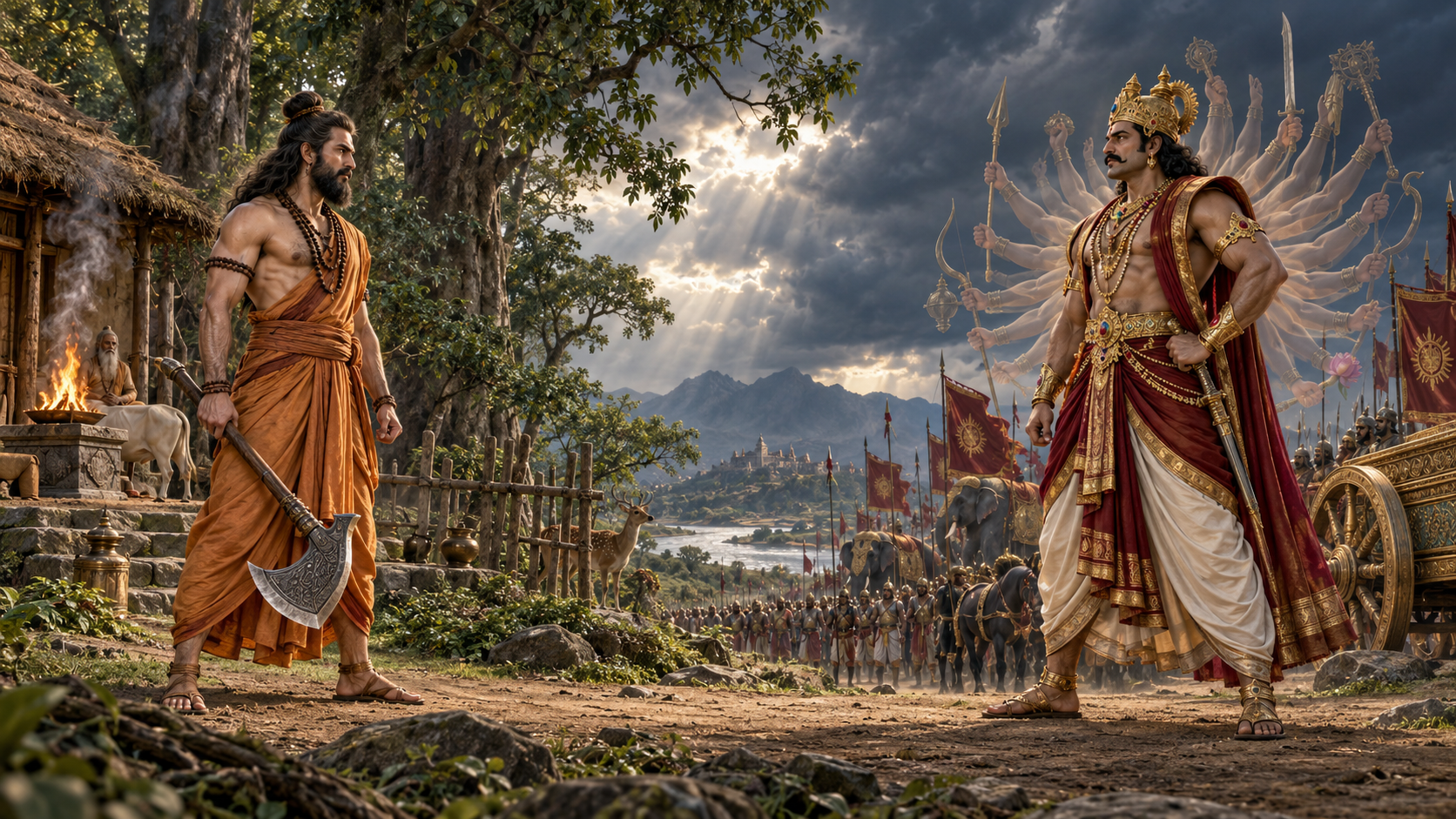
If you came here asking why Parashurama killed Kartavirya Arjuna, you may have encountered either a bare account of combat or a crowded retelling that never identifies its textual frame. The useful answer begins with what the episode actually establishes, then asks what the confrontation means under dharma.
At its clearest, this is a warning about exceptional power becoming arrogant. Kartavirya Arjuna possesses immense royal strength; Parashurama becomes the boundary that strength cannot cross without consequence. Once you see that structure, the episode is no longer just a contest between two formidable figures.
The most defensible answer to why Parashurama killed him
Kartavirya Arjuna is presented as a powerful and arrogant Yadava king, also called Sahasrarjuna and distinguished by a thousand arms. His conflict with Lord Parashurama culminates in battle and death.
The moral answer is therefore sharper than “Parashurama killed a powerful king.” Power alone is not the offense. The problem is power joined to arrogance: capacity has ceased to serve restraint, responsibility, and rightful order. Parashurama’s intervention marks the point at which royal might no longer validates its own conduct.
That is a moral cause, not a fully itemized chain of events. The exact triggering act is not established by the limited facts cited here. When someone supplies a detailed sequence of provocation and retaliation, ask which passage or named version it follows. Without that identification, treat the detail as version-specific rather than as an uncontested account shared by every tradition.
Kartavirya Arjuna, Sahasrarjuna, and the thousand arms
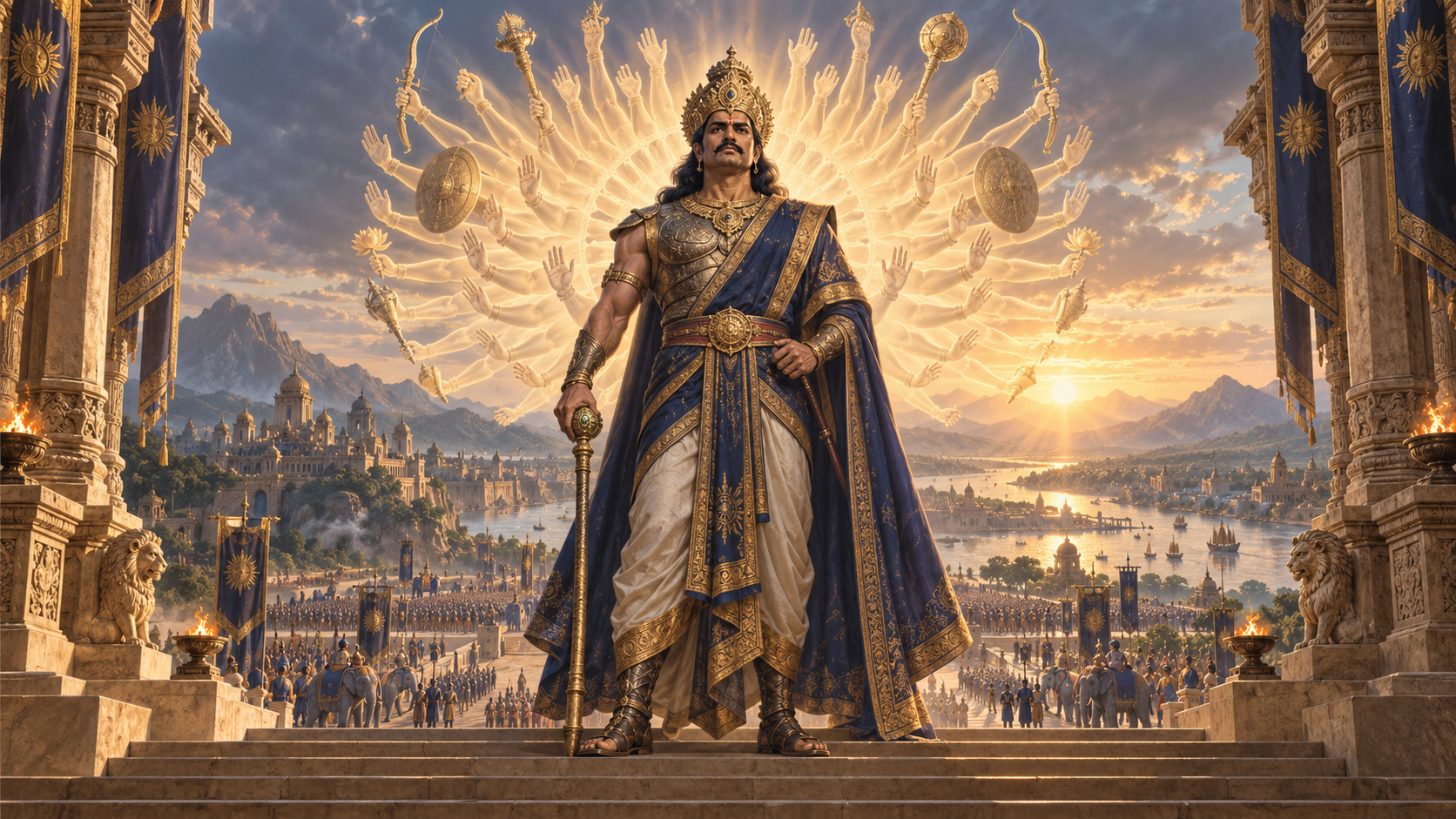
Kartavirya Arjuna and Karthaveeryarjuna are English spellings of the same name in this context. Sahasrarjuna is another name for the same king, tied to his thousand-armed identity. He should not be confused with Arjuna, the Pandava hero. That distinction matters when you search for the story, discuss it, or teach it to someone encountering the names for the first time.
The thousand arms first tell you that this is no ordinary ruler. Within the narrative, they mark an extraordinary concentration of ability. They also perform a moral function: they make the imbalance of power visible. The greater the king’s reach, the greater the need for self-command.
You do not have to reduce the arms to a mere metaphor in order to understand that function. Nor do you have to settle every question about how sacred narrative represents extraordinary bodies before learning from it. Keep two levels distinct: the narrative describes a thousand-armed king, while the ethical reading asks what happens when vast capacity is no longer governed by humility.
This gives you a practical test for interpreting the image. If an explanation dwells on the spectacle but ignores accountability, it has missed the episode’s pressure point. The arms matter because they enlarge agency. They do not excuse the way that agency is used.
Dharma changes what victory means
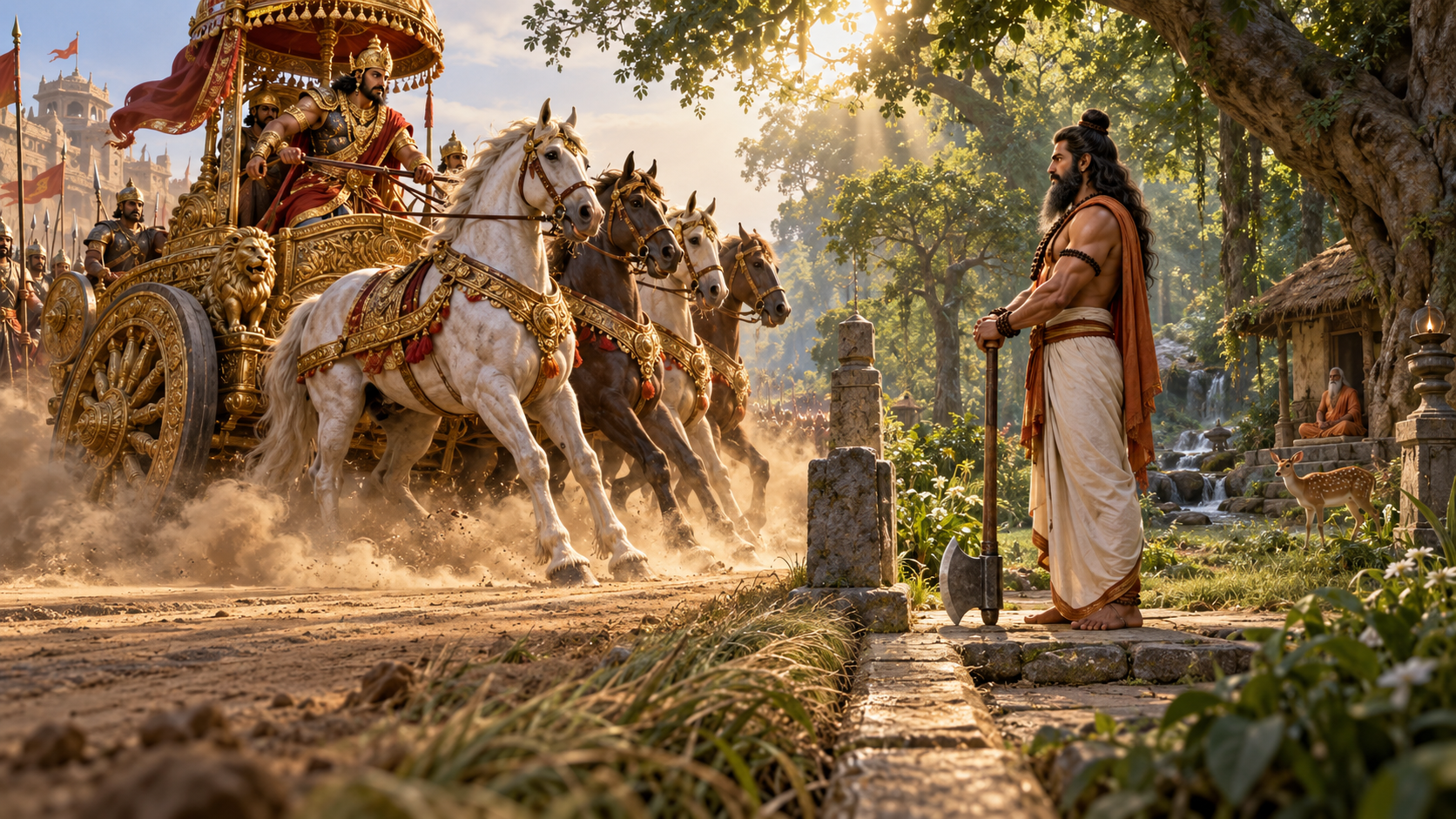
A shallow reading says that Parashurama wins because he is stronger. A dharmic reading asks why strength must answer to anything beyond itself. Kartavirya Arjuna’s royal standing and extraordinary form cannot turn arrogance into righteousness. Authority increases responsibility; it does not create an exemption from it.
The episode is therefore better understood as a criticism of unrestrained rule than as a rejection of kingship. Nothing in its central structure requires you to conclude that political power is inherently corrupt. Its warning is more exact: power becomes dangerous when the person holding it treats ability, status, or victory as sufficient proof of moral legitimacy.
Parashurama’s role also should not be converted into a private license for anger or violence. A sacred account of judgment between extraordinary figures is not an instruction for ordinary people to imitate force. The usable lesson belongs first in self-examination and public accountability. When you evaluate a leader, institution, or your own authority, ask three concrete questions:
- What real capacity does this person possess, and who is affected by its use?
- Which duty, restraint, or form of accountability limits that capacity?
- When challenged, does the person accept correction or treat power itself as the answer?
Those questions preserve the episode’s moral asymmetry. Kartavirya Arjuna is not condemned for being capable. He becomes vulnerable when exceptional capability is joined to arrogance. That is the distinction to carry into any modern application.
How to read differing retellings without mixing them together
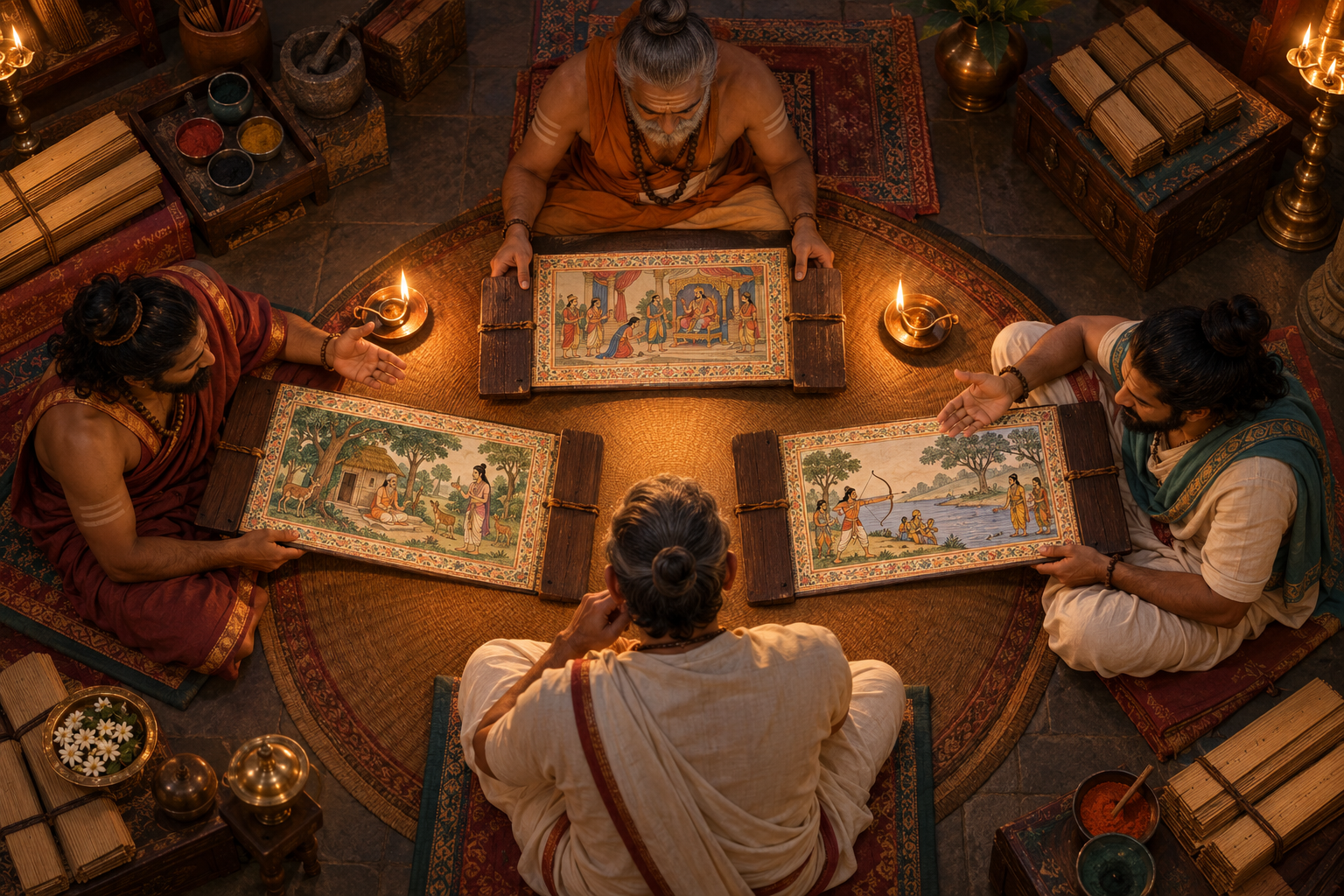
Kartavirya Arjuna is associated with the Mahabharata and the Puranas, so a careful reader should expect a discussion to identify its textual setting. “The story says” is not precise enough when a retelling includes a detailed motive, sequence, dialogue, or theological conclusion.
- Name the textual frame. Ask whether the claim is being attached to the Mahabharata, a particular Purana, or a later retelling. “Puranic” is still too broad if no Purana is named.
- Fix the identities before interpreting events. Record that Kartavirya Arjuna, Karthaveeryarjuna, and Sahasrarjuna refer here to the same king, while the Pandava Arjuna is a different figure.
- Separate the supported core from added detail. The core available here includes a powerful and arrogant Yadava king, his thousand arms, his confrontation with Parashurama, and his death in battle. Additional plot elements need their own textual grounding.
- Label interpretation as interpretation. Reading the thousand arms as an image of amplified agency can illuminate the story, but it should not be presented as though the narrative itself pauses to declare that explanation.
This method does not weaken tradition. It prevents one retelling from silently replacing the wider textual inheritance. It also lets you discuss the moral meaning confidently without pretending that every circulated detail has equal authority.
Key takeaways
- Kartavirya Arjuna, Karthaveeryarjuna, and Sahasrarjuna identify the same thousand-armed Yadava king in this episode; he is not the Pandava Arjuna.
- Parashurama’s conflict with him is best understood as a confrontation with arrogant, unrestrained power, not as hostility toward strength itself.
- The thousand arms magnify the king’s capacity and therefore sharpen the question of responsibility.
- The precise triggering offense should not be stated as universally settled unless the retelling names the scripture and passage it follows.
- The episode does not authorize personal violence. Its practical demand is to place power under duty, restraint, and accountability.
When you encounter the next version of this story, do one simple thing before accepting or repeating its details: write down the text it claims to follow. Then ask whether its interpretation keeps the central dharmic distinction intact. Great capacity is not adharma, but great capacity without restraint can become its instrument.
References

Leave a Reply
You must be logged in to post a comment.