
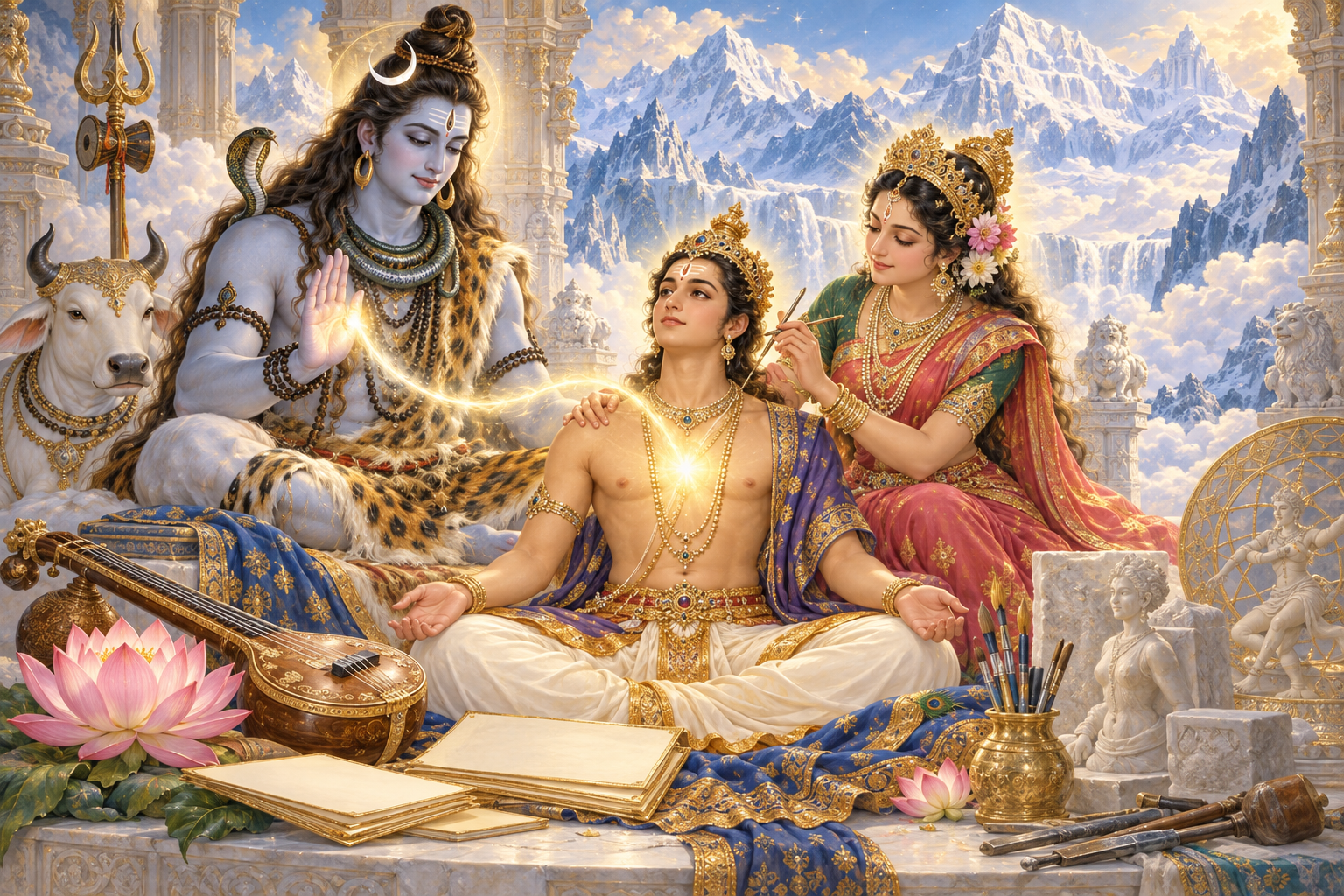
You may know Chitragupta as the keeper of karmic records and still wonder where he came from. His birth narrative gives a precise answer: his origin is not the work of Shiva or Parvati in isolation, but a shared divine act.
Parvati’s art gives Chitragupta form, and Shiva’s breath gives that form life. Understanding those two elements together reveals why a being born through creative vision and living consciousness becomes the witness who preserves the moral record of human action.
The origin story in its essential sequence
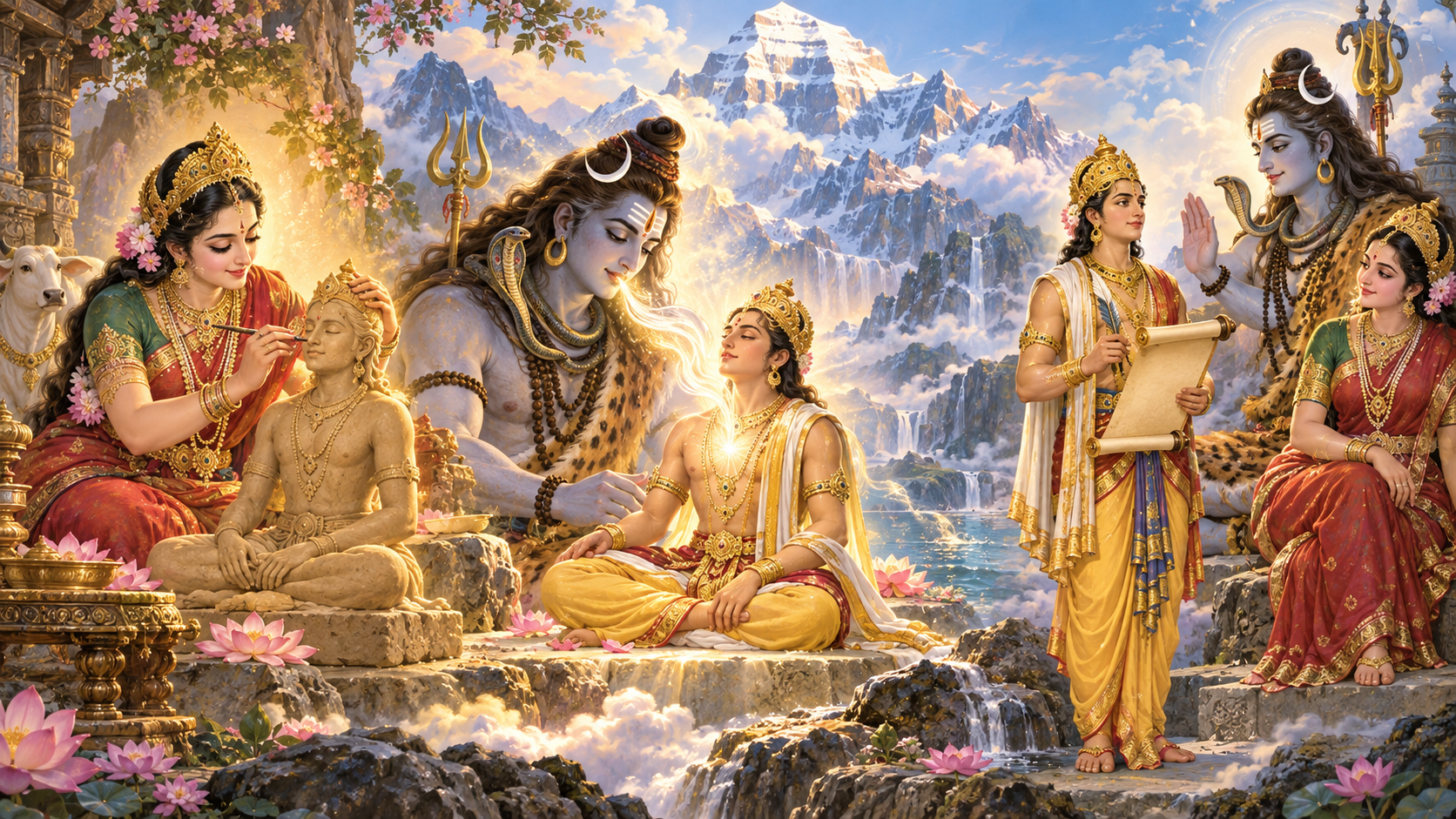
The sacred setting is Mount Kailasa. Parvati appears as Chatushashathi Kalamayi, the living embodiment of all sixty-four arts. While Devi is absorbed in creation, her art supplies Chitragupta’s form; Shiva’s breath animates it. The being produced through Devi’s creative power and Shiva’s life-giving breath is Chitragupta.
The sequence matters. Chitragupta exists before he assumes his cosmic responsibility as keeper of karmic records. His identity is therefore larger than the familiar image of a celestial clerk holding a ledger. He is first a divine creation, brought forth through two complementary powers; his office follows from that origin.
If you need to retell the account in one accurate sentence, use this: Chitragupta came into being on Kailasa through Parvati’s art and Shiva’s animating breath, and later became the keeper of karmic records.
Why art and breath must be understood together
Parvati’s art establishes form and distinction
Parvati’s identification with all sixty-four arts is not an incidental compliment. It establishes her as the divine power capable of giving an idea intelligible form. Art distinguishes one line from another and turns what is inwardly conceived into something that can be perceived.
Read symbolically, that quality suits the future keeper of karma. Accurate accounting requires distinction. An intention is not identical to an action; an action is not identical to its public reputation; and one person’s deed cannot be exchanged for another’s. The artistic origin points toward clarity, particularity and truthful representation.
Shiva’s breath turns form into living presence
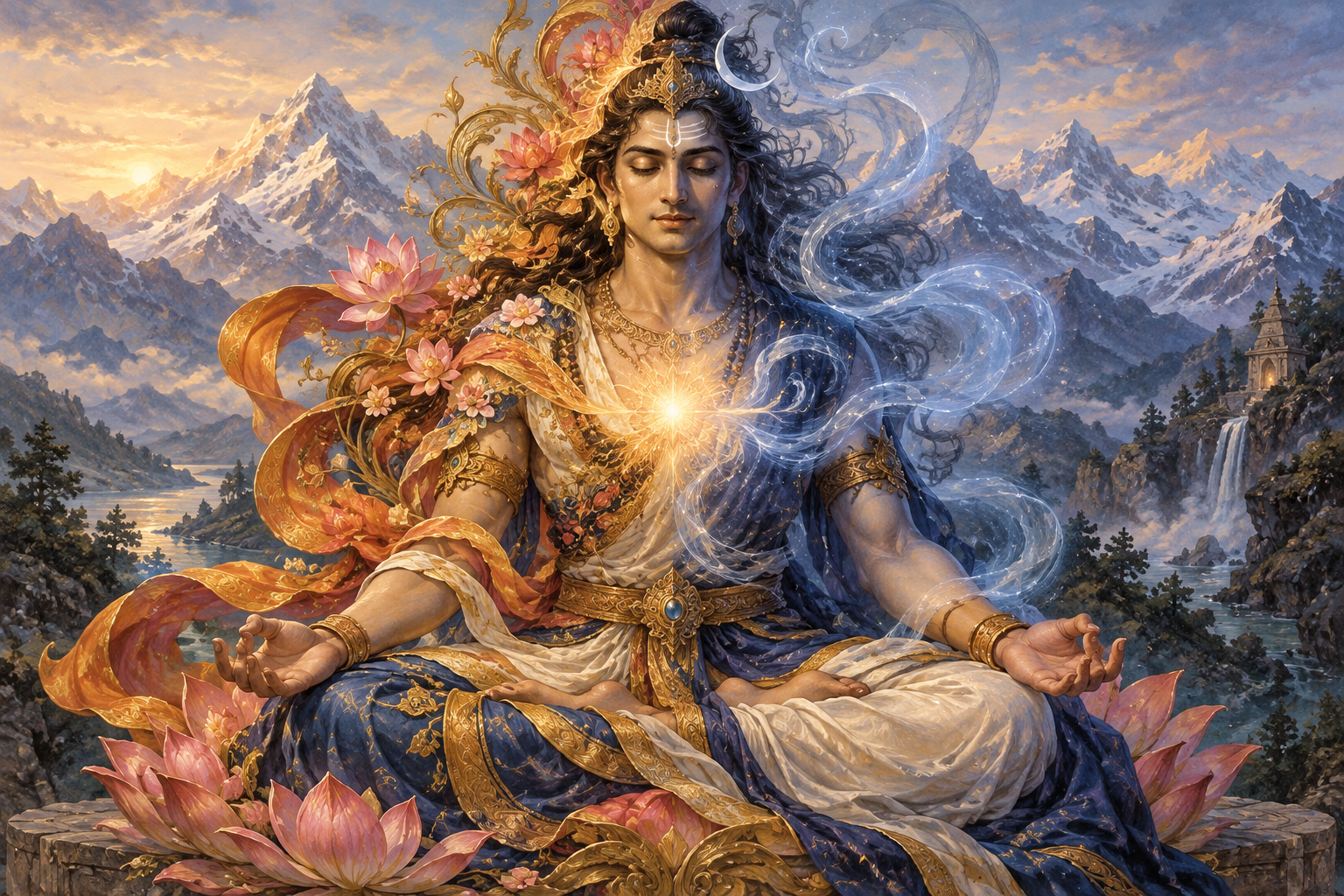
A form can be complete and still remain only a representation. Shiva’s breath marks the passage from represented life to living presence. In a spiritual reading, breath contributes consciousness, vitality and the capacity to witness.
The two acts answer different needs. Parvati’s art makes the form distinct; Shiva’s breath makes it alive. Chitragupta’s later vocation requires both qualities: a record must be precise enough to preserve distinctions, while its keeper must possess living awareness rather than function like an inert ledger.
This is why asking which deity “really” created Chitragupta misses the structure of the narrative. The faithful answer preserves the complementarity: Devi forms, Shiva animates, and Chitragupta arises through their joined powers.
His birth clarifies the meaning of karmic accountability
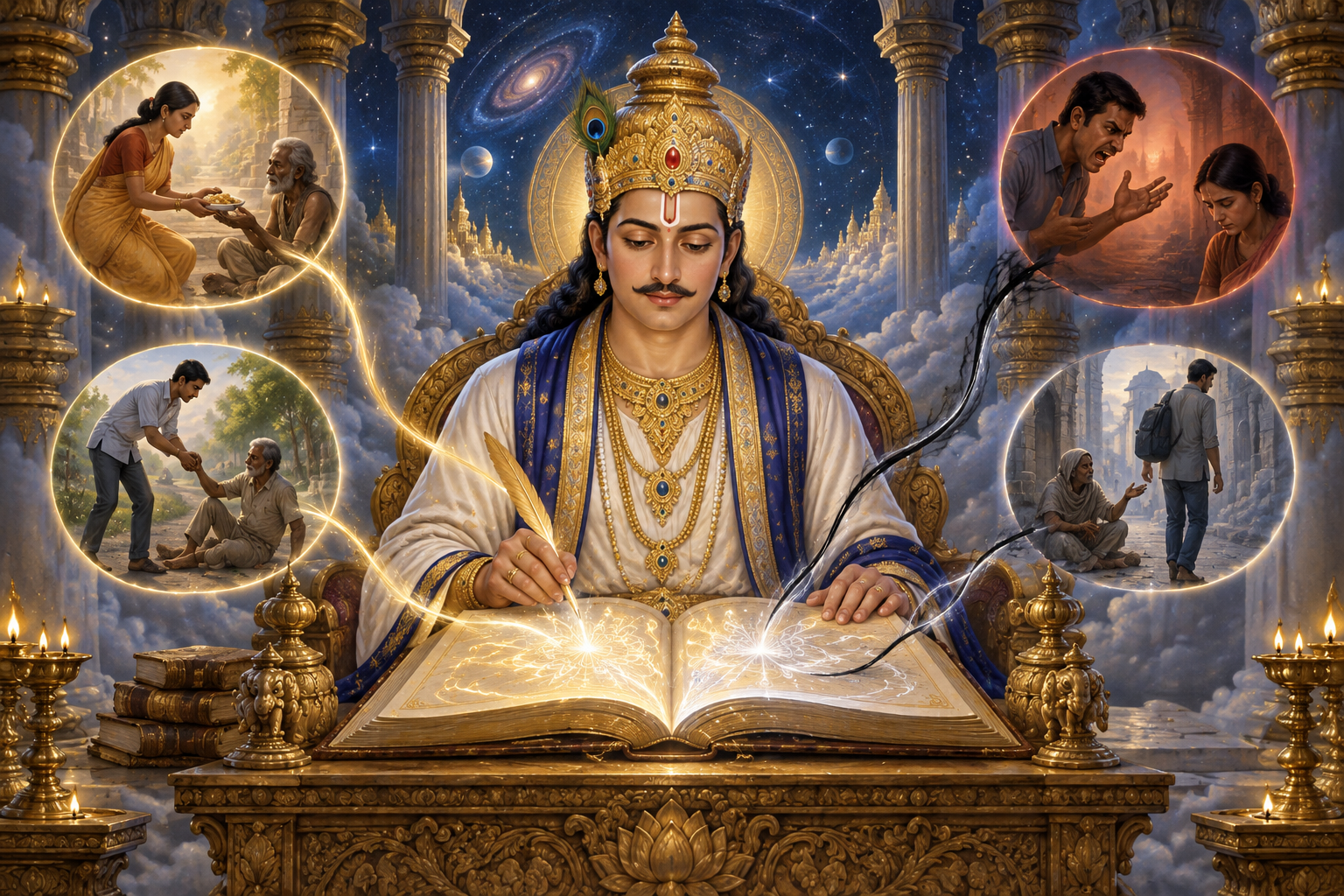
Chitragupta’s role as keeper does not make him the author of anyone’s actions. You act; the act becomes part of your moral record. That distinction blocks a fatalistic misreading in which a divine official supposedly decides your conduct in advance.
The image of a karmic record makes a sharper claim: an action does not become unreal merely because other people fail to see it. Secrecy can conceal a deed from society, but it cannot transform the deed into something else. Public praise likewise cannot purify conduct whose intention and effect were harmful.
Nor should the record be imagined only as a threatening scoreboard. Its ethical force lies in continuity. What you do belongs to the person you are becoming. A careless act, a kept promise, an uncorrected falsehood and a deliberate repair do not disappear when the moment passes. Each carries moral significance forward.
That makes accountability more demanding than guilt. Guilt can remain private and passive. Accountability names the deed accurately, recognises its effect and asks what must now be repaired. Chitragupta’s symbolism directs attention toward that honest accounting rather than toward fear alone.
How to carry the story into practice

Retell it without reducing Chitragupta to his job
When you explain the origin to a child, a study group or someone encountering Chitragupta for the first time, preserve four parts in order:
- Place the birth on Mount Kailasa.
- Name Parvati as Chatushashathi Kalamayi, the embodiment of all sixty-four arts, and retain her creative role.
- Describe Shiva’s breath as the power that brings the created form to life.
- Only then connect Chitragupta’s divine birth with his later responsibility for karmic records.
This sequence prevents two easy distortions. One erases Parvati by treating Shiva’s breath as the entire birth. The other skips the birth altogether and turns Chitragupta into nothing more than a supernatural bookkeeper. Both lose the relationship between his origin and his vocation.
Try a daily act of honest accounting
You can apply the story’s ethical structure without pretending that a modern exercise is an ancient prescribed ritual. Before sleeping, take one action from your day and examine it in four steps:
- Record the deed plainly. Write what you actually did, without flattering adjectives or excuses.
- Separate intention from effect. Note what you meant to do and what your action produced. Do not use a good intention to erase a harmful result.
- Name what remains unsettled. Identify any promise, apology, correction or practical repair still owed.
- Choose the next visible action. Decide exactly whom you will contact or what you will correct. Give yourself a definite next opportunity to act.
The value lies in precision. “I should be better” records nothing useful. “I dismissed a concern without listening; tomorrow I will reopen the conversation and hear the person fully” creates an accountable next step. Where material harm has occurred, reflection is only the beginning; repair must become conduct.
Key takeaways
- Chitragupta’s divine origin joins Parvati’s creative art with Shiva’s animating breath.
- Parvati’s identity as Chatushashathi Kalamayi explains why artistic creation is central rather than ornamental to the story.
- Chitragupta receives his responsibility as keeper of karmic records after his birth; the office does not exhaust his identity.
- His role represents accountability, not the loss of human agency: the choice belongs to the person who acts.
- You can honour the narrative ethically by naming your actions accurately and converting remorse into specific repair.
When you next encounter Chitragupta in worship, art or conversation, begin with both halves of his origin. Then let his vocation place one question before you: what in your own conduct needs to be recorded honestly and repaired deliberately? Write down the answer while the day is still clear.
References

Leave a Reply
You must be logged in to post a comment.