
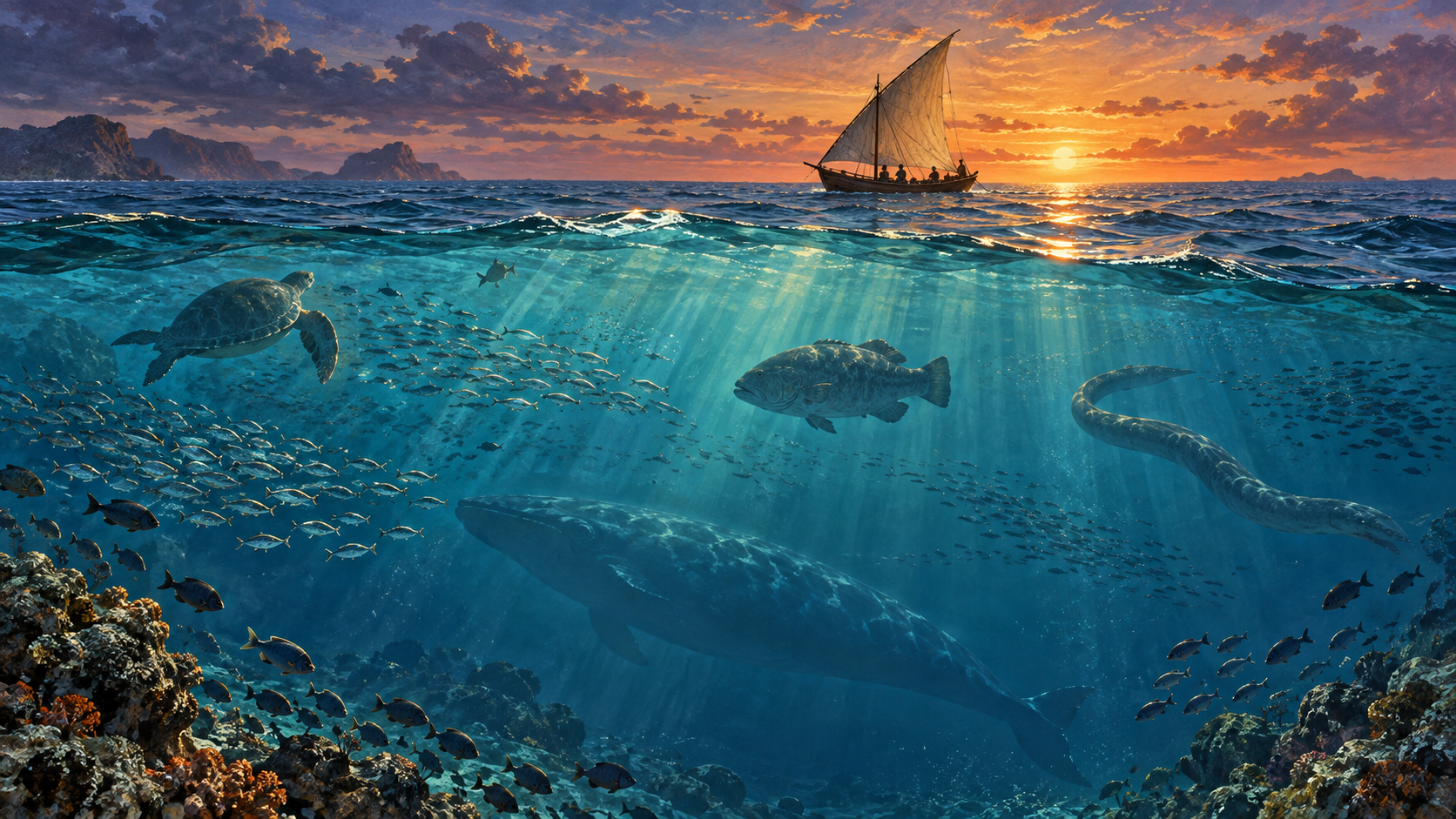
You may be trying to settle a deceptively simple question: does the Mahabharata preserve genuine awareness of sea animals, or are modern readers projecting scientific knowledge onto an ancient epic? The sound answer is narrower—and more interesting—than either slogan.
The Astika Parva shows that the Mahabharata’s world included an inhabited ocean and distinct kinds of large marine creatures. It does not, by itself, establish a modern system of marine biology, identify exact species, or tell us how the knowledge was acquired. Keeping those levels apart lets you defend what the text supports without weakening the case through exaggeration.
The Astika Parva breaks the landlocked stereotype
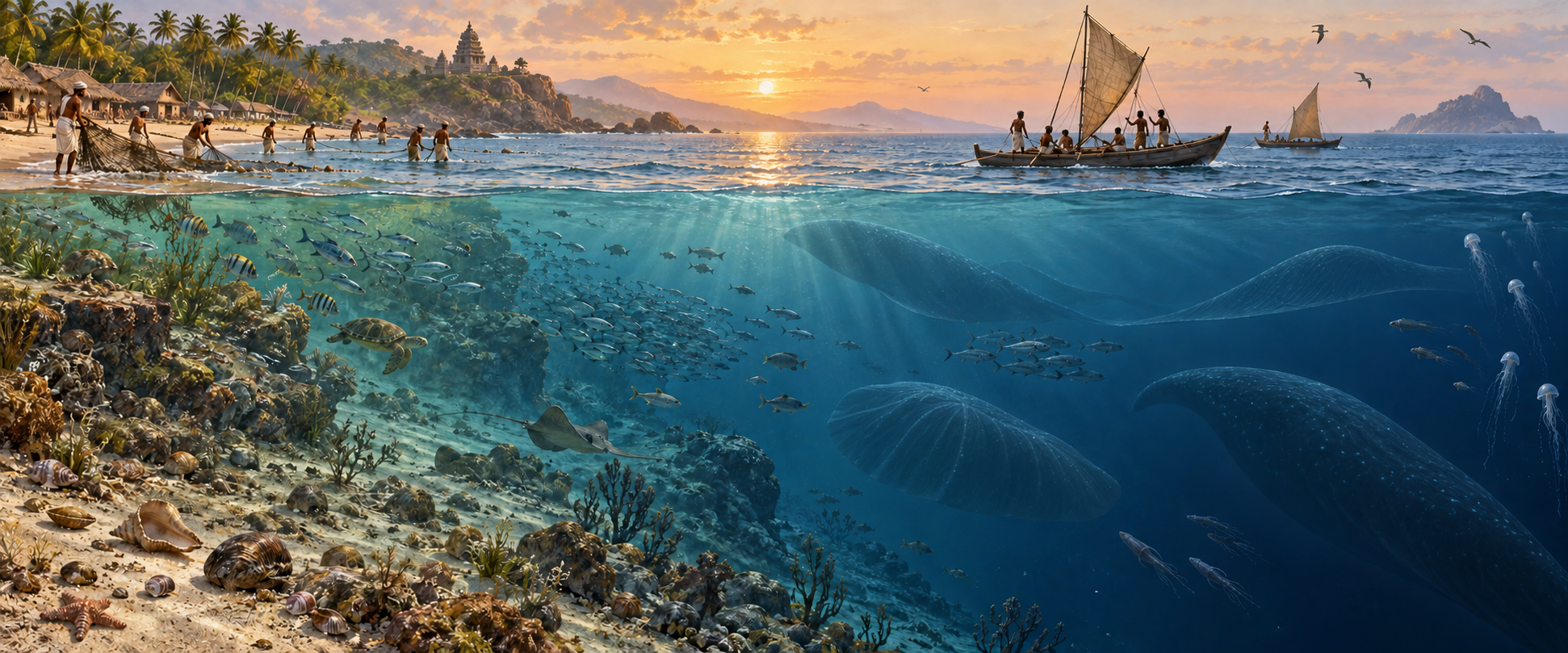
The claim that the people represented in the Mahabharata lived only in the interior of Bharatavarsha and therefore knew almost nothing about the sea is too absolute. Within the Adi Parva, the Astika Parva presents an ocean populated by whales, sharks, and other large marine creatures.
That detail matters because merely mentioning an ocean would prove little. A distant sea could function as no more than a boundary on a mental map. Naming different creatures within it is stronger evidence: the ocean appears as a habitat with its own living inhabitants, including animals of remarkable size.
You do not need to call this modern zoology to recognise it as meaningful knowledge. People can distinguish environments and animal kinds without possessing today’s species definitions, technical vocabulary, or research institutions. The relevant historical point is that marine animals had entered the epic’s field of knowledge and could be used intelligibly in its description of the sea.
This gives you a practical way to answer two opposing overstatements. If someone describes the Mahabharata’s imagination as wholly landlocked, direct attention to the Astika Parva. If someone claims that the same lines establish a complete ancient science of marine life, ask for the anatomical, behavioural, and classificatory details needed to support that larger conclusion.
What the evidence lets you say—and where it stops

A useful reading separates the textual observation from the historical inferences built upon it. Otherwise, a defensible civilizational insight can become tangled with claims the passage was never asked to prove.
What you can state firmly
- The Astika Parva belongs to the Adi Parva of the Mahabharata.
- Its picture of the ocean includes living creatures rather than featureless water alone.
- Those creatures include animals rendered in English as whales and sharks, alongside other large marine beings.
- The common assertion that the epic shows no awareness of major sea life does not fit this passage.
What you may reasonably infer
- Knowledge or reports of large marine animals circulated widely enough to enter the Mahabharata’s literary world.
- The sea formed part of the tradition’s meaningful geography, not merely an unknowable edge beyond inhabited land.
- An audience could be expected to understand that the ocean supported forms of life different in habitat and scale from familiar land animals.
What this passage does not establish
- The exact modern species intended by every ancient animal term.
- A systematic taxonomy comparable to present-day marine science.
- Direct observation by every composer, transmitter, or listener associated with the epic.
- A particular voyage, coastline, fishing practice, or method by which the knowledge travelled.
- A precise date for the first Indian observation of any named creature.
These limits do not cancel the evidence. They identify its proper scale. A precise claim—that the epic preserves awareness of large marine fauna—is stronger than an inflated claim that invites an easy rebuttal.
Why the English names require careful handling
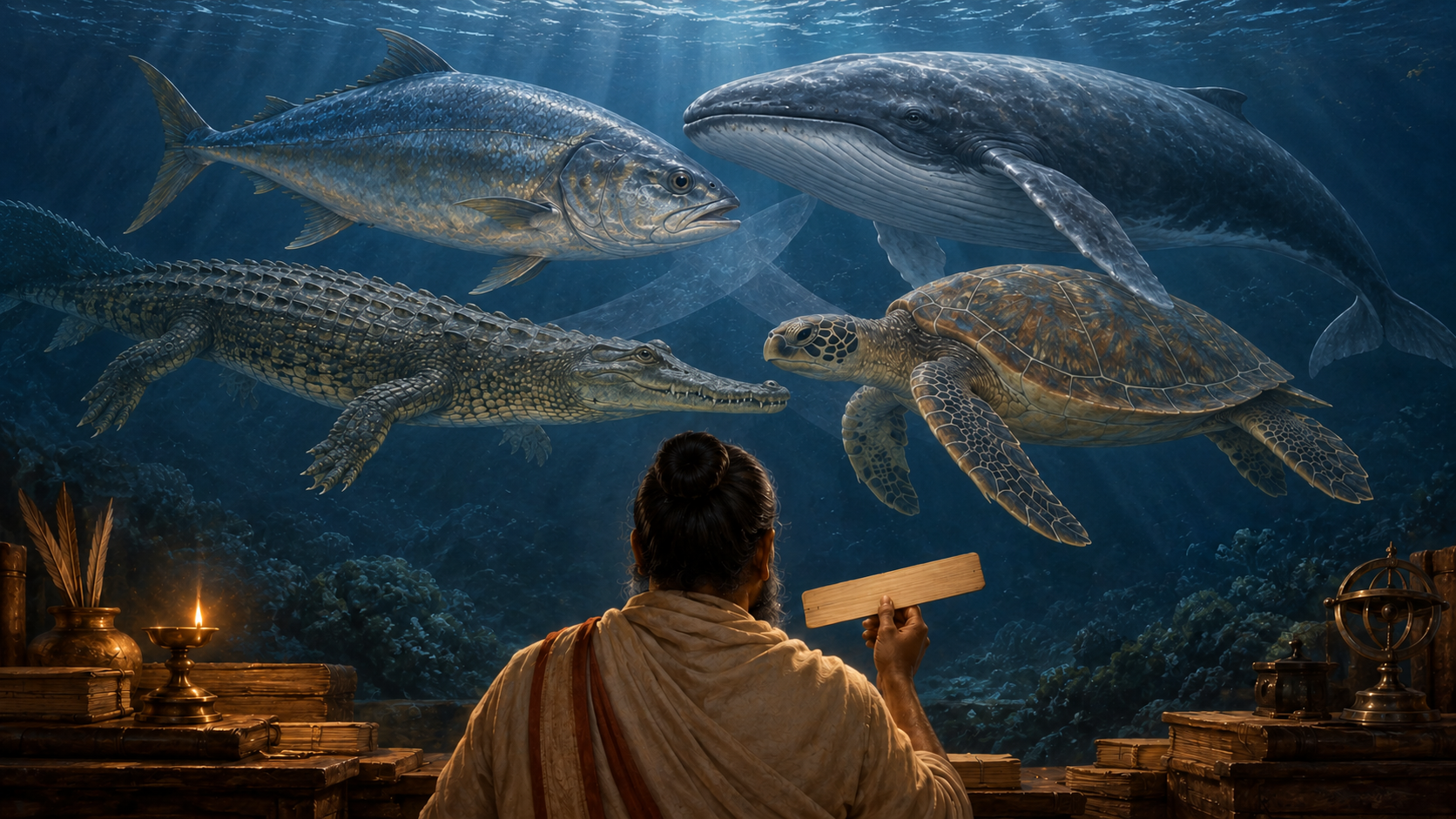
When you encounter the words “whale” and “shark” in English, they can feel more exact than the underlying identification may be. Modern readers instinctively connect such names to scientific categories. Ancient animal vocabulary may instead group creatures by habitat, appearance, size, movement, or perceived danger.
This does not mean that every translation is doubtful. It means that a translated common name should not silently become a species-level claim. If your argument depends only on the presence of very large sea animals, a broad identification may be sufficient. If it depends on one exact animal, the original term and the reasoning behind its translation become essential.
Use the following discipline when discussing the passage:
- Name the textual location. Say “Astika Parva of the Adi Parva” rather than vaguely attributing the claim to ancient India.
- Match the wording to your level of certainty. “Rendered as a whale” is more careful than declaring an exact species when you have not verified the original term.
- Check more than one translation for a technical claim. Agreement strengthens an identification; disagreement tells you to preserve the broader category.
- Do not invent precision. If you have not verified a verse number in a named edition, omit it rather than repeating an unsupported citation.
- Separate naming from description. A creature’s presence establishes awareness; details about its behaviour, anatomy, or ecology require additional lines that actually describe those features.
Mythic or sacred context does not make every natural detail worthless. Nor does the appearance of a recognisable animal turn a sacred narrative into a zoological handbook. Literature can carry inherited observation, cultural memory, symbolism, and imaginative amplification at the same time. Your task is to identify which conclusion each detail can bear.
A four-question test for claims about ancient knowledge
Claims about the scientific knowledge of ancient Bharat often become arguments over pride or scepticism before anyone defines what the text actually shows. You can keep the inquiry grounded by asking four questions in order.
- What is explicitly present? In this case, the relevant foundation is a differentiated picture of ocean life that includes very large creatures.
- What kind of knowledge does that demonstrate? Naming or recognising an animal shows awareness. Describing its habits would show observational knowledge. Organising many animals by stable criteria would support a claim about classification. Do not treat these as interchangeable.
- What route of knowledge is actually known? A literary tradition can preserve information carried by people from many regions, but this passage alone does not identify whether its marine knowledge came through coastal residence, travel, oral transmission, or another route.
- Would the claim survive more modest wording? Replace “proves advanced marine science” with “shows awareness of large marine fauna.” If the historical significance remains, the modest wording is usually the better argument.
This method protects both intellectual honesty and cultural memory. Uncritical scepticism can erase knowledge simply because it appears in an epic. Uncritical enthusiasm can attach unsupported technical claims to that same epic. Neither approach reads the Mahabharata on its own terms.
Key takeaways
- The Astika Parva gives you a direct textual answer to the claim that the Mahabharata knew nothing of major sea life.
- Its ocean is an inhabited environment containing whales, sharks, and other large creatures in English rendering.
- The strongest historical conclusion is awareness of differentiated marine fauna, not possession of modern marine taxonomy.
- Exact species claims require attention to the original animal terms and the choices made by translators.
- Careful limits strengthen the civilizational case: they make it harder to dismiss a sound observation because of an unnecessary exaggeration.
If you want to pursue the question further, place two translations of the Astika Parva side by side. Make a simple record of the original term, each English rendering, and only the qualities that the passage itself assigns to the creature. That small exercise turns a broad debate into serious textual inquiry—and gives you a claim you can explain, cite, and defend.
References

Leave a Reply
You must be logged in to post a comment.