

Your difficulty may not be a lack of spiritual knowledge. It may be that your knowledge disappears precisely when a message provokes you, a deadline tightens, or competing duties pull you in different directions. Inner discipline matters at that point: between the first impulse and the action that follows.
The routine below is deliberately narrow. It combines a Gita-shaped approach to purposeful action with the yogic use of mudra and a simple review of conduct. It does not pretend that every Indic tradition teaches an identical method. Its purpose is practical: to help you interrupt automatic reactions, recover your governing values, and take the next responsible action.
Discipline means steering yourself, not suppressing yourself
Many people approach discipline as a contest of force. The mind wanders, so they attack the wandering. Anger appears, so they pretend not to be angry. A demanding day disrupts practice, so they condemn the whole day as a failure. This produces an exhausting cycle of control, resistance, and guilt.
The image of an inner charioteer offers a more useful model. A charioteer does not eliminate movement, power, danger, or uncertainty. The work is to hold direction amid them. In the same way, inner discipline does not require you to become emotionless. It requires you to notice what is moving you before that force takes command.
A leadership reading of the Bhagavad Gita treats purposeful action, values, and self-awareness as parts of one continuing sadhana. That matters beyond formal leadership. You exercise leadership whenever other people will bear the consequences of your attention, speech, delay, or decision.
Before a difficult action, ask:
- What role am I occupying here: parent, colleague, citizen, student, caregiver, manager, or friend?
- What duty belongs to that role in this situation?
- Which value must not be traded away merely for speed, approval, or relief?
- What part of the response is actually mine to choose?
- Which outcome am I trying to control even though it is not fully mine?
These questions separate responsibility from agitation. They also prevent a common spiritual mistake: using detachment as an excuse for passivity. You can release your demand for a guaranteed result while remaining fully responsible for the honesty, care, and competence of your action.
Build sadhana around the transitions already in your day

A practice survives modern life when it has a clear place to occur. A vague promise to be more mindful has no trigger. It is easily displaced by whatever feels urgent. A transition, by contrast, gives the practice a home.
Choose transitions that already happen without negotiation: when you rise, before beginning concentrated work, before entering a meeting, after reading a provocative message, when you return home, or when you close the working day. Do not attach the practice to an ideal schedule you rarely keep. Attach it to a doorway you already cross.
Use this compact sequence at the chosen transition:
- Stop. Do not answer, click, speak, or decide during the first surge of reaction.
- Settle the body. Sit or stand steadily. Let the jaw, shoulders, and hands release unnecessary effort.
- Place the hands. Rest them naturally or use one familiar, comfortable mudra.
- Name the duty. Complete the sentence: In this moment, my responsibility is to…
- Choose the next clean action. Make it observable: ask the missing question, correct the error, decline clearly, listen without interrupting, or postpone the reply until you can write it responsibly.
- Begin. Do not keep refining the intention after the appropriate action has become clear.
This is the minimum form of the practice, not an inferior imitation of a longer session. On a spacious day, it can sit inside asana, pranayama, meditation, study, or prayer. On a crowded day, the compact form preserves continuity. Mudras are especially adaptable because they need little space or equipment and can be practised while seated on a mat or chair.
Create both a floor and a fuller form. Your floor is what you can still do when the day is disrupted. Your fuller form is what you undertake when time and conditions permit. The floor protects abhyasa, the continuity of practice; the fuller form allows depth. If you recognise only the fuller form as legitimate, ordinary life will repeatedly break your discipline.
Keep the trigger specific. Before work is better than sometime in the morning. Before sending a difficult reply is better than whenever I feel stressed. Specific triggers reduce the need to negotiate with yourself at the very moment your judgement is under pressure.
Use mudra as an embodied pause, not a magical switch
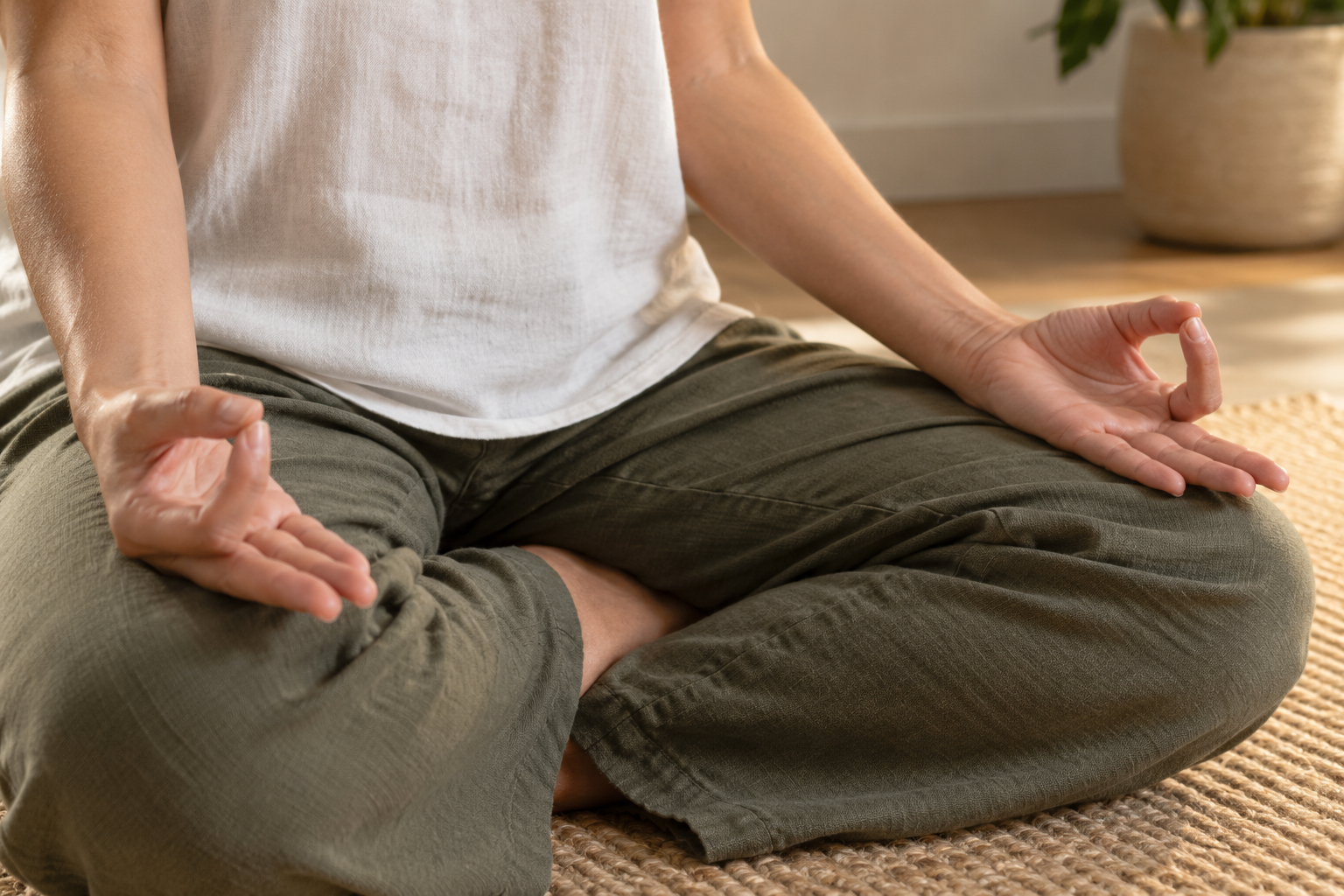
Traditional yoga understands mudras as more than decorative hand positions. It relates the fingers, elements, and subtle energies within a wider yogic framework. You can respect that framework without turning a gesture into an exaggerated promise of instant calm, perfect concentration, or medical relief.
For everyday discipline, a mudra can serve as a chosen bodily cue: when the hands take this position, you stop feeding the immediate reaction and return to deliberate action. Its usefulness depends on repetition and association. Constantly changing gestures makes that association harder to establish.
Make the practice concrete:
- Choose one familiar mudra. If you want to learn its traditional meaning and form, seek competent instruction rather than copying a striking image without context.
- Assign it one job. You might use it before consequential speech, at the start of study, or when you notice the urge to react online.
- Hold it without strain. A discipline intended to gather attention should not become a test of hand strength. Release the position if it causes pain, tingling, or discomfort.
- Pair it with one question. Ask what your duty requires now, not what would make the discomfort vanish fastest.
- End with action. Release the gesture and perform the responsibility you identified. The mudra is a doorway into conduct, not a refuge from conduct.
Avoid making claims the practice cannot carry. Mudra may belong meaningfully within your spiritual discipline, but it is not a substitute for appropriate medical or psychological care. Persistent distress, severe anxiety, or symptoms that interfere with ordinary functioning call for qualified professional help. Spiritual practice can accompany such care; it should not be used to conceal the need for it.
You should also be able to use the underlying pause when your hands are occupied or the setting makes a visible gesture impractical. The governing capacity is the return to awareness and duty. The physical form supports that capacity; it does not own it.
Turn the inward pause into a dharmic decision

An inward practice is incomplete if it never changes how you speak, decide, or repair harm. The purpose of the pause is not to admire your calmness. It is to improve the quality of the action that comes next.
When the situation is ethically tangled, pass the proposed action through these filters:
- Role: Does this action meet the real responsibility of my position, or am I borrowing authority that is not mine?
- Motive: Am I serving the work and the people affected, or protecting pride, status, and the desire to win?
- Means: Would the action still be defensible if its method, not merely its intended result, became visible?
- Proportion: What is the least harmful action that genuinely meets the duty? Restraint is not avoidance when it is sufficient; severity is not courage when it is excessive.
- Attachment: Can I act carefully without demanding that other people respond exactly as I want?
Suppose a colleague has made an error that affects shared work. Immediate irritation may push you toward public blame. Fear may push you toward silence. The filter reveals another path: verify the facts, protect people from the consequence, address the error with the appropriate person, and correct the process that allowed it. You neither indulge the impulse nor deny the responsibility.
End the day with a conduct review rather than a mood score. Ask where you reacted automatically, where you recovered direction, and what repair remains unfinished. Record observable behaviour. Did you send the harmful reply, delay it, or rewrite it? Did you keep the promise, renegotiate it honestly, or avoid the person affected? Did you acknowledge the mistake or construct a defence?
Then choose the repair while the event is still clear. Apologise without adding self-justification. Correct inaccurate information. Restore a missed commitment. Change the trigger for the next attempt. Self-punishment keeps attention fixed on your image of yourself; accountability returns attention to the duty and the person affected.
Do not measure progress by whether difficult emotions disappear. Notice whether they command less of your conduct. A trained inner charioteer can still encounter anger, fear, fatigue, and uncertainty. The difference appears in direction: you detect the pull earlier, recover more deliberately, and repair more honestly when you fail.
Key takeaways
- Treat inner discipline as steering your response, not suppressing thought and emotion.
- Attach practice to a transition that already occurs, especially before situations in which you tend to react automatically.
- Maintain a compact floor for disrupted days and a fuller practice for spacious days.
- Use a familiar mudra as a deliberate cue, not as a guaranteed cure or an escape from action.
- Translate values into role-specific duties and observable next steps.
- Review conduct, complete repairs, and adjust the trigger instead of punishing yourself for an imperfect day.
Choose the next predictable point of friction in your day. Decide now what physical cue you will use, which question you will ask, and what responsible action would look like. When that moment arrives, the practice will no longer be an inspiring idea waiting for better conditions. It will be available where dharma is actually lived: in the next choice.
References
- Hindu Post — Book Review | The Inner Charioteer by Dr. R. Balasubramaniam
- Hindu Post — Six Mudras for Modern Life

Leave a Reply
You must be logged in to post a comment.