
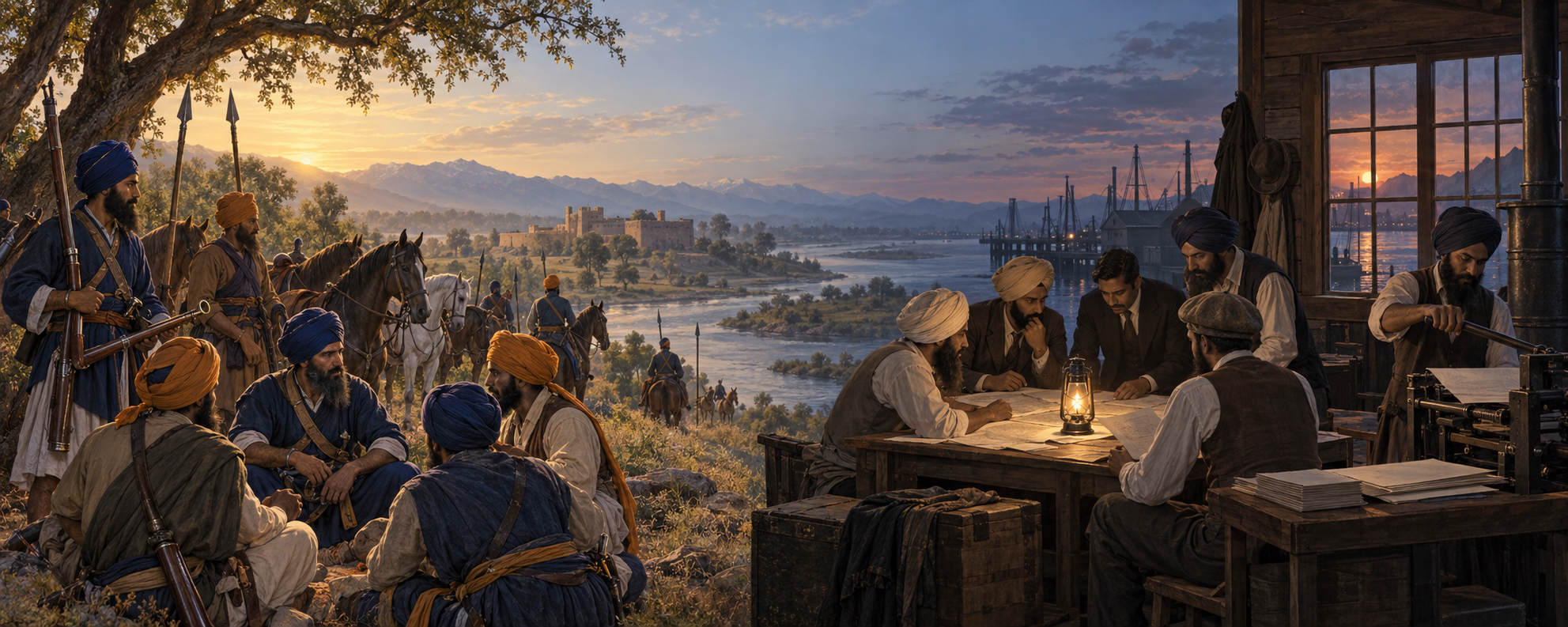
If you are trying to understand why Sikh resistance appears in such different settings – first among armed bands in eighteenth-century Punjab, and later among migrants organizing against British rule – the useful question is not whether one organization simply became the other. It did not.
The stronger connection is a recurring political grammar: organize collectively, refuse the inevitability of foreign domination, build institutions that can survive repression, and treat freedom as a duty rather than a favour. Reading the Dal Khalsa’s defiance of imperial power beside the Gadar movement’s contribution to Bharat’s freedom struggle shows how that grammar adapted when the battlefield changed.
Begin with the distinction: continuity is not sameness
The Dal Khalsa and the Gadar Party belonged to different centuries, confronted different imperial systems, and used different forms of organization. Treating them as a single uninterrupted body would blur the history rather than honour it.
The Dal Khalsa arose in an eighteenth-century Punjab marked by unstable authority, persecution, warfare and repeated imperial intervention. Its immediate problem was survival with sovereignty: how could dispersed Sikh fighting groups defend the Panth, protect communities and act together against powers far larger than any one band?
The Gadar Party operated in the age of the British Raj and global migration. Its problem was colonial rule over Bharat, reinforced by an international imperial system. Many Sikhs stood at the heart of the movement, but Gadar was not a Sikh-only project. It called Indians across religious and regional lines into a common struggle against British domination.
This distinction gives you a reliable way to read the connection. Do not look for an institutional family tree. Look for recurring answers to four political questions: Who must act? What makes resistance legitimate? How is courage converted into organization? What must change when the empire changes its methods?
Dal Khalsa turned a hunted community into a collective force
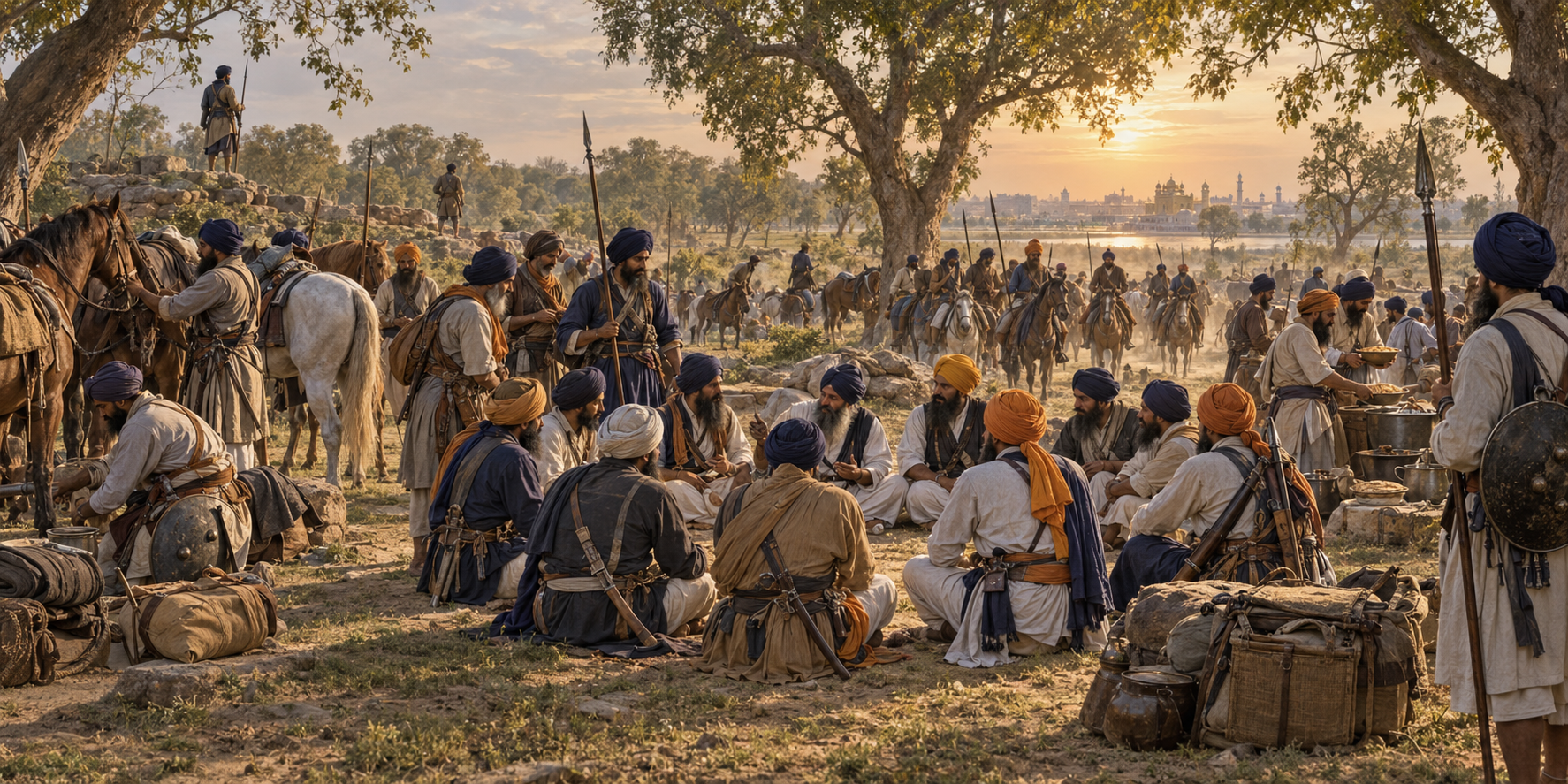
A persecuted community does not become politically effective merely because its members are courageous. Courage can remain scattered. The Dal Khalsa’s importance lies in the conversion of dispersed courage into coordinated capacity.
That conversion required more than battlefield skill. Separate bands had to recognize a shared cause, accept collective discipline and coordinate without surrendering every local identity. The result was a form of resistance suited to a landscape in which fixed control could be lost, restored and contested repeatedly. Mobility allowed survival; coordination allowed power.
This is where a shallow description of the Sikhs as simply a “martial people” fails. It treats resistance as temperament, as though bravery were an inherited reflex. The more useful explanation is institutional. Sikh resistance endured because the community could gather, deliberate, distribute responsibility, sustain loyalty and rebuild after severe losses. Arms mattered, but the social capacity behind the arms mattered more.
You should therefore notice three layers whenever you encounter an account of the Dal Khalsa:
- Spiritual formation: the Khalsa ideal made dignity, discipline and responsibility inseparable. Resistance was not merely the pursuit of territory.
- Collective organization: scattered strength became consequential when groups could act under a common purpose.
- Public legitimacy: a force claiming to defend the Panth and vulnerable people had to be judged by conduct, not victory alone.
This last point is essential. Sikh resistance cannot be understood only through the question, “Who defeated whom?” Its moral claim rested on what power was for. The standard was not domination for its own sake, but the defence of freedom, faith and human dignity. That distinction separates dharmic resistance from revenge.
Gadar moved resistance from the Punjab battlefield to a global network
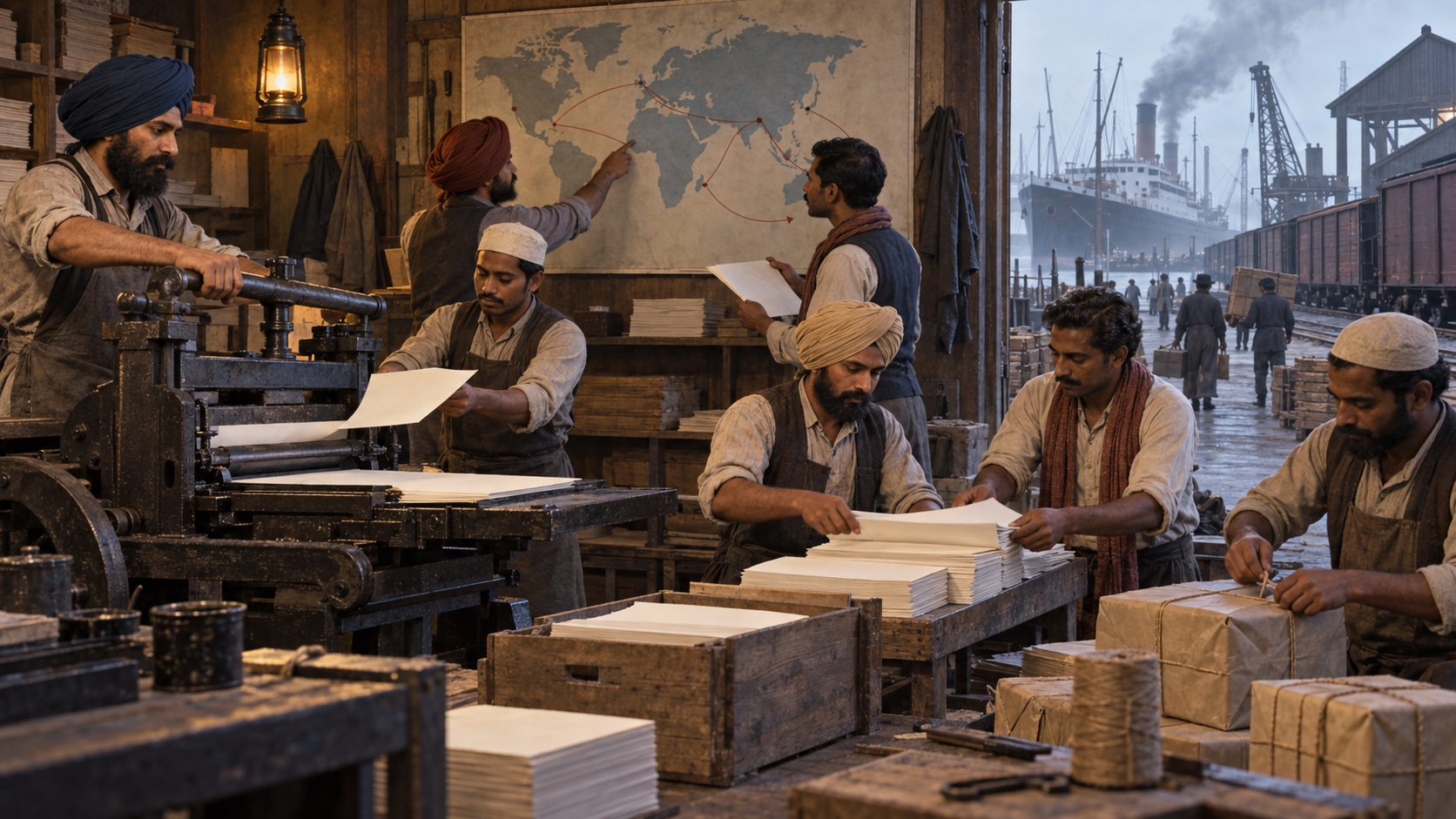
By the time of the Gadar Party, imperial power worked differently. British rule rested not only on armies but also on administration, communication, law, finance and the service of Indians within the colonial system. Resistance therefore had to travel through new channels.
Gadar’s organizers used the world created by empire against empire itself. Migration had carried Punjabis and other Indians abroad. Those communities could become political networks. Print could move an argument farther than a mounted band. Overseas organization could challenge the assumption that Indians who left Bharat had also left its fate behind.
The shift is easy to miss if you focus only on attempted insurrection. Gadar’s deeper work was to change political consciousness. The migrant labourer was no longer merely someone earning a living far from home. He could become a carrier of ideas, a contributor, an organizer and a revolutionary returning with a wider view of imperial power.
Sikh participation was central to that transformation, but historical accuracy requires another distinction: Gadar was both deeply shaped by Sikh courage and broader than a single religious community. Its Indian nationalism brought Sikhs, Hindus, Muslims and others into a shared anti-colonial purpose. Sikh prominence should not be erased, yet neither should Gadar’s cross-community character.
For a Dharmic reader, that combination matters. A rooted identity need not produce a narrow political horizon. Gadar demonstrates how people can draw discipline and courage from a particular tradition while serving a cause larger than their own community. The Sikh contribution to Bharat’s freedom was not diminished by cooperation with non-Sikhs. It became nationally consequential through that cooperation.
The connecting thread is organized freedom, not violence

Both movements used armed resistance, but violence alone is a poor connecting principle. Many armies use violence; that does not make them heirs to the same moral tradition. The better connection is the disciplined organization of people who rejected foreign rule as permanent.
Five continuities help you see that pattern clearly:
<!– wp:list {
Leave a Reply
You must be logged in to post a comment.