
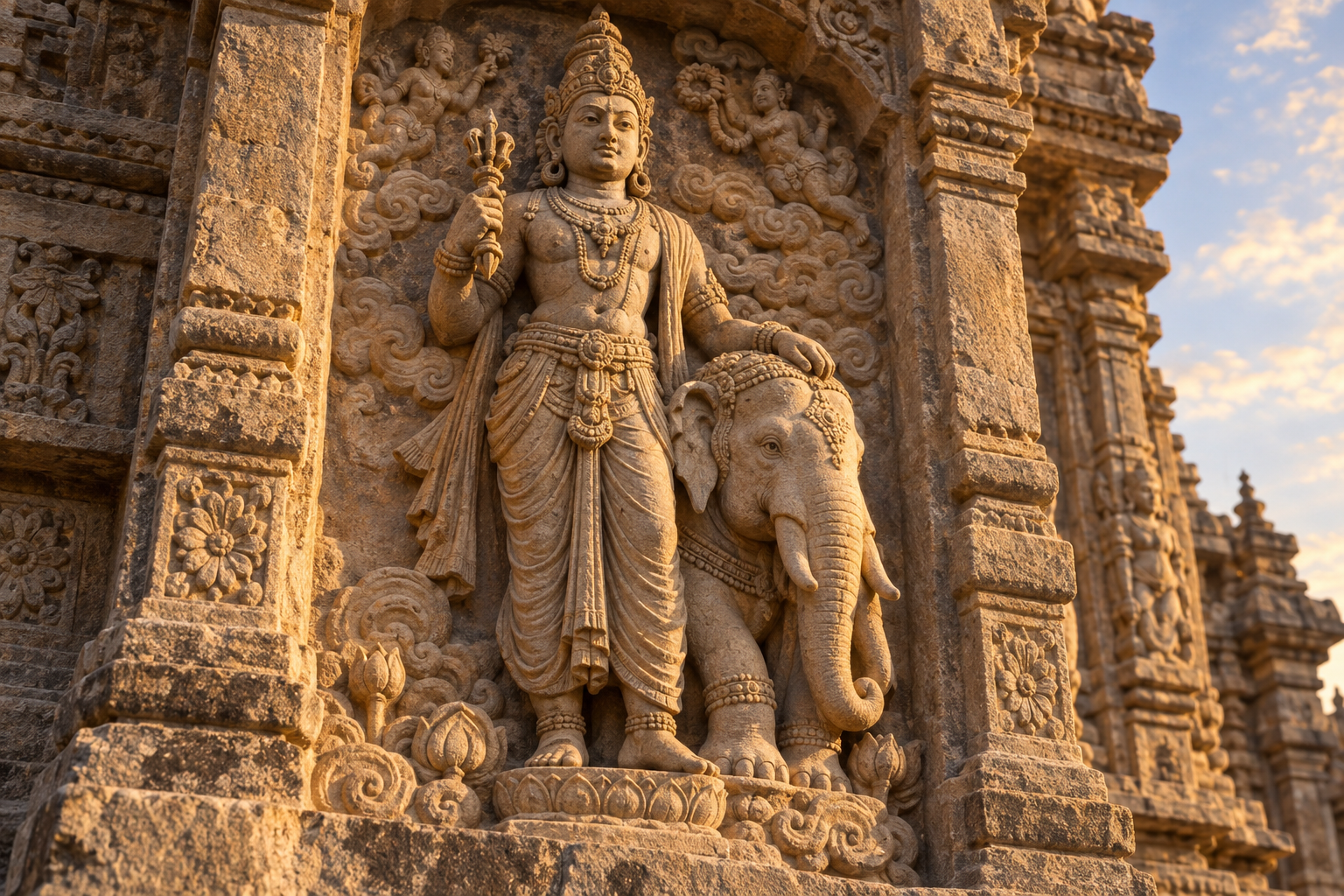
You are walking around a Hindu temple when you find a crowned deity beside an elephant, perhaps holding a compact, unfamiliar object. Is this Indra, and why has he been placed on the temple wall rather than at the centre of worship?
The answer lies in his office as a Dikpalaka: a guardian assigned to one of the directions. Once you know how placement, vehicle, attribute and architectural context work together, you can identify Indra with far more confidence and understand what his presence says about the temple as a model of an ordered cosmos.
Begin with the direction, not the deity’s face
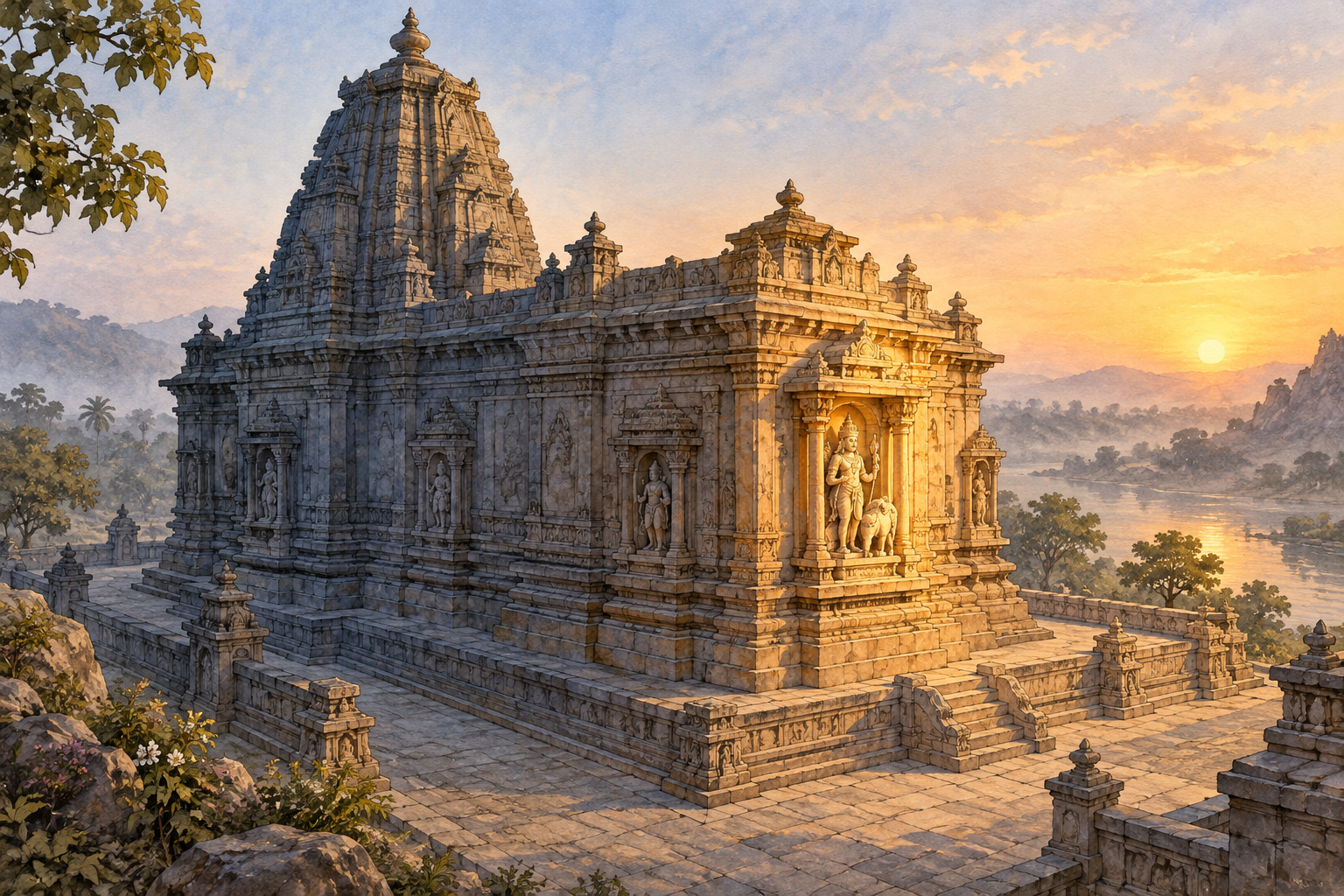
Dikpalaka combines the ideas of direction and guardianship. In the system of the Ashtadikpalakas, eight celestial guardians preside over the cardinal and intercardinal directions. Indra’s assigned direction is the east.
This changes how you should approach a temple sculpture. A free-standing image can often be read through its attributes alone. A directional guardian must be read through both iconography and location. The building is part of the image’s meaning.
First establish the temple’s orientation. Do not assume that the doorway in front of you faces east, or that your right-hand side corresponds to an absolute direction. Later additions, surrounding buildings and the path by which visitors enter a complex can all make orientation difficult to judge. If a plan, compass or knowledgeable temple attendant is available, use it before deciding what a weathered figure represents.
- Locate the sanctum or architectural core rather than using the outer gate as your only reference point.
- Identify the eastern sector of that core.
- Look for a guardian figure in a wall niche, projection or other part of the temple’s directional programme.
- Only then compare the figure’s mount and attribute with Indra’s known signs.
This order matters. A crown by itself proves little, and an elephant may appear in decorative or narrative scenes. Eastern placement narrows the possibilities before the surviving details are interpreted.
Confirm Indra through a cluster of signs
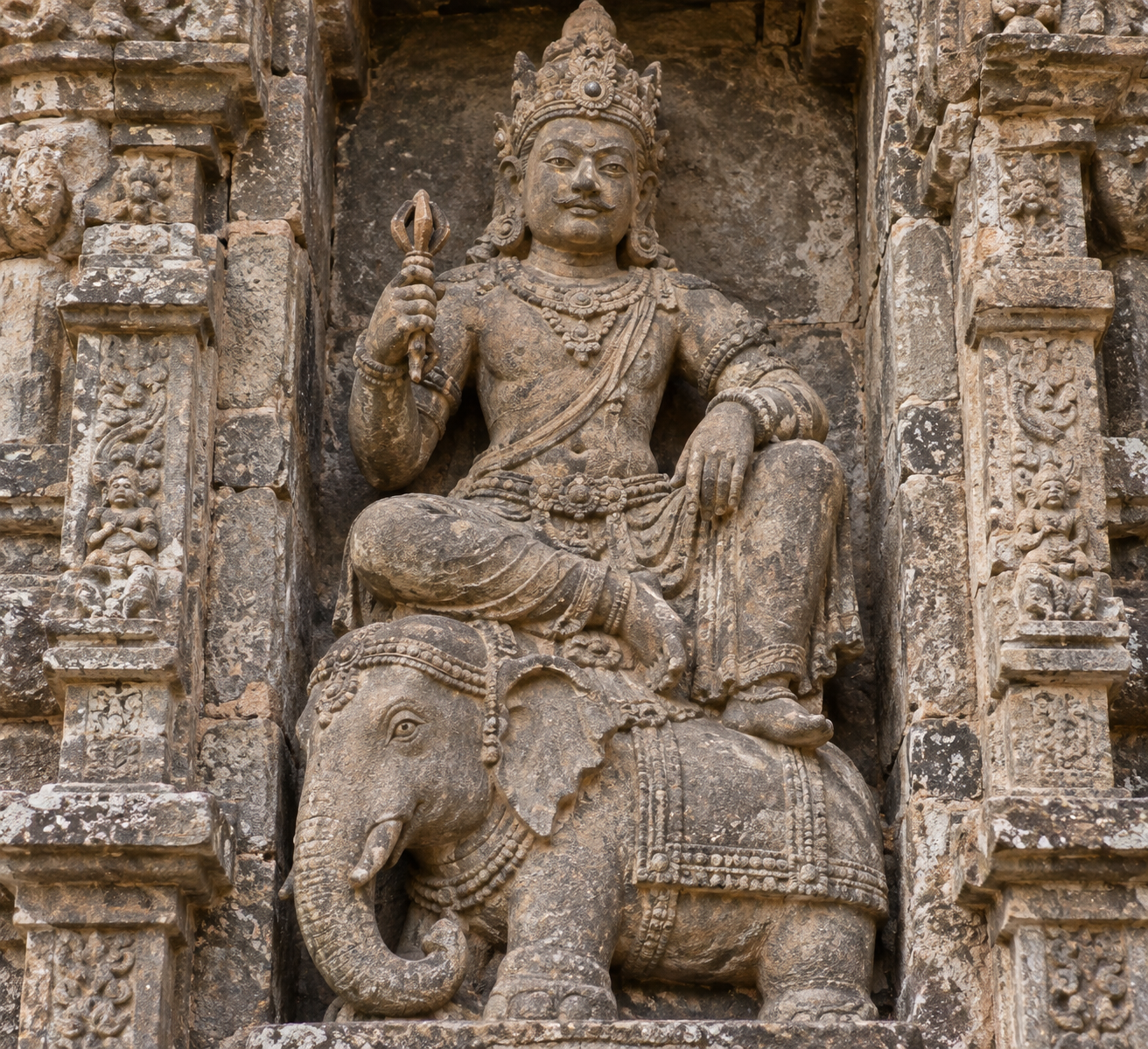
The strongest identification comes from several features agreeing with one another. Look for the following cluster rather than demanding that every sculpture reproduce one rigid model.
- The elephant: Indra’s vehicle is Airavata. The animal may appear prominently beneath him, beside him or in a reduced form suited to a crowded niche.
- The vajra: Indra’s characteristic implement is the thunderbolt. In sculpture it may be compact and stylised, so it should not be mistaken automatically for a club, flower or damaged fragment.
- Royal bearing: A crown, jewellery and composed bearing suit Indra’s status as a celestial ruler. These support an identification but cannot establish it alone, because many divine figures receive regal treatment.
- Directional context: Placement in the eastern part of a coordinated group is especially important. A comparable figure elsewhere may belong to a narrative scene or represent a different deity.
Temple iconography is not a game of matching one object to one name. Regional conventions, period styles, available space and damage can change how a figure appears. Even Airavata may be easier to recognise than the vajra in one temple and nearly lost in another.
If the upper body is damaged, start with the mount and location. If the lower section is missing, inspect the hands and the surrounding directional arrangement. If both are uncertain, leave the identification provisional. Calling a figure “probably Indra because of its eastern placement and possible vajra” is more responsible than turning a weak clue into certainty.
The neighbouring niches can settle a doubtful case. Directional guardians were conceived as a system, not as isolated ornaments. When several figures occupy positions corresponding to different directions, the entire sequence becomes evidence for each member. Record the arrangement before concentrating on the most intact sculpture.
Indra’s eastern office is not his whole identity
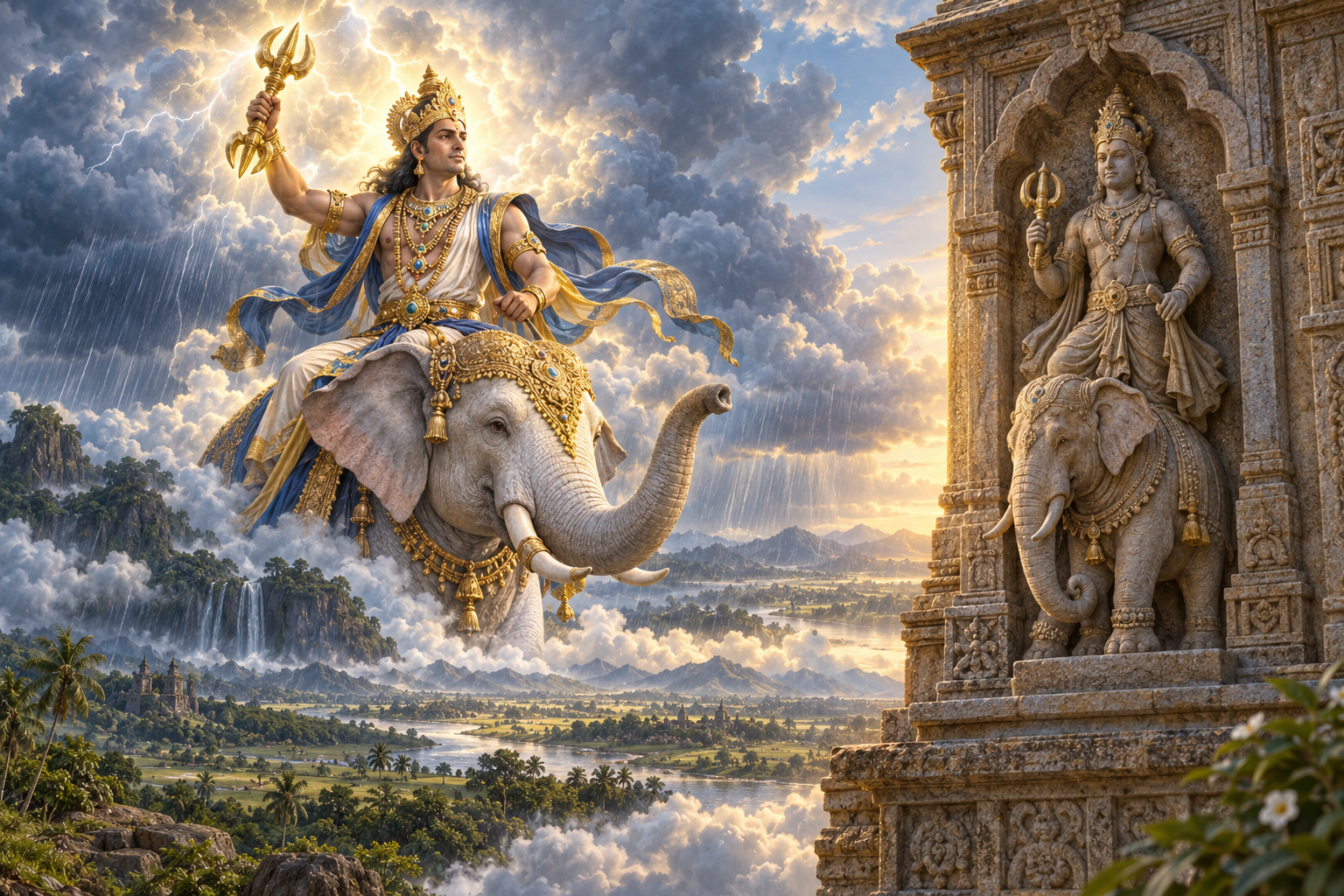
Indra appears in Dharmic memory as a Vedic deity, wielder of the vajra, ruler among the devas and a figure in many narratives. The Dikpalaka form does not erase those identities. It selects the qualities needed for a particular architectural office: sovereignty, vigilance, strength and the protection of order.
This distinction prevents two common mistakes. The first is to treat every image of Indra as a complete summary of his theology. The second is to regard a directional guardian as merely decorative because he is not the principal deity of the sanctum. In this setting, Indra’s task is relational. His position makes sense alongside the sacred centre, the eastern direction and the other guardians.
The east carries an immediate visual meaning because it is where the sun rises. It marks emergence from darkness, the opening of the day and a renewed field of activity. Indra’s royal and protective character gives that threshold a guardian. The symbolism is therefore spatial as well as devotional: the temple does not stand in an empty, directionless world.
Calling Indra a guardian also requires care. It does not mean that he blocks the east like a sentry at a gate, nor that every act of worship directed eastward is worship of Indra. Guardianship here belongs to a larger vision of cosmic order. Each direction has a place, each guardian has a responsibility, and the sacred structure gathers those relationships around its centre.
Nor does Indra’s presence compete with the deity in the sanctum. The presiding deity and the directional guardian perform different iconographic functions. One establishes the temple’s devotional centre; the other helps articulate the ordered sacred world surrounding that centre. Reading rank into physical distance from the sanctum can therefore be misleading.
Use a three-minute method at the temple
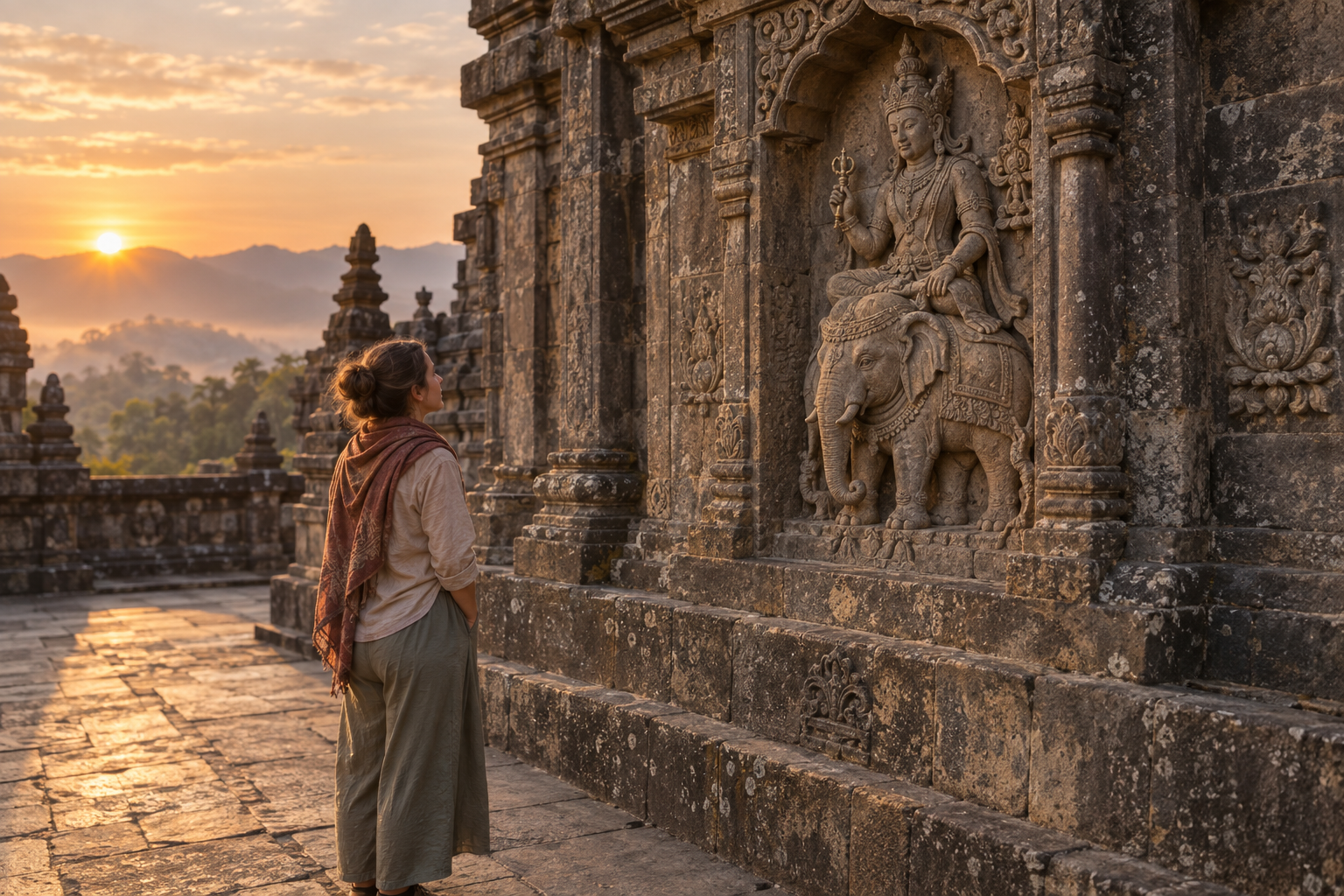
You do not need specialised equipment to make a disciplined first reading. Pause before taking a close photograph and work from the whole structure toward the individual detail.
- Orient yourself. Determine east in relation to the sanctum, not merely in relation to where you entered the complex.
- Scan the full wall. Notice whether the figure occupies a deliberate niche and whether similar niches continue around the building.
- Find the vehicle. Look below and beside the deity for an elephant. Check whether it belongs to this figure rather than to a separate decorative band.
- Inspect the attribute. Look for a vajra, while allowing for stylisation, erosion or a broken hand.
- Test the group. Search the other directions for corresponding guardians. A coherent series is stronger evidence than one apparently familiar object.
- Record uncertainty. Note which signs are visible, which are missing and which remain ambiguous. This preserves the difference between observation and inference.
If photography is permitted, take one frame showing the figure within the wall before taking close-ups. The contextual photograph preserves the niche, direction and neighbouring architecture; a tight image of the face or hand may lose the very evidence that identifies a Dikpalaka. Respect any local restrictions and never climb, touch or apply substances to a sculpture to improve its visibility.
When following a prescribed circumambulatory route, keep to the temple’s practice rather than changing direction to reach the eastern wall first. The aim is attentive recognition within a living sacred space, not the collection of iconographic specimens. By the time you reach Indra’s sector, you may already have noticed that the building itself is teaching you to see direction as sacred order.
Key takeaways
- Indra serves as the Dikpalaka of the east within the eight-directional system.
- Identify him through converging evidence: eastern placement, the elephant Airavata, the vajra and royal bearing.
- Do not rely on a crown, elephant or apparent weapon in isolation.
- Use the wider arrangement of directional niches to test an uncertain identification.
- Read guardianship as part of the temple’s cosmic order, not as decoration or competition with the sanctum’s presiding deity.
- Photograph architectural context before details, and preserve uncertainty when damage prevents a firm conclusion.
On your next temple visit, find east before searching for Indra. That single change of method turns a weathered figure into part of a larger sacred map: a guardian, a direction and a temple ordered around its divine centre.
References

Leave a Reply
You must be logged in to post a comment.