
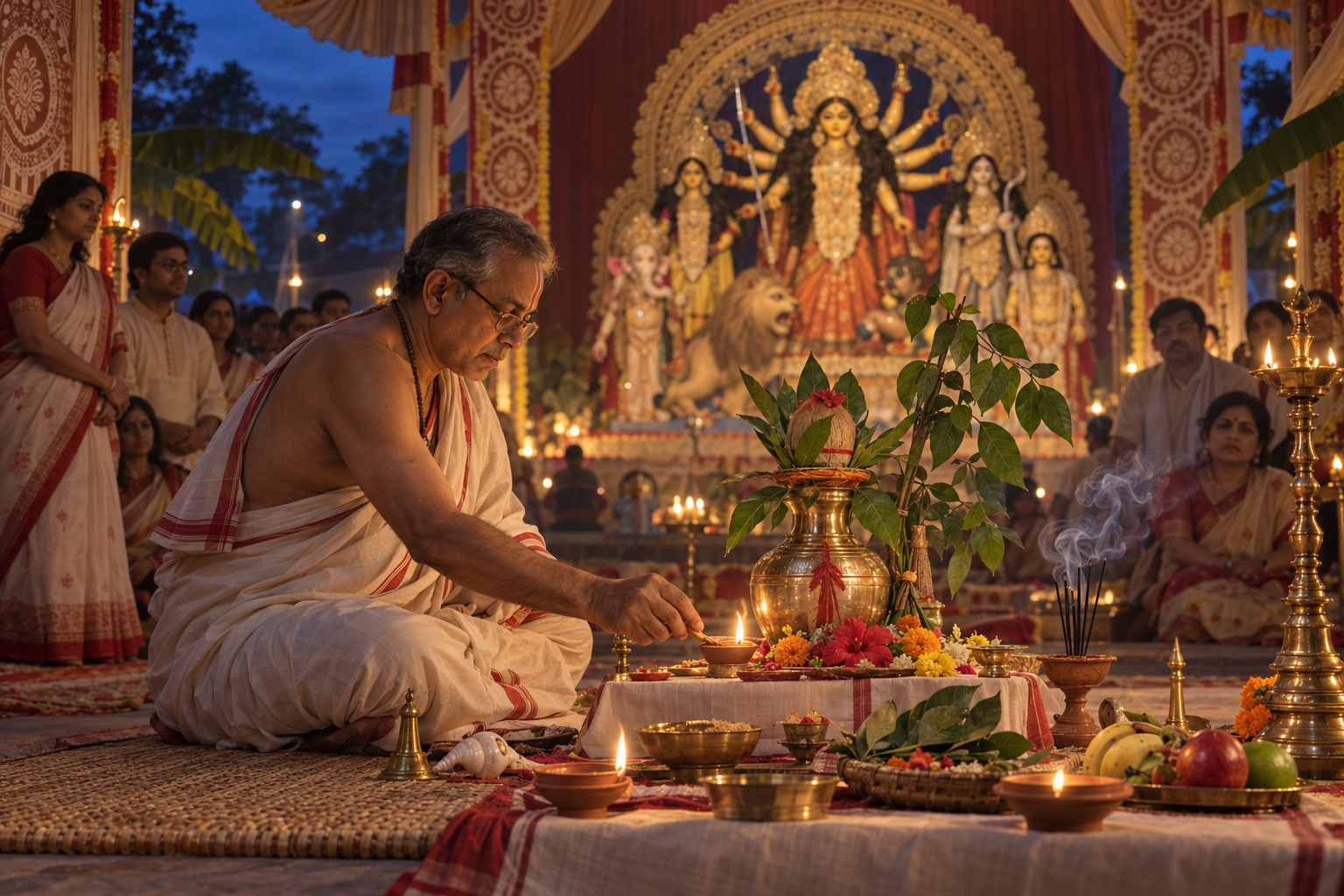
You may know when to arrive for darshan or pushpanjali, yet still be unsure what happens during Bodhan. The rite is quieter than the public celebration around it, but it marks a decisive change: preparations become an addressed act of worship, and the gathered community turns its attention toward Devi.
If you want to witness Bodhan, or are wondering whether to perform it at home, begin with one distinction. Formal Bodhan belongs to an inherited ritual discipline. Personal prayer to Durga is open to every sincere devotee, but it should not be presented as a complete formal rite when its prescribed method has not been followed.
Bodhan does not imply that the Divine Mother was absent
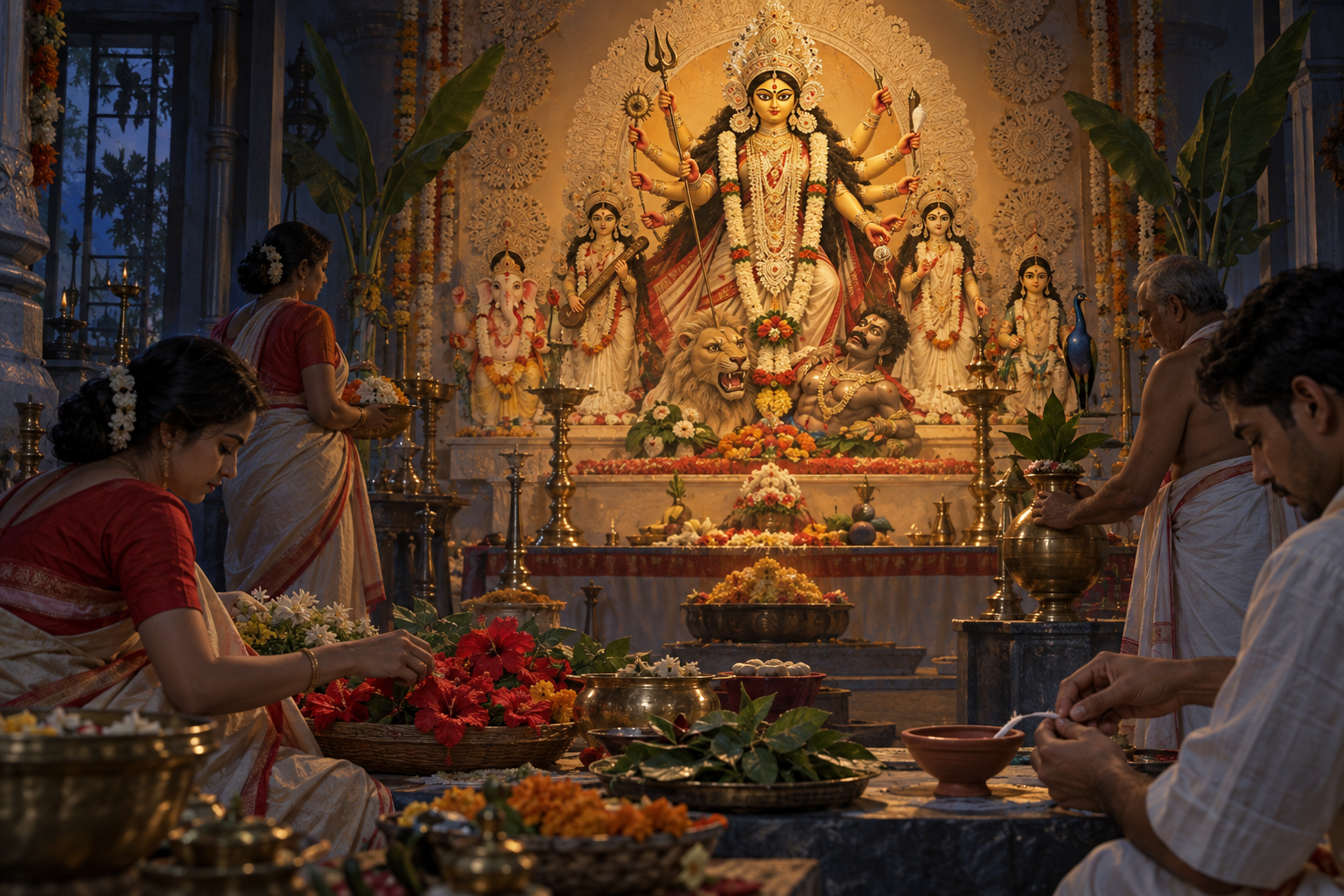
Bodhan is the ceremonial awakening of the Divine Mother within Durga Puja. Taken too literally, the word can create an unnecessary theological puzzle: if Devi is the all-pervading Shakti, how could she be asleep or unavailable?
The more useful reading is liturgical. The rite establishes a conscious relationship between worshipper, sacred space, ritual time, and the form of Devi being worshipped. What changes is not the universal existence of Shakti. What changes is our mode of attention. The community stops treating the image, altar, implements, and festival space as preparations and begins relating to the Mother through worship.
This is why Bodhan should not be reduced to an opening announcement, a cultural performance, or a signal that the pandal is ready for visitors. Its work is inward as well as ceremonial. It asks you to wake up to the presence you have come to honour.
That understanding also corrects a common mistake. Bodhan is not a claim that human beings command Devi to appear. Invocation is an act of reverence and receptivity. The devotee prepares to receive; the ritual gives that preparation an ordered form.
One sacred purpose can have three inherited forms
Durga worship has preserved three distinct forms of Bodhan. Their existence matters because Hindu ritual unity does not require every community to use an identical procedure. A shared purpose can be carried through more than one authorised method.
This is not permission to assemble a fourth method from whichever instructions are easiest to find. Ritual variation and casual improvisation are different things. An inherited paddhati is a coherent procedure transmitted within a tradition; an internet checklist may detach materials, mantras, and actions from the sequence that makes them intelligible.
Use this decision rule when different instructions appear in front of you:
- If your family has an established Durga Puja practice, follow that practice and the person responsible for transmitting it.
- If you are joining a temple or community puja, follow its officiating priest and local paddhati. Do not interrupt the rite because another community uses a different order.
- If you have a guru-given or sampradaya-specific procedure, keep its instructions together rather than mixing them with a second procedure.
- If you have no inherited method or qualified guidance, perform a simple devotional worship of Durga instead of claiming to reproduce formal Bodhan.
The practical question is therefore not, “Which version looks most authentic?” Ask, “Which tradition is responsible for this puja, and who is qualified to guide it?” That question respects both the unity of Durga worship and the integrity of its different forms.
Watch for the movement from preparation to presence
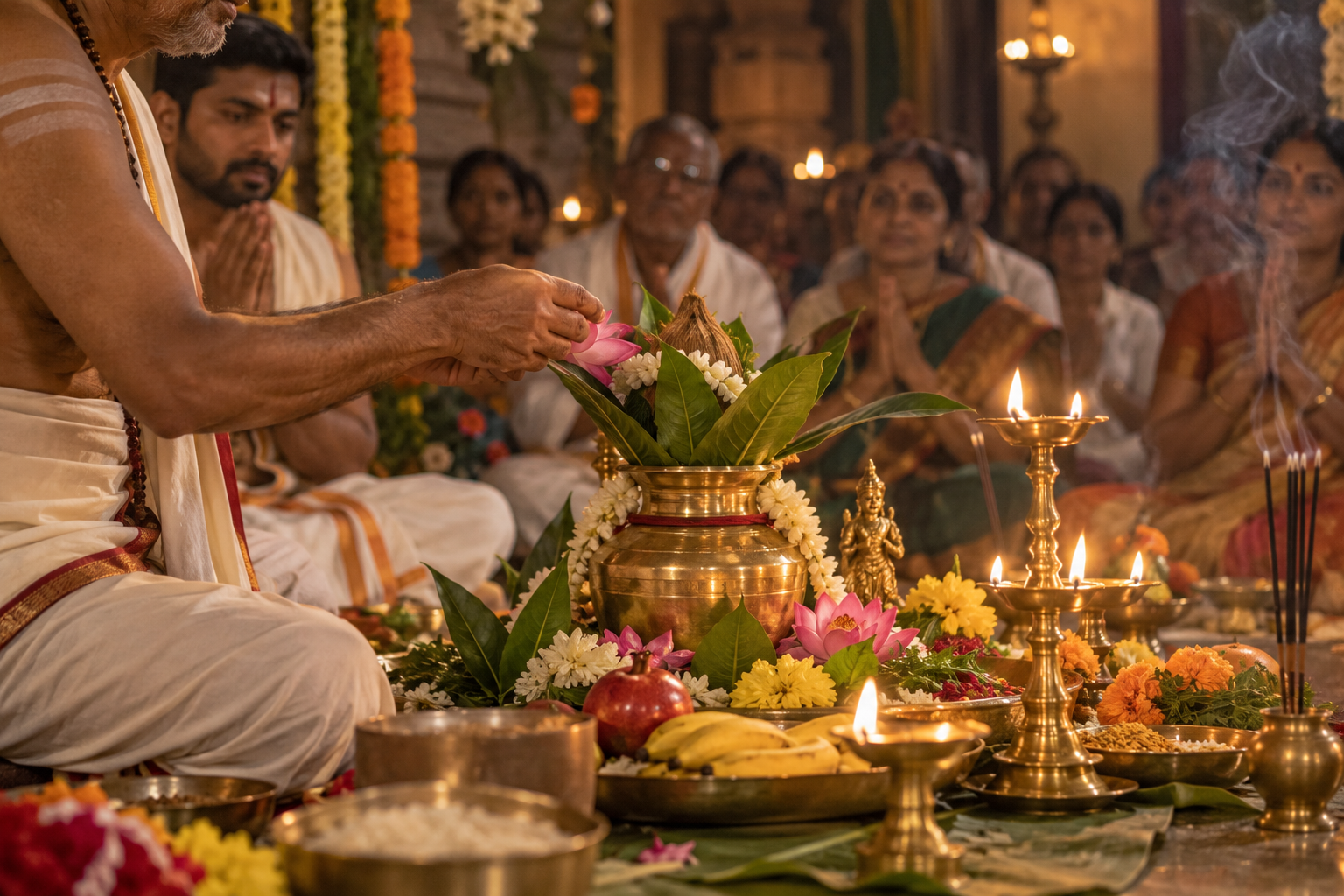
You do not need to recognise every mantra to follow the inner movement of Bodhan. Attend to three broad phases: preparation, invocation, and response. These are a way to understand what you witness, not a substitute for the detailed sequence of any particular paddhati.
- Preparation: The ritual field is made ready and ordinary distractions are set aside. For you, this is the moment to stop talking, silence your phone, and let your attention settle.
- Invocation: Mantra and prescribed action address Devi directly. Listen rather than trying to perform along from an unrelated text on your screen.
- Response: Offerings and reverence express welcome, service, and relationship. Remain present until the officiant or organisers indicate that the observance has concluded.
This lens helps when the visible actions are unfamiliar. Instead of treating each gesture as an isolated custom, notice what the sequence is doing: separating sacred time from ordinary time, gathering attention, invoking the Mother, and answering her with worship.
Mantra deserves particular care. It is not decorative language added to create atmosphere. Pronunciation, placement, and ritual context matter within formal worship. If you have not been taught the recitation being used, attentive silence is more respectful than guessing aloud. You can inwardly remember Durga through a familiar name or prayer without competing with the officiated rite.
How to participate without obstructing the ritual
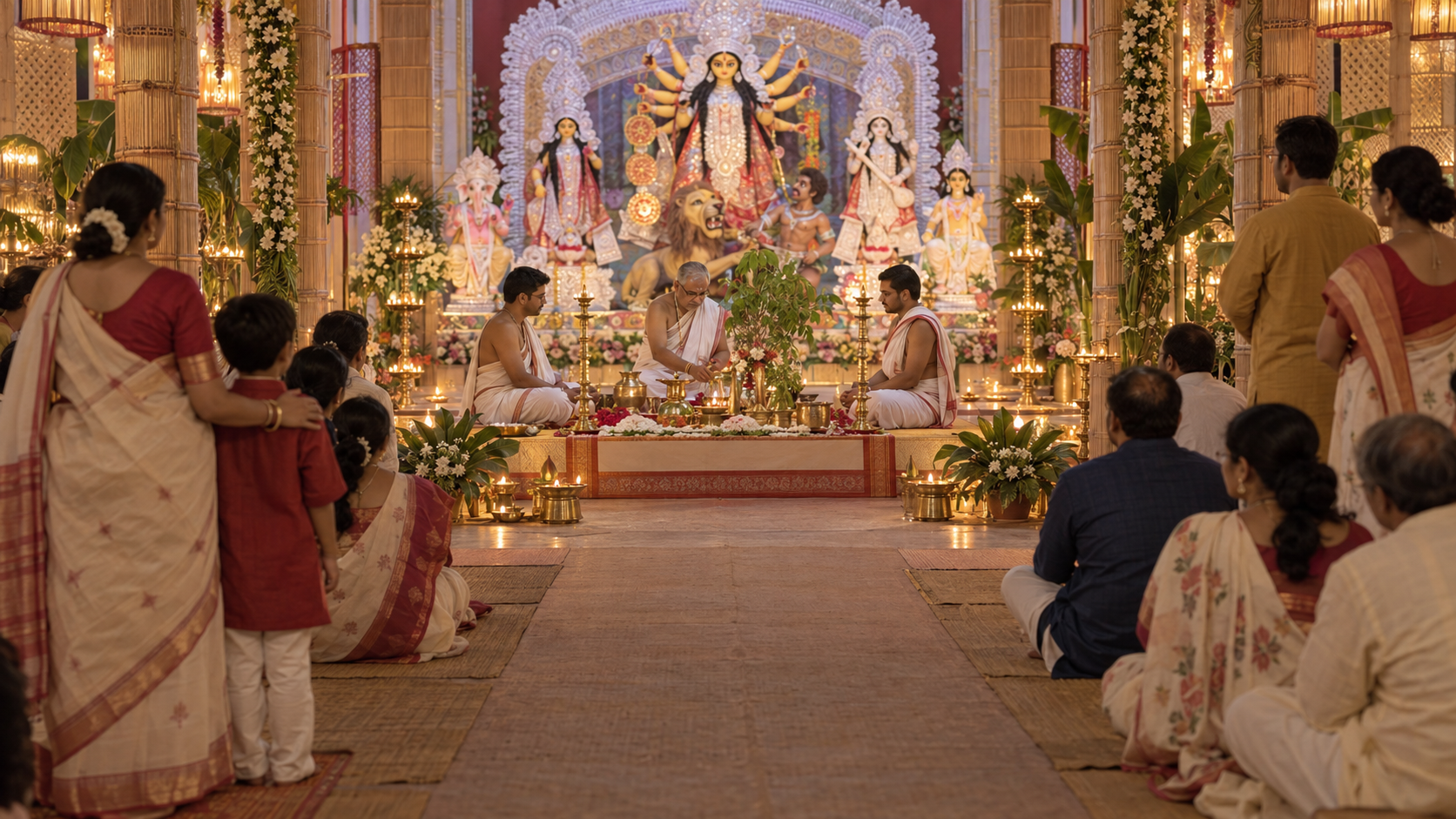
A little preparation lets you witness Bodhan closely without turning the worship into a spectacle. Before leaving for a community puja, ask the organisers three concrete questions: when the rite is scheduled to begin, whether the ritual area is open to the public, and whether photography is permitted. The time advertised for general visitors may not tell you when a quieter observance begins.
Once you arrive, follow these boundaries:
- Arrive before the announced start so that you are not moving through the gathering during invocation.
- Keep outside the marked or implied ritual workspace. Do not step over implements, offerings, vessels, or the priest’s working area to obtain a better view.
- Use no flash, additional lighting, or camera sound. If photography is restricted, put the device away rather than negotiating during worship.
- Do not touch ritual objects or add an offering unless someone responsible invites you to do so.
- Let the officiant set the pace. A pause may be part of the procedure, not a cue for conversation.
- If you bring children, explain beforehand that this is worship rather than a stage performance. Stand where you can leave quietly if necessary.
At home, the safest distinction is between formal Bodhan and simple Devi upasana. Without a transmitted procedure, you can clean the worship space, place an image of Durga respectfully, offer water or a flower, light a lamp where it can be tended safely, recite a prayer you already know, and sit for a few moments in remembrance of the Mother. This is meaningful worship. Honesty about its form protects it from pretence.
If you intend to establish a complete Durga Puja rather than a personal observance, obtain the relevant paddhati and guidance before collecting materials. A shopping list cannot tell you which inherited form is being followed, what order its actions require, or where its mantras belong. Settle the ritual authority first; the list of items comes afterward.
Key takeaways for your next Durga Puja
- Bodhan is the ceremonial awakening and invocation of the Divine Mother, not a suggestion that universal Shakti literally ceased to be present.
- The rite changes the worshipper’s relationship to ritual time and space: preparation becomes an active encounter with Devi.
- Three inherited forms can serve the same sacred purpose; their existence does not justify mixing separate procedures.
- For formal worship, follow the family, temple, guru, or officiating priest responsible for the chosen paddhati.
- If you have no such guidance, choose sincere personal Durga worship and do not label it a complete formal Bodhan.
- As an attendee, arrive early, protect the ritual boundary, listen attentively, and let the officiant determine when participation is appropriate.
Before the next Durga Puja, make one practical enquiry: ask when Bodhan will occur and whether devotees may quietly observe it. Then arrive in time to do more than see the actions. Let the rite call your own attention awake.
References

Leave a Reply
You must be logged in to post a comment.