

You may have encountered a chart pairing Hindu directional guardians with Greek gods and wondered whether it reveals a forgotten connection between the two civilizations. The resemblance is real enough to invite comparison, but it is not strong enough to make the two systems interchangeable.
The useful question is not, “Which Greek god is the Hindu god under another name?” It is, “What does each tradition believe a direction can mean?” That change of question protects the distinctiveness of the Dharmic framework while still allowing a serious cross-cultural conversation.
The shortest accurate answer: parallel ideas, different systems
Hindu cosmology presents a clearly ordered model in which eight directions are governed by divine guardians called Dikpalas, collectively known as the Ashtadikpalakas. “Dikpala” means a guardian or protector of a direction. The name therefore describes an office within an organized spatial system, not merely a deity who happens to be associated with a place.
Ancient Greek traditions also gave personality and divine agency to directional phenomena, especially winds. This is a meaningful parallel: neither culture treated the surrounding world as spiritually empty. Direction could possess character, power and consequence.
The resemblance stops short of identity. A divine wind coming from a direction is not automatically equivalent to a guardian exercising authority over that direction. One is first understood through movement and natural force; the other is defined by a protective spatial jurisdiction. You can compare those ideas without collapsing them.
Why the eightfold Hindu pattern matters

The prefix “ashta” means eight. That number is structural. The four cardinal directions alone do not account for the whole field; the four intermediate directions complete it. The result is an ordered circumference rather than a simple cross drawn through space.
This distinction matters when you look at a sacred diagram, a temple plan or an image arranged around a central figure. If you search only for north, south, east and west, you may miss half of the intended organization. Begin by locating the centre, then read outward into all eight sectors.
The guardians also change how you should interpret sacred space. A direction is not merely an address. It becomes a domain with a divine custodian. The surrounding cosmos is differentiated, bounded and made intelligible through relationships between centre, direction and guardian.
That is why reducing the Ashtadikpalakas to “eight compass gods” loses too much. A compass tells you where to travel. A guardian system tells you that orientation itself participates in a larger cosmic order. When reading a depiction, ask what each position is doing within the whole arrangement rather than treating every figure as an isolated mythological character.
- Find the centre before identifying the perimeter.
- Count all eight sectors, including the intermediate directions.
- Distinguish a guardian’s office from the deity’s other identities and stories.
- Read the complete arrangement as a system, not as eight unrelated images.
Where the Greek parallel helps—and where it breaks
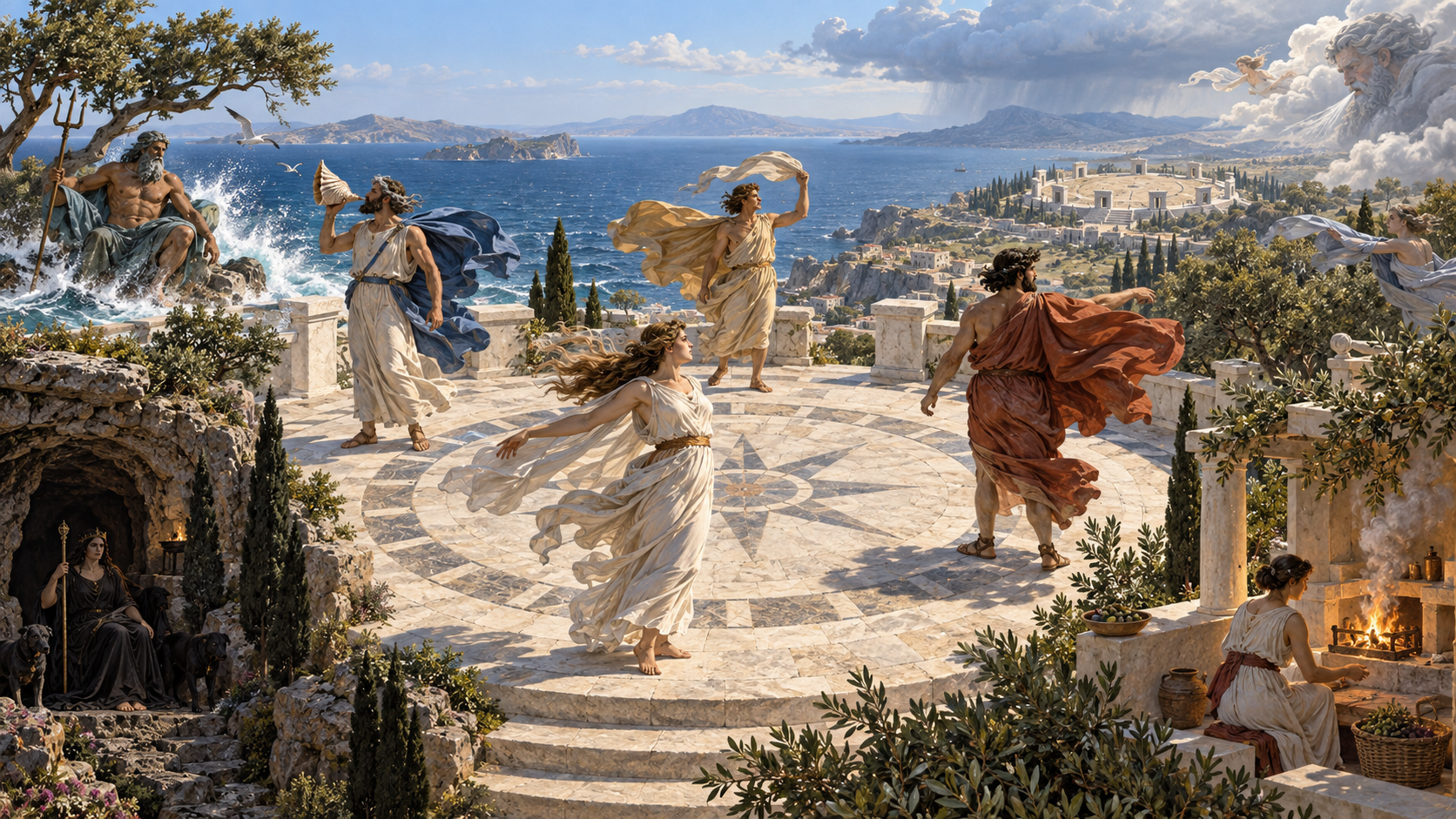
The Greek parallel is useful at the level of religious imagination. Directional winds show that natural orientation could be personified and encountered through divine figures. Both traditions therefore permit you to think of space as qualitative: east or west can mean more than a coordinate on a neutral map.
Yet “directional divine being” is a broad category. It can include a guardian, a wind, a ruler, a messenger or a personified natural force. Similar placement does not guarantee the same function. A figure associated with the north in one culture need not perform the same work as a northern figure in another.
| Question to ask | Hindu Ashtadikpalaka framework | Greek directional parallel |
|---|---|---|
| What organizes the idea? | An eight-direction system of guardianship | Divine agency associated with directional phenomena, especially winds |
| What defines the figure? | Custodianship of a direction | Character and force expressed through a directional phenomenon |
| What can be compared safely? | The personification of oriented space and the refusal to treat nature as spiritually vacant | |
| What should not be assumed? | Identical duties, a one-to-one roster, an interchangeable cosmology or a shared historical origin | |
This functional distinction is more dependable than visual resemblance. Two figures may both hold weapons, ride animals or occupy the edge of an image while serving entirely different theological purposes. Conversely, figures that look unlike one another may still offer a useful structural parallel if both make direction religiously meaningful.
There is another caution. “Greek tradition” was not one uniform manual, just as Hindu traditions cannot be reduced to one diagram detached from context. When a neat chart offers perfect pairs across civilizations, treat its tidiness as a warning. A comparison becomes less trustworthy when every difference has been edited away.
How to evaluate claims of a shared origin
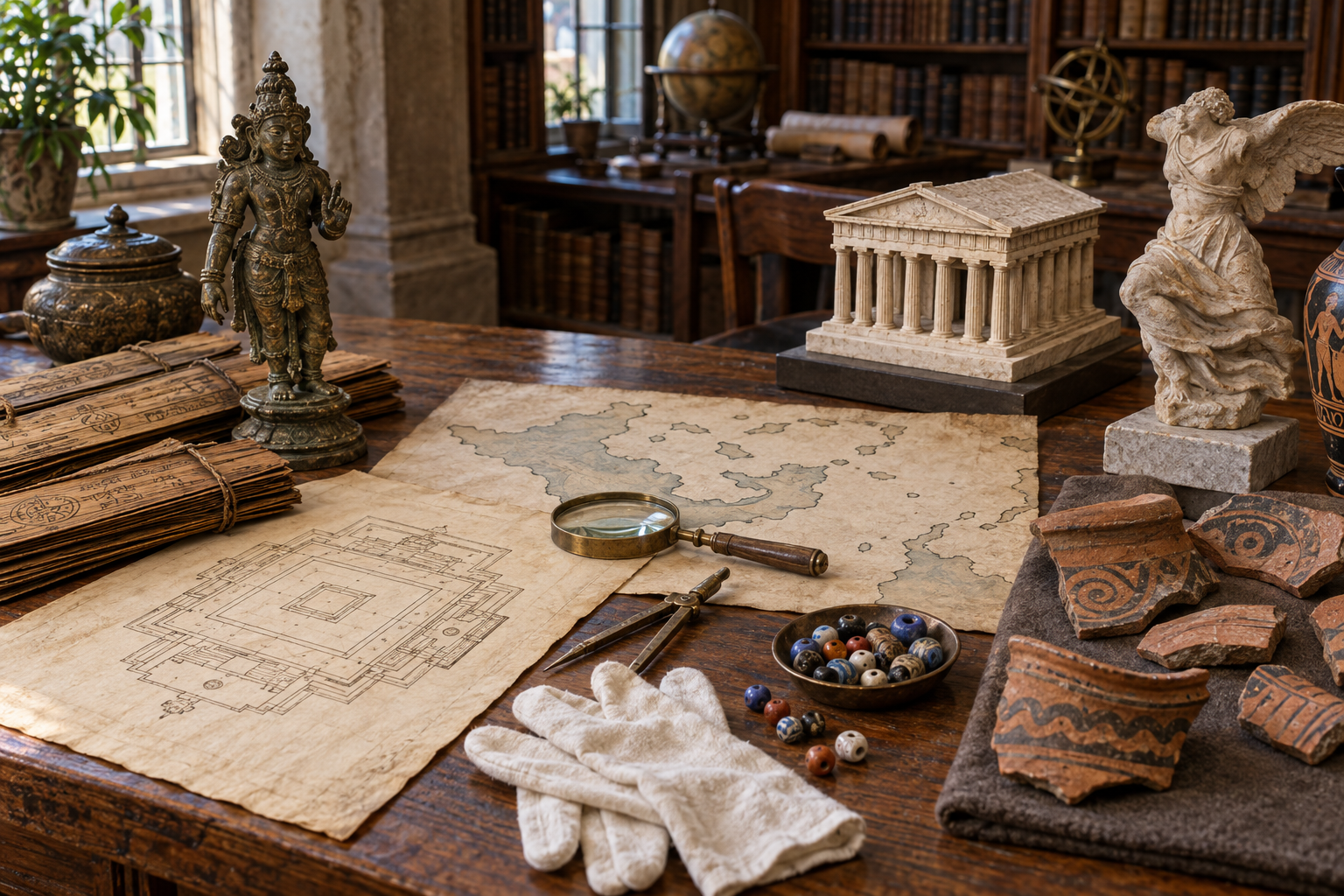
Similar religious ideas can emerge through several routes. Cultures may influence one another, inherit something from an earlier setting, or independently personify the same features of human experience. Every settled community has to orient buildings, journeys and rituals. Direction is therefore an obvious field for sacred interpretation.
For that reason, resemblance alone cannot establish borrowing or common descent. Nor does caution require you to deny every possibility of contact. It simply keeps the historical claim separate from the theological comparison.
- Define the units being compared. Decide whether each figure is a guardian, wind, ruler or natural personification. Do not let the shared word “god” conceal different functions.
- Compare complete structures. An eight-direction system should be examined as an eight-direction system. Pairing one convenient figure from each tradition cannot establish equivalence between the wholes.
- Separate position from duty. Sharing a direction is only the beginning. Ask what the figure protects, governs, carries or represents within its own tradition.
- Keep theology and history distinct. A meaningful conceptual resemblance is not yet evidence of transmission. A historical argument needs evidence beyond a modern list of parallels.
- Preserve unmatched elements. If a figure has no convincing counterpart, leave the space blank. An honest gap teaches you more than a forced pairing.
This method is especially important for readers interested in Bharat’s influence on the wider world. Civilizational influence should be argued with disciplined evidence. Overstated parallels make a strong heritage look dependent on speculation; careful distinctions reveal what is actually distinctive in the Dharmic conception.
Key takeaways for reading directional symbolism
- Treat the Ashtadikpalakas as an integrated eightfold order, not as a loose collection of deities.
- Use the Greek material as a parallel in the personification of direction, not as a translated version of the Hindu system.
- Compare functions before comparing names, images or compass positions.
- Do not turn resemblance into proof of borrowing, common origin or exact equivalence.
- When a chart produces perfect pairs, check what differences had to be ignored to make it look perfect.
The next time you encounter a directional diagram, start at its centre and work outward. Count the sectors, identify the role assigned to each boundary and ask whether you are looking at guardianship, natural force or something else. That small discipline lets you appreciate the Greek parallel while seeing the Hindu eightfold order on its own terms.
References

Leave a Reply
You must be logged in to post a comment.