

You may know the outline of Kashyapa and Kadru’s story yet still find its central decision puzzling. If Kashyapa could grant the birth of powerful, venomous serpents, why did Brahma later have to grant knowledge capable of countering their poison?
The apparent contradiction is the point. Read the events in order and the episode becomes a precise lesson about power, consequence, and responsibility: when a dangerous capacity grows, dharma requires the knowledge needed to restrain its effects.
The sequence explains why the antidote was necessary
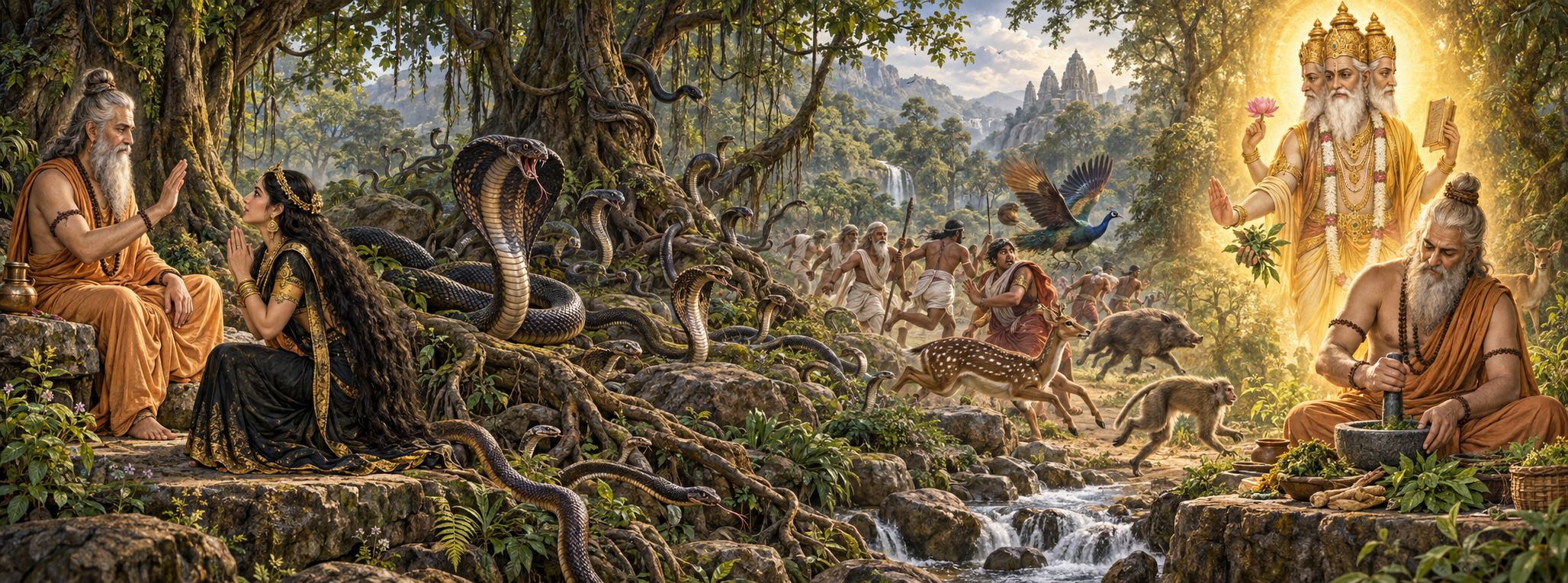
The episode moves through four closely connected events:
- Kadru, Kashyapa’s wife, asks for one thousand sons in the form of serpents.
- Kashyapa grants her the boon.
- The serpents are born strong and mighty. Their poison is dangerous, and they become numerous.
- Brahma blesses Sage Kashyapa with knowledge of an antidote to poison.
The order matters. Brahma’s blessing does not appear as an isolated reward for Kashyapa’s learning. It follows the multiplication of beings whose natural power can inflict grave harm. A corresponding protective knowledge enters the world because the dangerous capacity has expanded.
That gives you the simplest answer to the question in the title: the boon had consequences beyond the fulfilment of Kadru’s desire. Once potent venom existed on a large scale, the possibility of a cure also had to exist. The act of granting could not remain morally separated from what the grant produced.
The number one thousand therefore does more than make the story magnificent. It marks scale. One dangerous serpent presents a danger; a proliferating serpent lineage changes the balance of the world around it. Greater reach requires a greater capacity to respond.
Why Kashyapa receives the knowledge
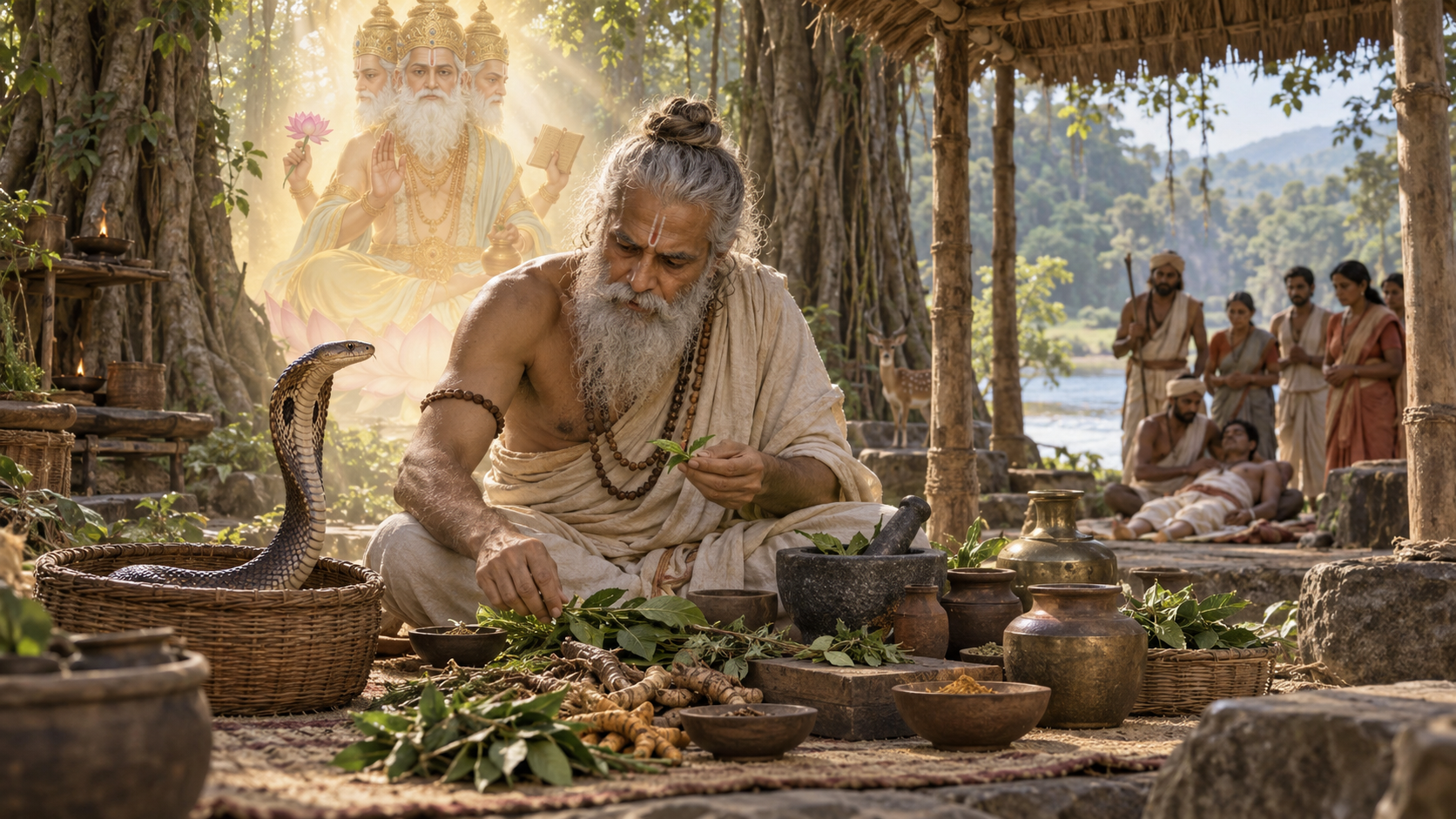
Brahma does not place the antidote knowledge with an unrelated observer. He gives it to Kashyapa, the same sage whose boon enabled Kadru’s serpent sons to be born. That symmetry connects agency with aftercare.
Kashyapa occupies two positions at once. He is the giver of a desired boon, and he becomes the bearer of knowledge that can answer one of its harmful consequences. The second role does not erase the first. It completes the responsibility created by it.
This is a useful Dharmic distinction. A boon may be valid as a response to tapas, desire, relationship, or promise, yet its consequences still require stewardship. Dharma is not exhausted when someone receives what was requested. You must also ask what the fulfilled request releases into the shared world.
The response highlighted in the episode is knowledge. Force is answered by understanding: knowledge of poison is paired with knowledge capable of countering poison. The balance is not achieved by pretending the danger is unreal. It begins by recognizing the danger accurately enough to prepare a remedy.
Nor does the existence of an antidote make venom harmless. A cure cannot retroactively turn injury into non-injury. Protective knowledge matters precisely because the threat is real. The episode therefore supports responsibility, not complacency.
A practical Dharmic test for every powerful boon
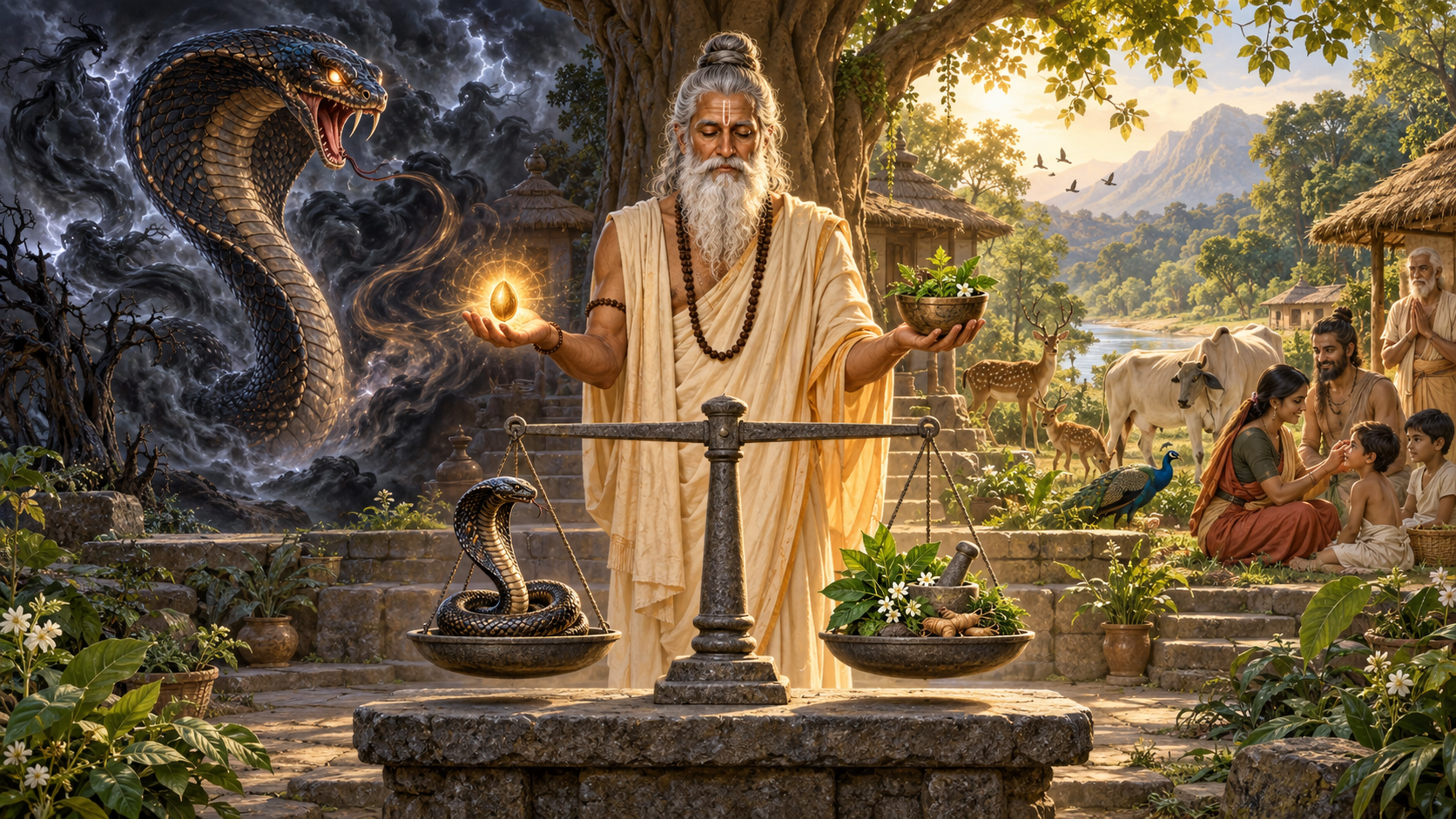
You can apply the structure of this episode without pretending that its modern applications are its literal plot. Whenever a person, family, institution, or society enlarges a power, ask four questions:
- What capacity is being increased? Name the actual power rather than the desire behind it: reach, authority, speed, force, influence, reproduction, or access.
- What harm can arise from that same capacity? Do not limit the answer to intended use. A boon can create consequences its recipient did not request.
- What is the antidote? Identify the knowledge, discipline, safeguard, or form of redress that can contain the specific danger.
- Who is responsible for keeping that antidote available? If everyone is responsible in the abstract, no one may be prepared when harm becomes concrete.
Suppose someone is given public influence. The corresponding antidote is not silence but a reliable practice for checking claims, acknowledging error, and issuing corrections. If a leader receives greater authority, review and redress must grow with that authority. If a teacher transmits powerful knowledge, the student also needs instruction about limits and misuse.
In each case, the antidote is tailored to the danger. It is not merely an opposing opinion or a vague promise to behave well. It is the specific competence or safeguard that reduces the damage the enlarged power can cause.
A simple discipline can make this test concrete. Before supporting a major grant of power, complete these two statements:
- This boon increases the power to __________.
- If that power causes harm, the antidote will be __________, maintained by __________, and available to __________.
If you can fill in the first statement but not the second, preparation is incomplete. The Mahabharata episode directs your attention to what enthusiasm for the boon tends to leave out.
Four misreadings that weaken the lesson
Do not reduce the serpents to a flat symbol of evil. The narrative identifies a dangerous property: their potent poison. A being’s capacity to harm is not the same as a complete verdict on that being. The lesson concerns the responsible management of real danger, not indiscriminate hatred of everything associated with it.
Do not treat an antidote as permission to create avoidable harm. The availability of a remedy does not make reckless action dharmic. Cure, restraint, and prevention have different functions. The possibility of repair never cancels the duty not to injure.
Do not make the story fatalistic. A harmful consequence does not have to be accepted merely because it followed a boon. Brahma’s gift introduces the possibility of an informed response. That movement from consequence to corrective knowledge is central to the episode’s usefulness.
Do not mistake sacred narrative for a medical treatment manual. Antidote knowledge is part of the episode’s religious and ethical meaning; it is not a home remedy for poisoning or a venomous bite. If you suspect either, treat it as a medical emergency and seek qualified emergency help immediately. Do not delay care while attempting a ritual, mantra, or improvised remedy.
Key takeaways
- Kadru asks for one thousand serpent sons, and Kashyapa grants the boon.
- The serpents’ strength, dangerous poison, and multiplication create the need for a corresponding protective capacity.
- Brahma gives antidote knowledge to Kashyapa, linking the origin of the power with responsibility for its consequences.
- The episode pairs dangerous power with corrective knowledge; it does not pretend the danger is absent.
- An antidote does not excuse harm. It represents preparedness, restraint, and the continuing duty to repair.
- When you support any expansion of power, identify its possible harm, its specific antidote, and the person responsible for maintaining that remedy.
The next time you encounter this episode, do not stop at the marvel of a thousand serpents or at the mystery of Brahma’s blessing. Trace the chain from request to boon, from boon to danger, and from danger to responsible knowledge. Then carry one question into your own decisions: if this power grows, where will its antidote live?
References

Leave a Reply
You must be logged in to post a comment.