
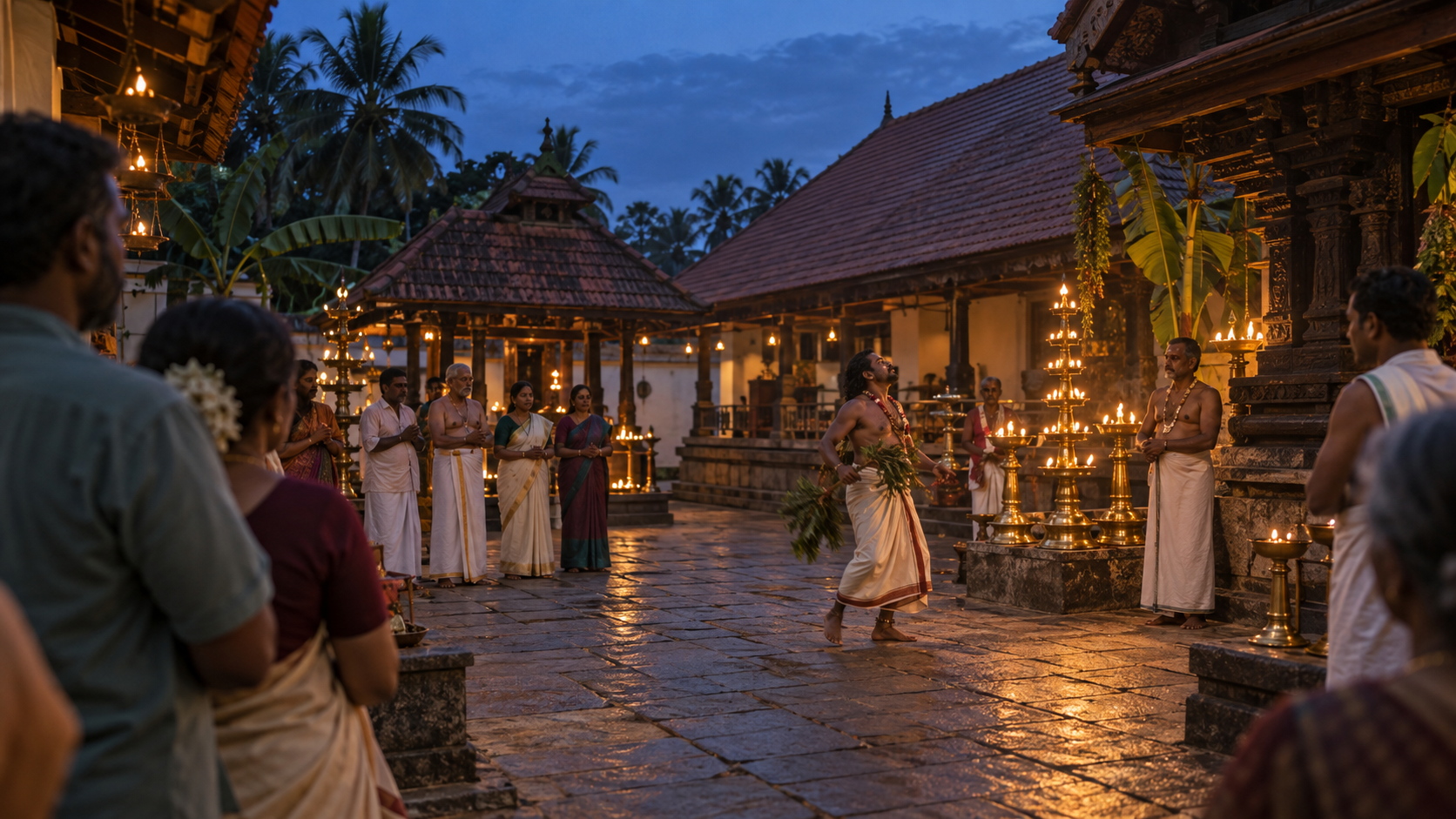
You may enter a Kerala temple expecting quiet prayer and instead see a devotee begin to sway, turn, stamp, or dance with striking intensity. If you do not know the local context, the moment can be difficult to read. Is it worship, performance, possession, emotional release, or a medical problem?
The most responsible answer is not to force the event into one category. Uranju Thullal is associated with ecstatic ritual dancing in Kerala Hindu temple worship. You can understand it more clearly by separating what you can observe from what the participant and temple community believe it means.
Begin with the ritual setting, not the movement alone
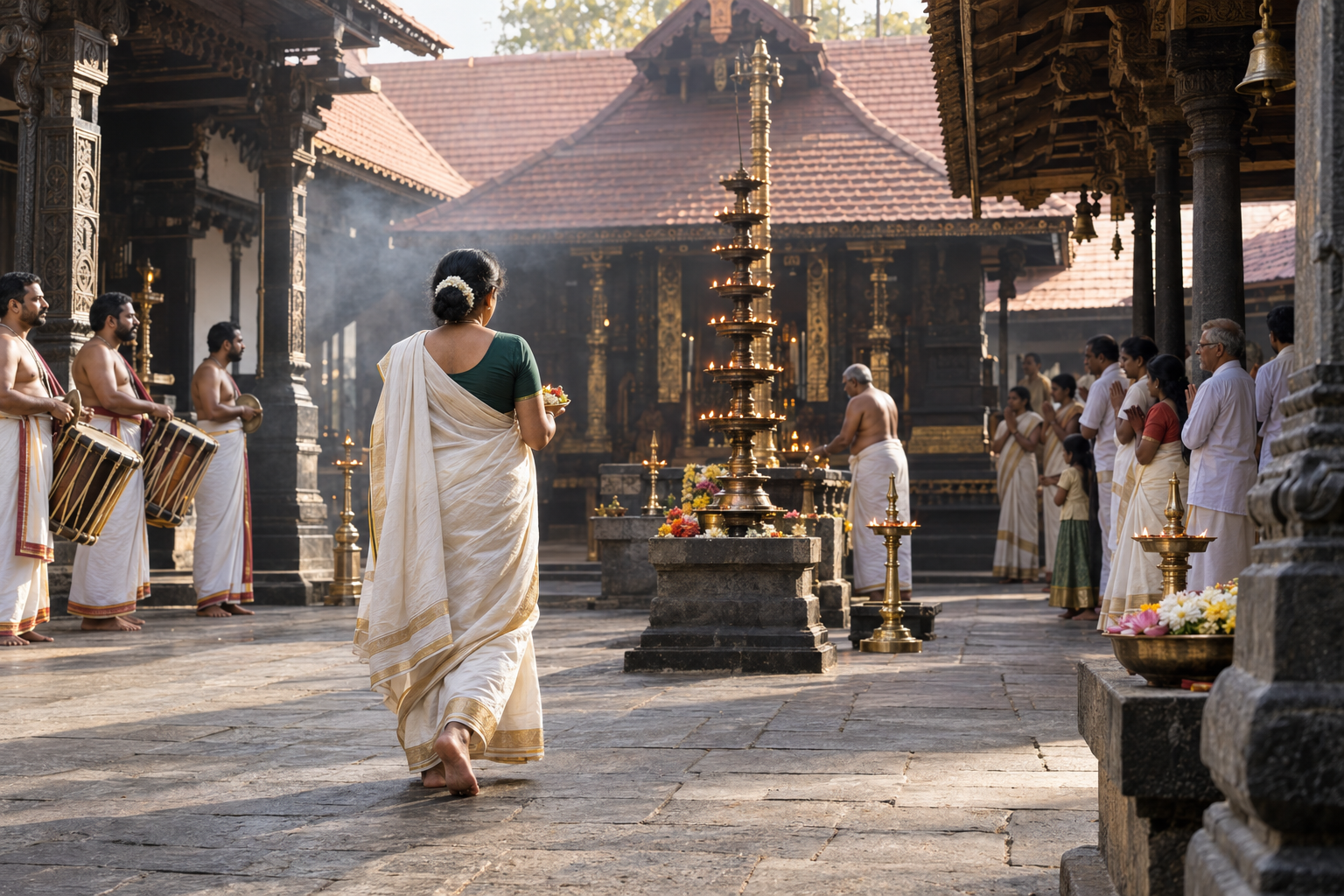
A forceful bodily movement looks different when it occurs inside worship rather than on a stage. The temple setting, the presence of the deity, the devotional purpose of the gathering, and the community’s inherited understanding all contribute to its meaning. Removing the movement from that setting and treating it as an isolated spectacle produces a distorted picture.
This does not mean that every vigorous gesture seen near a temple is automatically Uranju Thullal. Nor should you assume that every participant has an identical experience. The responsible first question is local and concrete: what do the temple’s devotees and functionaries call what is happening here?
That question matters because an outside label can erase an important distinction. Calling the event simply a dance may make it sound rehearsed for an audience. Calling it possession may impose a theological interpretation that the local tradition has not supplied. Calling it illness may turn an unfamiliar sacred expression into a diagnosis. Observe first, ask respectfully later, and allow the community’s vocabulary to lead.
Three lenses can explain different parts of the experience
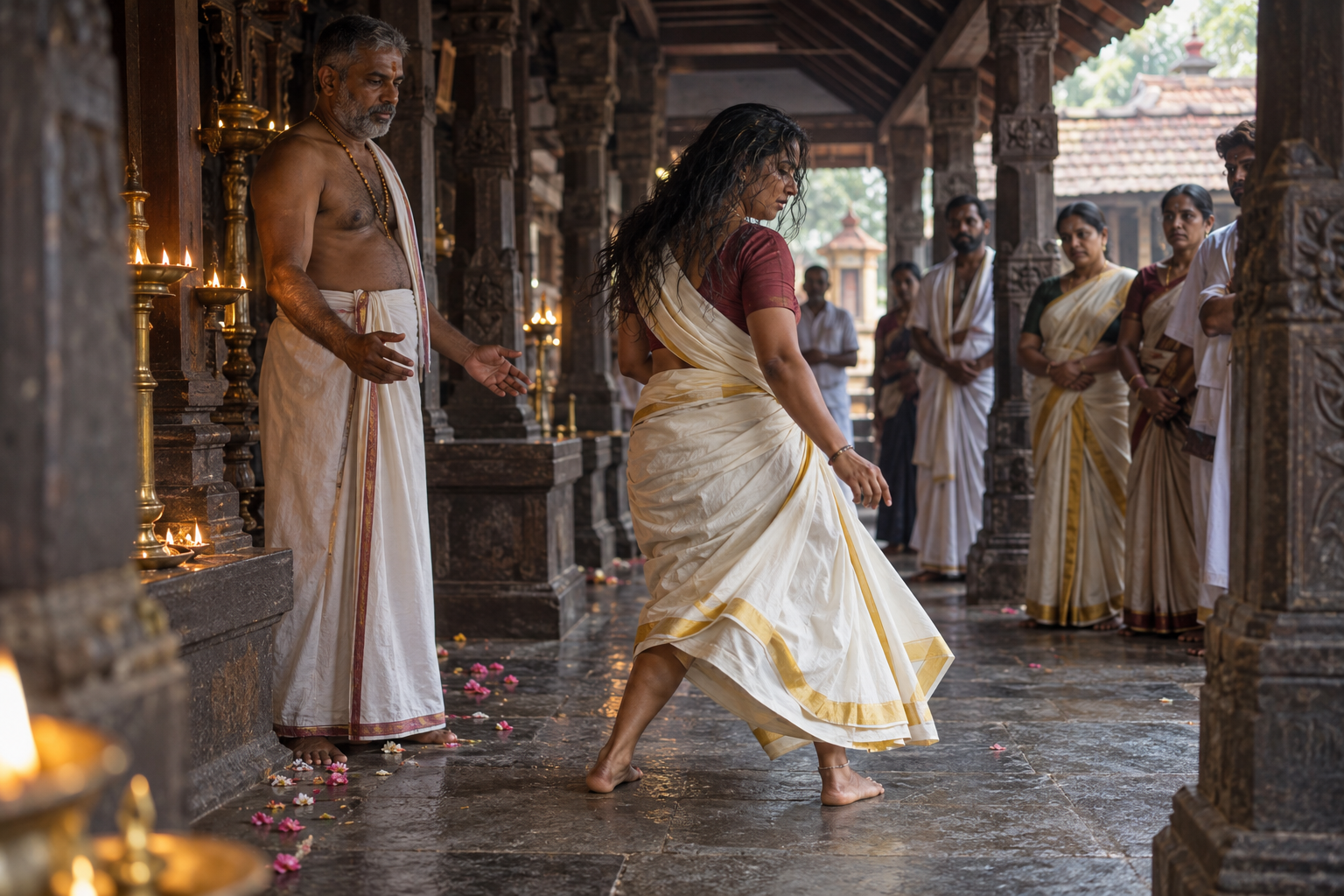
Uranju Thullal can be approached through spiritual, bodily, and psychological lenses. These approaches answer different questions. None should be stretched beyond what it can establish.
The spiritual lens asks what the event means
Within a devotional interpretation, intense movement can be understood as a sacred response rather than entertainment. The participant’s relationship with the deity, the ritual occasion, and the community’s traditional belief give the movement religious significance. If you are a visitor, you do not have to claim the experience as your own in order to recognise that it may be real and consequential for the worshipper.
This lens is strongest when discussing meaning. It tells you why the event may be received with reverence and why casual imitation, mockery, intrusive filming, or demands for proof are inappropriate in the moment.
The bodily lens asks what can be observed
Ecstatic movement is also a physical event. Muscles work, breathing changes, attention narrows or shifts, and the surrounding sound and activity may affect the participant’s responses. These observations do not settle the ritual’s spiritual meaning. They describe bodily processes that can accompany an intense experience.
A scientific explanation becomes careless when it leaps from general bodily mechanisms to a diagnosis of a person who has not been examined. It also becomes careless when ordinary physiological language is presented as if it disproved devotion. Describing how the body participates is not the same as deciding what the experience ultimately means.
The psychological lens asks how experience is shaped
Expectation, emotion, focused attention, memory, belief, and the presence of a worshipping community can all shape how a person experiences a ritual. That is true of many powerful human activities, religious and non-religious. Psychological participation does not automatically make an experience false, fabricated, or pathological.
This lens helps you notice why the same visible event may be interpreted differently by a devotee, a relative, a temple functionary, and an unfamiliar visitor. It does not give an outsider permission to announce which interpretation is the only valid one.
Avoid the two easiest misreadings
The first misreading is romanticisation. An intense ritual can attract outsiders who want an exotic image or an instant encounter with the supernatural. That expectation turns a worshipper into an object of consumption. It can also encourage visitors to copy movements without preparation, context, or permission.
The second misreading is reduction. A sceptical observer may treat unfamiliar movement as proof of ignorance, manipulation, or disorder. That conclusion usually says more about the observer’s assumptions than about the particular event. A bodily or psychological account can add understanding, but it cannot by itself erase the theological and communal meaning of a ritual.
You can avoid both errors by keeping three kinds of statement separate:
- Observation: Describe only what you can actually see or hear, without assigning a hidden cause.
- Community interpretation: Ask how participants and authorised temple representatives understand the event.
- Personal judgement: Recognise your own conclusion as an interpretation, not as a fact established merely by watching.
This separation is especially important when sharing the event online. A short clip removes the ritual sequence, local explanation, and events outside the camera frame. Do not use a fragment to make confident claims about a participant’s mind, health, sincerity, or spiritual condition.
How to behave if you witness Uranju Thullal
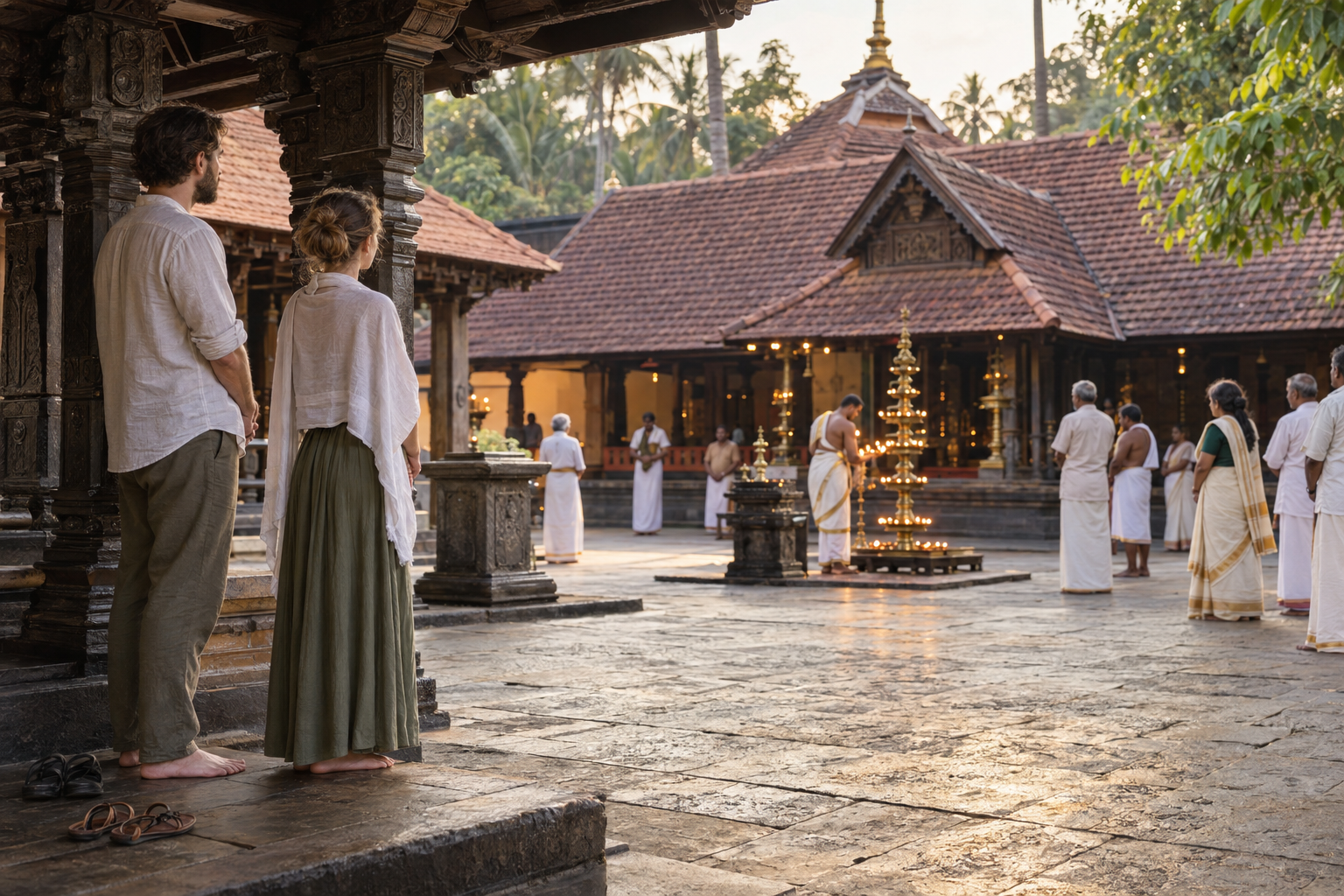
Temple customs are local. The safest approach is to follow instructions given at that temple rather than assuming that conduct accepted elsewhere will be accepted here.
- Pause and make space. Do not crowd the participant or block the path of priests, attendants, relatives, or other devotees.
- Put the phone away unless permission is explicit. General permission to photograph a temple does not necessarily include permission to record a person during an intense devotional experience.
- Do not touch or interrupt the participant on your own initiative. Follow the direction of temple functionaries or family members who understand the immediate setting.
- Do not imitate the movement. What you are witnessing belongs to a ritual context; it is not an invitation to join by copying visible actions.
- Ask questions after the moment has passed. A calm question to an appropriate local devotee or temple representative is more respectful and more informative than questioning the participant during the event.
- Respond to evident danger as danger. If someone falls, is injured, cannot breathe normally, or faces an immediate physical hazard, alert temple personnel or local emergency help. Sacred interpretation should not be used to ignore an urgent safety problem.
If you later describe what you saw, choose language that preserves both accuracy and dignity. Say that a devotee engaged in intense ritual movement within temple worship. Add a more specific spiritual interpretation only when the local context supports it. Avoid presenting speculation as an eyewitness fact.
Key takeaways
- Uranju Thullal is best approached as an ecstatic ritual movement situated within Kerala Hindu temple worship, not as an isolated performance.
- Spiritual, bodily, and psychological explanations address different aspects of the event; one vocabulary does not automatically cancel the others.
- Do not diagnose a participant, declare a supernatural cause, or infer deception merely from visible movement.
- Let local temple usage determine the most accurate name and interpretation for the particular event you witness.
- Give the participant space, avoid filming without clear permission, and follow temple personnel if a safety concern arises.
If you encounter Uranju Thullal, your most useful next step is simple: lower the camera, watch without crowding, and ask a knowledgeable local person about the ritual after it concludes. Respectful attention will teach you more than either instant belief or instant dismissal.
References

Leave a Reply
You must be logged in to post a comment.