
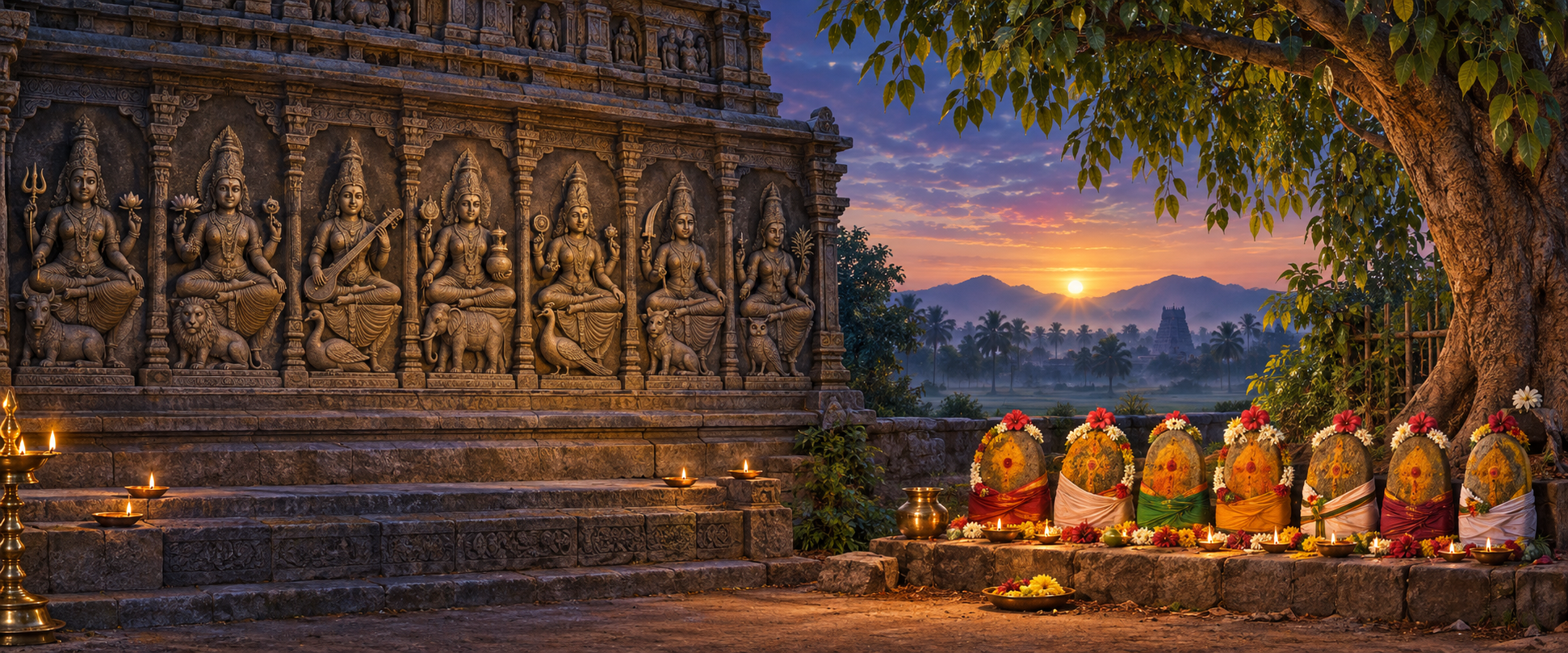
If you have encountered Sapta Kannigal at a South Indian shrine and then found almost the same goddesses described as Saptamatrikas, your question is a sensible one: are these two names for the same group? The safest answer is that they are closely related and may be identified with one another in a particular tradition, but they are not automatically interchangeable everywhere.
The difference matters because each name asks you to notice something different about Shakti. Matrika presents divine power as Mother; Kanya presents it as Maiden. Those are theological and ritual identities, not merely descriptions of a woman’s age or family status.
The two names emphasize different dimensions of Shakti
Sapta means seven. Matrika means mother, while kanya means maiden. The number is shared, but the second word changes the lens through which the goddesses are approached.
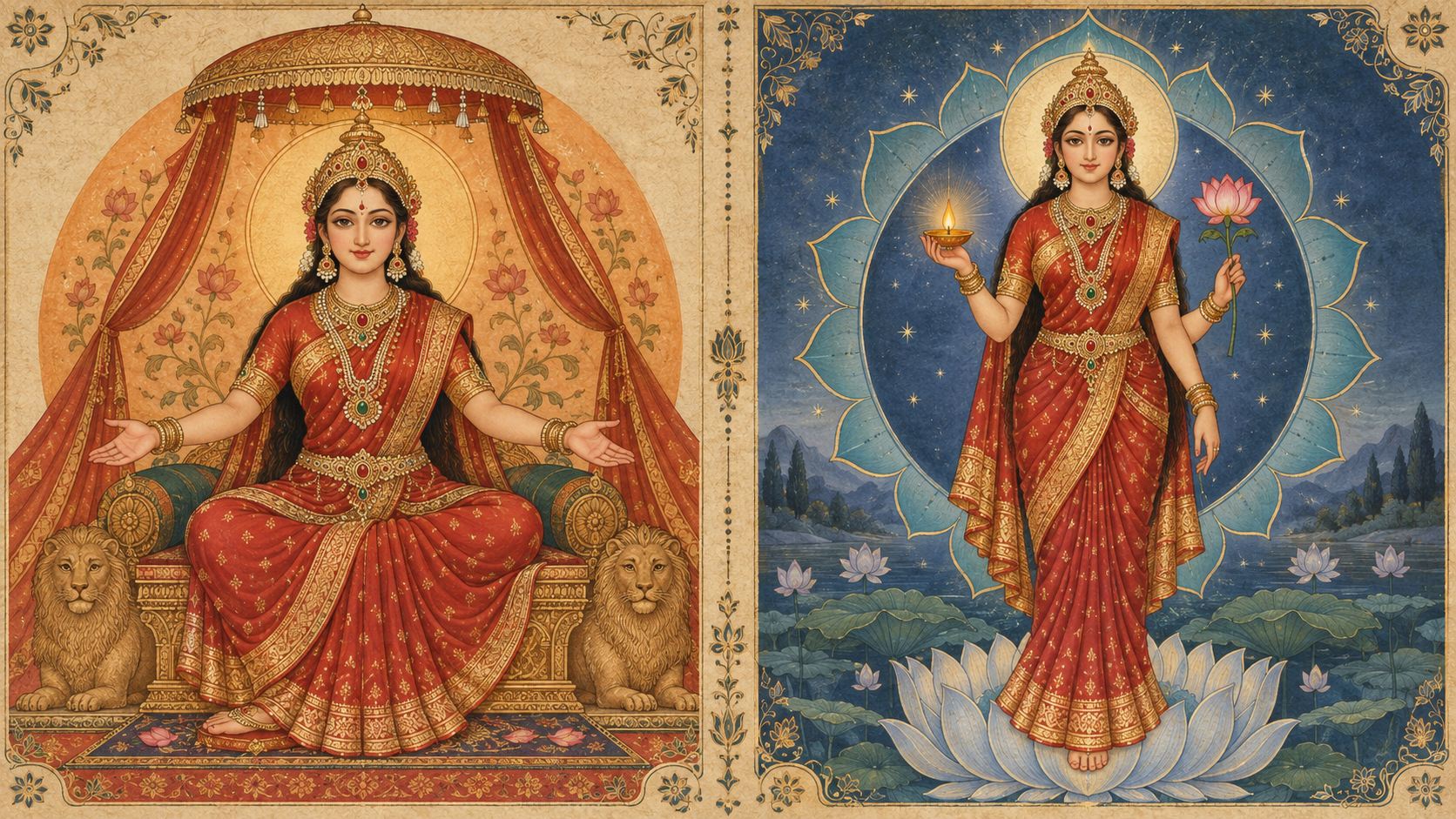
The Saptamatrikas are the Seven Mothers: a collective manifestation of divine powers associated with protection, cosmic order and the defeat of destructive forces. Calling them Mothers does not reduce them to domestic or gentle figures. Their motherhood can be fierce. It is the power that generates, sustains, guards and, when necessary, destroys what threatens life and dharma.
The Saptakanyas are the Seven Maidens. In Tamil usage, you may encounter names such as Sapta Kannigal, Saptha Kannigal or Sapta Kanni. Here maidenhood points most usefully to autonomy: Shakti is present in her own right, not defined only through motherhood or a marital relationship. This is why the two groups are best understood as related expressions of the Divine Mother rather than a universally identical roster.
| Question | Saptamatrikas | Saptakanyas |
|---|---|---|
| What does the name emphasize? | Motherhood as generative, protective and formidable power | Maidenhood as autonomous and self-possessed power |
| What usually anchors identification? | A recognizable collective of divine powers and their iconographic associations | The names, worship and inherited understanding of a regional or local tradition |
| Can the members overlap? | Yes | Yes |
| Are the labels universal synonyms? | No. A particular community may equate them, but that equivalence should not be imposed on every shrine or lineage. | |
A useful rule follows: identity may overlap while emphasis differs. A goddess can be approached as a Mother in one ritual setting and as a Maiden in another without becoming a different ultimate reality.
How the familiar Saptamatrika group is organized
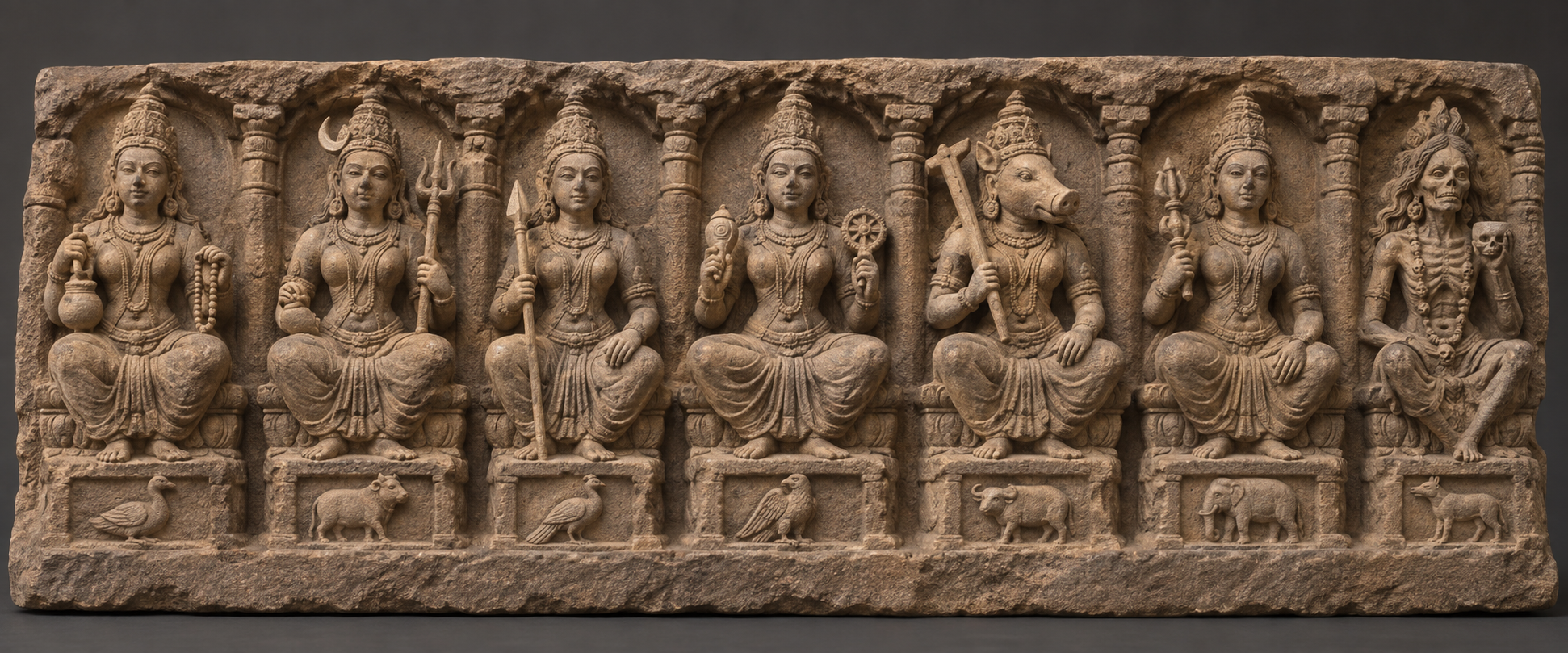
A widely encountered Saptamatrika enumeration consists of Brahmani, Maheshvari, Kaumari, Vaishnavi, Varahi, Aindri and Chamunda. Most of these names make their divine associations immediately visible:
- Brahmani expresses the power associated with Brahma.
- Maheshvari expresses the power associated with Maheshvara, Shiva.
- Kaumari expresses the power associated with Kumara or Skanda.
- Vaishnavi expresses the power associated with Vishnu.
- Varahi bears the identity associated with Varaha.
- Aindri, also called Indrani, expresses the power associated with Indra.
- Chamunda embodies a fierce form of Devi’s own power.
These associations should not be read as a list of ordinary wives or as evidence that the goddesses are secondary copies of male deities. The operative idea is shakti: effective divine power. The Matrikas make powers visible as goddesses who can act collectively.
That collective character is important. A Matrika image is not simply seven unrelated female deities placed side by side. The grouping itself communicates coordinated power. If you are reading a sculptural panel, therefore, look for relationships across the entire arrangement rather than treating each figure as an isolated icon.
You should also resist turning the familiar seven names into an inflexible checklist. Hindu traditions preserve variant enumerations, and additional forms can appear. Narasimhi, for example, may occur in an expanded or variant grouping. An eighth figure may indicate an Ashtamatrika arrangement, but the local identification still deserves priority over a conclusion based only on counting.
Why Saptakanyas cannot be reduced to one fixed list
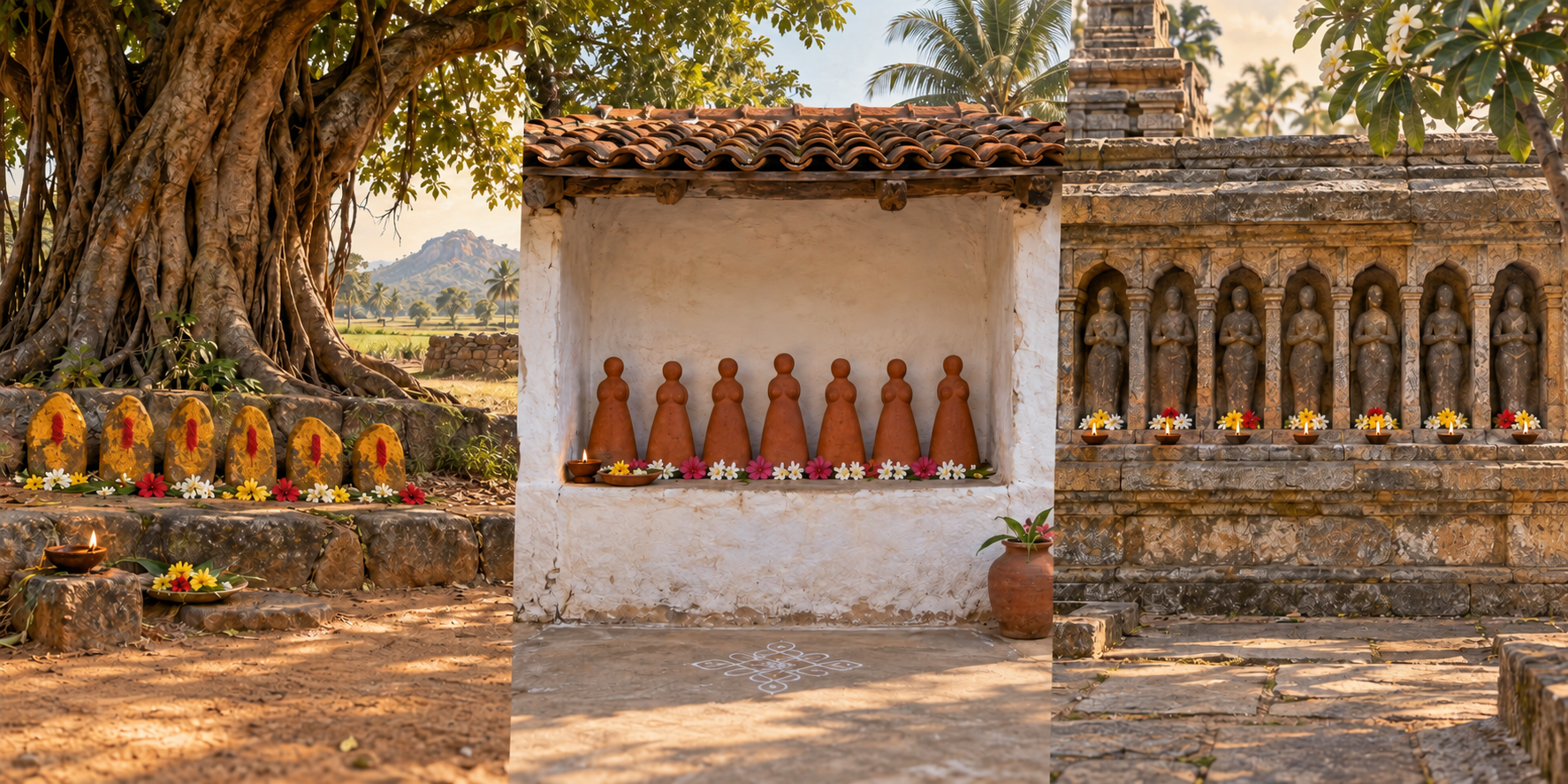
The word kanya is easy to mistranslate too narrowly. In this setting, it does not require you to imagine seven human children. Nor does it imply that the goddesses possess less authority because they are not being addressed as Mothers. Maidenhood marks power that is whole and active without depending on a domestic identity.
This emphasis helps explain why Saptakanya traditions can be strongly local. One shrine may identify its seven Maidens with the familiar Matrikas. Another may preserve regional names, guardian forms or a history known through the community’s ritual practice. Both usages can be authentic within their own settings.
The mistake is to assume that one printed list settles every local case. A Sanskrit collective name, a Tamil name such as Sapta Kannigal, and the names used orally by devotees may belong to overlapping layers of the same tradition. They need not provide a simple one-to-one translation.
This does not mean that identification is arbitrary. It means that the evidence is local. The shrine’s own names, liturgy, festival customs, oral memory and iconography carry more weight than resemblance to a generalized list. If the community calls the deities Kannimars or Sapta Kannigal, record that designation before trying to fit every member into the Saptamatrika scheme.
How to identify the group at a shrine or in an image
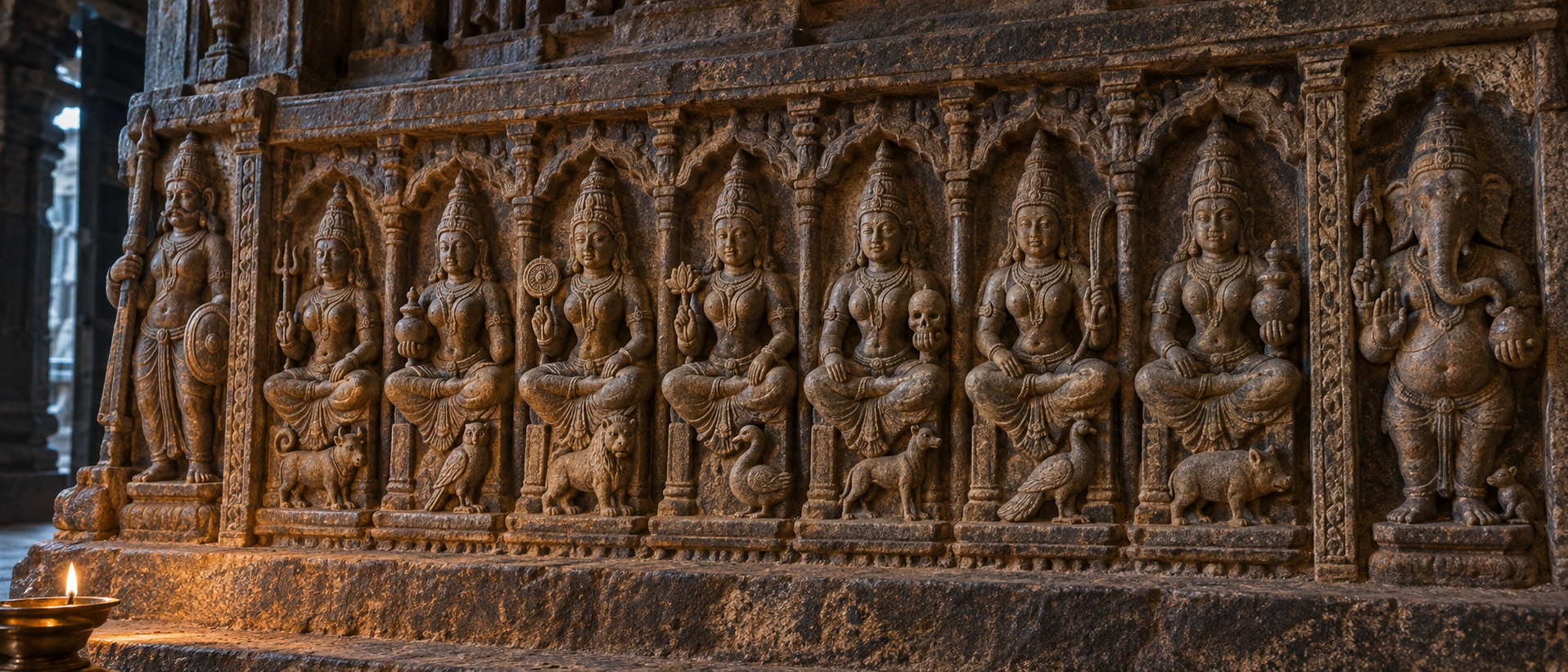
If you are visiting a temple, documenting an image or writing a caption, use the following sequence. It prevents the two most common errors: treating every group of seven goddesses as Saptamatrikas, and treating every Saptakanya tradition as unrelated to them.
- Record the collective name exactly. Note whether the shrine uses Saptamatrika, Sapta Kannigal, Sapta Kanni, Kannimars or another local expression. Do not silently replace the local name with a Sanskrit label.
- Ask whether the seven have individual names. A locally supplied roster is stronger evidence than a visual guess. Preserve variant pronunciation and transliteration when they matter to the community.
- Examine attributes across the whole group. Emblems, mounts, headgear and posture may support an identification with Brahmani, Maheshvari, Kaumari, Vaishnavi, Varahi, Aindri and Chamunda. One ambiguous figure should not determine the identity of the complete panel.
- Notice whether the forms are iconic or aniconic. When the deities are represented by simple stones or other non-figural forms, there may be no visual attribute from which to infer a classical name. Oral and ritual evidence then becomes especially important.
- Observe how the group is worshipped. The invocations, offerings, festival role and place of the shrine within the community may reveal more than the number of figures. Function is not a substitute for a name, but it helps you understand what the name means locally.
- State uncertainty honestly. If the identification is incomplete, write “locally worshipped as Sapta Kannigal” rather than assigning seven individual names without evidence. Precision includes knowing when not to standardize.
For a field note, museum label or personal record, four lines are often enough: the local collective name, the individual names if known, the basis of identification, and the degree of certainty. That small discipline preserves information that would otherwise disappear beneath a convenient but possibly inaccurate label.
Key takeaways
- Saptamatrikas means Seven Mothers; Saptakanyas means Seven Maidens.
- The first title emphasizes Shakti as maternal, protective and formidable power. The second emphasizes Shakti as autonomous maiden power.
- The two groups can overlap completely in a particular tradition, but their names are not universal synonyms.
- A common Saptamatrika list is Brahmani, Maheshvari, Kaumari, Vaishnavi, Varahi, Aindri and Chamunda, though variations exist.
- Saptakanya identities can depend heavily on regional and shrine-specific tradition, especially under names such as Sapta Kannigal or Sapta Kanni.
- When identifying a group, begin with the local name and ritual context; use iconography to support that evidence, not erase it.
The deeper point is not that one group is active while the other is passive. Both are forms of active Shakti. The distinction lies in relationship: the Mothers reveal divine power through generation and protection, while the Maidens reveal that the same power remains complete and sovereign in itself.
When you next encounter seven goddesses, write down the name actually used at the shrine before reaching for a standard list. That one step will help you recognize a broad Dharmic pattern without flattening the living tradition in front of you.
References

Leave a Reply
You must be logged in to post a comment.