
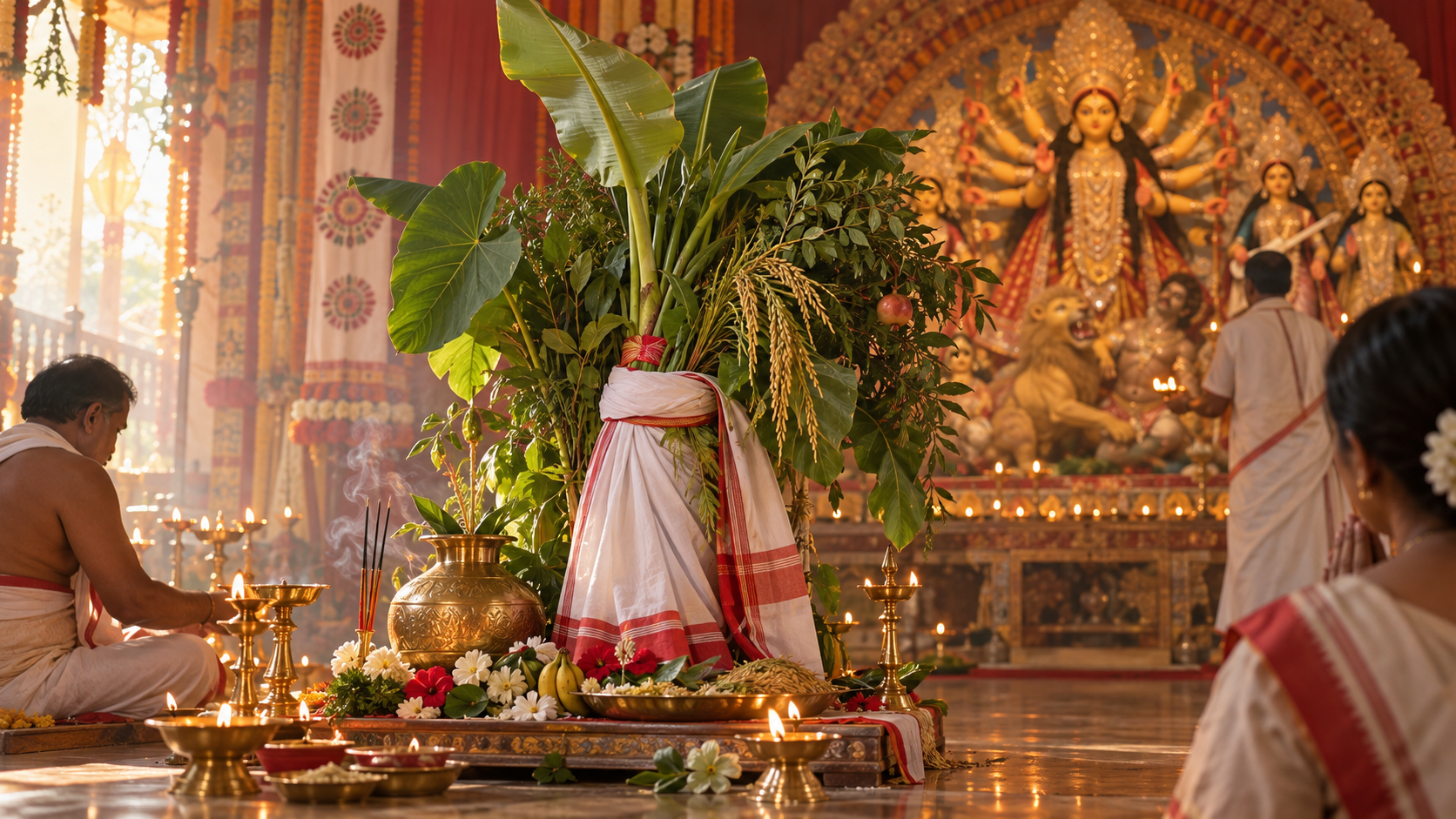
You are at a Durga Puja mandap on Maha Saptami when a bound cluster of leaves and plants enters the worship. If nobody explains what you are seeing, the Nabapatrika can look like a botanical accessory beside the more recognisable image of Durga. It is nothing of the kind.
The ritual makes a central Dharmic insight visible: the Divine Mother is one, yet her power appears through many forms and throughout the living world. Once you see that structure, the Nabapatrika stops being an obscure custom and becomes one of Durga Puja’s clearest lessons about Shakti, nature and unity.
Nine manifestations disclose one Divine Mother
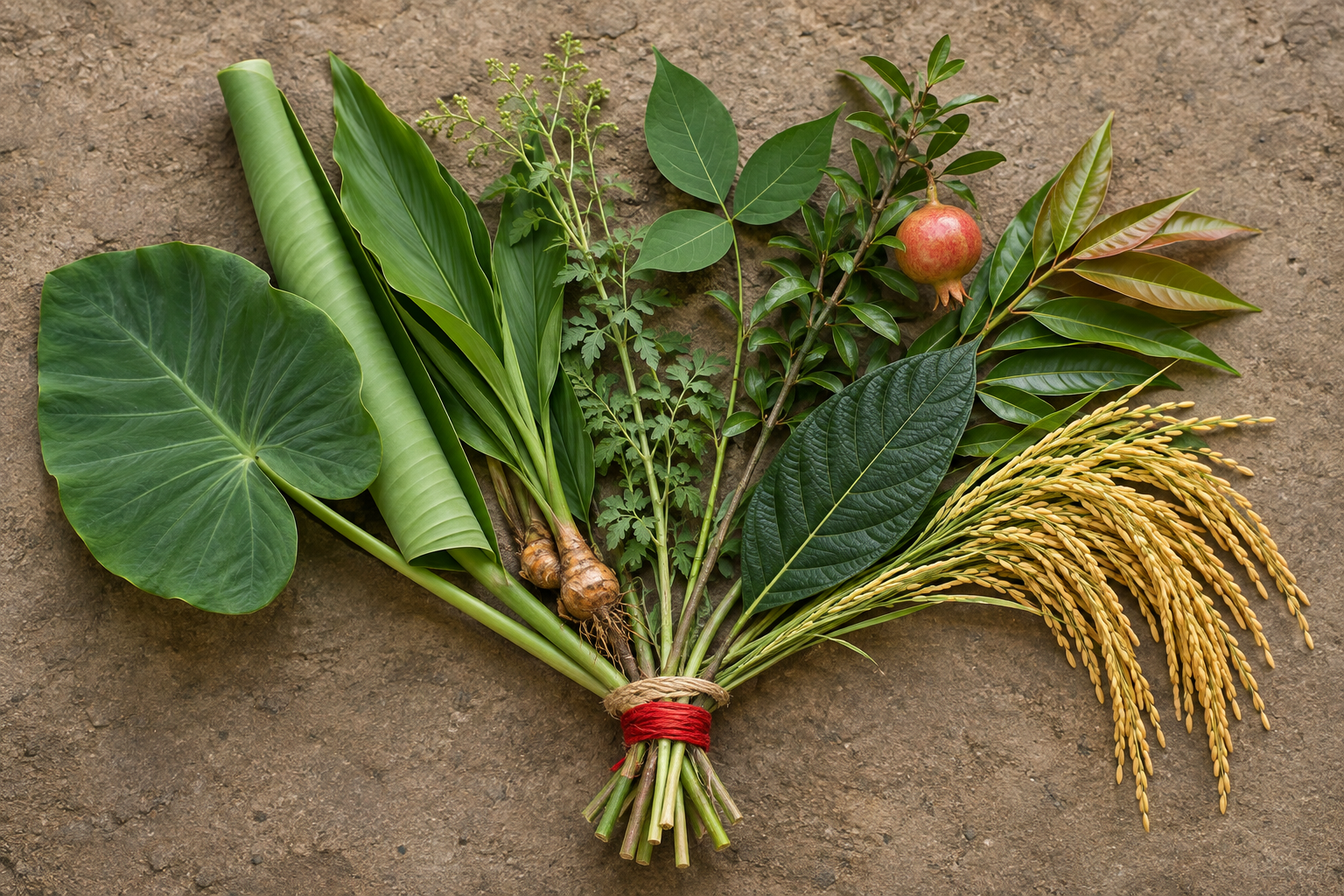
On Maha Saptami, the seventh day of Navratri, nine plant elements are gathered as the Nabapatrika and associated with divine manifestations. The ritual therefore works at two levels at once. Each plant has a distinct identity and association, while the complete bundle manifests the encompassing energy of Durga.
This distinction matters. The Nabapatrika is not asking you to imagine nine unrelated powers competing for attention. Nor is it reducing Durga to a collection of botanical parts. It presents plurality without division: several recognisable forms remain distinct while belonging to a single sacred whole.
That is a familiar grammar within Hindu worship. Divine unity does not require every form to look the same, bear the same name or perform the same function. Difference can disclose the richness of the one reality rather than contradict it. The physical form of the Nabapatrika teaches this without requiring a philosophical lecture: you can see the separate plants, and you can see that they have been brought together.
When you encounter a list pairing each plant with a particular divine form, use it as an entrance into this larger meaning. Memorising the correspondences may help you recognise the ritual, but the symbolism is not exhausted by a nine-item chart. The more important question is what their union reveals: Durga’s power is manifold in expression and undivided at its source.
Why the symbolism must be embodied in plants
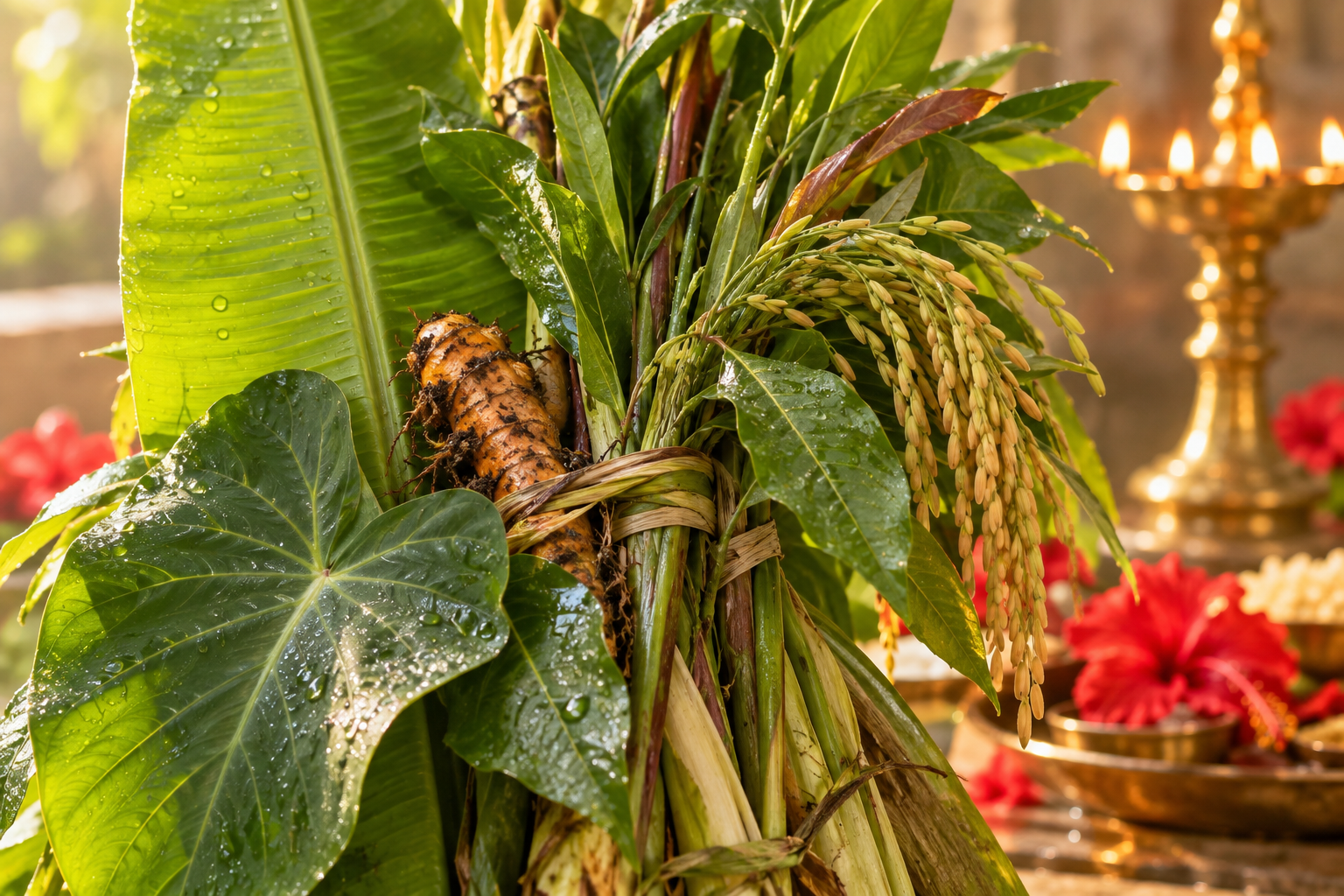
A ritual using living plants communicates something that an abstract statement cannot. Plants are rooted in soil, nourished by water, opened by light and shaped by season. Human life depends on this living order. By bringing plant forms into worship, the Nabapatrika places that dependence inside the devotee’s encounter with the Goddess.
The plants should therefore not be dismissed as disposable props. Within the rite, nature is capable of bearing sacred meaning because the Divine Mother’s presence is not confined to an image, a temple wall or an idea in the mind. Her energy pervades creation. The boundary between theology and the natural world is deliberately crossed.
Calling this sacred ecology can be helpful, provided we do not turn the ritual into a modern slogan. The Nabapatrika does not hand us a complete environmental policy. It does, however, challenge the habit of viewing nature only as inert material available for consumption. A world through which Shakti manifests cannot be treated as spiritually empty.
You can act on that meaning in a simple way. During the puja, do not look past the plants while waiting for a more dramatic ritual moment. Notice their living textures and their individual forms. After worship, treat consecrated plant material with care and follow the temple, household or puja committee’s established practice for handling it. Reverence is shown not only in the mantra but also in how sacred material is approached before and after the ceremony.
How to observe the Maha Saptami rite attentively
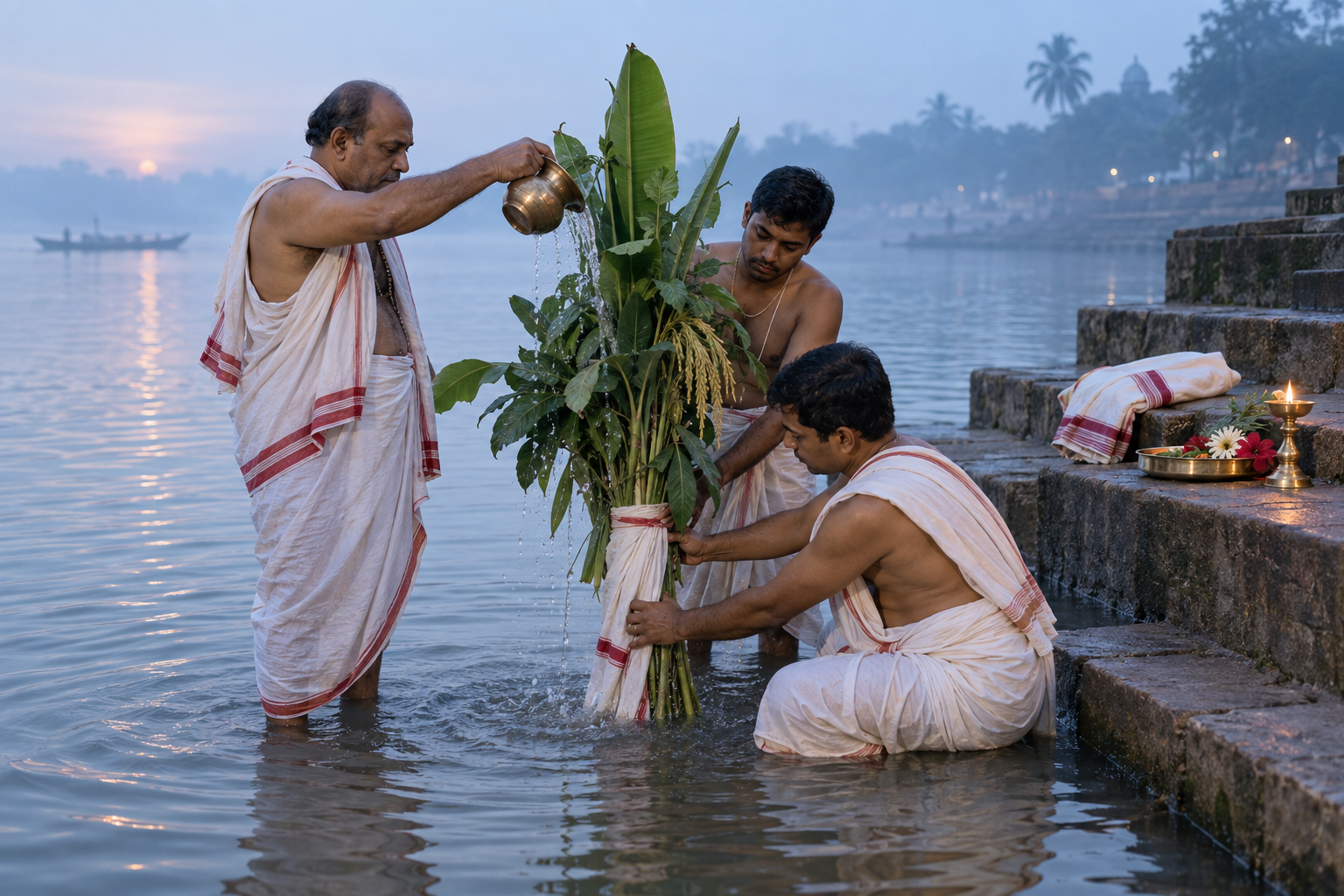
The Maha Saptami timing tells you that the Nabapatrika belongs to the unfolding worship of Durga. It is not seasonal greenery added to make a mandap look complete. If you are visiting a community puja, ask when its Nabapatrika observance will take place rather than assuming that seeing the finished arrangement is the same as seeing the rite.
Use this three-step method to follow what is happening:
- Begin with distinctness. Identify that the Nabapatrika contains nine plant elements rather than one anonymous mass of foliage. You do not need to know every name before you can recognise that each member retains its identity.
- Notice their union. The plants are encountered as a bundle. That visible relationship is part of the teaching: many manifestations are held together within the worship of Durga.
- Ask tradition-specific questions. Ask a priest, elder or knowledgeable organiser which names are used for the plants in that puja, which divine manifestation is associated with each one and what ritual actions mark the Nabapatrika as sacred. Those questions invite explanation without pretending that a label copied from elsewhere has given you the whole practice.
This method also keeps you from making two opposite mistakes. The first is treating the ceremony as meaningless folklore because its symbolism is unfamiliar. The second is collecting correspondences without watching what the ritual actually does. Attentive participation requires both knowledge and observation.
If different teachers use different vocabulary, record the terms before trying to reconcile them. Ask whether the difference concerns a plant name, a divine association or the explanation of the complete bundle. A precise question usually produces a more useful answer than asking which version is correct in the abstract.
How to explain Nabapatrika without flattening it
You may need to explain the ritual to a child, a visitor or someone who assumes that Hindus are merely worshipping vegetation. Avoid responding by saying that the plants are only symbols. That defence removes the very insight the ritual is expressing. A Dharmic symbol is not necessarily an arbitrary sign pointing to something absent; it can be a material form through which sacred presence is invoked, honoured and contemplated.
A clear explanation has three layers:
- The visible layer: the Nabapatrika is a sacred gathering of nine plant elements used in Durga Puja on Maha Saptami.
- The theological layer: the plants are associated with divine manifestations, while the complete form expresses the pervasive energy of Durga.
- The contemplative layer: the rite trains the devotee to recognise unity amid difference and sacred presence within nature.
If you need a short explanation, use this: On Maha Saptami, nine plant forms are gathered into the Nabapatrika. Their distinct divine associations and their union express the many manifestations of one Divine Mother, whose energy pervades creation.
That answer is more accurate than calling the bundle a good-luck charm, decorative foliage or a puzzle whose only purpose is to match nine names with nine leaves. It preserves the plants’ real place in the worship while keeping Durga at the centre.
The same care should guide photography and commentary at a public puja. First learn where the Nabapatrika stands in the ritual sequence. Do not move, separate or handle its components merely to obtain a clearer picture. If you publish an explanation, distinguish what you directly observed from what a practitioner explained. The object before you is part of worship, not an exhibit detached from its sacred setting.
Key takeaways
- Nabapatrika is worshipped on Maha Saptami and consists of nine plant elements associated with divine manifestations.
- The number nine expresses plurality, while the bound sacred form directs attention back to the unity of Durga’s Shakti.
- The use of plants embodies the teaching that the Divine Mother’s energy pervades nature; the plants are not incidental decorations.
- A list of plant-deity correspondences is useful, but it should lead you into the ritual’s larger meaning rather than replace it.
- For exact names and associations, ask how the temple, household or puja community conducting the rite understands them.
- The most faithful way to observe the ceremony is to notice distinctness, union and sacred treatment together.
At your next Durga Puja, give the Nabapatrika two unhurried minutes. Look first at the individual plant forms, then at the whole they create. Carry one question to a knowledgeable practitioner and one insight home: honouring the Divine Mother also changes how you learn to see the living world.
References

Leave a Reply
You must be logged in to post a comment.