
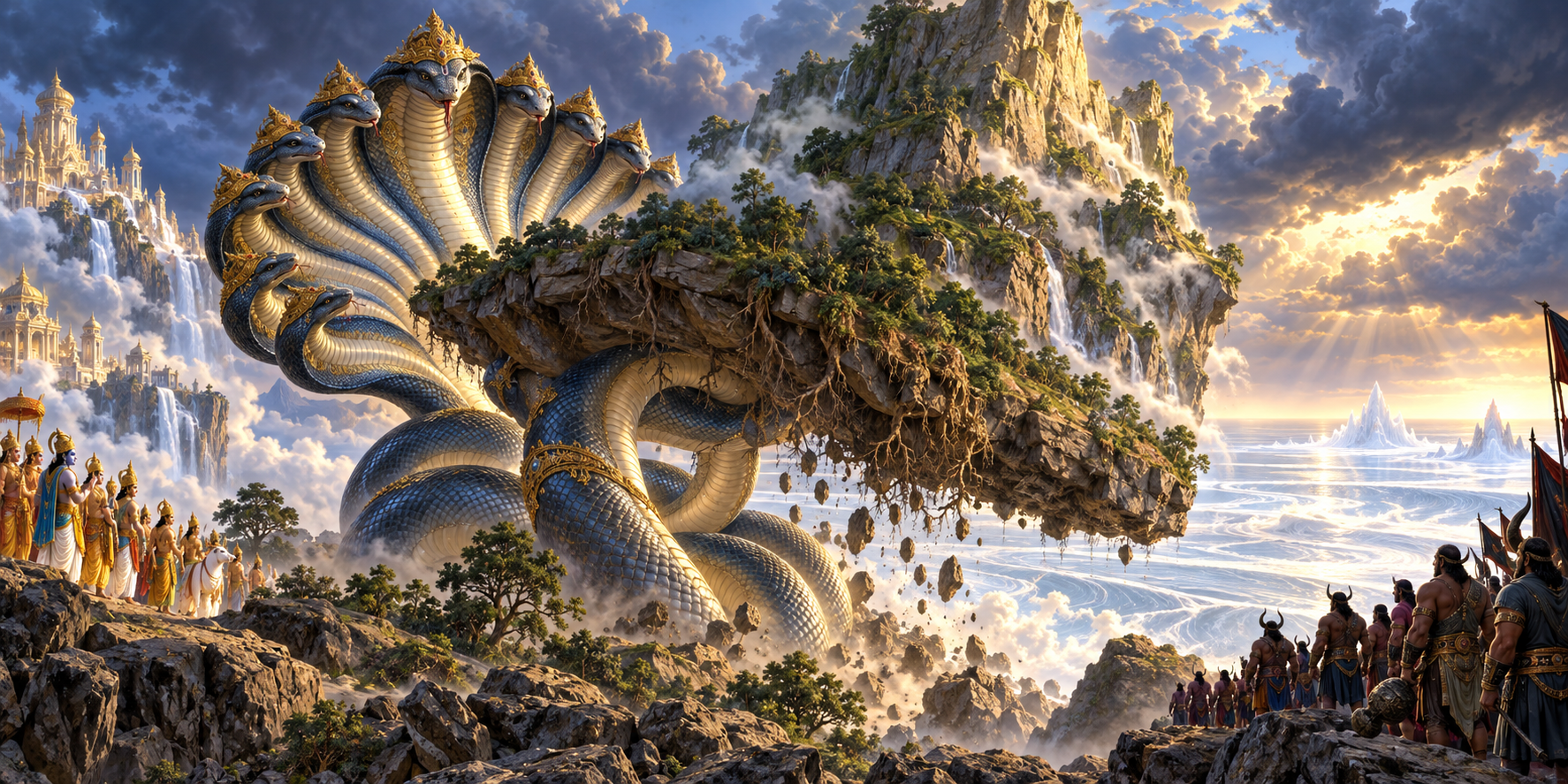
If you have seen Ananta Shesha raising Mount Mandara and wondered why the great serpent appears before the ocean is churned, focus on the practical problem in the scene. The chosen churning rod is a mountain. Before it can serve its purpose, someone must uproot and lift it.
That brief action gives you more than a missing plot detail. It shows how a Dharmic narrative can distinguish a worthy aim, a suitable instrument, and the supporting power that makes action possible. Keeping those roles separate is the key to understanding the episode.
The lifting of Mandara is the first necessary act

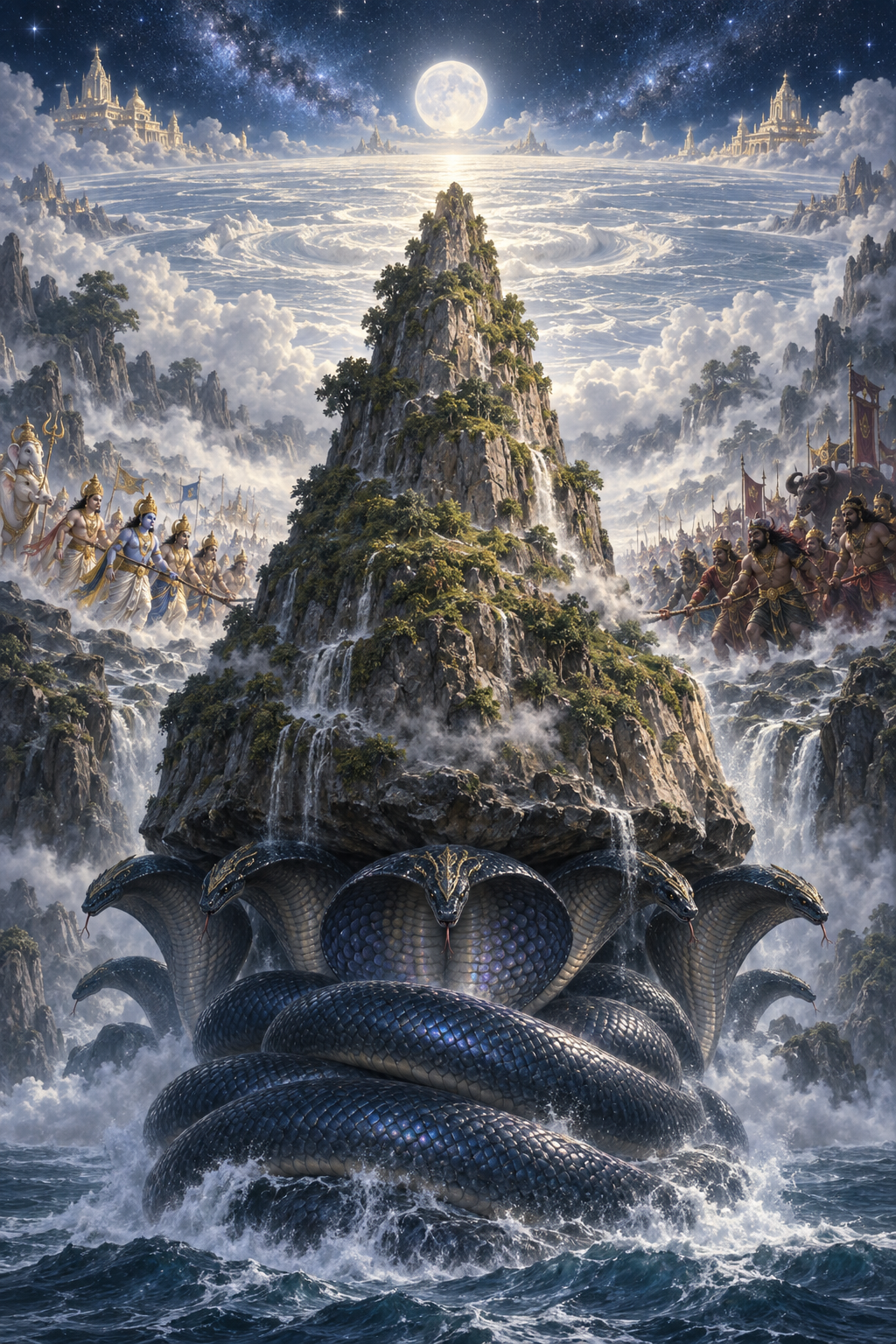
In the Astika Parva, which forms part of the Adi Parva of the Mahabharata, the Devas need a strong and stable rod for Samudra Manthan, the churning of the ocean of milk. They choose Mount Mandara. Ananta Shesha then uproots and lifts the mountain for the great undertaking.
The roles are precise. Mount Mandara is the instrument selected for churning. Ananta Shesha is the power that makes the chosen instrument available. The Devas identify what the work requires, but recognition alone does not put the mountain into service.
This distinction corrects a common misreading. Ananta Shesha is not the churning rod in this moment; Mandara is. Nor is the lifting itself the final achievement. It is preparatory work without which the larger action cannot begin. If you look only at the celebrated churning, you miss the enabling act on which it depends.
The sequence therefore matters: a need is recognised, a fitting instrument is chosen, and the obstacle to using it is overcome. Read in that order, the episode becomes much clearer.
Three levels of meaning can be held together
You do not have to choose between treating this as sacred narrative and drawing insight from it. A disciplined reading can preserve the event as narrated while also noticing its structure and applying that structure to your own conduct.
The narrative level: an immense task needs an adequate instrument
The Devas do not approach an extraordinary undertaking with an ordinary implement. They seek something strong and stable, and Mandara is selected for that function. The immediate lesson is concrete: the scale of your instrument must match the scale of your task.
When you face difficult work, ask whether the apparent lack of progress is really a failure of effort. Sometimes the chosen means is too weak, too unstable, or simply unavailable. More exertion cannot repair a mismatch between the task and the instrument.
The structural level: selection is not the same as readiness
Choosing Mandara does not complete the preparation. The mountain still has to be uprooted and lifted. This is the easily overlooked middle stage between knowing what is needed and being able to use it.
You can apply that distinction immediately. A community may know which scripture it wants to teach but still need a competent teacher, an accurate edition, a suitable language, and a dependable meeting time. A family may value daily prayer but still need to create a place and schedule that protect it. A decision becomes operational only when the required conditions exist.
The contemplative level: enabling strength may stand behind visible action
Ananta Shesha’s contribution invites you to notice the strength that comes before the spectacle. The churning is the visible undertaking; lifting Mandara makes it possible. This does not establish one compulsory allegorical meaning for the image. It offers a sound question for contemplation: what indispensable support are you treating as mere background?
That question can change how you recognise service. The person who secures a place, transports what is needed, preserves continuity, or quietly removes an obstacle may not perform the most visible part of the work. Yet the visible work may depend upon that contribution. The episode trains your attention toward enabling duty, not only public achievement.
Do not flatten the episode into a single symbol
Sacred images often tempt readers into instant equations: the mountain must mean one thing, the ocean another, and the serpent a third. Such a scheme may sound neat while ignoring what the figures actually do. Begin with action before assigning symbolism.
- Do not confuse the mover with the instrument. Ananta Shesha lifts; Mount Mandara serves as the rod. Their functions are related but not interchangeable.
- Do not detach the lift from the churning. Uprooting Mandara is meaningful because it prepares the mountain for a defined purpose.
- Do not treat preparation as a lesser form of action. The larger undertaking cannot start until the preparatory obstacle is removed.
- Do not present a personal reflection as the only textual meaning. A useful application should remain visibly grounded in the sequence of the narrative.
- Do not turn every character into a rival claimant for importance. The episode presents distinct contributions to one undertaking; importance need not mean identical function.
This method protects both reverence and clarity. You neither reduce the account to a mechanical report nor make it say whatever suits the moment. The narrated action sets the boundaries within which reflection can remain responsible.
A five-step way to study the scene for yourself
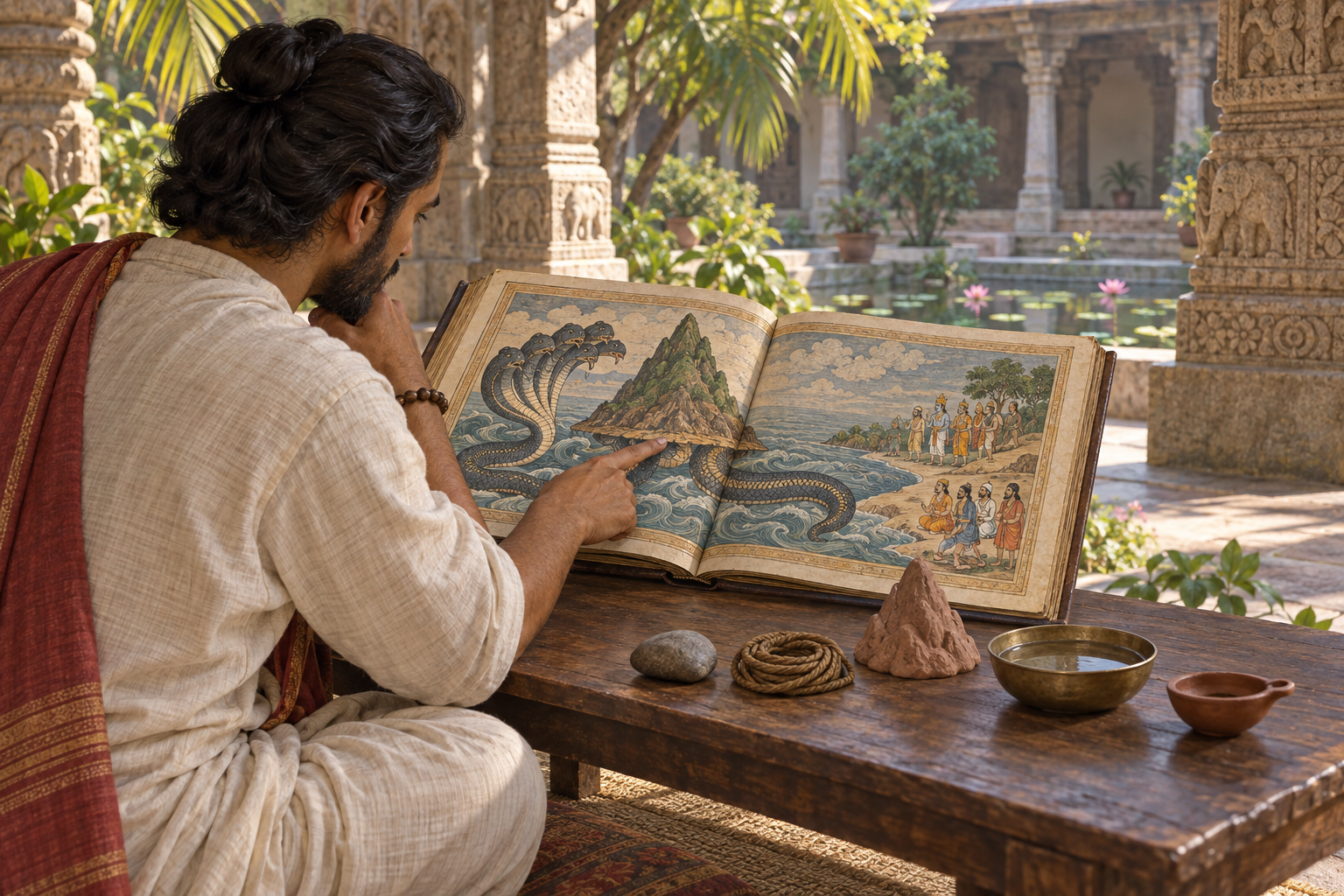
If you are preparing a discussion, teaching a younger reader, or studying the episode during your own svadhyaya, use the following sequence. It keeps observation separate from interpretation while still allowing the narrative to shape conduct.
- Locate the episode. Begin with the Mahabharata, specifically the Astika Parva within the Adi Parva. This prevents details from different retellings or remembered images from being treated as though they all occur in the same passage.
- Name the task. The immediate undertaking is Samudra Manthan, the churning of the ocean of milk.
- Name the required instrument. The Devas need a strong and stable churning rod and choose Mount Mandara.
- Name the obstacle and intervention. A mountain cannot be used merely because it has been selected. Ananta Shesha uproots and lifts it, moving the undertaking from intention toward action.
- Form an application that preserves the sequence. Ask what you have chosen for an important task, what prevents you from using it, and what kind of enabling support must come first.
Make the final question specific. Do not settle for “I need more strength.” Ask instead: “What is my Mandara, why is it not yet usable, and what must be lifted or repositioned before the real work can begin?” The answer might be training, access, time, coordination, or a stable routine. Naming the actual obstacle turns contemplation into a decision.
The same method works in collective Dharmic activity. Before announcing a large programme, identify its indispensable instrument and the work required to put that instrument in place. If the project depends on a venue, teacher, text, permission, or transport, secure that condition before measuring enthusiasm. Intention is not yet readiness.
Key takeaways
- Mount Mandara, not Ananta Shesha, is selected as the strong and stable rod for Samudra Manthan.
- Ananta Shesha’s role is to uproot and lift the chosen mountain so that the greater undertaking can proceed.
- The order of events reveals three distinct elements: a worthy aim, an adequate instrument, and the enabling power that makes the instrument usable.
- A responsible symbolic reading begins with the narrated action rather than imposing a fixed code upon every figure.
- The practical question for you is not only “What must be done?” but also “What must be made ready before it can be done?”
The next time you encounter this image, pause before looking ahead to the churning. Notice the mountain in Ananta Shesha’s grasp. Then identify the essential thing in your own duty that has been chosen but not yet made usable, and take the preparatory action the larger work requires.
References

Leave a Reply
You must be logged in to post a comment.