
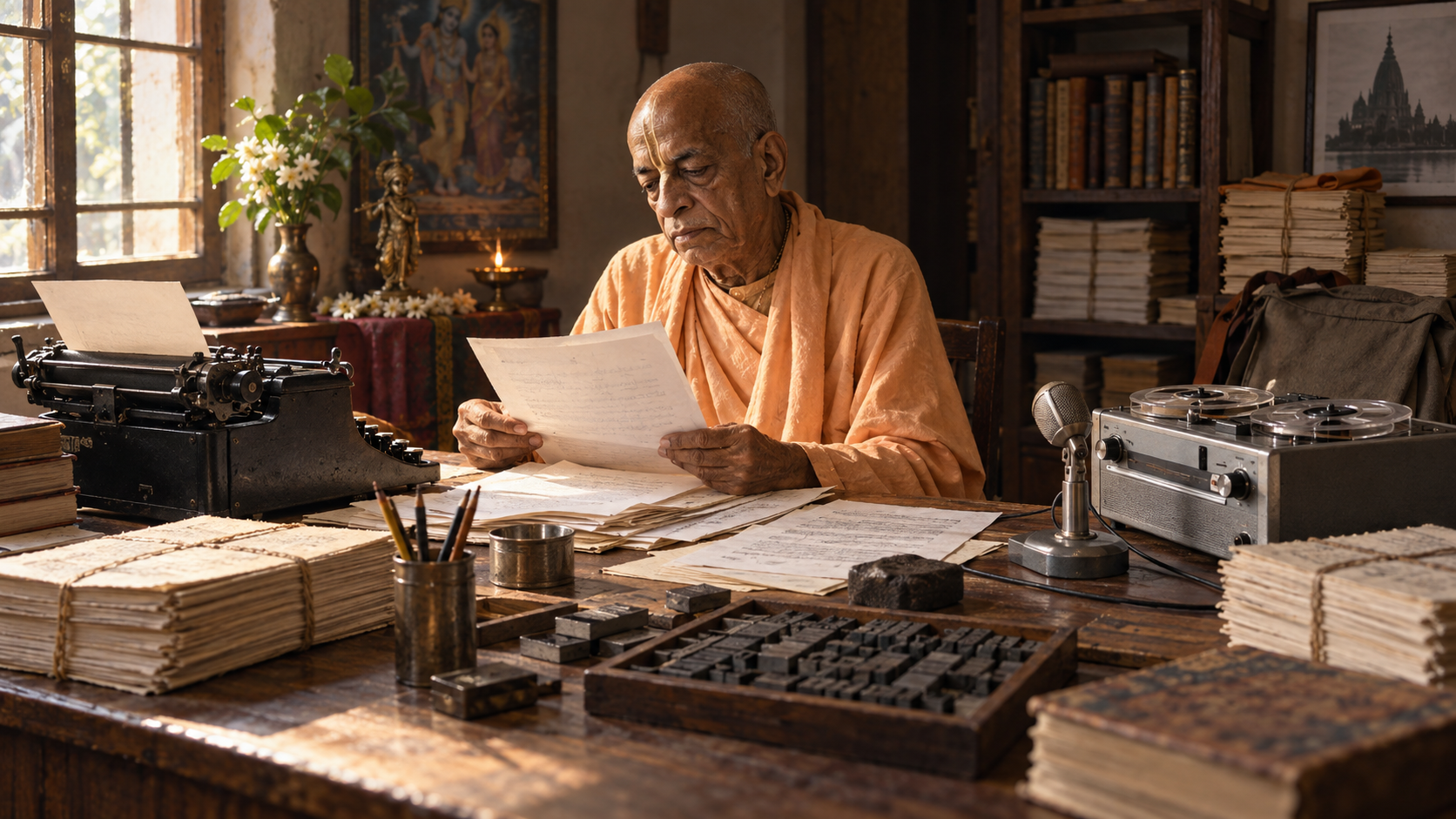
If you want to understand how Srila Prabhupada began publishing, don’t start with the finished books. Start with the chain of work behind a single printed page: composing, finding paper, reaching a printer, checking the typeset proof, marking corrections and carrying it back.
That chain explains more than a story of perseverance. It shows how a solitary writing practice became an organized form of devotional service without losing its purpose. It also gives you a practical model for preserving and publishing Dharmic teachings when money, equipment and trained help are limited.
In Delhi, writing was only the first stage
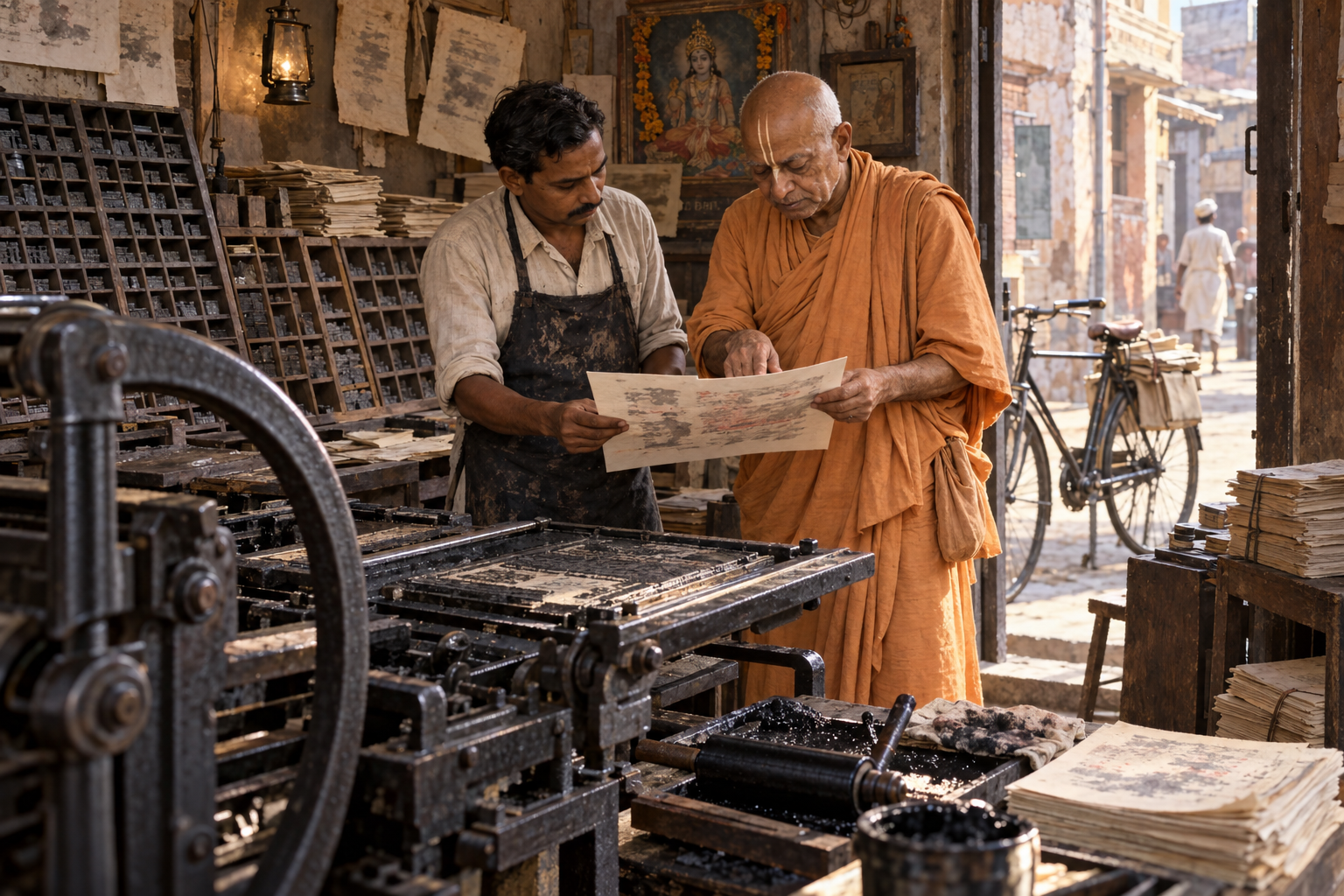
Prabhupada’s Delhi routine joined two very different settings. He could write in the quiet of his room at the Radha-Damodara temple, while an old manual typewriter in a rented Chippiwada workroom helped turn his work into manuscripts. The intellectual and spiritual labor required seclusion; publication required entering the crowded streets and dealing with the material demands of printing.
He did not merely hand a manuscript to a publisher and wait. With little money behind the undertaking, he had to seek help for paper and printing. He brought the paper himself and arranged for it to be carried by rickshaw to the printer. After the printer typeset the manuscript, he read the resulting pages, entered corrections by hand and returned them.
The working sequence was concrete:
- Compose and type the manuscript.
- Obtain the paper and secure the printing.
- Deliver the materials to the printer.
- Read the typeset pages rather than assuming production had preserved the text correctly.
- Mark corrections by hand and return the proof for another production step.
This is the first point to notice: Prabhupada treated every handoff as part of the publishing work. Translation and commentary were central, but the teaching did not reach a reader until paper, transport, typesetting and correction had all been handled. Material details were not beneath the mission; they were where the mission either advanced or stopped.
If you are responsible for a Dharmic publication, inspect your process in the same order. Don’t ask only whether the writing is complete. Ask who controls the working copy, who checks the typeset text, how corrections are recorded and who confirms that the printer received them. A preventable error usually enters at a handoff, not at the moment of inspiration.
In America, continuity mattered more than convenience
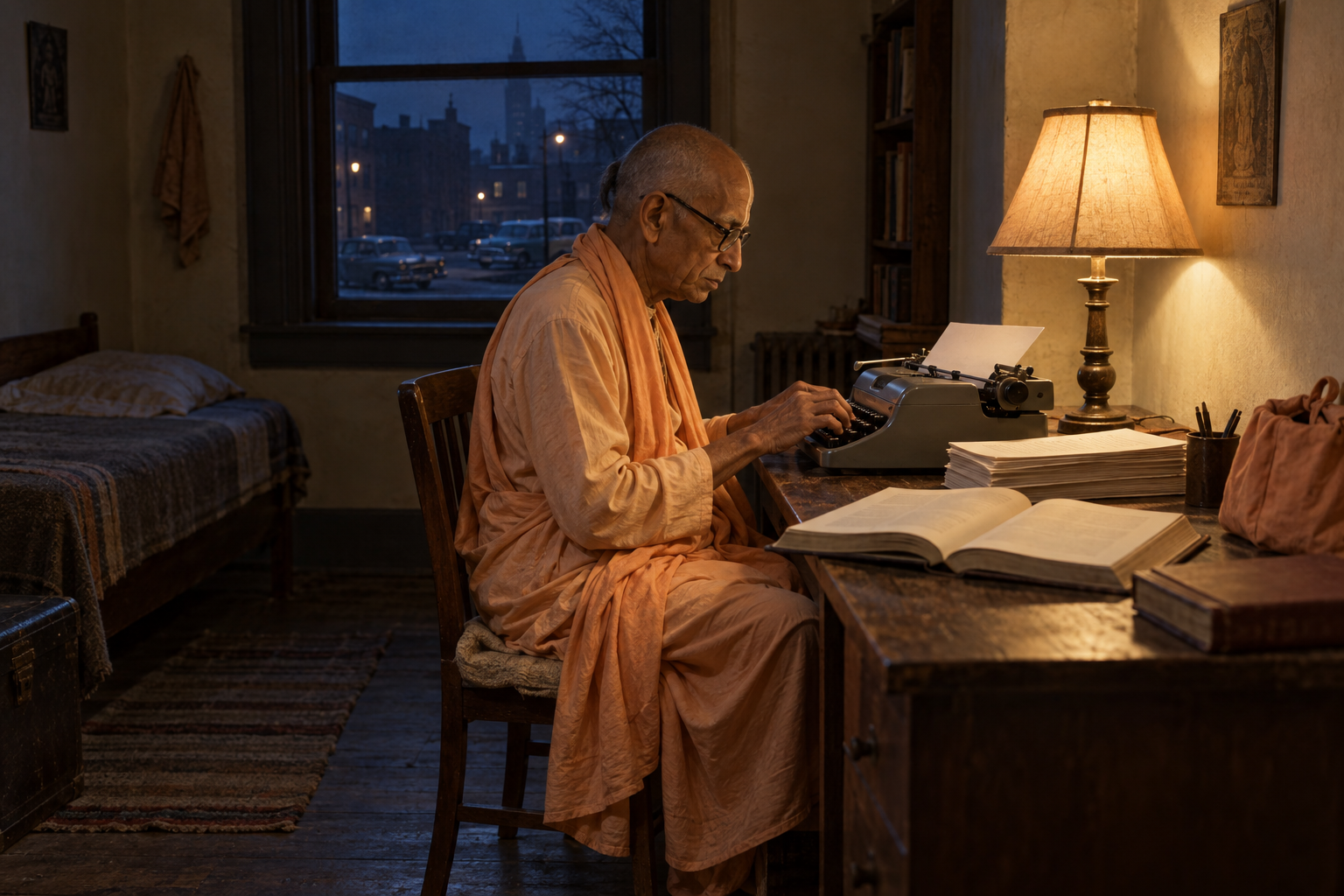
Prabhupada carried hundreds of completed manuscript pages with him to America and continued composing his translation and purports for the Second Canto of the Srimad-Bhagavatam. These pages represented work already brought through the difficult early stages in India. They also allowed the publishing mission to continue across a major change of country and circumstances.
The equipment was not secure. His typewriter was stolen from his room at Dr. Misra’s ashram. After moving to the Bowery, he received another typewriter and resumed the work. The loss interrupted the tool, but it did not redefine the task.
At 26 Second Avenue, a further change appeared: Hayagriva began editing pages Prabhupada had already typed. This was an important division of labor. Prabhupada remained responsible for the translations and purports, while another person could help prepare the existing manuscript. The publishing effort was beginning to move from one person’s complete physical workflow toward coordinated service.
There is a useful distinction here for anyone preserving a spiritual teacher’s work. Delegation does not require surrendering the originating voice. Separate the tasks that carry doctrinal meaning from the tasks that prepare, check and transmit that meaning. Then give each person a defined responsibility. Vague assistance produces uncertain texts; a clear editorial handoff protects both fidelity and momentum.
The Dictaphone turned composition into a service network
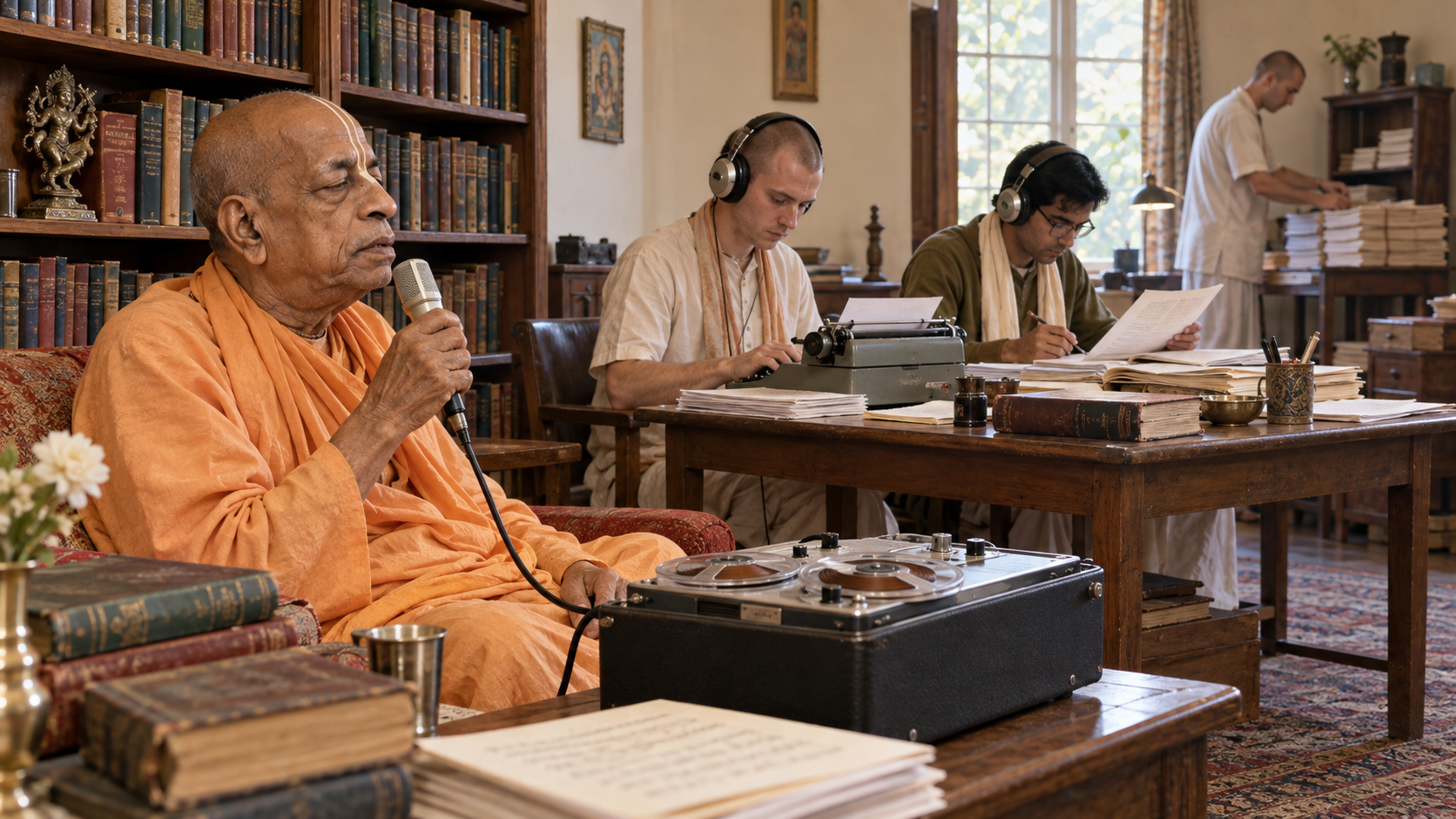
The decisive technical change came when Gargamuni bought Prabhupada his first Dictaphone. Prabhupada could speak into its microphone and produce recorded tapes instead of typing every manuscript page himself. He then stopped using the typewriter. The device changed the point at which his words became typed text, but it did not remove the need for typing, editing, duplication or careful tracking.
Satsvarupa Dasa Goswami became one of the first people to transcribe those recordings. He initially used his own manual typewriter at his apartment and also worked in Prabhupada’s apartment at 26 Second Avenue. When Prabhupada moved to San Francisco and Satsvarupa moved to Boston, the collaboration continued over distance, with Satsvarupa serving as the sole typist of the tapes during that period.
The method was simple but disciplined. While dictating The Teachings of Lord Caitanya, Prabhupada mailed tapes to Boston at a rate of about two each week. Satsvarupa typed the recordings, retained a carbon copy and mailed the original manuscript back. Their correspondence tracked which tapes each person possessed. That distributed workflow was used for the Third and Fourth Cantos of Srimad-Bhagavatam, The Teachings of Lord Caitanya and Krsna Book.
Three practical safeguards are visible in that routine. First, the transcriber kept a duplicate before the original entered the mail. Second, the participants communicated about custody of the tapes instead of relying on memory. Third, work arrived in a continuing stream rather than waiting for every recording to be finished. Those safeguards matter even more than the specific technologies used.
The arrangement also reveals something easily missed when publishing history is reduced to machines. Transcription was not merely clerical labor. Satsvarupa described hearing his spiritual master’s voice while typing before going to his welfare job, learning the philosophy through the work and finding emotional steadiness in the service. The Dictaphone therefore did more than increase Prabhupada’s ability to compose: it gave a disciple sustained contact with the teaching through attentive listening.
If you are digitizing lectures or preparing a guru’s spoken teachings today, don’t treat transcription as an invisible final step. Assign it to someone who understands the vocabulary and can flag doubtful words. Preserve the recording alongside the transcript, keep a second copy before transferring files and maintain a ledger showing what has been recorded, transcribed, checked and returned. Modern storage changes the medium, not the need for custody and verification.
What a Dharmic publishing project should copy – and what it should not
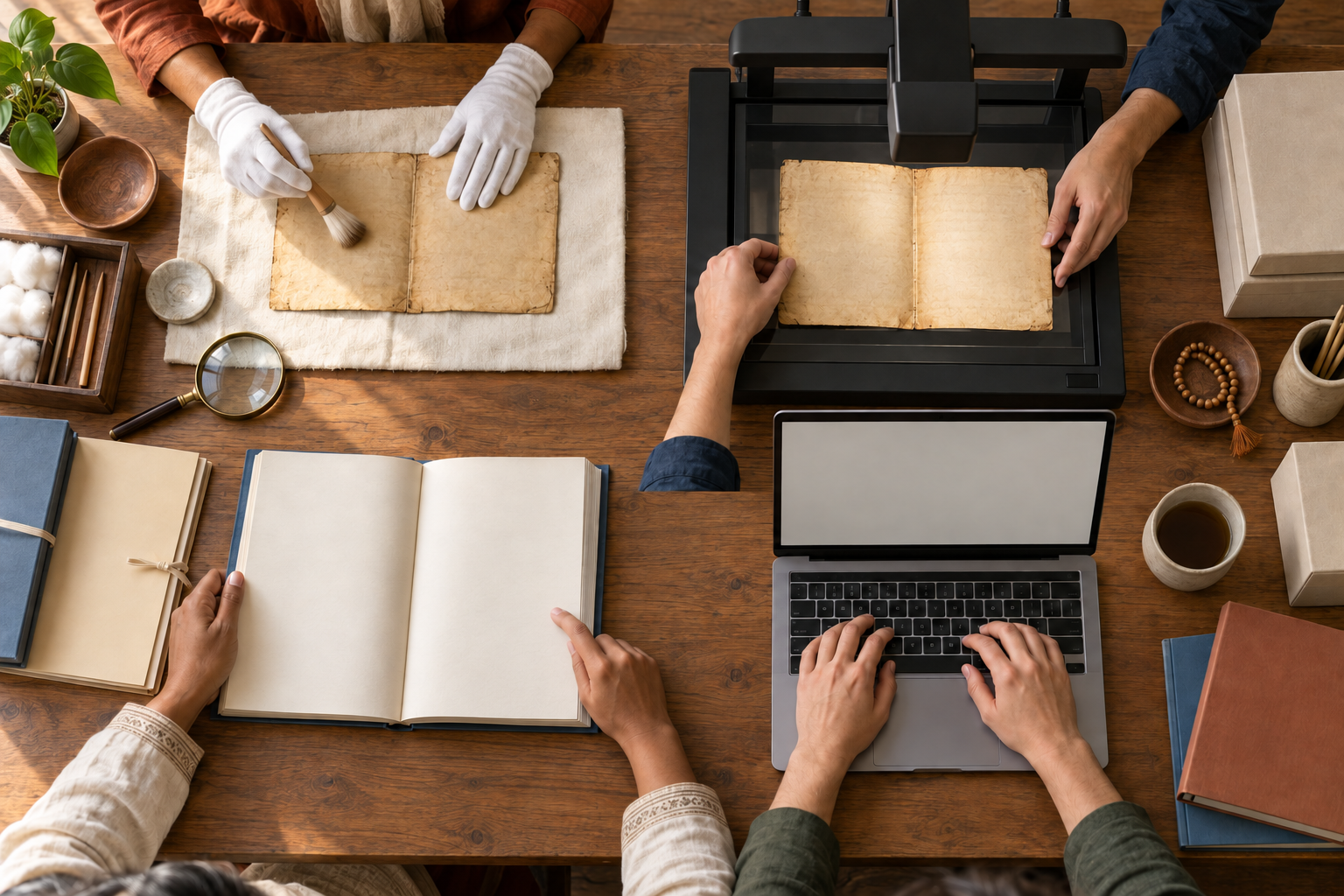
Prabhupada’s lack of resources should not be romanticized. Having to seek paper, carry materials through Delhi or depend upon a single distant typist was not an efficiency to imitate. The useful inheritance is the structure he maintained despite those constraints.
- Protect the non-delegable core. Decide whose judgment controls translation, commentary and doctrinal meaning. Editing should clarify that voice, not silently replace it.
- Write down every handoff. A manuscript is not simply “in progress.” It is with the composer, transcriber, editor, proofreader or printer. Record which one.
- Keep a duplicate before transfer. The carbon-copy practice addressed a real vulnerability. Apply the same principle to digital files with a separate, verified copy.
- Proof the produced version. A correct manuscript can acquire errors during typesetting. Check the actual pages intended for readers, not only the draft supplied to production.
- Choose technology by its bottleneck. The move from typewriter to Dictaphone shifted keyboard work to a transcriber and let Prabhupada compose by voice. Adopt a tool only after identifying which task it moves and who will inherit the displaced work.
- Train beyond one willing worker. A dedicated sole typist can carry a project through a difficult period, but concentration in one person also makes the workflow fragile. Document spelling conventions, file status and editorial decisions so another trained sevaka can assist when needed.
The deeper standard is accountability. Prabhupada did not treat a typed page, a mailed tape or a printer’s proof as somebody else’s problem. Each object was followed until it reached the next responsible person. For a sacred-text project, that attentiveness is part of fidelity to the teaching.
Key takeaways
- Prabhupada’s early publishing depended on a repeatable sequence of composition, production, proofing, correction and return.
- When a typewriter was lost, the work continued with a replacement; when dictation became practical, the workflow changed around it.
- Hayagriva’s editing and Satsvarupa’s transcription show how defined service roles allowed the publishing mission to expand without detaching the books from Prabhupada’s voice.
- Carbon copies and correspondence about tape custody provided simple protection against loss and confusion.
- For a Dharmic publisher now, the most transferable lesson is to treat every editorial and production handoff as a responsibility that must be named, checked and completed.
If you are starting a publication, archive or transcription project, draw its complete path on one page before accumulating more material. Name who composes, duplicates, transcribes, edits, proofs and approves. Then take one short work through the entire path. A mission becomes durable when its smallest recurring handoff is dependable.
References

Leave a Reply
You must be logged in to post a comment.