
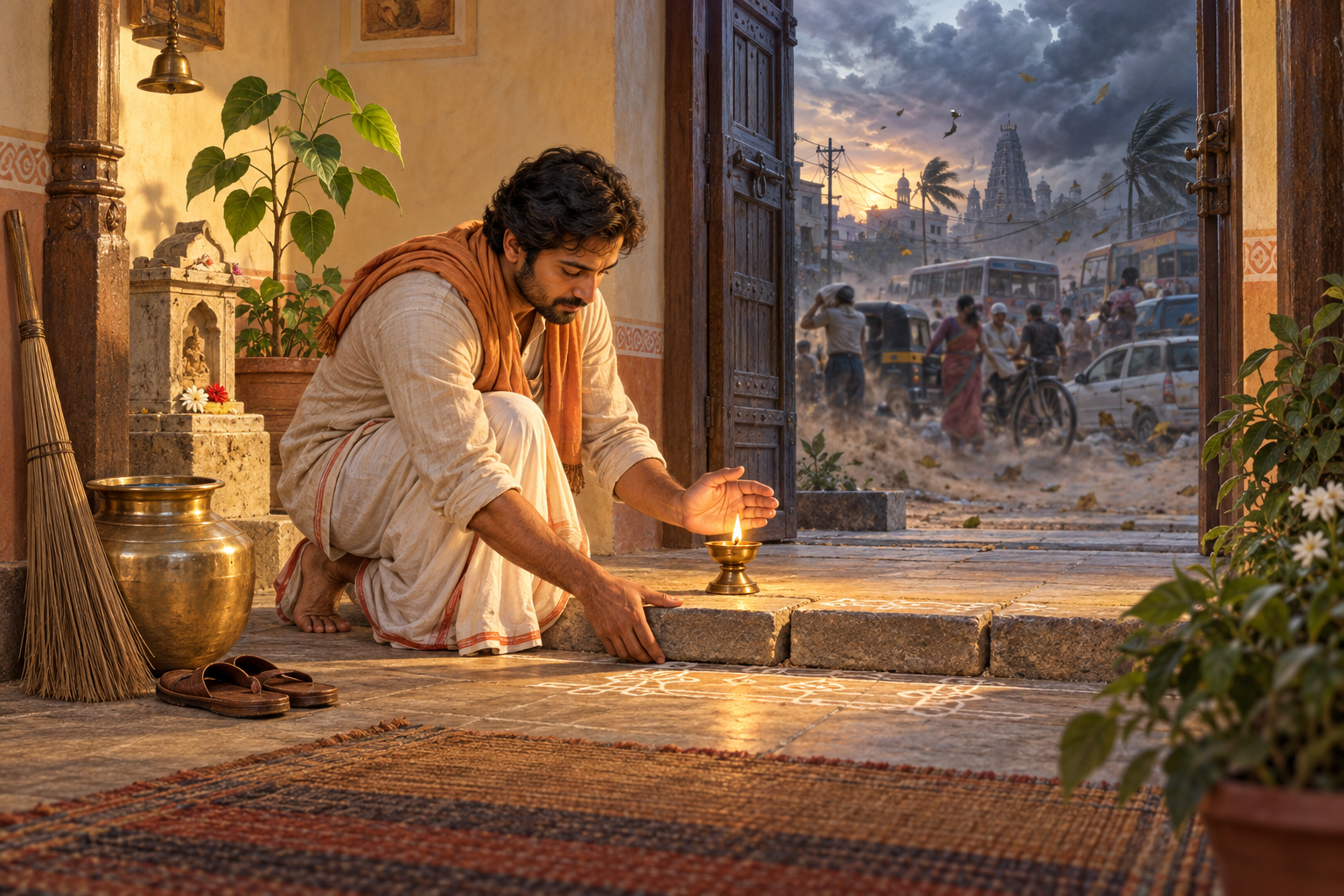
If you can see adharma everywhere but no longer know what to do before breakfast, Kali-yuga has already gained an advantage: your concern has become agitation instead of duty. You do not protect dharma by carrying the disorder of the entire age in your head. You protect it by refusing specific forms of disorder wherever your choices still have authority.
This gives you a workable aim. You are not expected to defeat a yuga. You are responsible for your conduct, your household, your obligations and the portion of community life entrusted to you. The useful question is how to keep the effects of Kali-yuga from governing those places.
Kali-yuga tests conduct, not your talent for predicting decline
First, clear away a common confusion. Kali in Kali-yuga is not Devi Kali. Kali-yuga names an age of moral and spiritual deterioration in Hindu cosmology; the Bhagavata tradition also personifies its corrupting influence. Confusing the two obscures both the dignity of the Goddess and the moral meaning of the yuga.
The crisis is made concrete in Srimad Bhagavatam 1.17.2, where a frightened bull is beaten and struggles to remain standing. In the wider episode, the bull represents Dharma. The image does not invite passive fascination with decay. It asks whether a person who encounters vulnerable life, injured order and abused authority can recognise what is happening and respond.
That scene supplies a practical test for dharma-raksha, the protection of dharma:
- Recognise the injury. Do not hide cruelty, deception or neglect behind slogans, status or religious appearance.
- Judge conduct, not costume. A sacred vocabulary cannot make dishonest behaviour dharmic, just as worldly clothing cannot make a sincere person adharmic.
- Use the authority you actually possess. Protecting a child, keeping a promise, correcting a false claim or maintaining a temple responsibly may be more urgent than arguing about a distant controversy.
Kali-yuga is therefore not an alibi. Saying that corruption is inevitable can become a spiritual way of avoiding responsibility. The age may explain why a struggle recurs; it does not decide how you must behave inside that struggle.
Locate the breach before choosing the battle

Civilisational concern easily becomes too large to act upon. You scroll through attacks on Hindu society, institutional failures and public mockery of sacred traditions. By the end, you are angry at everything and accountable for nothing. The cure is not indifference. It is a more exact diagnosis.
For the next week, examine four points at the end of each day. Write one line under each heading. Do not write an essay and do not evaluate anyone else.
- Speech: Did you repeat something you had not verified, exaggerate an opponent’s position, conceal a relevant fact or speak to humiliate?
- Attention: What repeatedly seized your mind? Notice whether outrage, entertainment, appetite or anxiety displaced prayer, study, rest or a duty you had already accepted.
- Responsibility: Which promise, payment, act of care, piece of work or religious obligation did you postpone while doing something easier?
- Association: Which people, feeds or environments strengthened truthfulness and self-command? Which rewarded suspicion, vanity or contempt?
This audit separates awareness from absorption. Awareness notices adharma so that you can answer it. Absorption lets the object of opposition shape your inner life. If every provocation controls your attention, your opponent is setting your spiritual schedule.
Choose the smallest recurring breach that is genuinely yours to repair. Stop forwarding claims you have not checked. Apologise for the dishonest sentence. Complete the neglected duty. Remove the feed that trains you to enjoy humiliation. A modest repair repeated in real life protects more dharma than a grand declaration that changes no conduct.
Build protection into the shape of an ordinary day

Sadhana is not an escape from the age. It is how you prevent the age from arranging your desires before you have consciously chosen them. The precise discipline should follow your sampradaya, family tradition and qualified guidance. The structure, however, can be made clear.
- Choose one inherited anchor. Use a mantra, nama-smarana, puja, recitation or scriptural discipline that belongs to a tradition you are prepared to learn properly. Do not assemble a novel practice from disconnected online fragments merely because novelty feels intense.
- Define the form you can keep on a difficult day. Your full observance may be larger, but establish a minimum that survives travel, pressure and low enthusiasm. This prevents one disrupted day from becoming abandonment.
- Give the practice a protected boundary. Let your first discretionary attention belong to sadhana rather than an algorithm. Keep the required text, mala or worship materials ready so that beginning does not depend on fresh negotiation with yourself.
- Join worship to responsibility. After practice, identify the duty that most needs honest action. Prayer that makes you more evasive toward family, work or community obligations has not yet entered the whole of your life.
- Review the pattern with trustworthy company. A family member, teacher or stable satsanga can notice drift that private enthusiasm overlooks. Choose people who strengthen discipline without rewarding display or sectarian vanity.
A household can also adopt a short dharmic code. Keep it observable rather than ornamental:
- We do not circulate accusations that we have not verified.
- We do not mock sacred practices to gain social approval.
- We do not use Hindu identity to excuse cruelty, dishonesty or neglect.
- We maintain a shared practice appropriate to our tradition and life stage.
- We give regular time, skill or resources to a living dharmic institution or local need.
Life stage matters. A householder does not protect dharma by imitating the appearance of renunciation while dependants are neglected. A student’s discipline includes serious learning. An elder who knows a prayer, family history or ritual meaning protects transmission by teaching it patiently. Dharma becomes durable when spiritual aspiration clarifies the duty in front of you.
Defend dharma without borrowing the methods of adharma
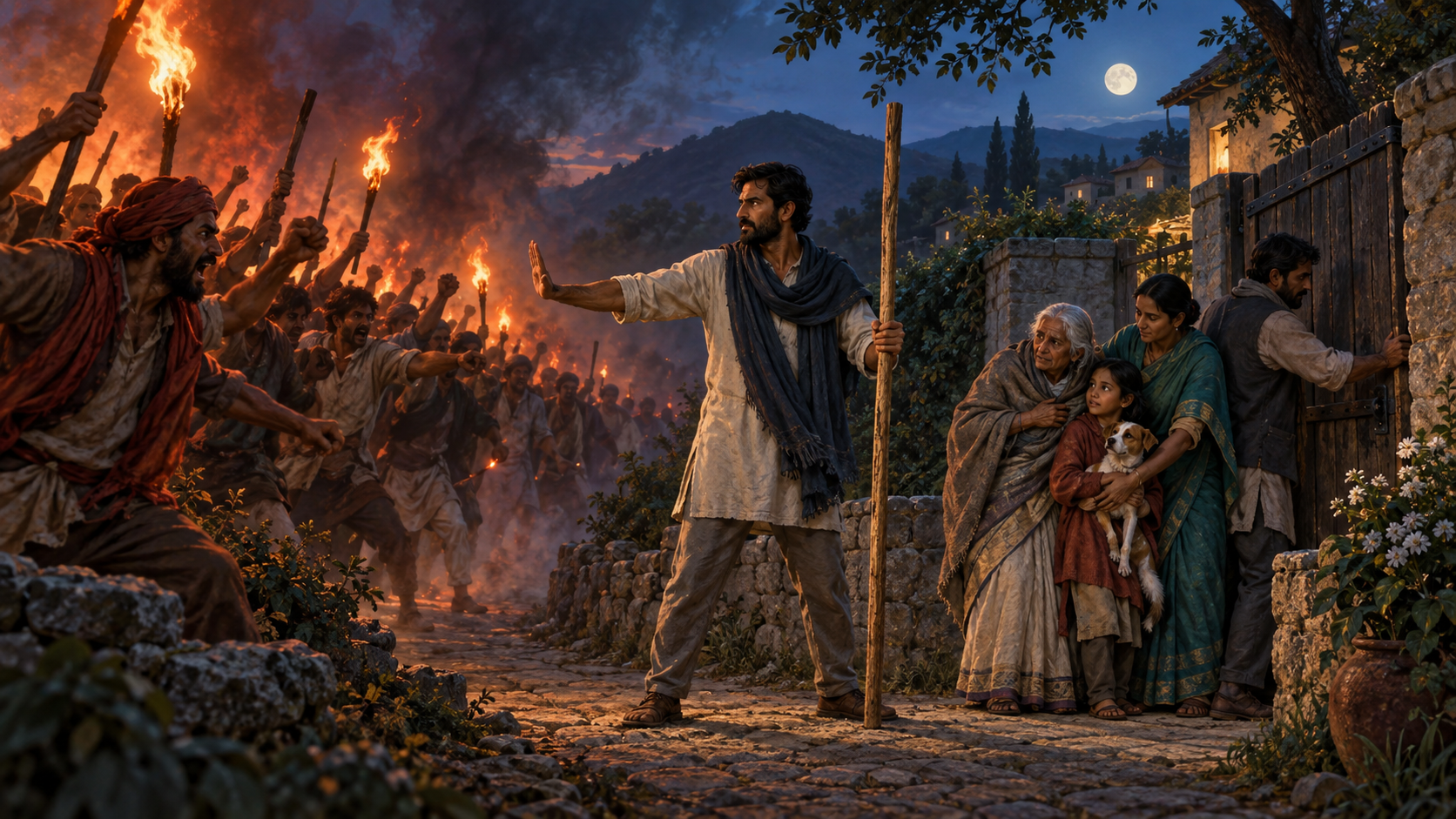
Protection sometimes requires public resistance. A falsehood may need correction, an institution may need organised support, or a vulnerable person may need immediate help. Passivity is not automatically peaceful. Yet a defence built on fabrication, indiscriminate blame or delight in humiliation carries the disorder it claims to oppose.
Before acting, move through this sequence:
- Verify the event. Separate direct evidence from commentary, cropped material and repetition. If you cannot verify a charge, do not make yourself one more link in its circulation.
- Name the object of protection. Is a person in danger, a sacred site being damaged, a teaching being misrepresented, or a community being denied fair treatment? A precise object produces a proportionate response.
- Identify your role. A witness, parent, donor, temple officer, scholar and public official do not hold the same duty or authority. Act from the role you truly have.
- Choose a truthful channel. Preserve evidence, support the affected person, contact responsible management or lawful authorities, publish an exact correction, or organise constructive assistance. If there is immediate physical danger, seek emergency help instead of converting the confrontation into online content.
- Stay for the repair. Outrage peaks at exposure; dharmic responsibility continues through protection, restitution, education and institutional improvement.
Online, this often means correcting one exact falsehood with evidence and refusing the mob that forms around it. In community life, it may mean showing up for the unglamorous work of governance, safeguarding, cleaning, teaching or accounting. In the family, it may mean explaining why a practice matters instead of demanding obedience without meaning.
Transmission is part of defence. A tradition preserved only as anger at its enemies has not yet been handed to the next generation. Teach a child the words of a prayer and its meaning. Learn a festival well enough to explain more than its external custom. Support teachers and institutions that unite scriptural seriousness with trustworthy conduct. Protect manuscripts, temples and symbols, but also protect the competence required to understand them.
You can be firm without becoming coarse, vigilant without becoming consumed and proud of Hindu civilisation without treating truth as optional. Those distinctions are not restraints placed on dharma-raksha. They are what keep the defence dharmic.
Key takeaways
- Kali-yuga explains recurring moral pressure; it does not excuse your participation in it.
- Begin with the sphere you can govern: speech, attention, obligations, association and household practice.
- Use stable, tradition-rooted sadhana to protect the day before distraction arranges it for you.
- Verify a threat, identify what needs protection and act through the authority you genuinely hold.
- Reject rumours, dehumanisation and performative rage even when they are offered in the name of defending dharma.
- Preserve transmission as well as symbols: teach meaning, support responsible institutions and make practice visible in ordinary life.
Before taking up the next controversy, repair one breach within your reach today. Keep one discipline, tell one truth, fulfil one duty or protect one vulnerable being. Then repeat the choice when the next pressure comes. That is how dharma remains living in an age that continually tests it.
References
- Dandavats – Keep the Effects of Kali-yuga Away – Bhadra 2026 Message by Bhima Prabhu
- Dandavats – Srimad Bhagavatam 1.17.2 | HH Prahladananda Swami | ISKCON Ljubljana Live

Leave a Reply
You must be logged in to post a comment.