

If Krishna’s confrontation with Kamsa’s wrestlers has seemed like a straightforward contest between good and evil, slow the scene down. The decisive question is not simply who can overpower whom. It is whether an assembly will recognize an unjust spectacle while it is still unfolding.
In Srimad Bhagavatam 10.44.7-12, the women watching the arena give you a practical way to examine any public conflict: compare the participants honestly, identify the authority benefiting from the arrangement, and decide whether your presence is becoming consent.
The injustice is visible before the result

Krishna faces Canura while Balarama faces Mustika. Kamsa’s arena presents their confrontation as a wrestling match, but the women refuse to accept that label without examining the terms. They contrast the hardened, mountain-like bodies of the wrestlers with the tender limbs and youth of Krishna and Balarama.
Their comparison is not idle commentary about appearance. It exposes the political design of the event. Kamsa controls the arena. His wrestlers carry out his purpose. Members of the royal assembly lend the appearance of legitimacy. Krishna and Balarama bear the danger created by everyone else.
- The ruler designs the spectacle and expects satisfaction.
- The stronger-looking contestants serve the ruler’s intention.
- The assembly treats obedience to power as though it were fairness.
- The people placed at risk did not create the conditions of the encounter.
This distinction matters because an eventual victory cannot make the original arrangement just. If a person survives a trap, the trap does not become a fair test. If someone proves stronger than an aggressor expected, the aggression does not disappear. Judge the design of an encounter before its outcome tempts you to rewrite what happened.
The assembly is also on trial
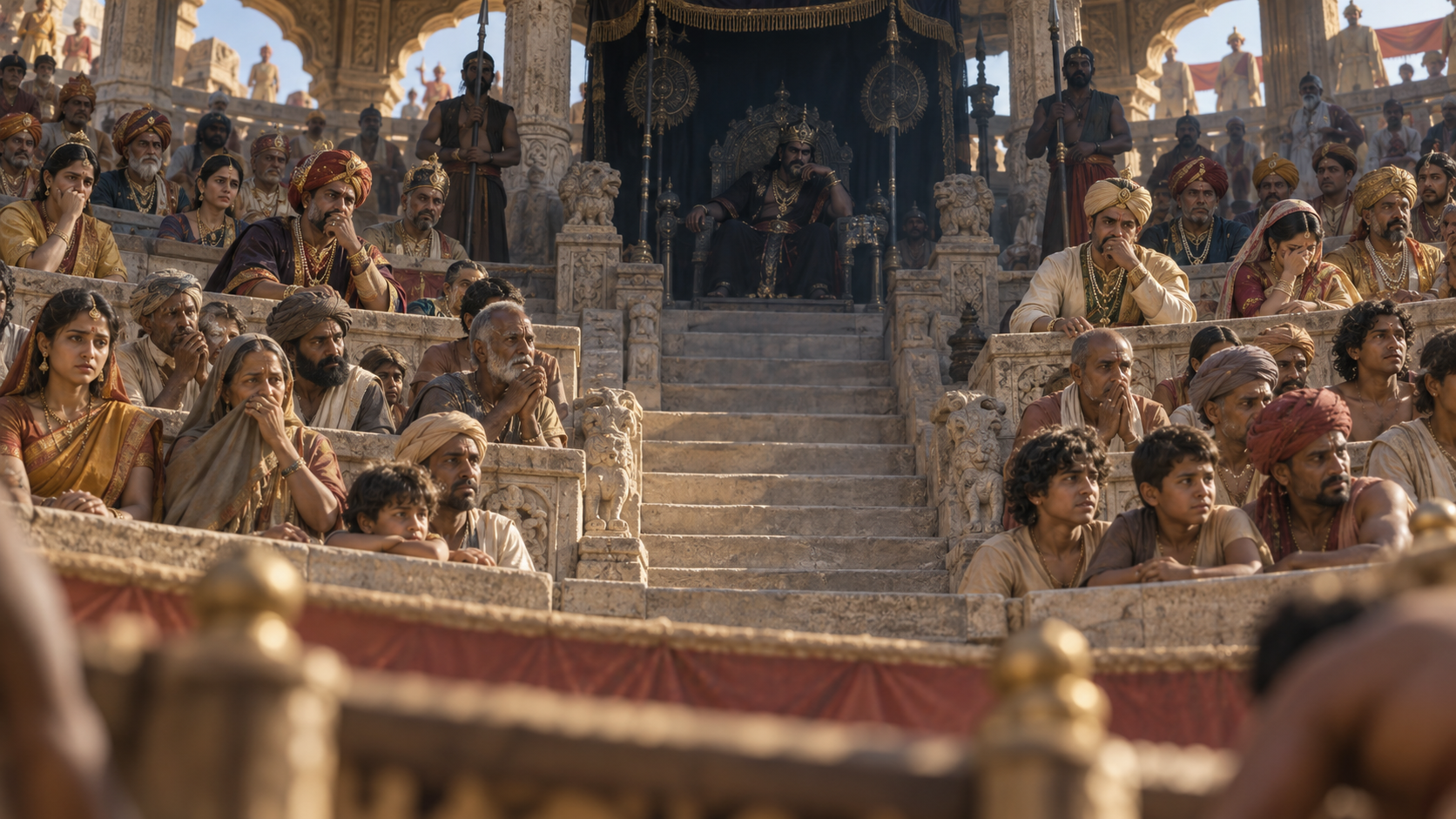
The women call the unequal contest a great adharma, but their criticism does not stop with Kamsa or the wrestlers. They turn toward the members of the assembly who tolerate the event in order to please the king. That move widens the moral field: wrongdoing belongs not only to the person who commands it or the person who performs it, but also to those whose approval helps it pass as normal.
They then move from judgment to duty: one should not remain where adharma is rising. Their next distinction is sharper still. A person who enters such an assembly and then withholds the truth, speaks falsely, or pretends not to understand shares responsibility for the corruption of the gathering.
These are three different failures, and you should learn to recognize each one:
- Silence: You see the unfairness clearly but protect your comfort, access, or status by saying nothing.
- False speech: You repeat the official description even though it conceals who controls the situation and who carries the risk.
- Performed ignorance: You claim that the matter is too complicated to judge when the decisive imbalance is already visible.
Not every witness has equal power. An official who can stop an abuse bears a different burden from a bystander with no authority. Yet lack of office does not require moral surrender. At minimum, you can refuse applause, refuse a dishonest description, and refuse to let your name or presence be used as evidence of agreement.
The women show how dharmic judgment should begin
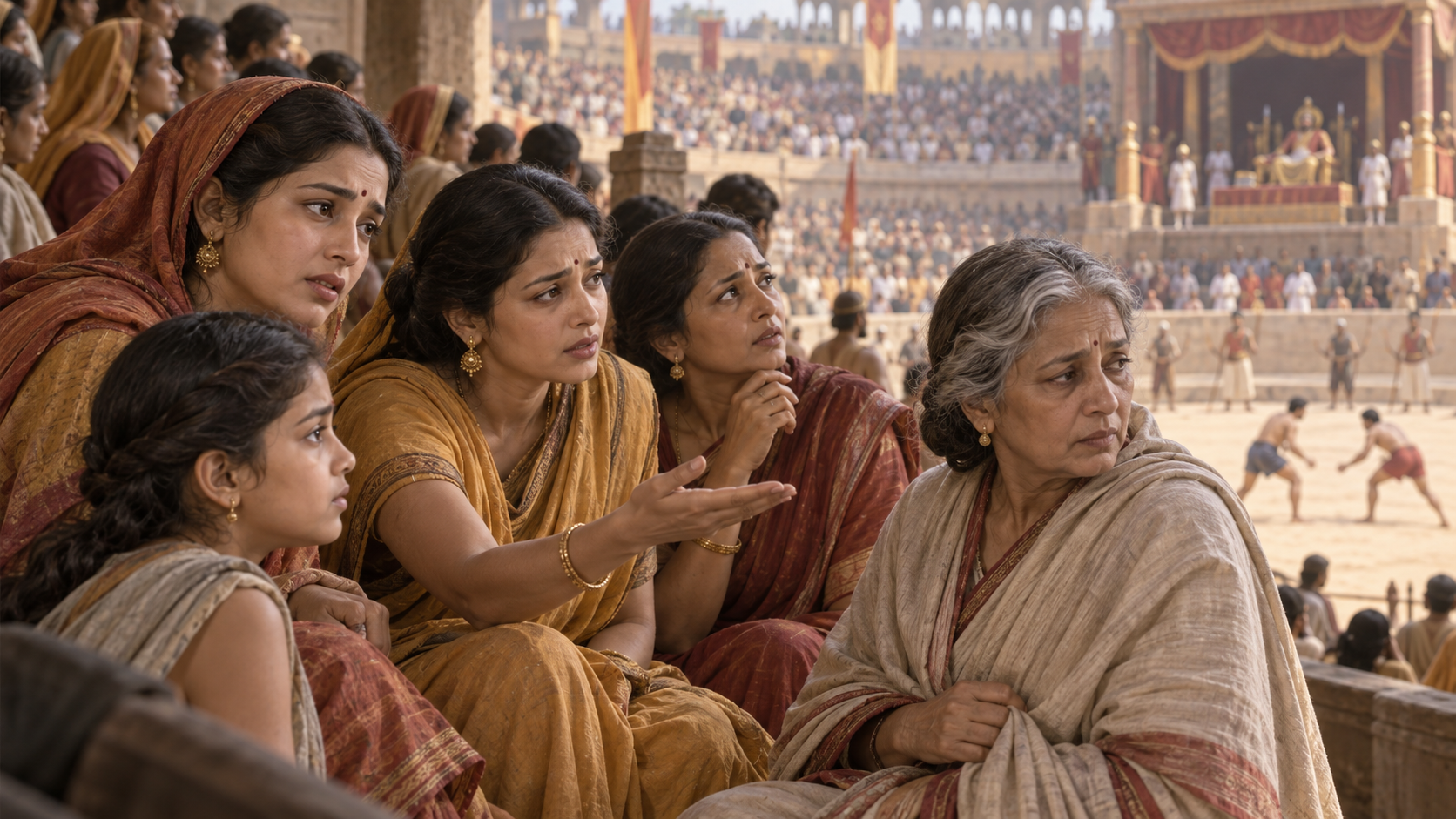
The women do not begin with a slogan. They begin with observation. They compare bodies, ages, roles, and risks. Only after identifying the disparity do they name the event as adharma and consider what a truthful witness must do.
That order is worth preserving. If you begin with a label, loyalty can decide your conclusion before you have examined the situation. If you begin with concrete relationships, you can ask who controls the rules, who benefits from them, and who will suffer if the arrangement goes wrong.
- Describe what is happening without adopting the authority’s preferred label.
- Compare the participants’ actual power, including institutional and social power as well as physical strength.
- Identify who selected the setting, the rules, and the audience.
- Name the dharmic breach precisely enough that another person can evaluate it.
The women’s compassion sharpens rather than clouds their perception. They notice Krishna’s perspiring face and Balarama’s reddish eyes, anger toward Mustika, and smiling intensity. They can recognize danger without reducing the brothers to helpless figures. This is disciplined attention: see the wrong, see the person facing it, and do not allow either fear or admiration to erase the facts.
Divine strength does not excuse human complicity
A tempting misreading runs like this: Krishna and Balarama possess extraordinary strength, so the apparent unfairness does not really matter. The women’s verdict makes that conclusion untenable. Their concern is directed at what Kamsa and his assembly are choosing to authorize, not merely at whether the brothers are capable of surviving it.
The capacity of the threatened person never transfers righteousness to the aggressor. A resilient person can still be mistreated. A courageous community can still be subjected to injustice. A divine outcome does not absolve the human beings who chose adharma on the assumption that its victims were vulnerable.
This is especially important in a devotional reading. Bhakti is not permission to ignore civic duty. To admire Krishna while excusing the assembly that serves Kamsa would separate devotion from the moral clarity displayed inside the scene itself. Trust in dharma should make truthful action more urgent, not less.
When someone dismisses an unjust arrangement by saying that its target can handle it, ask a better question: was it right to impose that arrangement in the first place? Strength may change what happens next, but it does not change the character of the choice that created the danger.
A four-question test before you lend legitimacy
You should not turn every disagreement into a miniature version of Kamsa’s arena. Unequal roles are not automatically adharmic. A teacher and student, judge and litigant, or leader and subordinate may have different powers while remaining bound by duties that protect the less powerful person. The problem begins when authority weaponizes the imbalance and then asks an audience to call the result fair.
When you enter a difficult meeting, public controversy, institutional hearing, family council, or religious gathering, use four questions:
- Who designed the encounter? Identify who chose the venue, terms, participants, and acceptable language.
- Who benefits from calling it fair? Notice whether the official description protects the most powerful person from scrutiny.
- Who bears the risk? Compare the likely harm to each participant instead of treating formal participation as proof of equal standing.
- What does my presence communicate? Decide whether dharma requires truthful speech, refusal to cooperate, or withdrawal from a gathering that uses your presence as validation.
If you need to speak, avoid a vague accusation. State the structure plainly: this is not an equal contest, because one party controls the terms while another carries the danger. A precise sentence is harder to dismiss than moral outrage without an explanation.
Apply the structure of the arena, not its costumes. The useful analogy is not that every bad ruler is literally Kamsa or every mistreated person is Krishna. It is that power often disguises coercion as procedure and counts a quiet audience as approval. Dharmic discernment uncovers that disguise.
Key takeaways for the next difficult room
- Judge the design of a contest before its result influences your memory of it.
- Ask which authority created the terms, who benefits, and who carries the risk.
- Recognize silence, false speech, and feigned ignorance as distinct forms of complicity.
- Do not treat a person’s strength or resilience as an excuse for placing that person in an unjust situation.
- Name the exact disparity, then choose truthful speech, principled refusal, or withdrawal according to your responsibility.
The next time a public scene asks for your approval, pause before watching for the winner. Examine the terms, the beneficiary, and the burden. If those terms serve adharma, say what is wrong in the clearest sentence available to you, and do not allow your presence to be counted as consent.
References
- Dandavats — Today’s Featured Video: Srimad Bhagavatam 10.44.7-12 | HH Hanumat Presaka Swami | September 21, 2026
- Vedabase — Srimad Bhagavatam 10.44.7

Leave a Reply
You must be logged in to post a comment.