
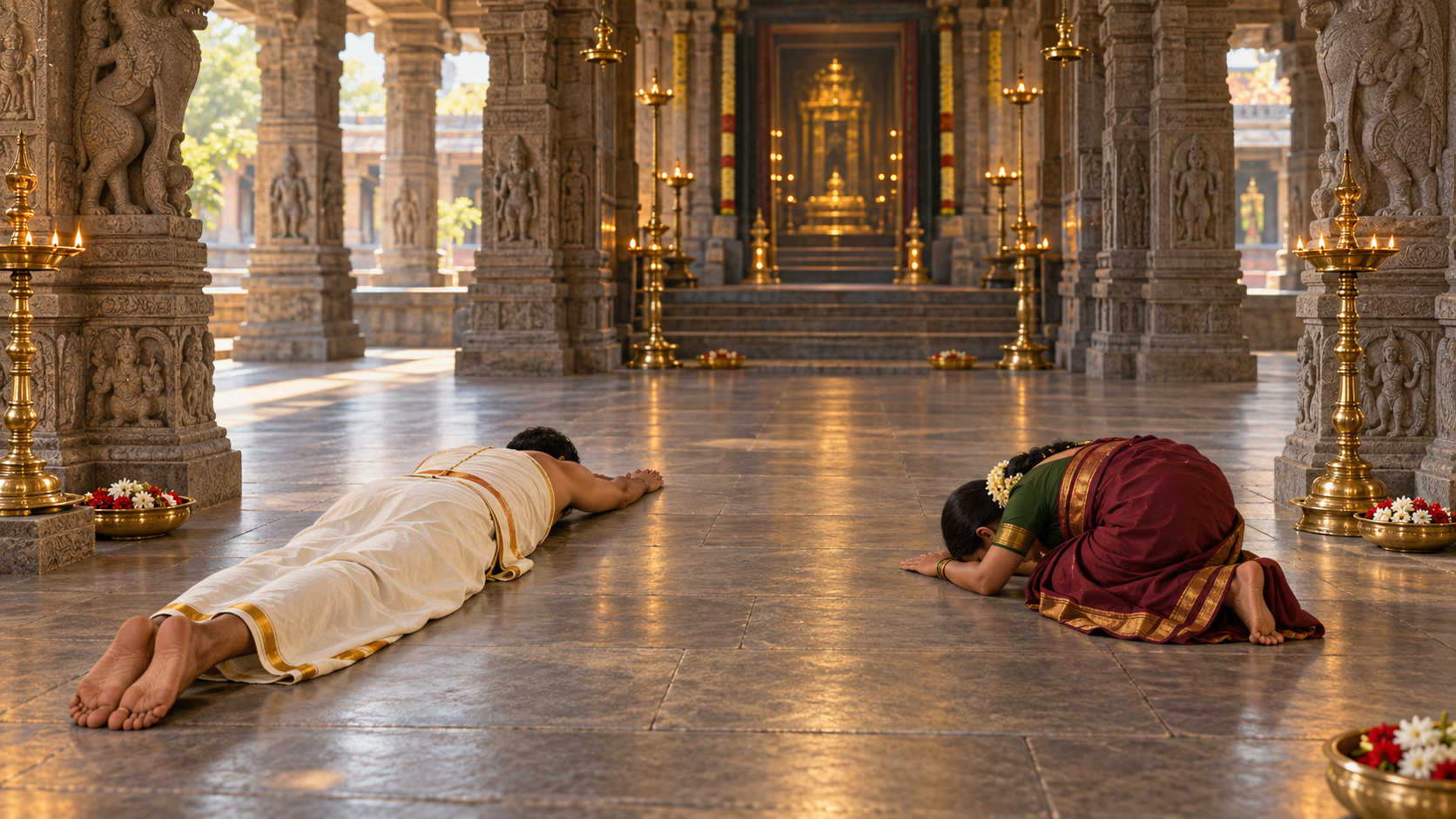
You are in a temple, the moment for namaskaram arrives, and everyone around you seems to know a rule that nobody has explained. Should a man lie fully prostrate? Should a woman use a different form? Is the distinction religious, physical, or simply customary?
The direct answer is that a familiar Hindu convention assigns Sashtanga Namaskaram to men and Panchanga Namaskaram to women. That tells you what some traditions expect. It does not establish a scientific or biological necessity, and it should not be turned into a judgment about anyone’s devotion.
What the two forms signify
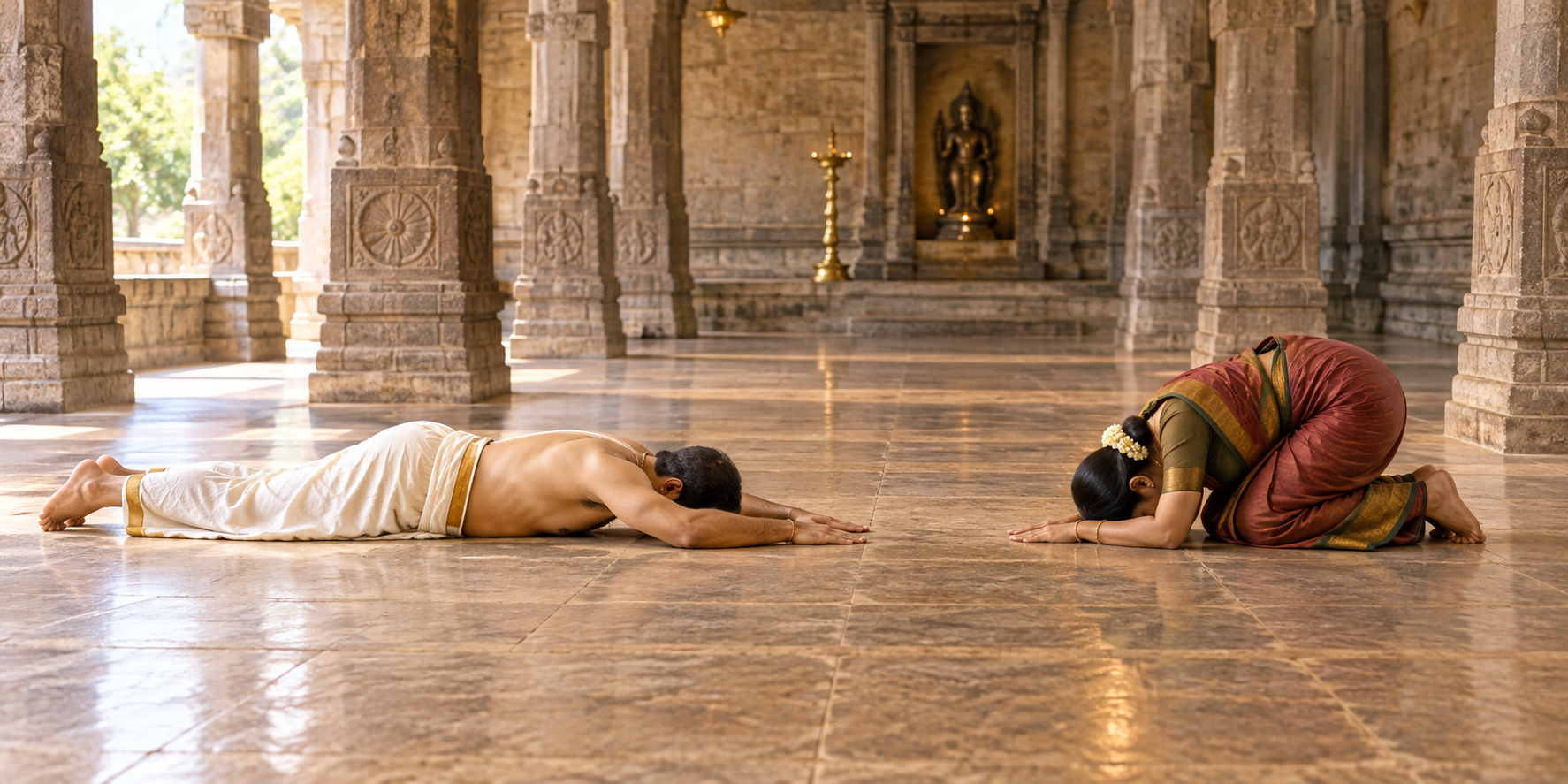
Both forms are acts of reverence. The devotee lowers the body rather than offering only a spoken greeting or a gesture from a standing position. The outward action expresses humility before the deity, guru, elder, or sacred presence being honoured.
The names distinguish the forms by the number of angas, or bodily parts, involved: Sashtanga is conventionally understood as an eight-limbed prostration, while Panchanga is a five-limbed prostration. If your family, sampradaya, or temple teaches particular mechanics, follow that instruction rather than trying to reconstruct the posture from its name alone.
Under the gendered convention, men are directed toward Sashtanga Namaskaram and women toward Panchanga Namaskaram. The important distinction is between a customary prescription and a universal claim. A temple may preserve the rule as inherited achara, but the existence of that custom does not prove that every Hindu community applies it identically.
How to act when a temple’s practice is unfamiliar
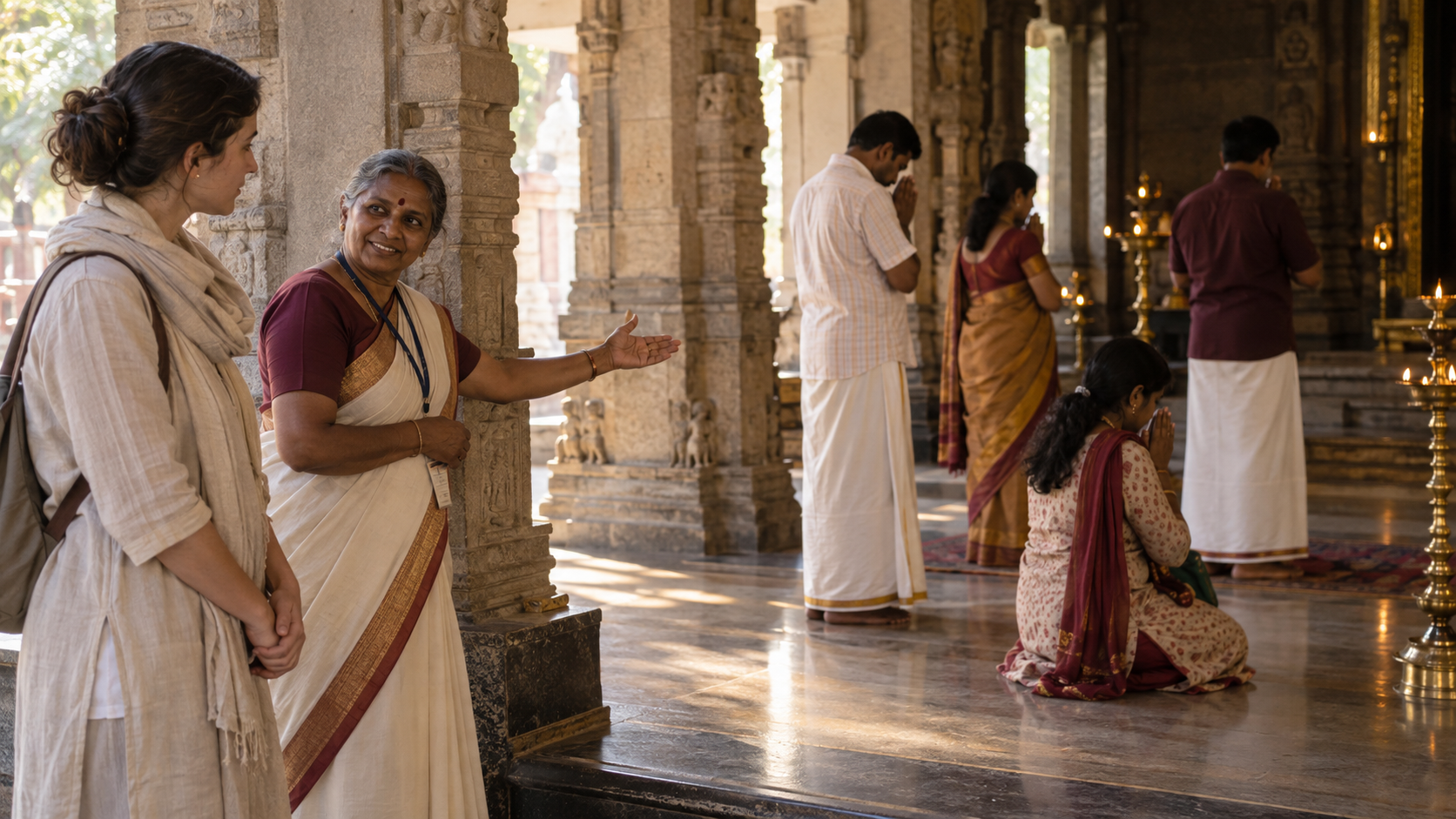
You do not need to solve a broad debate while standing in the darshan queue. You need to learn what this particular place expects and participate without disrupting worship.
- Look for an explicit instruction. A posted notice or direction from temple personnel is more reliable than copying one devotee whose circumstances you do not know.
- Ask a precise question. Say, “Does this temple ask men and women to perform different forms of namaskaram?” If necessary, follow with, “Is that required here or simply the customary form?”
- Make room before lowering yourself. Do not prostrate where you will obstruct a moving queue, doorway, or another devotee’s worship. Ask where the gesture should be performed if the space is crowded.
- Follow the local form deliberately. A calm, attentive bow is more appropriate than a hurried attempt to imitate movements you have not learned.
- State any physical limitation plainly. If kneeling or going to the floor is painful, unsafe, or likely to make you unsteady, do not force the movement. Ask the priest or attendant which respectful alternative is suitable in that setting.
This approach also helps when family practice and temple practice differ. You can honour the house tradition during a visit without declaring every other form incorrect. If the difference matters to your sampradaya, ask your own guru or teacher how to reconcile the two contexts afterward.
Do not turn custom into pseudo-science
The gender distinction is traditional, but there is no scientific reason established for assigning the two forms by sex. That boundary matters. It prevents a local ritual convention from being presented as a demonstrated fact about male and female anatomy.
This does not require you to dismiss tradition. Science is not the only language through which a religious community understands reverence, discipline, or inherited etiquette. It does require honesty about the kind of claim being made. “This is our customary practice” is clear. “Women are biologically incapable of the other form” would require evidence that the convention itself does not supply.
When someone offers an elaborate physical explanation, ask a simple question: is that explanation part of a named teaching you actually know, or is it a later attempt to make the custom sound scientific? If you cannot establish the claim, do not repeat it as fact. A tradition does not become stronger when uncertain explanations are attached to it.
The same restraint applies in the other direction. The absence of a scientific basis does not, by itself, tell you that a ritual has no spiritual or communal meaning. It tells you only that biological necessity is not the right justification for the gender split.
Teach the practice without ranking devotees
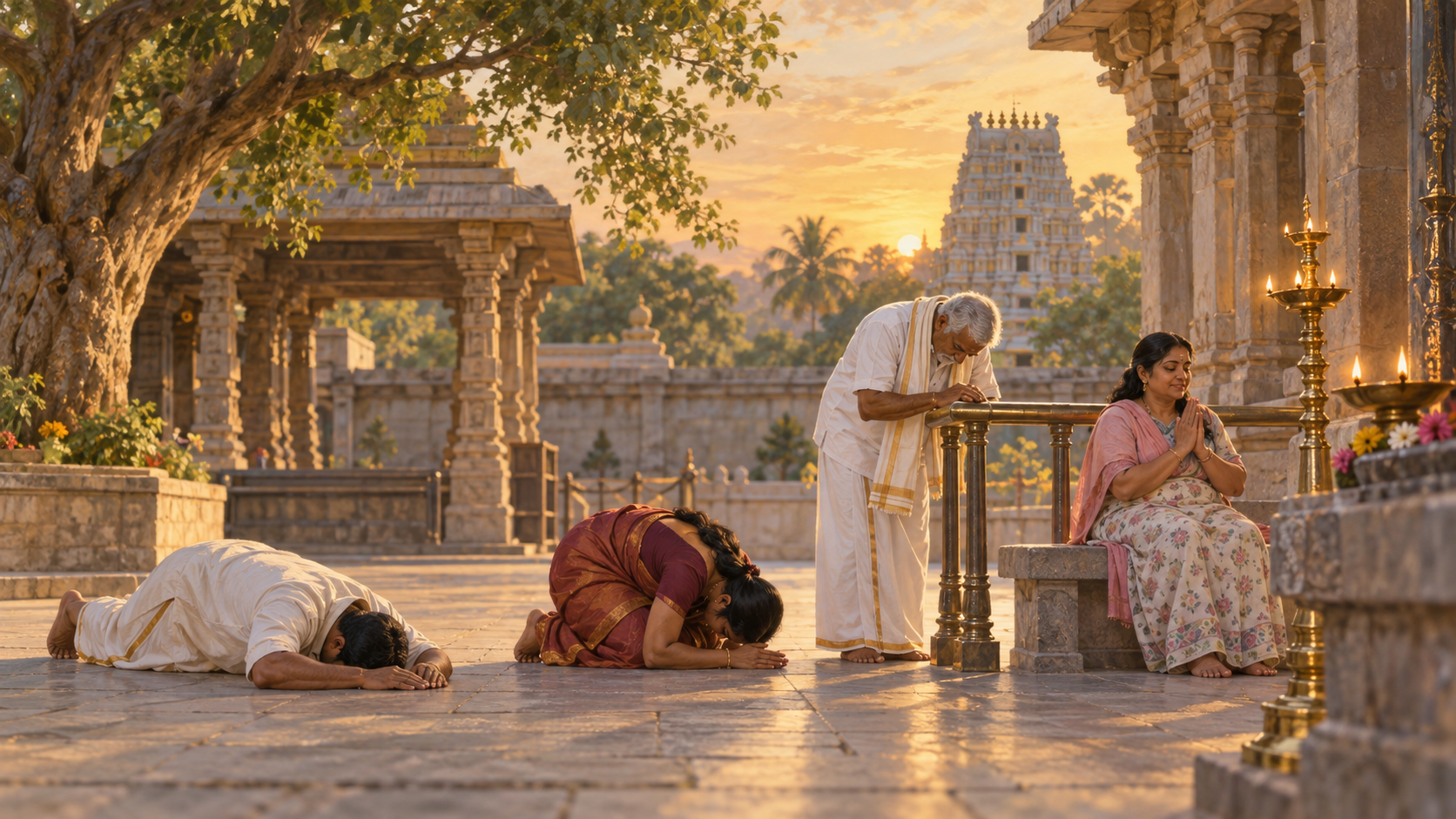
If you are explaining these forms to children, visitors, or new members of a temple, separate three questions that are often collapsed into one:
- What does our community do? State the customary form plainly, including the traditional assignment of Sashtanga to men and Panchanga to women where it applies.
- Why do we prostrate? Centre the act on reverence, humility, and surrender rather than on performance.
- What is the status of the gender rule? Describe it as a traditional convention, not as proven anatomy or a measure of spiritual worth.
This language protects both continuity and truthfulness. It lets a community transmit its etiquette without teaching that the deeper prostration automatically belongs to a spiritually superior person. The number of bodily points touching the ground cannot, by itself, measure bhakti.
It also leaves room for humane judgment. An elderly devotee, a pregnant devotee, someone recovering from injury, or anyone with limited mobility may be unable to perform the customary posture safely. The useful response is to identify an acceptable alternative, not to demand pain as proof of reverence. Because temple protocols differ, the responsible practical step is to ask rather than presume that one substitute is universal.
Key takeaways
- Sashtanga Namaskaram is the eight-limbed form traditionally prescribed for men in the gendered convention.
- Panchanga Namaskaram is the five-limbed form traditionally prescribed for women under that convention.
- The distinction is a matter of traditional practice; it does not have an established scientific basis.
- A local rule should be described as local or inherited custom, not automatically expanded into a universal biological claim.
- When you are unsure, ask what the temple expects and whether the form is required or preferred.
- If going to the floor is unsafe for you, do not force it. Ask for the appropriate alternative in that temple.
On your next temple visit, settle the practical question before the moment of prostration: learn the local expectation, make space, and perform the form you can offer safely and sincerely. Preserve the custom where it belongs, but do not burden it with claims it cannot support.
References

Leave a Reply
You must be logged in to post a comment.