

You may already know that Ekadashi involves some form of fasting. The harder question is what you should actually do with the day. If the observance changes your food but not your attention, speech, service or sense of ownership, its most important opportunity has been missed.
A workable Ekadashi practice has two movements: reduce what ordinarily occupies you, then give the recovered attention to Bhagavan. The Vamana-Bali tradition sharpens that practice by asking a demanding question: what are you still trying to possess, protect or control when the Lord asks for your surrender?
What Ekadashi should change besides your meals
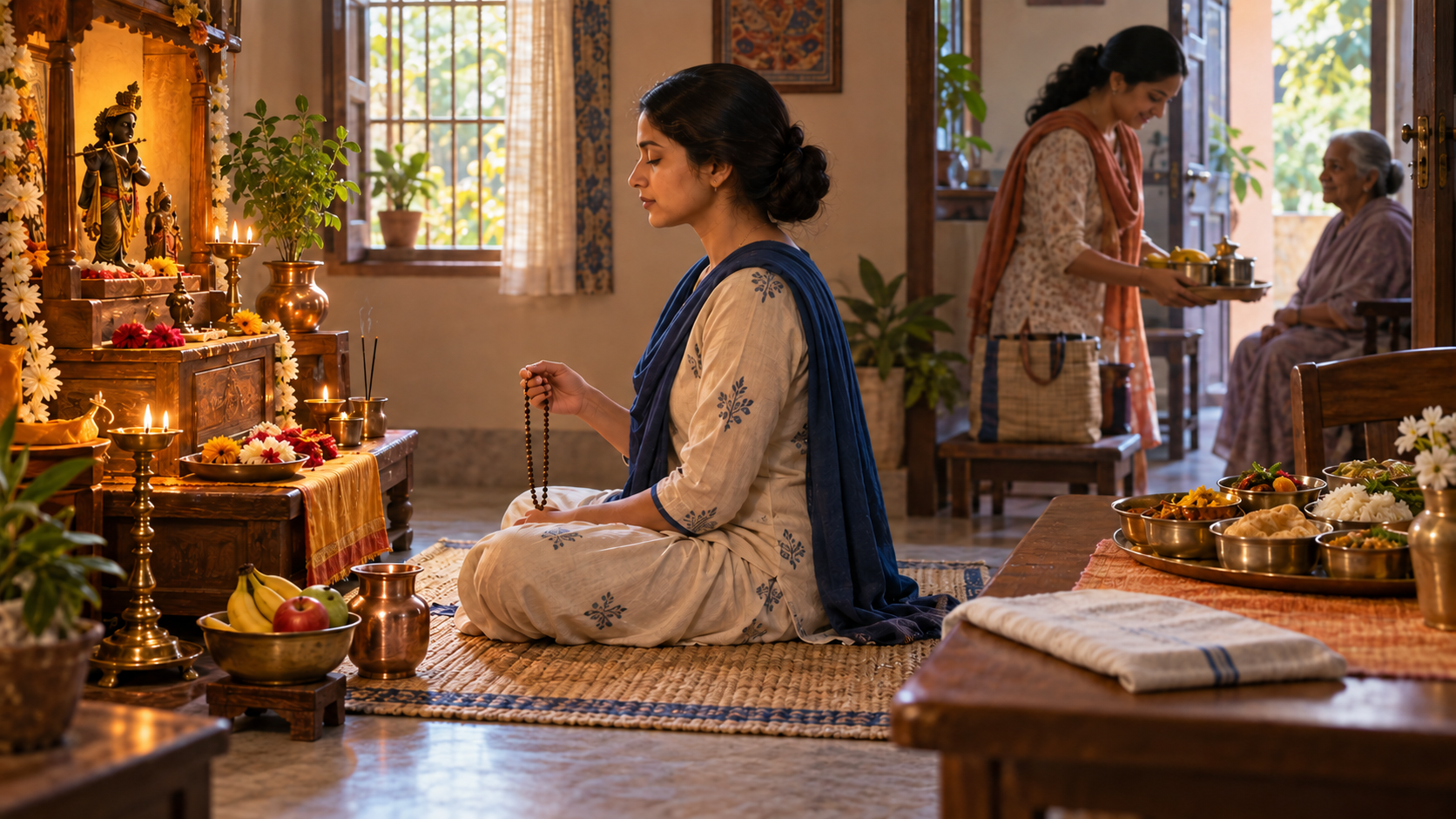
Ekadashi is observed as a sacred day for spiritual purification, remembrance of Lord Krishna and devotional service. Those three purposes give you a simple test for every choice you make during the observance.
- Does this simplify the day, or does it merely replace ordinary food with elaborate fasting food?
- Does this help you remember Krishna, or are you spending the day thinking mainly about what you cannot eat?
- Does the time and energy you save become japa, kirtan, hearing, reading or seva?
Food restraint is therefore a means, not the whole vow. It interrupts habit and makes desire easier to notice. The moment hunger, inconvenience or irritation appears, you can observe what the mind demands. That is useful spiritual information. Instead of treating discomfort as proof of achievement, use it as a prompt to return to the holy name, prayer or service.
Srila Prabhupada’s emphasis on using Ekadashi for deeper spiritual practice keeps the day from becoming a private endurance contest. A simpler plate accompanied by increased remembrance is more coherent than a severe menu accompanied by distraction, pride or quarrelling.
The Vamana-Bali tradition turns restraint into surrender
Parsva Ekadashi joins the glories of Vamana Dev with the remembrance of Bali Maharaj. That connection gives the fast an inner subject. Bali’s encounter with Vamana is not only something to hear about; it is a mirror for the devotee’s own claims of ownership.
The useful question is not simply, “What did Bali give?” Ask, “What do I call mine so firmly that I resist the Lord’s claim upon it?” The answer may be money, status, time, a plan, a grievance, an opinion or the need to appear spiritually accomplished. None of these has to be dramatic. Attachment often becomes clearest in the ordinary thing you refuse to release.
This is why the Vamana-Bali remembrance belongs naturally inside Ekadashi practice. Fasting works at the visible level of appetite. Bali’s surrender directs your attention toward the subtler appetite to remain the proprietor. The lesson is not that responsible stewardship is wrong. It is that stewardship becomes possessiveness when service to Bhagavan is welcome only on your own terms.
While hearing the Vamana-Bali narrative, resist the urge to reduce it to “generosity is good.” Generosity can still leave the giver in control. Surrender begins where the devotee stops negotiating for spiritual credit. Notice where Bali’s remembrance unsettles you; that point is likely to be more fruitful than an abstract moral.
A practical plan for the day

You do not need to improvise an impressive programme. Decide in advance what you will reduce, what devotional practice will take its place, and how the Vamana-Bali meditation will guide one concrete act.
- Confirm the observance locally. Use the calendar followed by your temple, guru or sampradaya. Do not copy the date or completion time from a community in another location, because the applicable observance can depend on the local calendar.
- Write a one-sentence intention. For example: “Today I will simplify food and entertainment so that I can remember Krishna with greater attention and examine my possessiveness.” A written intention gives you something more useful than hunger by which to judge the day.
- Choose the food discipline before the day begins. Follow the standard given by your tradition and household rather than inventing a harsher vow in the moment. Make the arrangements simple enough that shopping, cooking and discussing the fast do not consume the time you meant to offer.
- Assign the recovered time. Put japa, kirtan, scriptural hearing, temple worship or seva into the spaces normally occupied by meals and entertainment. If you merely remove an activity, the phone and the wandering mind will usually reclaim the opening.
- Hear or read the Vamana-Bali account. Then write brief answers to two questions: “What am I protecting as mine?” and “What would offering it in service look like in practice?” Keep the answer specific enough to act upon.
- Make one offering of control. Complete a neglected duty, give time without demanding recognition, release an unnecessary argument, or place a valued resource in responsible service. The action should address the attachment you identified, not function as a symbolic substitute for it.
- Complete the observance attentively. Follow your trusted calendar and community guidance for concluding the vow. Do not let the first ordinary meal become a swing from restraint into indulgence; carry the day’s simplicity into the way you eat, speak and use your time.
If work or caregiving makes a long programme unrealistic, keep a smaller structure instead of abandoning the day. Protect one fixed period for attentive remembrance, simplify whatever can safely be simplified, and choose one act of seva. Consistency is more spiritually useful than designing a demanding observance that collapses under your actual duties.
Adapt the fast without emptying the vow
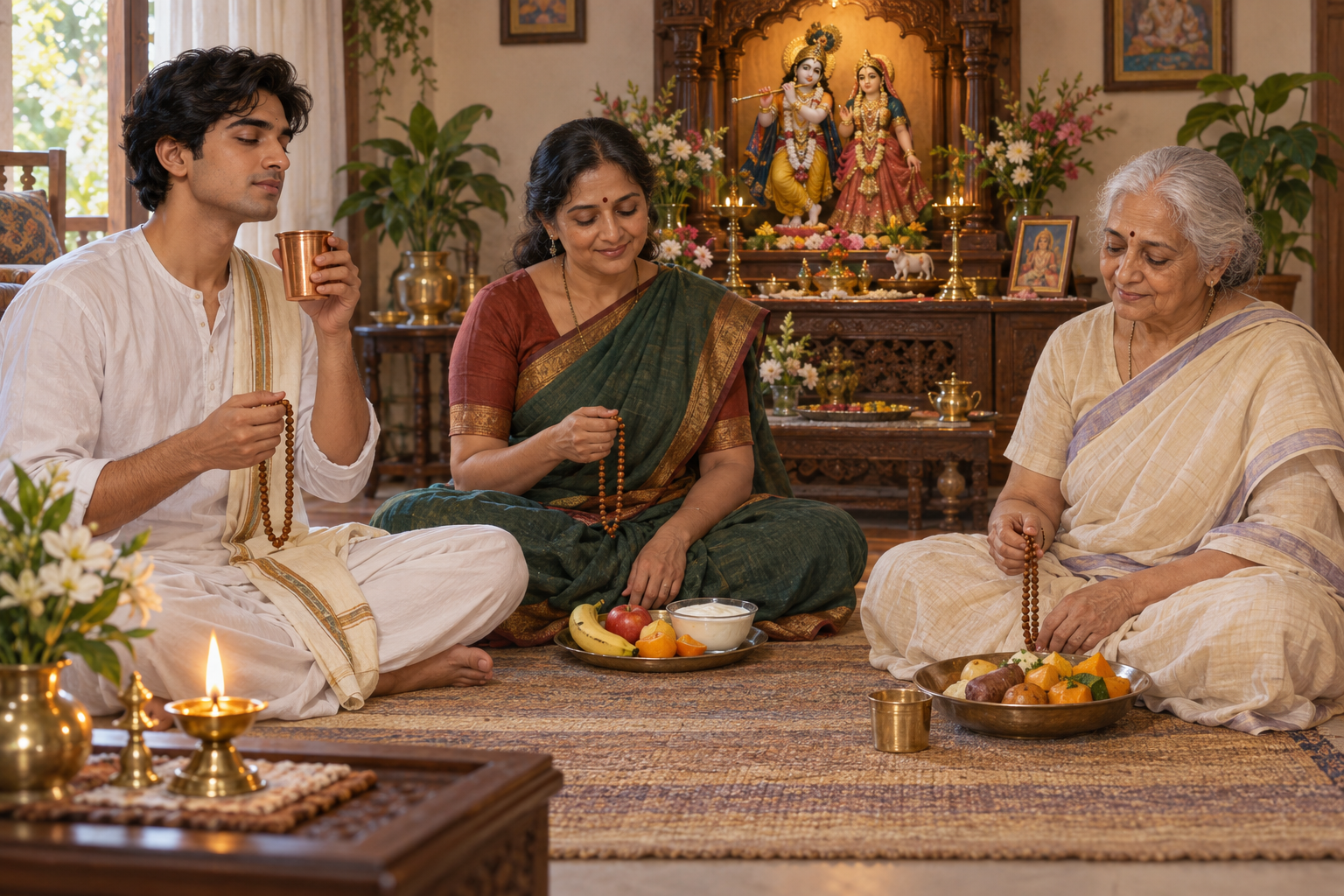
Households and Vaishnava traditions do not all observe Ekadashi in exactly the same way. Your first responsibility is therefore fidelity to the guidance you have actually received, not competition with another devotee’s plate. Ask your temple or teacher when you are uncertain about permitted foods, the degree of fasting or the proper completion of the observance.
If food restriction could conflict with a medical condition, prescribed medicine or recovery from disordered eating, do not intensify the fast for the sake of appearances. Seek guidance from a qualified clinician and your spiritual teacher. You can preserve the devotional purpose through suitable dietary simplicity, increased remembrance and service without treating medical risk as a measure of surrender.
The opposite mistake is to use flexibility as permission for an ordinary day. If strict food restraint is not appropriate, identify another real form of restraint. Reduce entertainment, unnecessary speech, habitual browsing or needless consumption, then deliberately redirect that attention toward Krishna. The substitute should free attention for devotion; it should not merely make the vow effortless.
Watch especially for three distortions: pride about severity, irritability caused by self-imposed strain, and preoccupation with special foods. Each one turns attention back toward the ego. When you notice it, simplify again and return to remembrance. Ekadashi is not strengthened when your observance makes life harder for everyone around you.
Key takeaways
- Treat food restraint as a support for purification, remembrance and seva, not as the complete observance.
- Let the Vamana-Bali tradition expose possessiveness: ask what you defend as “mine” and how it can be placed in service.
- Plan the devotional use of saved time before Ekadashi begins, or ordinary distractions will take it back.
- Follow the calendar and fasting guidance of your own temple, guru or sampradaya.
- Adapt dietary restraint when health requires it, while retaining a genuine discipline of attention and service.
- Judge the day by whether it leaves you more attentive, less possessive and more willing to serve.
Before your next Ekadashi, prepare three lines: the restraint you will follow, the devotional practice that will replace what you set aside, and the attachment you will examine through Bali Maharaj’s surrender to Vamana Dev. That small preparation can turn a familiar calendar observance into a day with a clear spiritual direction.
References
- Dandavats – Parsva Ekadashi: Glories of Vamana Dev & The Story of Bali Maharaj | Mayapur TV English
- Dandavats – Ekadashi Special | Srila Prabhupada’s Lecture

Leave a Reply
You must be logged in to post a comment.