
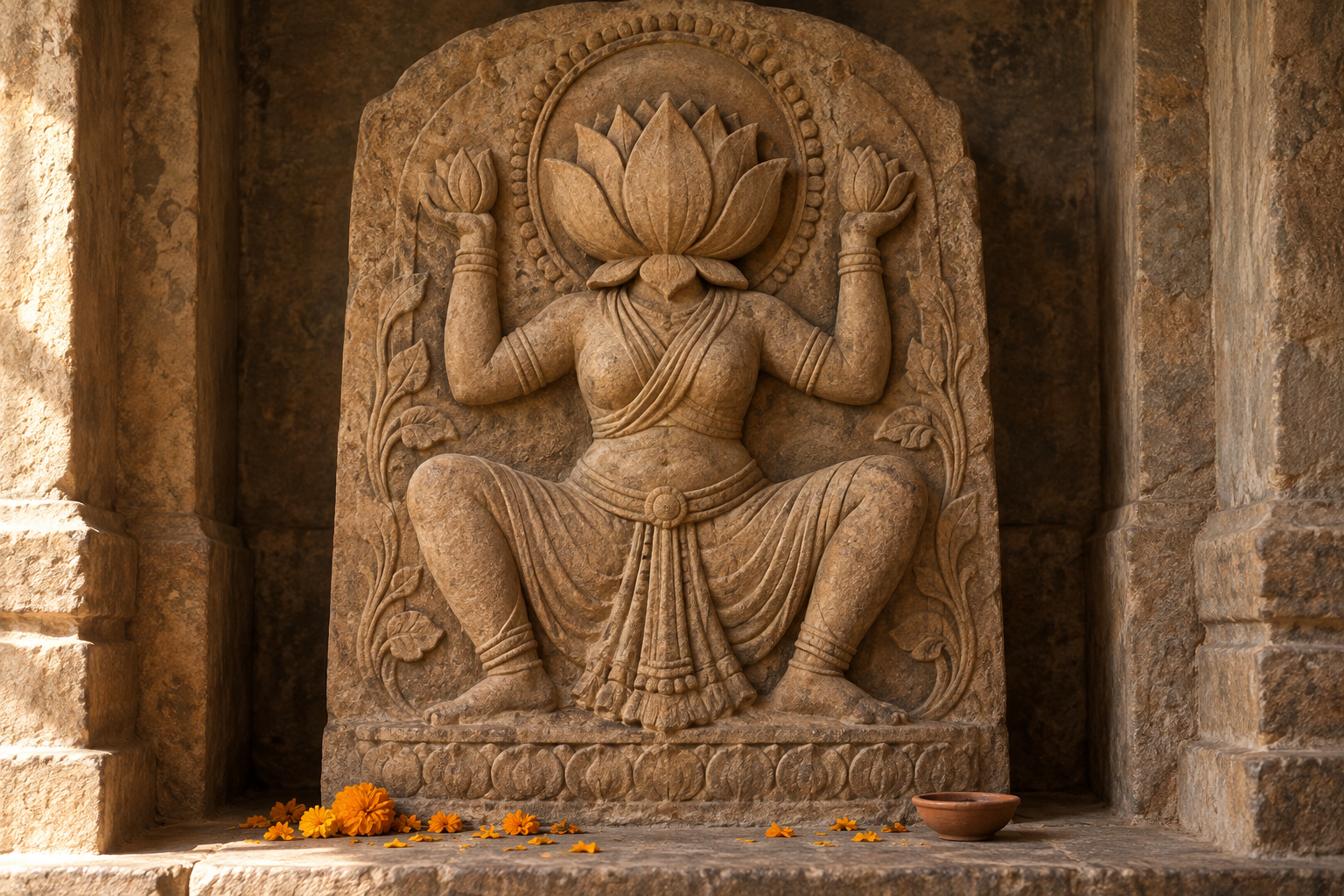
If Lajja Gauri unsettles you, the difficulty may be deciding what kind of image you are seeing. Her exposed female form can look startlingly direct, while the absence of a face denies you the ordinary clues of identity, emotion, and intention.
You do not have to choose between embarrassment and uncritical reverence. You can read the image carefully: first as a visual composition, then through a Dharmic understanding of generative nature, and finally with an honest awareness of what the image does not allow us to claim.
Begin with what the image makes visible
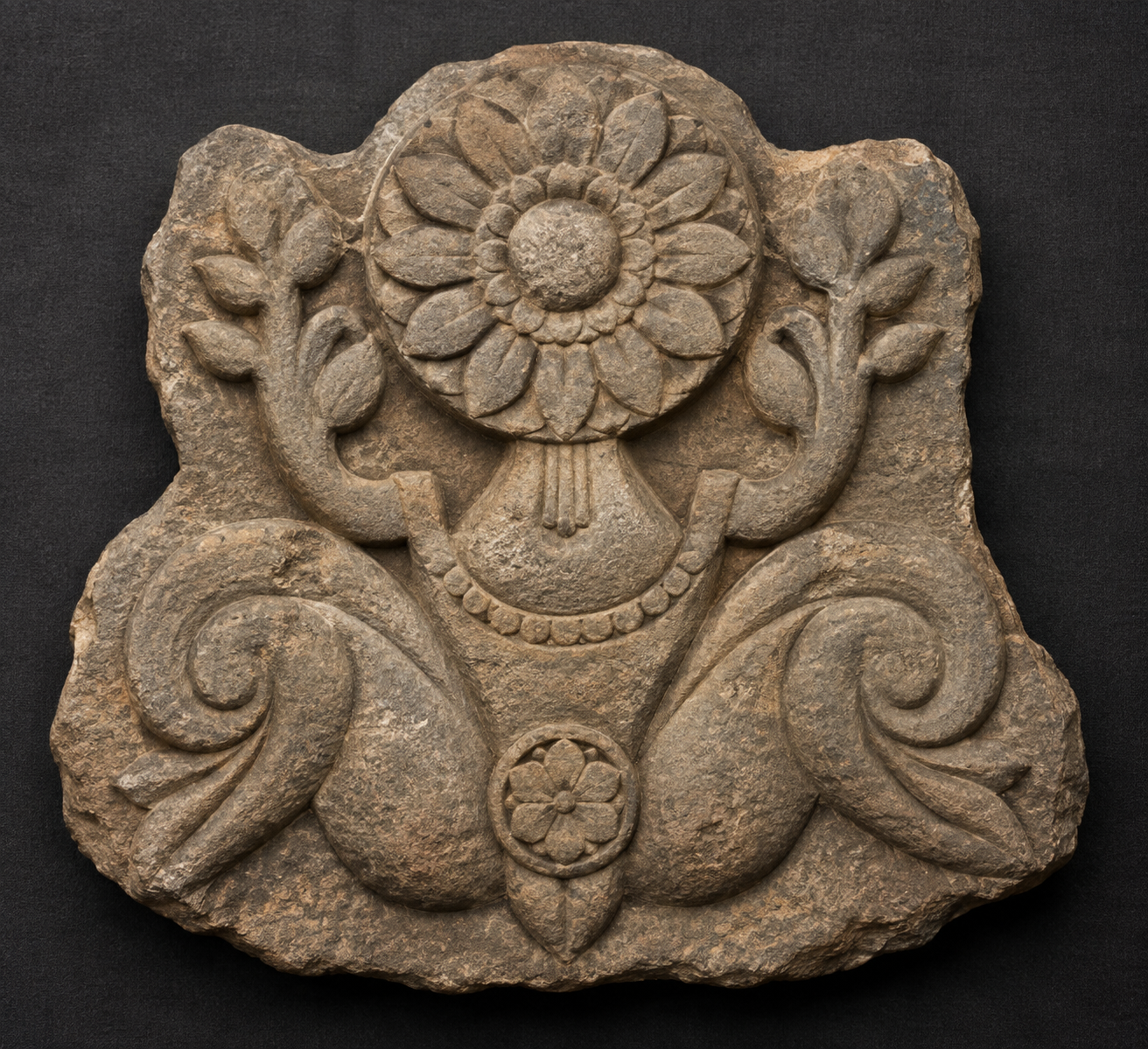
Before deciding what Lajja Gauri means, separate observation from interpretation. The recurring form presents a female body lying openly exposed, places strong emphasis on reproductive power, and withholds a conventional face. Examples have been found on ancient temple walls and at archaeological sites from Maharashtra to Karnataka.
Three features therefore need to remain together in any serious reading:
- The body is explicit. The generative region is not incidental, hidden, or softened into an abstract suggestion.
- The person is not individualized. A face ordinarily supplies character, mood, and personal identity; here that channel is absent.
- The setting is sacred or archaeological. A temple image cannot responsibly be interpreted as though it were an isolated modern picture with no ritual or cultural environment.
This first step matters because viewers often begin with a moral label and then force every visual feature to support it. Reverse that order. Describe the form before deciding whether it is modest, erotic, maternal, cosmic, disturbing, or beautiful.
The missing face redirects rather than removes meaning
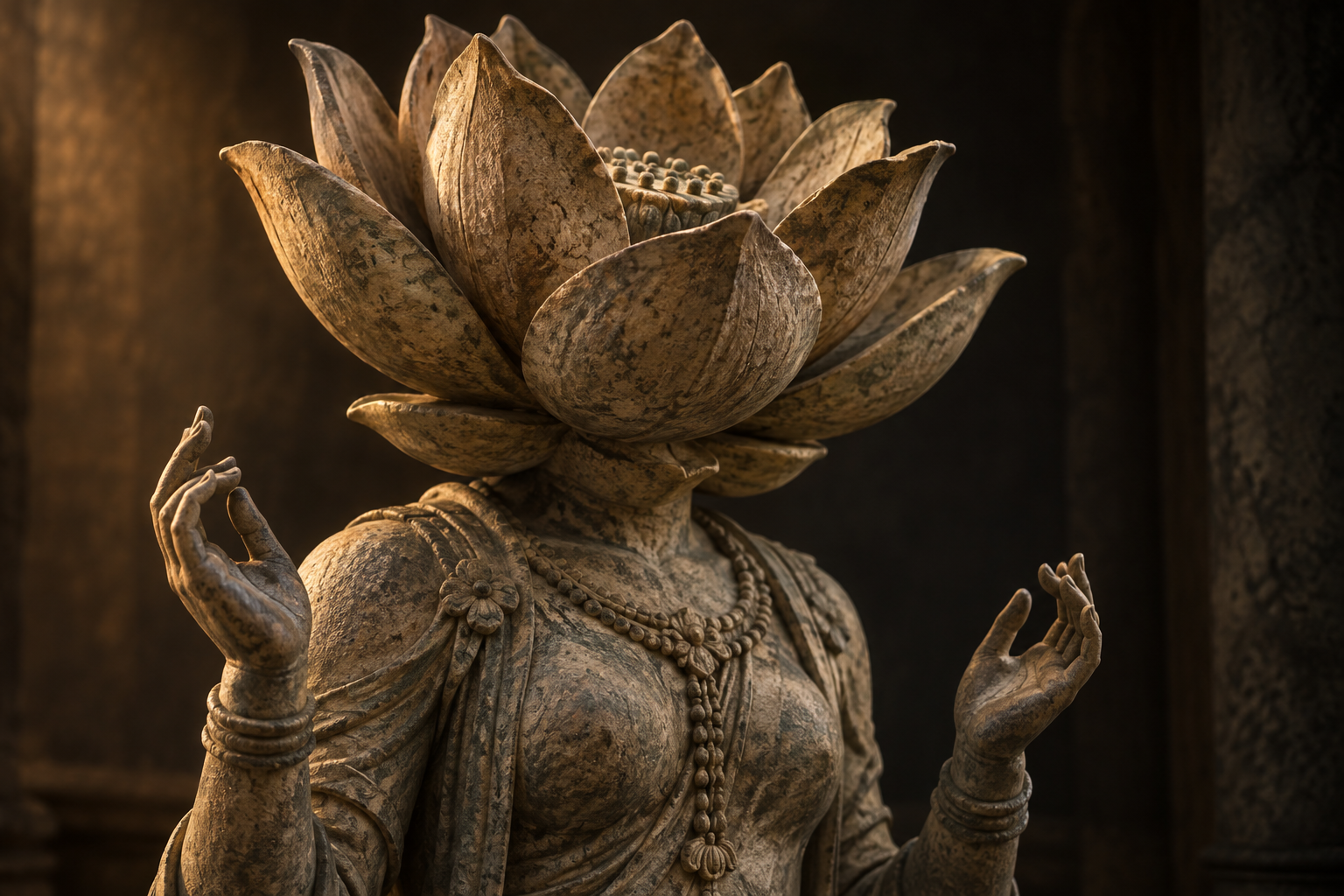
A face draws attention toward an individual. We look for eyes, expression, temperament, and biography. Without it, the usual invitation to meet a particular personality is interrupted. Your attention returns to posture, bodily openness, and the capacity for generation.
That makes a reading through Prakriti especially useful. In Dharmic thought, Prakriti is not merely scenery or passive matter. It is nature as active manifestation: the generative matrix through which embodied forms arise. Lajja Gauri can therefore be approached as an image of power before personality, fecundity before biography, and manifestation before social identity.
This does not prove that every sculptor, devotee, or community gave the form one identical explanation. Iconography can preserve several layers of meaning at once. The disciplined claim is narrower: facelessness visually supports an impersonal or transpersonal reading. It turns the image away from portraiture and toward a principle larger than an individual life.
Calling the figure faceless should not make you treat her as deficient. Nothing requires us to imagine an ordinary portrait from which a head has simply gone missing. Within the composition as encountered, absence itself performs work. What is withheld is as important as what is displayed.
Sacred exposure is not the same as sexual display

Many modern viewers have learned to classify visible reproductive anatomy almost immediately as sexual, obscene, or private. That reflex tells you something about the viewer’s conventions, but it does not settle the purpose of a sacred image. Anatomical explicitness and erotic invitation are not interchangeable.
Eroticism depends on more than the presence of a body part. It involves the image’s visual address, setting, relationships, and apparent purpose. In Lajja Gauri, the openly presented generative body can direct attention toward emergence, fertility, abundance, and the mystery of embodied life rather than toward possession or consumption.
The opposite mistake is to sanitize the image until its bodily directness disappears. If we call her merely a vague symbol of nature, we avoid the very feature the form insists that we confront. Her reproductive power is not placed behind a curtain. A faithful interpretation must allow the body to remain sacred without pretending that it is not a body.
The name Lajja Gauri also needs restraint. If you associate lajja with modesty or reserve, do not turn the compound into a complete translated sentence such as “the goddess ashamed of her body.” The visual form does not conceal itself in shame. Name and image must be read together, and the image prevents an easy equation between modesty and bodily denial.
When you encounter a confident explanation, test it against the whole composition. Does it account for the exposed generative center? Does it explain why personal facial identity is withheld? Does it respect the sacred setting? Does it distinguish the image’s visual logic from the viewer’s discomfort? An interpretation that cannot answer those questions is incomplete.
Use a disciplined method instead of a quick label
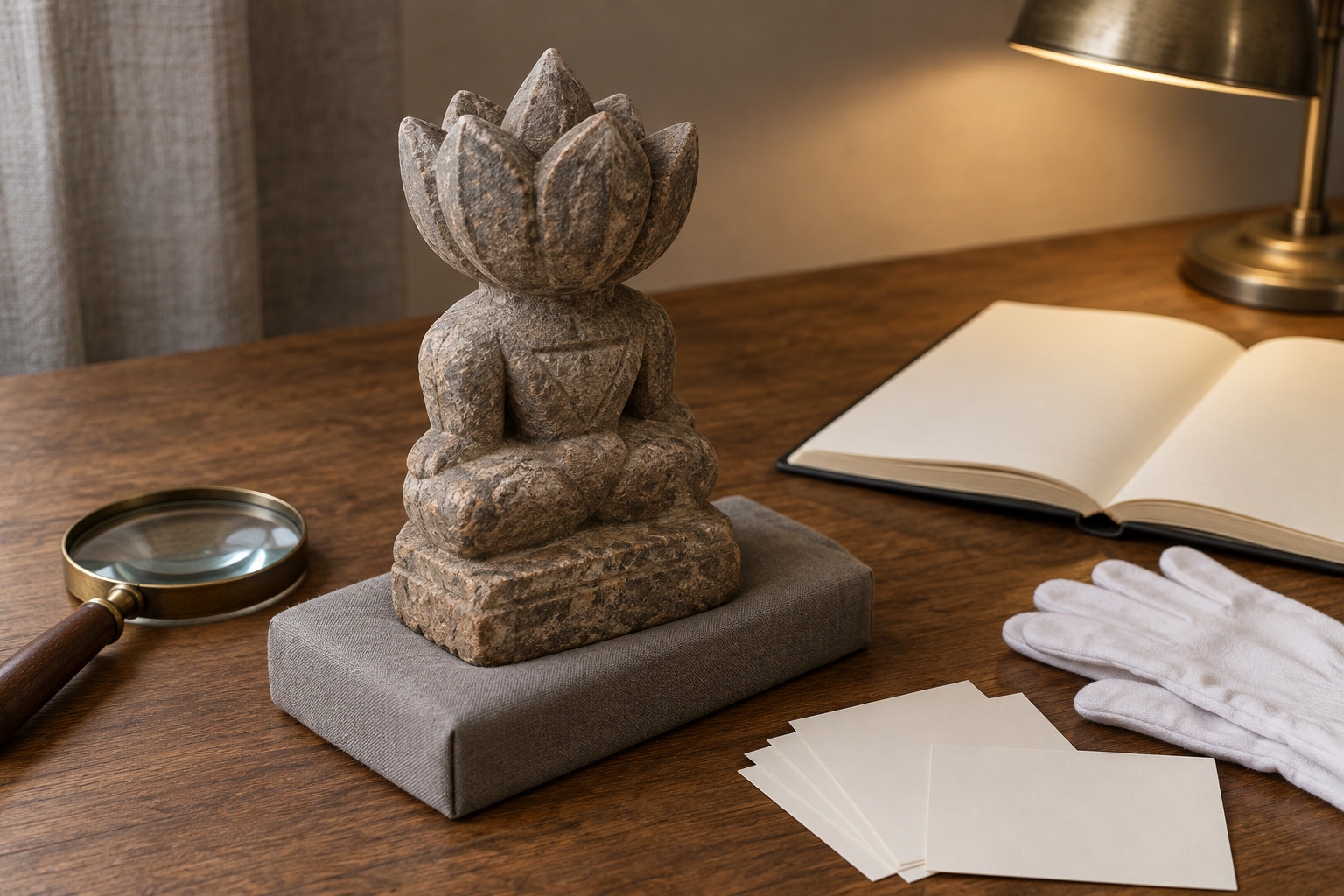
The same reading method works in a temple, a museum, a book, or a digital image. It prevents both dismissive reactions and exaggerated claims.
- Record only what you can see. Begin with the exposed female form, the emphasis on reproductive anatomy, the posture, and the absence of a conventional face. Avoid interpretive words at this stage.
- Identify the visual hierarchy. Ask where the composition sends your attention. What is enlarged, opened, centered, or withheld? Meaning is often carried by emphasis rather than by a written statement.
- Read presence and absence as a pair. The generative body is made intensely present while personal identity is held back. Interpretations should explain that contrast rather than treating each feature separately.
- Restore the setting. A cropped photograph can make an icon look like a freestanding provocation. Remember that temple placement and archaeological context change the questions you should ask, even when the exact ritual function is unknown.
- Mark your level of confidence. Distinguish what is visible, what is a plausible Dharmic interpretation, and what remains unproven. “The missing face encourages an impersonal reading” is more responsible than “we know exactly what the maker intended.”
This method exposes the limits of several common labels. “Fertility goddess” may identify an important dimension, but it can flatten the sacred feminine into biological reproduction. “Erotic goddess” can mistake anatomical candour for the image’s purpose. “Ashamed goddess” cannot easily explain the absence of concealment. Each label notices a fragment; none should replace attention to the entire visual grammar.
Questions that clarify what Lajja Gauri means for you
Does the image reduce women to childbearing?
It need not. An iconographic emphasis is not an exhaustive definition of every woman. Lajja Gauri can honour generative power without implying that a woman’s dignity depends on pregnancy or motherhood. The move from divine symbolism to a compulsory social role is not automatic. If an interpretation turns the icon into a rule that measures the worth of living women, it has crossed from reading the image into imposing an ideology upon them.
Why does she have no face?
The most defensible answer begins with visual effect: the absent face redirects attention from individual identity toward the power represented by the body. It may support an archetypal or cosmic reading, especially through Prakriti. The exact intention behind every surviving form cannot be recovered from appearance alone, so present this as a strong visual inference rather than an exclusive historical explanation.
What should you do if the image makes you uncomfortable?
Do not suppress the reaction, but do not promote it into a verdict. Name its cause as precisely as you can. Is it the exposed anatomy, the posture, the missing face, or the unfamiliar combination of sacredness and reproductive imagery? Then return to the composition and its setting. Discomfort is useful information about your encounter with the image; it is not, by itself, evidence of what the image means.
At your next encounter with Lajja Gauri, write a description that contains no moral label. Then form an interpretation that accounts for the displayed body, the absent face, and the sacred context together. If it cannot hold all three, revise it. That small discipline opens the icon on its own terms and lets the sacred feminine challenge categories that would otherwise remain invisible.
References

Leave a Reply
You must be logged in to post a comment.