
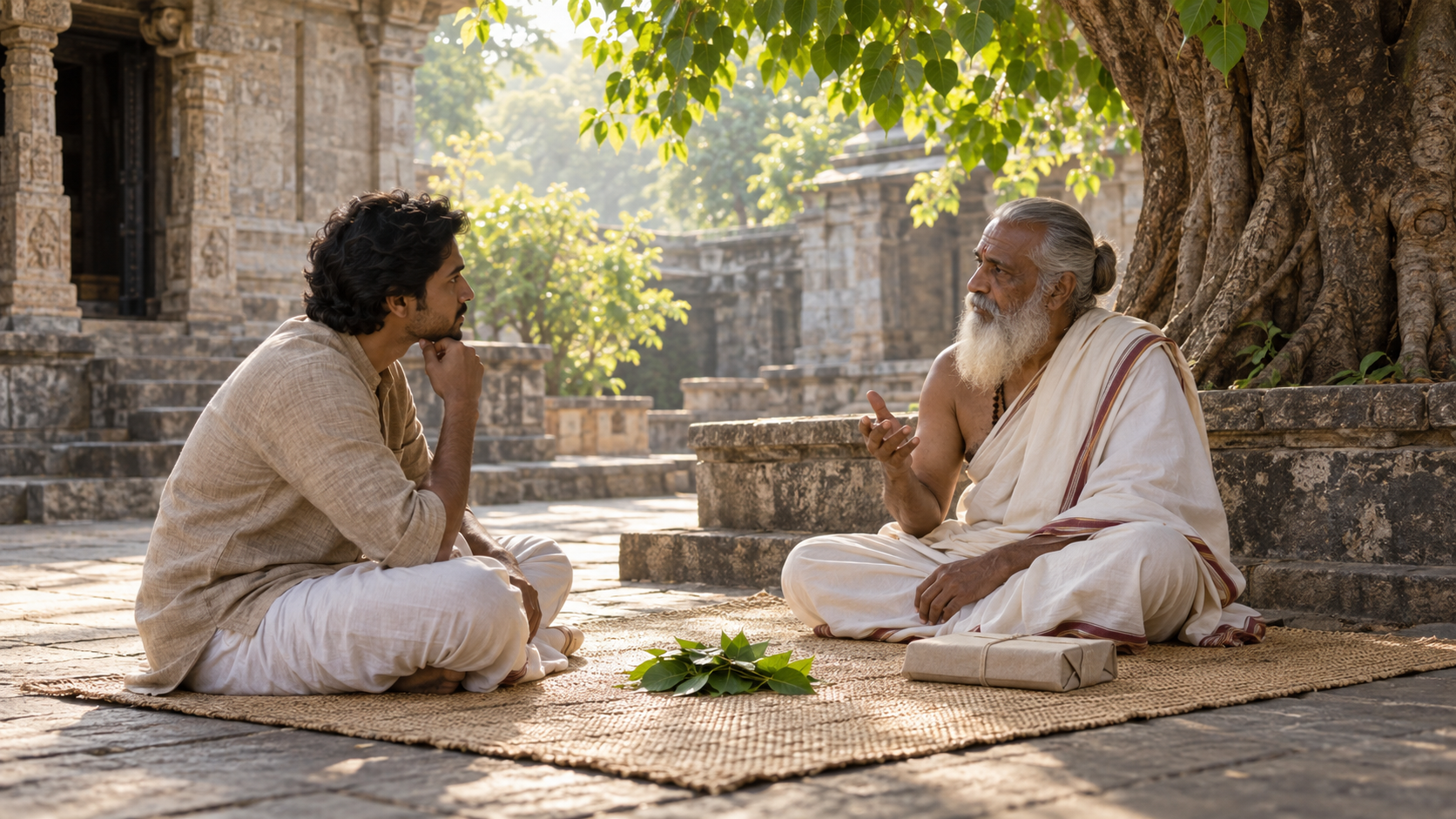
If you came looking for a list of leaves and a timetable, pause before following any recipe. Parnakricchra is a named Hindu expiatory discipline, not a generic cleanse that can be reconstructed safely from its name. Your first task is to identify the wrong being addressed, the authority for the observance, and the instructions that actually apply to you.
That caution does not make the practice irrelevant. It protects its meaning. Prayaschitta asks you to face a transgression, repair what can be repaired, accept disciplined restraint, and return to dharmic conduct. The outward observance matters, but it cannot do the moral work in your place.
What Parnakricchra means – and what the name leaves unanswered
The Sanskrit word parna means leaf, while kricchra conveys hardship, difficulty, or an austere discipline. Parnakricchra can therefore be understood as a leaf-associated form of expiation. It belongs to the ancient Hindu framework of prayaschitta, concerned with transgression, spiritual purification, and the restoration of harmony.
The name identifies the broad character of the observance. It does not, by itself, tell you the botanical identity of the leaves, whether they are consumed or used in another manner, how they are prepared, how much is used, how long the discipline lasts, who is eligible, or what completes it. Without a clearly identified textual or lineage-based protocol, those details remain unspecified. Instructions that fill in every blank without naming their traditional basis deserve scrutiny.
This distinction prevents three common mistakes. Parnakricchra is not permission to consume any leaf considered sacred. It is not proof that the harshest possible regimen is the most sincere one. It is also not a ritual mechanism for erasing responsibility while leaving harmful conduct unchanged.
A useful way to understand it is to distinguish the instrument from the purpose. Leaves belong to the discipline’s outward form. Prayaschitta is the larger moral and spiritual purpose. If you focus only on the material and ignore truthfulness, restraint, restitution, and changed conduct, you preserve the shell while losing the point.
Begin with the transgression, not the austerity

Hindu reflection on prayaschitta recognizes that human beings transgress knowingly and unknowingly. That does not make every mistake morally identical. It means that spiritual accountability is not limited to acts committed with a fully formed intention to do wrong.
When the act was deliberate
Name it without softening the description. Ask whom it harmed, what benefit you gained, whether the conduct is continuing, and what you are reluctant to surrender. A demanding observance can become another form of avoidance if you are willing to endure discomfort but unwilling to stop the act.
Where another person was harmed, outward repair remains necessary. Return what was taken. Correct a consequential falsehood. Fulfil an abandoned duty where it is still possible and appropriate. Offer an apology that acknowledges the act rather than asking the injured person to relieve your guilt. If contact would expose someone to renewed harm, seek responsible guidance instead of forcing an encounter for your own peace of mind.
When the harm was unintended or initially unnoticed
Do not confuse lack of intention with lack of consequence. Ask what you failed to know, whether reasonable care could have prevented the harm, and what habit or condition could cause it again. The proper response may include learning, correcting a recurring pattern, or changing how you make decisions.
Unintentional wrongdoing also requires proportion. Not every accidental lapse calls for the most burdensome penance you can find. The relevant question is not, “How severely can I punish myself?” It is, “What response truthfully addresses the act and helps restore dharmic order?” That question is one reason a qualified teacher matters.
Keep two responsibilities visible at once: ritual purification addresses your religious and spiritual relationship to the transgression, while ethical repair addresses its effects in the world. One should not be used to cancel the other.
How to approach Parnakricchra without inventing a ritual

A sound approach begins before you take a vow, obtain leaves, or restrict your diet. Work through the following sequence in order:
- State the matter plainly. Write one sentence describing the act, omission, or impurity you believe requires expiation. If you cannot name it, you are not ready to select a remedy.
- Stop any continuing wrong. A penance performed alongside the same misconduct contradicts its purpose.
- Identify outward repair. List what can still be returned, corrected, disclosed, restored, or prevented. Separate what you owe another person from what you wish to do for your own purification.
- Ask why Parnakricchra applies. A competent acharya, guru, or purohita should be able to explain the basis for choosing this observance rather than treating the name as a universal answer.
- Request the complete protocol. Do not act on a fragment. Obtain the exact materials, botanical identification, preparation, quantity, timing, duration, permitted substitutions, conduct expected during the observance, completion requirements, and procedure if it is interrupted.
- Check your physical capacity. If the prescribed form changes food or fluid intake, involves ingesting plant material, or conflicts with medication or a medical condition, obtain appropriate medical advice before beginning.
- Undertake only what was actually prescribed. Do not intensify the regimen to prove devotion. Do not add extra fasting, unfamiliar plants, or longer duration on your own.
- Carry the resolve beyond completion. Decide what concrete safeguard will prevent repetition: a restored daily discipline, a changed habit, greater study, accountability, or withdrawal from the situation that enabled the act.
The safety questions are not secondary. “Leaf-based” does not mean harmless, edible, or interchangeable. Do not harvest an unfamiliar plant or consume leaves merely because an image, common name, or devotional association appears to match. Botanical misidentification and unsuitable dietary restriction can cause real harm. Use only materials explicitly identified in the instructions you have received.
If illness or another genuine limitation makes the prescribed discipline unsafe, do not conceal the limitation and do not improvise an equivalent. Ask the same qualified guide whether a suitable alternative exists. A safe modification grounded in competent guidance is different from redesigning an austerity around personal preference.
You should also ask how authority is being used. A trustworthy instruction should clarify the practice rather than exploit fear. Be wary if someone demands secrecy, money, personal access, or harmful conduct as the price of purification. Prayaschitta is not a licence for coercion, humiliation, abuse, or evasion of lawful responsibility.
Key takeaways
- Parnakricchra is a leaf-associated form of Hindu expiation within the larger discipline of prayaschitta.
- The name alone does not supply a safe or complete ritual procedure.
- Begin by naming the transgression and stopping any harm that is still continuing.
- Keep spiritual purification and outward restitution together; neither replaces the other.
- Obtain tradition-specific instructions, including exact plant identification and eligibility, from a qualified guide.
- If the observance affects eating, drinking, medication, or health, seek appropriate medical advice before undertaking it.
- The measure of completion is not discomfort alone, but a credible return to dharmic conduct.
Make your next step concrete

Before searching for ritual ingredients, complete three sentences: “The wrong I am addressing is…”; “The outward repair still required is…”; and “The person I will consult for the exact traditional basis is…” If one answer is missing, resolve that gap before making a vow.
Then approach Parnakricchra with the seriousness its place in prayaschitta requires. Let competent instruction determine the form, let honest repair address the consequences, and let changed conduct show that the expiation has reached beyond the ritual moment.
References

Leave a Reply
You must be logged in to post a comment.