
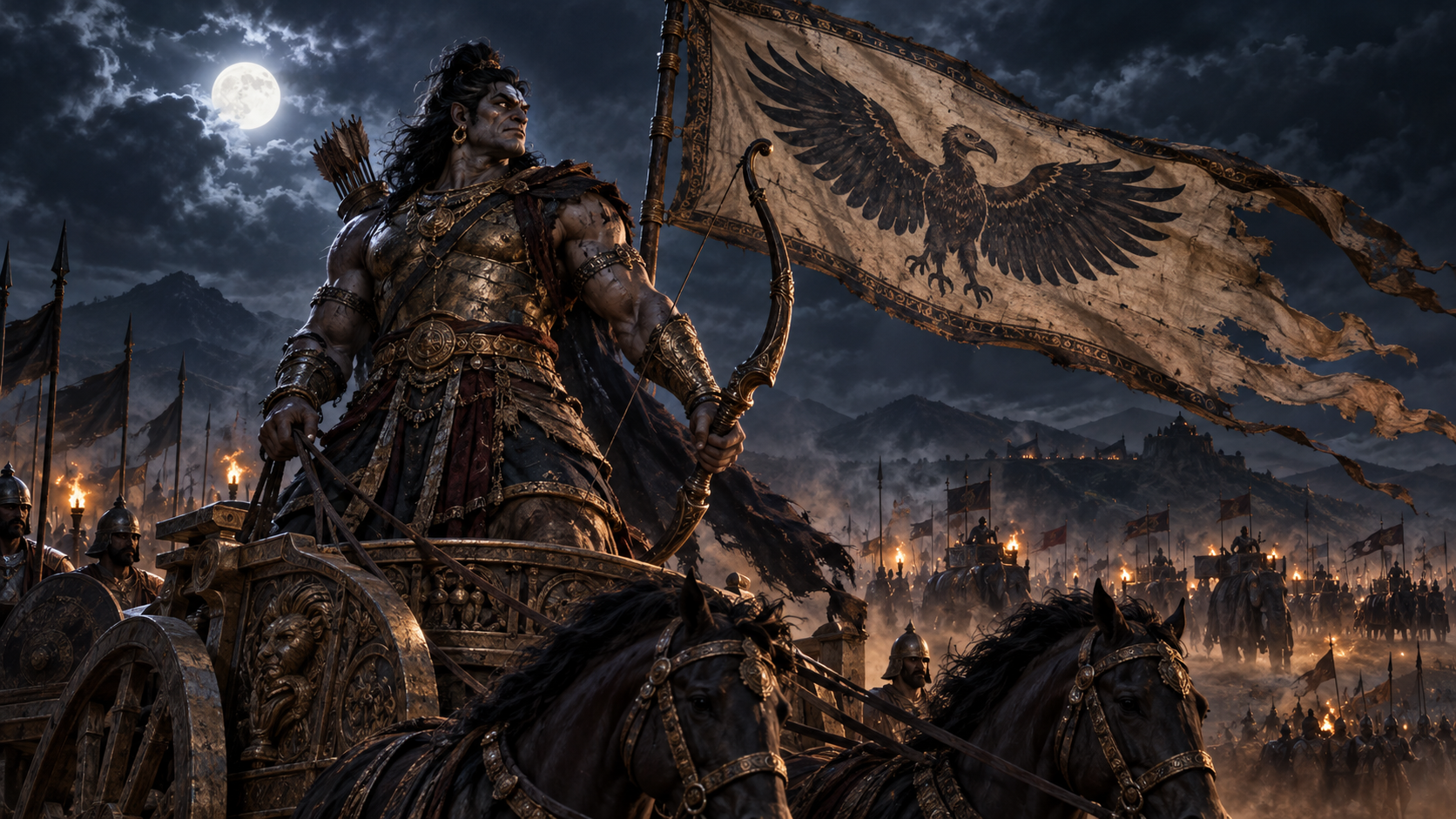
If you noticed the vulture on Ghatotkacha’s banner and wondered whether it marked him as sinister or inauspicious, pause before accepting that conclusion. It imports a modern hierarchy of attractive and unattractive animals into a battlefield language built around identity, presence and purpose.
The defensible answer is not that the vulture has one secret meaning. It is that the bird gives Ghatotkacha an unmistakable relationship with death, wilderness, watchfulness and nature’s handling of what human beings would rather not face. You can read those associations seriously without pretending that every possible interpretation is stated by the Mahabharata itself.
First separate the emblem from its interpretation
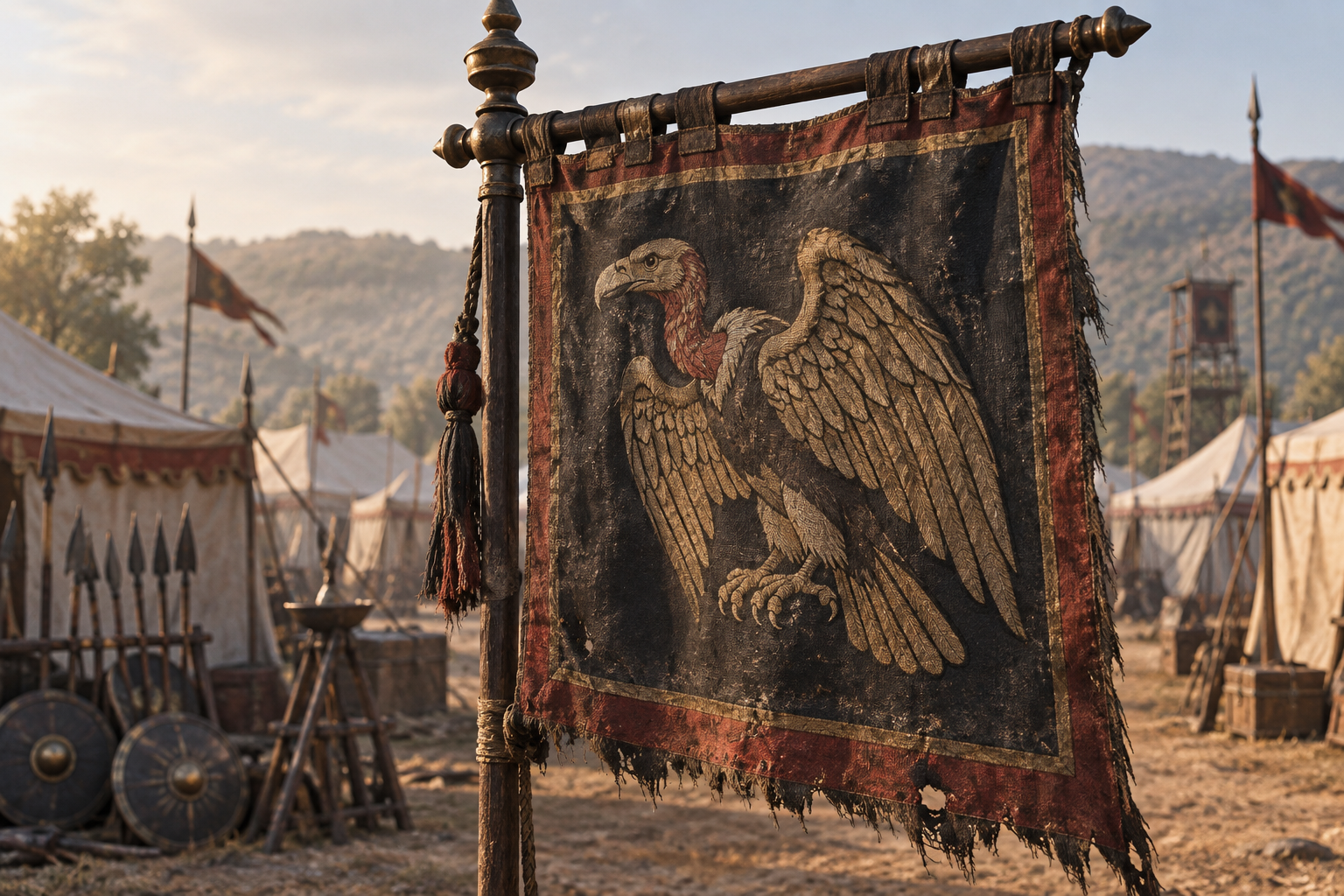
Flags in the Kurukshetra War were not incidental decoration. They identified warriors and projected a symbolic presence before weapons met. Ghatotkacha bore the vulture, while Bhishma had the palm tree, Drona the water pot, Arjuna Hanuman and Karna the elephant rope.
That comparison matters. These emblems are neither simple portraits nor moral report cards. Arjuna is not literally Hanuman, and Drona is not being reduced to a vessel. In the same way, Ghatotkacha’s vulture should not be flattened into “he is a scavenger” or “he represents evil.” The image establishes a field of associations; it does not erase the warrior beneath it.
Keep three levels distinct when you explain the banner:
- Established detail: the vulture is Ghatotkacha’s emblem.
- Immediate context: it appears within a wider system of identifying and symbolically presenting warriors.
- Interpretation: death, vigilance, wilderness and transformation are meanings the bird can evoke in the setting of war.
The first two levels give the interpretation its footing. The third requires judgement. Unless a passage or a traditional commentary explicitly assigns one exclusive meaning, treat symbolic conclusions as plausible readings rather than hidden facts you have decoded.
Why the vulture belongs on a battlefield banner
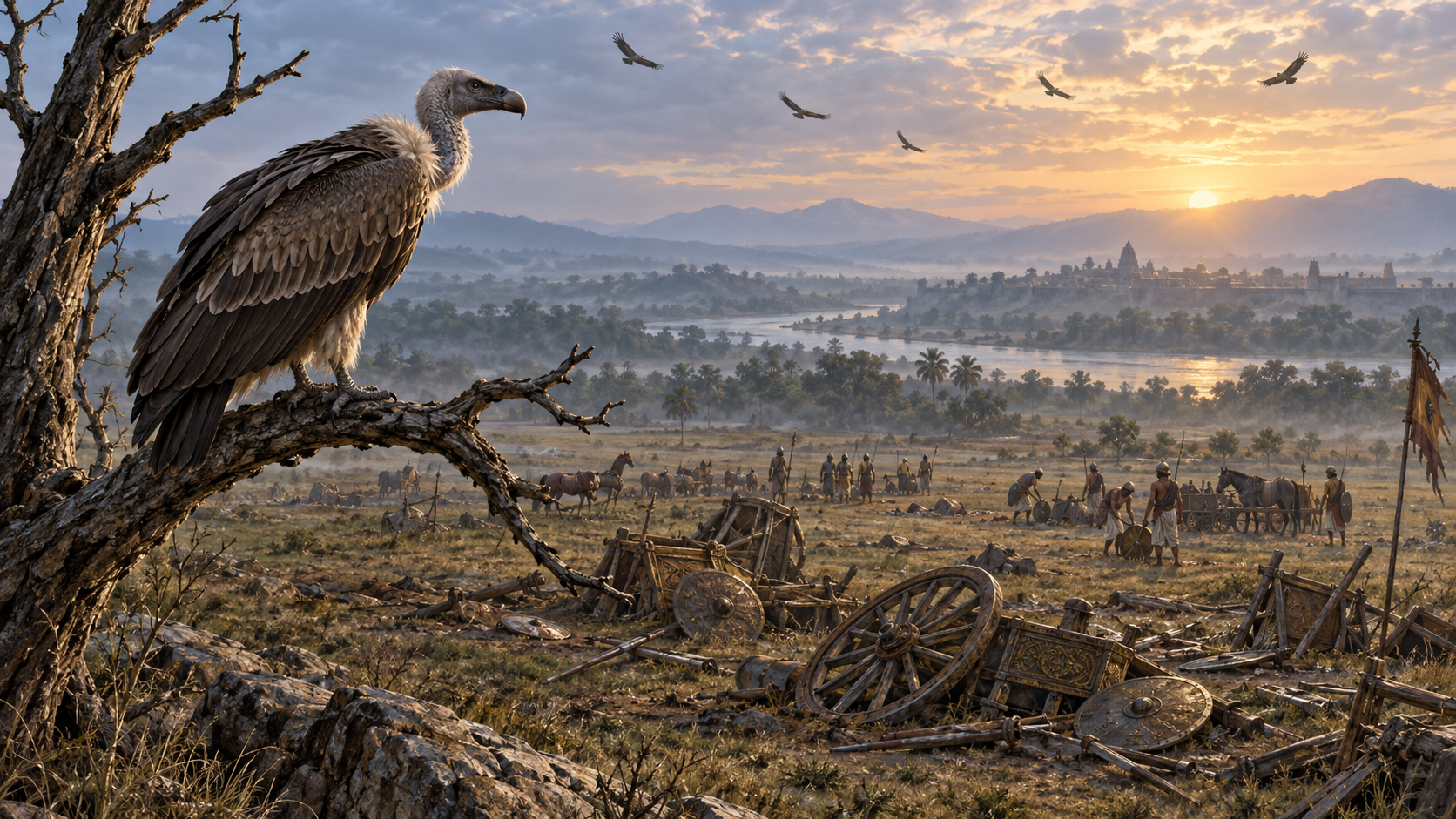
A vulture lives near death without being its cause. It feeds on remains after life has departed. On a field where warriors know that bodies will fall, that distinction gives the emblem unusual force: the bird does not promise a clean or romantic war. It points toward what war leaves behind.
This is why “inauspicious bird” is too shallow a reading. Human discomfort with carrion does not make the vulture morally corrupt. The bird performs a natural function by consuming what would otherwise decay. Symbolically, it can therefore represent not only death but also the transformation that follows death. What looks like an ending from the warrior’s position remains part of a larger natural process.
The bird’s place in the sky adds another possible meaning. A circling vulture observes from above and waits rather than rushing blindly. That makes watchfulness and command of the field reasonable associations. It does not prove that the emblem predicts events or grants supernatural sight; it tells you what kind of presence the image can project to anyone who sees the banner approaching.
The vulture also refuses aesthetic comfort. It is not chosen because it makes violence look beautiful. It forces the spectator to remember that nature contains processes humans need but prefer not to witness. For a Dharmic reader, this is a useful correction: what appears unpleasant to human taste is not automatically outside order, meaning or sacred reflection.
What the emblem lets you notice about Ghatotkacha
The vulture gives Ghatotkacha a visual identity unlike the courtly or devotional associations carried by some other banners. His emblem comes from the untamed world and remains at home above a battlefield after its heroic appearance has broken down. It announces a warrior who does not need war to look ceremonially pure before he can enter it.
That is a literary reading, not a licence to attach every negative idea about vultures to Ghatotkacha. The banner does not, by itself, prove cowardice, cruelty, low status or moral pollution. A scavenging bird need not signify scavenging conduct. The relevant traits are those that make sense in the narrative setting: endurance in the presence of death, an affinity with the wild, an elevated view of the field and comfort with realities others avoid.
You should also resist turning the emblem into a prediction of Ghatotkacha’s fate. A symbol may gain additional resonance when you read an epic retrospectively, but resonance is not the same as a coded announcement. Begin with what the banner communicates when it appears: identity, atmosphere and the kind of force entering the conflict.
This approach preserves the vulture’s dignity as a living creature rather than using it as shorthand for ugliness. It also preserves Ghatotkacha’s dignity as a warrior rather than making his identity dependent on whether modern readers find his emblem noble enough.
A reliable way to read Mahabharata banners
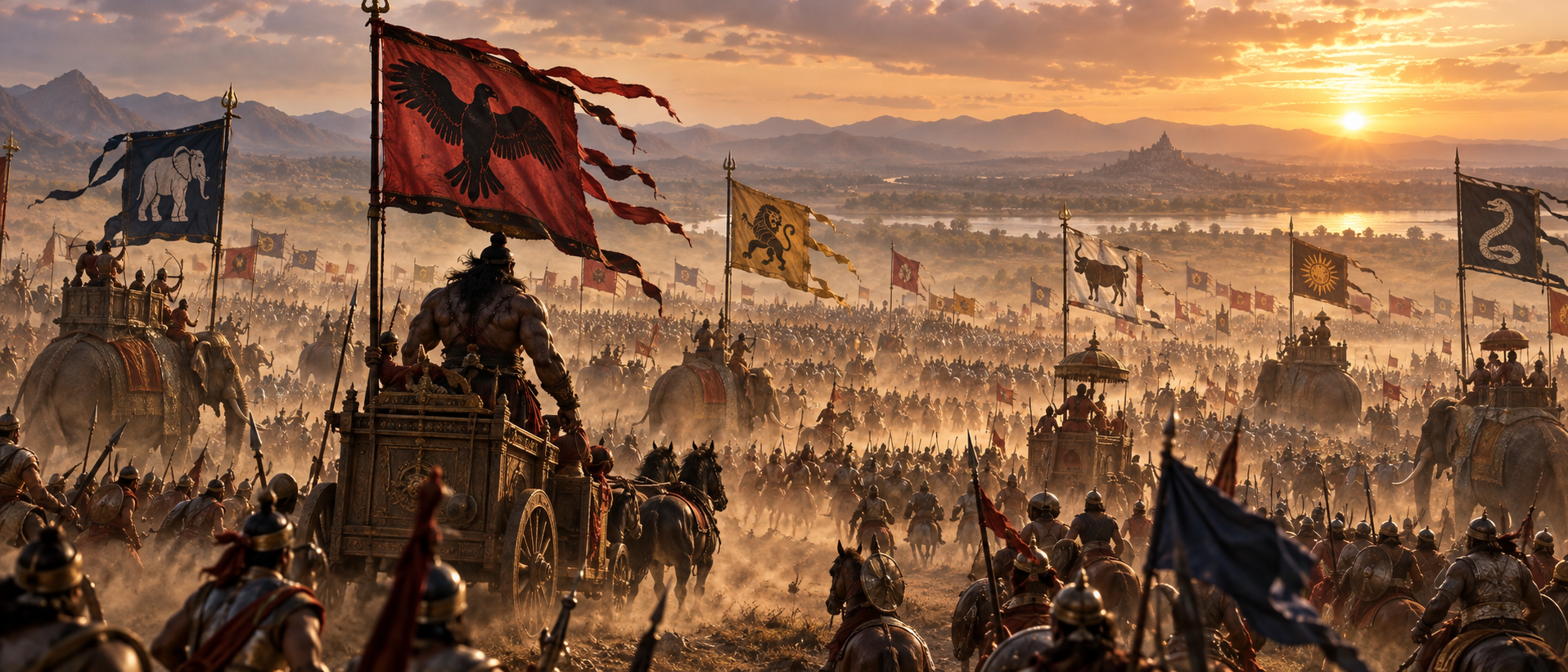
You can use the same method whenever the Mahabharata names a warrior’s standard:
- Record the exact emblem. Do not replace it with a more familiar or attractive symbol.
- Ask what the flag does in the scene. It may identify a warrior, announce an arrival, rally allies or make an opponent immediately recognisable.
- Begin with observable qualities. For the vulture, these include feeding on remains, living in the wild and watching from the air.
- Translate qualities into possible meanings. Death, transformation, vigilance and fearlessness before decay follow more naturally than a generic claim such as “the bird means evil.”
- Compare, but do not force uniformity. The palm tree, water pot, Hanuman, elephant rope and vulture do not have to encode their warriors in precisely the same way.
- Leave uncertainty visible. If the narrative does not provide an explicit gloss, retain more than one compatible meaning.
Applied to Ghatotkacha, the result is disciplined and still rich. The fixed point is the vulture banner. The battlefield and the wider system of warrior emblems supply the context. The bird’s natural behaviour supplies the symbolic vocabulary. Death, watchfulness, wilderness and transformation are then defensible possibilities, while the claim that only one of them was intended remains unproven.
This method protects you from two opposite errors. The first is dismissing the emblem as decoration. The second is inventing a rigid allegory in which every feather has a secret definition. Epic symbolism is usually more rewarding when you allow an image to carry several related associations at once.
Key takeaways
- Ghatotkacha’s vulture is a personal battlefield emblem, not a simple judgement that he is good or evil.
- The bird’s relationship with carrion makes death its clearest battlefield association, but the vulture encounters death rather than causing it.
- Transformation, aerial watchfulness and affinity with the wilderness are plausible secondary meanings.
- The other warriors’ distinct standards show that banners communicate identity and presence through different symbolic languages.
- A responsible interpretation states the emblem as fact and labels its meanings as readings unless an explicit textual explanation settles them.
When you next encounter a banner in the Mahabharata, stop before the fighting begins. Make two short notes: “what the narrative shows” and “what the emblem may evoke.” With Ghatotkacha, that small discipline turns the vulture from an apparent omen into a serious image of how a warrior stands within nature, death and war.
References

Leave a Reply
You must be logged in to post a comment.