

You notice Prakriti standing to the left of Purusha in a sacred image, and the arrangement raises an uncomfortable question: does the left-hand position make her secondary? Or is the placement expressing something that our ordinary language of rank cannot see?
Read the image as a relationship before you read it as a hierarchy. Once you distinguish consciousness from creation, establish whose left you are looking at, and examine the whole composition, the sacred left becomes a precise way of thinking about how awareness and manifested life belong together.
Purusha and Prakriti name functions, not social ranks

Purusha names awareness itself. It is not one more visible object within the world. It does not acquire a shape, rush from state to state, or become identical with whatever passes through experience. Its symbolic qualities are stillness, continuity and the capacity to be conscious.
Prakriti names generative nature. She is the dynamic principle through which form, movement, sensation and change become possible. Calling Prakriti primordial matter should not make you imagine lifeless material waiting to be manipulated. In this framework, material nature is productive: it gives rise to the world that can be seen, touched and felt.
The distinction therefore concerns two irreducible roles. Purusha illuminates experience as consciousness; Prakriti supplies the changing field of experience. The pairing asks you to hold stillness and activity together without confusing them.
| Reading question | Purusha | Prakriti |
|---|---|---|
| What does the term identify? | Conscious awareness | Creative and manifesting nature |
| What quality does it emphasize? | Stillness, continuity and formlessness | Movement, formation and transformation |
| What should you notice? | That which is aware | That which appears, acts and changes |
| What should you avoid assuming? | A biological man or a socially superior husband | A biological woman or subordinate material |
When you encounter a paired image, mentally replace the names for a moment with “awareness” and “creative nature.” If the composition becomes clearer, you are reading its philosophical grammar. If you immediately turn the pair into a household chain of command, you have probably replaced that grammar with a social assumption.
Why the left can carry sacred meaning
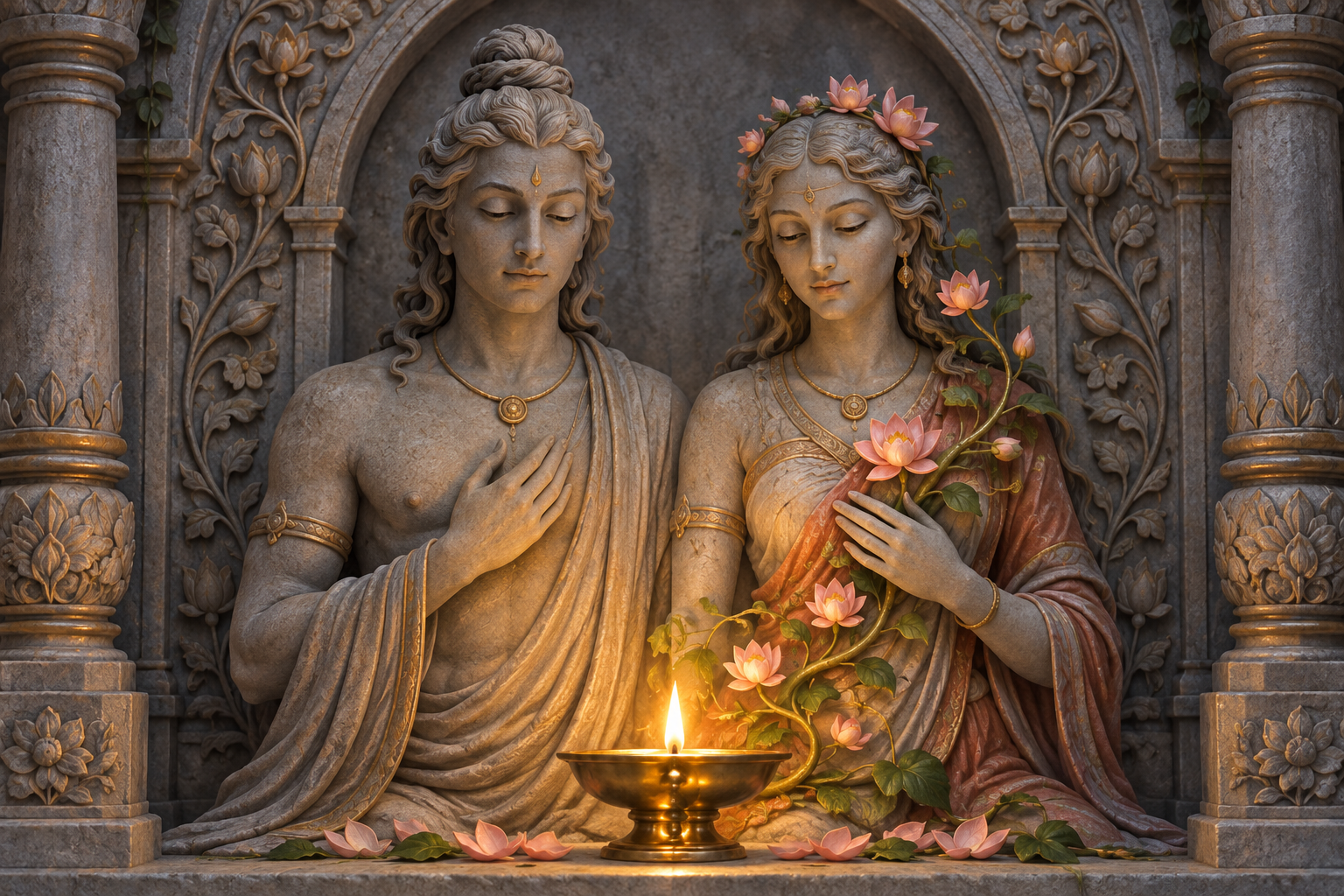
Left and right do not possess one fixed meaning in every Hindu image, rite or region. A position gains significance from the particular relationship being portrayed. That is why it is unsafe to begin with a rule such as “right is always superior” and force every sacred arrangement to obey it.
In the Purusha-Prakriti arrangement, Prakriti’s place on the left is understood as the heartside of creation. The heartside here is symbolic, not a lesson in anatomy. It indicates felt nearness, living presence and the intimacy of creative power. Prakriti is not pushed to a margin outside consciousness; she is placed beside it as the force through which a manifest world becomes present.
This changes the question you should ask. Do not ask, “Who has been assigned the better side?” Ask, “What relationship does this side make visible?” The sacred left can signify that creation is close rather than remote, necessary rather than disposable, and dynamic without being spiritually profane.
There is also a practical visual problem: the figure’s left and the viewer’s left face opposite directions. Before drawing a conclusion from a photograph, caption or temple arrangement, determine which perspective is being used. If the available description does not settle that point, state the uncertainty instead of building an interpretation on an unverified orientation.
Position is only one part of the image’s syntax. Relative scale, posture, gaze, touch, shared space and surrounding context may strengthen or qualify the meaning. Read all of those elements before treating one side of the composition as a complete explanation.
Three shortcuts that distort the symbolism
- “Left means inferior.” That conclusion imports an external ranking into a configuration in which the left has been made sacred. A symbolic contrast can distinguish functions without grading their worth.
- “Purusha means every man, and Prakriti means every woman.” The terms can be personified through masculine and feminine forms, but their philosophical work is larger than biological sex. Purusha identifies consciousness; Prakriti identifies creative nature. Turning those principles into permanent social duties is a category error.
- “The changing world must therefore be worthless.” Change is Prakriti’s defining field, not proof of her insignificance. The very act of representing creative nature in sacred proximity to consciousness prevents an easy dismissal of embodied and experienced life.
These shortcuts often reinforce one another. First, the left is declared lower. Then the feminine is identified exclusively with that supposedly lower side. Finally, a metaphysical image is recruited to justify a social hierarchy. Each step adds a claim that the symbolism itself does not establish.
You can test a proposed interpretation by asking what it makes unnecessary. If it reduces Prakriti to decoration, it cannot explain why creative nature is given a sacred position at all. If it turns Purusha into an active ruler managing a passive subordinate, it loses the contrast between unmoving consciousness and dynamic manifestation. A sound reading must preserve the distinct work of both principles.
You should also resist converting this one arrangement into a universal code for every divine pair. Hindu symbolism is contextual. The same visual side can participate in a different theological, ritual or narrative relationship elsewhere. Interpret the image in front of you before exporting its meaning to another shrine, tradition or form.
A disciplined way to read the arrangement
You do not need to become an iconography specialist before looking carefully. Use the following sequence whenever a left-right arrangement is presented as spiritually meaningful.
- Name the question carried by the image. Is the arrangement addressing consciousness and creation, stillness and action, or some other relationship? Do not assume that every paired form is answering the same question.
- Fix the viewing perspective. Determine whether “left” means the figure’s left or the observer’s left. Use the temple’s own identification, a reliable caption or the composition’s stated convention when one is available.
- Separate metaphysical function from human identity. Write down “awareness” for Purusha and “manifestation” for Prakriti. Begin with those functions before considering masculine and feminine personification.
- Read the whole visual sentence. Notice whether the figures share a seat or base, face one another, differ in scale, touch, mirror each other, or carry contrasting signs. Placement matters, but it does not speak alone.
- Test the interpretation for complementarity. The reading should explain why formless consciousness and form-producing nature appear together while remaining distinguishable. If one side becomes ornamental or expendable, revise the reading.
- Stop where the evidence stops. Do not turn a plausible interpretation of one configuration into a claim about every Hindu tradition, every use of left and right, or the proper social position of men and women.
Suppose you are shown a composition in which an unmoving figure is paired with an active figure on the sacred left. A careful first reading would be: consciousness is accompanied by creative power at the side of living nearness. An incautious reading would be: the wife has been placed in a lesser position. The first uses the concepts and the composition; the second assumes a domestic hierarchy that has not been demonstrated.
This method also gives you a useful way to evaluate explanations offered in conversation or online. Ask whether the explanation defines Purusha and Prakriti, resolves the viewing perspective, considers the complete image, and acknowledges the limits of its claim. If it does none of those things, confidence alone does not make it reliable.
Key takeaways
- Purusha identifies conscious awareness; Prakriti identifies dynamic, form-producing nature.
- The distinction is metaphysical. It should not be converted directly into a ranking of men and women.
- Prakriti’s sacred-left position can be read as the heartside of creation: intimate, generative and present beside consciousness.
- Left is not a universal synonym for inferiority, nor does it carry an identical meaning in every Hindu context.
- Always establish whether a description refers to the figure’s left or the viewer’s left.
- A persuasive interpretation must account for the whole composition and preserve the significance of both principles.
The next time you meet this arrangement, pause before assigning rank. Identify awareness, identify creative movement, settle the perspective, and then look at how the two have been brought together. That short discipline lets the sacred image challenge your assumptions instead of merely reflecting them back to you.
References

Leave a Reply
You must be logged in to post a comment.