
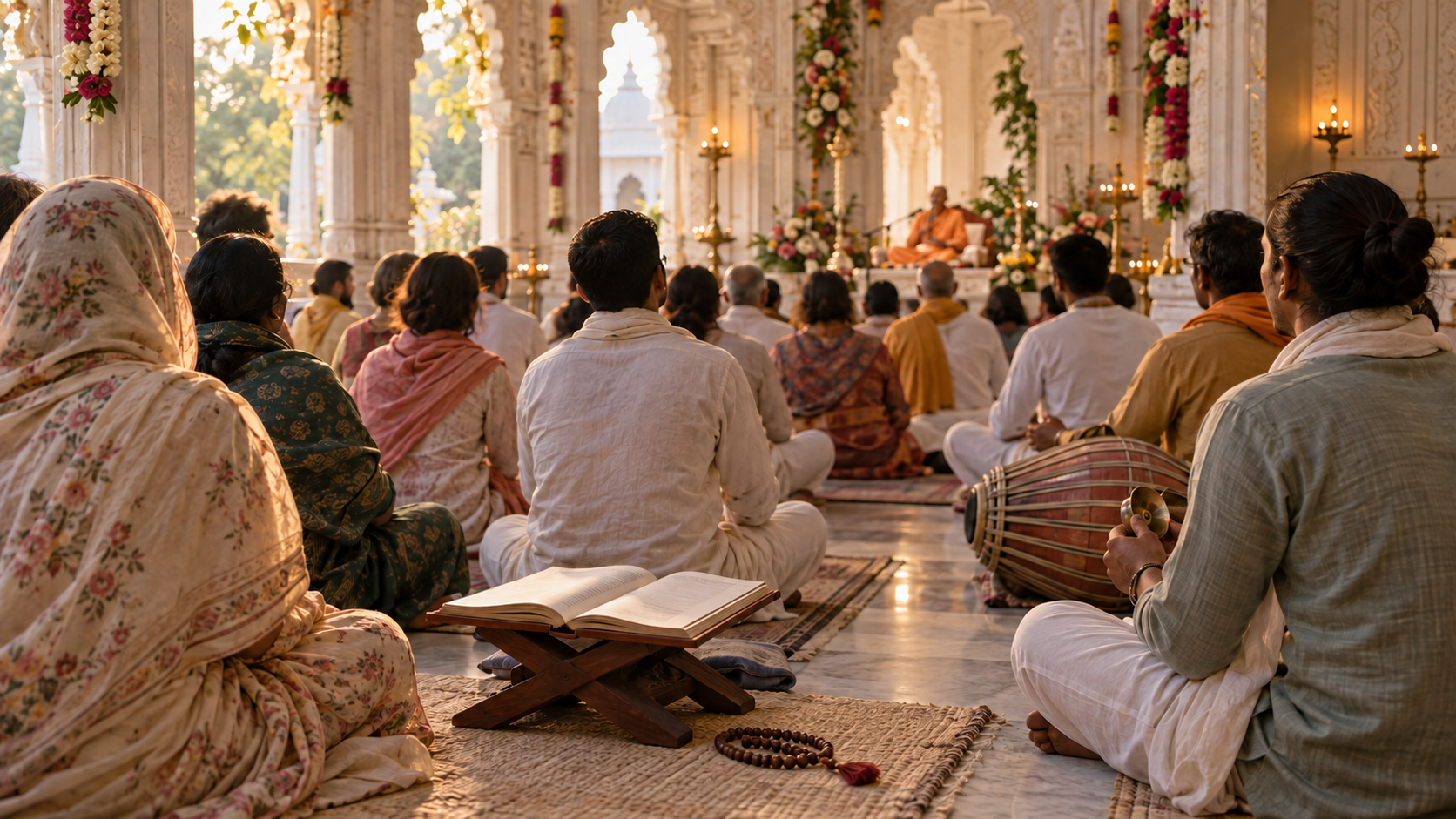
You have the discourse ready to play, but the reference looks dense: SB 11.04.13-14, a named teacher, a Vrindavan temple and kirtan in the same programme. The useful question is not simply, “What happens in the video?” It is, “How should you listen so that the teaching and the chanting leave a trace in your practice?”
His Holiness Bhakti Gaurav Narayan Swami Maharaj speaks on Srimad-Bhagavatam 11.4.13-14 in the programme dated 15 September 2026, connected with Kirtan Utsav at Sri Sri Krishna Balaram Mandir, ISKCON Vrindavan. That gives you a precise point of entry: two verses, one discourse and a devotional setting in which hearing leads naturally toward chanting.
Give the discourse and kirtan different jobs

A Bhagavata discourse and a kirtan ask for two related but distinct forms of attention. During the discourse, your task is to hear meaning. During kirtan, your task is to participate in remembrance through sound. If you treat both as background audio, you lose the distinction that makes the combination fruitful.
Begin with shravana, attentive hearing. Follow the speaker’s movement from the scriptural words to their explanation and then to their practical consequence. Do not measure the discourse by how many facts you can collect. Listen for the one distinction, warning or instruction that changes how you understand the passage.
Let kirtan do something different. You no longer need to organise every sentence intellectually. Hear the lead, answer the response and return when the mind wanders. The repetition is not an absence of content; it is the method by which attention is gathered around the sacred name.
Use SB 11.4.13-14 as your listening anchor

From the verse numbers alone, you know the location in the text, not the interpretation. Resist the urge to arrive with a guessed summary. If you have a copy of the Srimad-Bhagavatam, read verses 13 and 14 of Canto 11, Chapter 4 in the edition you normally use. If you use a translation, keep it beside you because wording can differ between editions.
A simple two-pass method will keep the discourse from dissolving into general inspiration:
- Write “SB 11.4.13-14” at the top of a page before you begin. This prevents your notes from becoming detached from the text.
- Listen once without frequent pausing. Your first task is to follow the complete movement of the explanation.
- On a second hearing, pause only when you notice a decisive word, a distinction or a direct application.
- Arrange your notes under three labels: “Text,” “Explanation” and “Practice.” Put the words of the verses under the first, the teacher’s exposition under the second and your own response under the third.
- End with one unresolved question. A precise question is more useful than a page of vague agreement.
The three-label method matters because a discourse contains several layers. The scriptural verse, the teacher’s commentary and your personal inference are not interchangeable. Keeping them separate allows you to revisit the passage honestly and prevents a passing impression from being remembered as the text itself.
Your practice note should also be concrete. “Be more devotional” is too vague to survive the day. “Give the first minutes of tomorrow’s japa my full attention” or “return to the two verses before opening unrelated media” tells you what to do and when to do it.
Enter the kirtan without making it background sound

Kirtan is easiest to enter when you stop trying to perform it. The leader carries the phrase; the congregation responds. Your first discipline is therefore listening, not volume. Hear the full lead before answering, especially when the melody or pattern is unfamiliar.
- Wait for the response rather than anticipating the leader. This keeps you with the shared rhythm.
- Repeat the phrase you actually hear. Do not add melodic variations merely to display familiarity.
- Use a comfortable pitch and volume. Clear, steady participation serves the kirtan better than strain.
- If you do not yet know the response, listen through one cycle and join when the pattern becomes clear.
- Keep unrelated tabs, messages and commentary closed. Divided attention quickly turns sacred sound into ambience.
If you are participating through a screen, you cannot reproduce the physical presence of a temple congregation. You can still protect the inner conditions of hearing: choose one uninterrupted period, sit or stand attentively, and do not browse while the chanting continues. The practical test is simple. If you can no longer hear the lead clearly enough to respond, your attention has moved elsewhere.
Let Vrindavan shape your attention without romanticising it

For Vaishnavas, Vrindavan is inseparable from remembrance of Krishna and His lila. Sri Sri Krishna Balaram Mandir is therefore more than a venue name attached to the programme. Its devotional setting tells you how the discourse and kirtan are meant to be approached: as seva through hearing and chanting, not simply as religious content to consume.
That does not mean pretending that watching from home is the same as standing in the mandir. Honour the difference. A remote listener receives access to the teaching and sacred sound, while a pilgrim in Vrindavan also encounters the temple, the congregation and the disciplines of being physically present. Reverence does not require you to blur those experiences.
Use the location to sharpen three questions. What does the discourse ask you to understand? What does the kirtan ask you to remember? What will you carry into conduct after the sound stops? These questions connect scripture, devotion and daily dharma without forcing an interpretation onto verses before you have heard them explained.
Key takeaways
- Read SB 11.4.13-14 in your own edition before or immediately after listening.
- Separate the words of the verses, the teacher’s explanation and your personal inference.
- Use two passes: one for the overall teaching and one for careful notes.
- In kirtan, hear the lead completely, answer the response and return gently when attention wanders.
- Finish with one specific practice and one precise question rather than a vague feeling of inspiration.
Set aside one uninterrupted sitting for the programme. Put the Bhagavatam and a blank page beside you, write the verse reference at the top, and begin with the intention to hear one teaching well. When kirtan begins, close the notebook and participate. That small change of posture can turn a video you merely watched into a discourse you studied and a kirtan you actually entered.
References

Leave a Reply
You must be logged in to post a comment.