
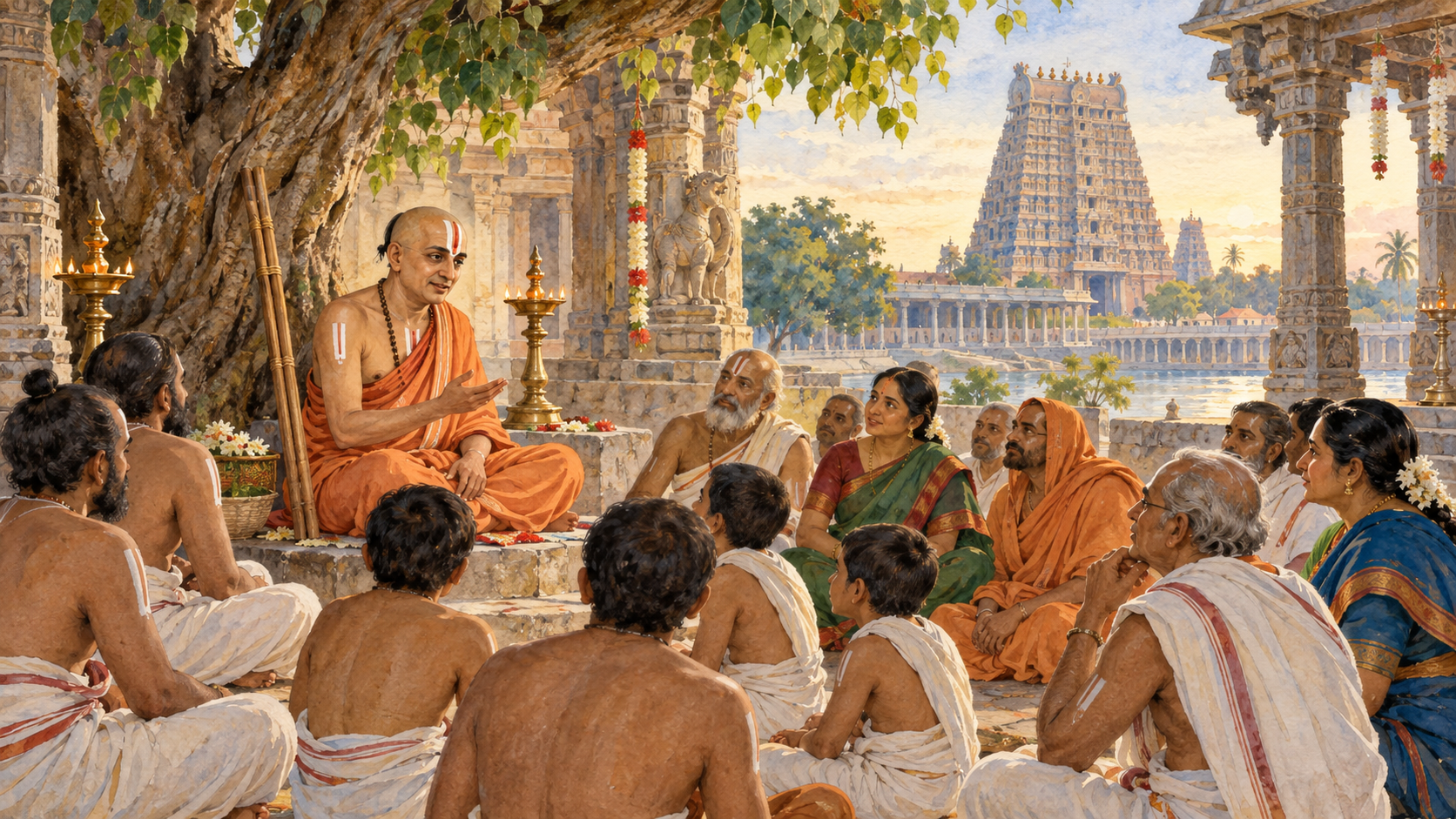
You may know Ramanujacharya as a revered acharya whose birth is celebrated each year, yet still wonder what accepting his teaching would change in your life. His answer joins ideas that are often pulled apart: Bhagavan is one, individual souls and the world matter, devotion requires understanding, and surrender must become service.
The practical direction is clear. Do not treat moksha as a self-made escape from creation. Learn to see yourself as belonging to Bhagavan, cultivate a personal relationship through bhakti, depend on divine grace without abandoning disciplined effort, and test your worship by the compassion it produces.
Read his life through the work he chose
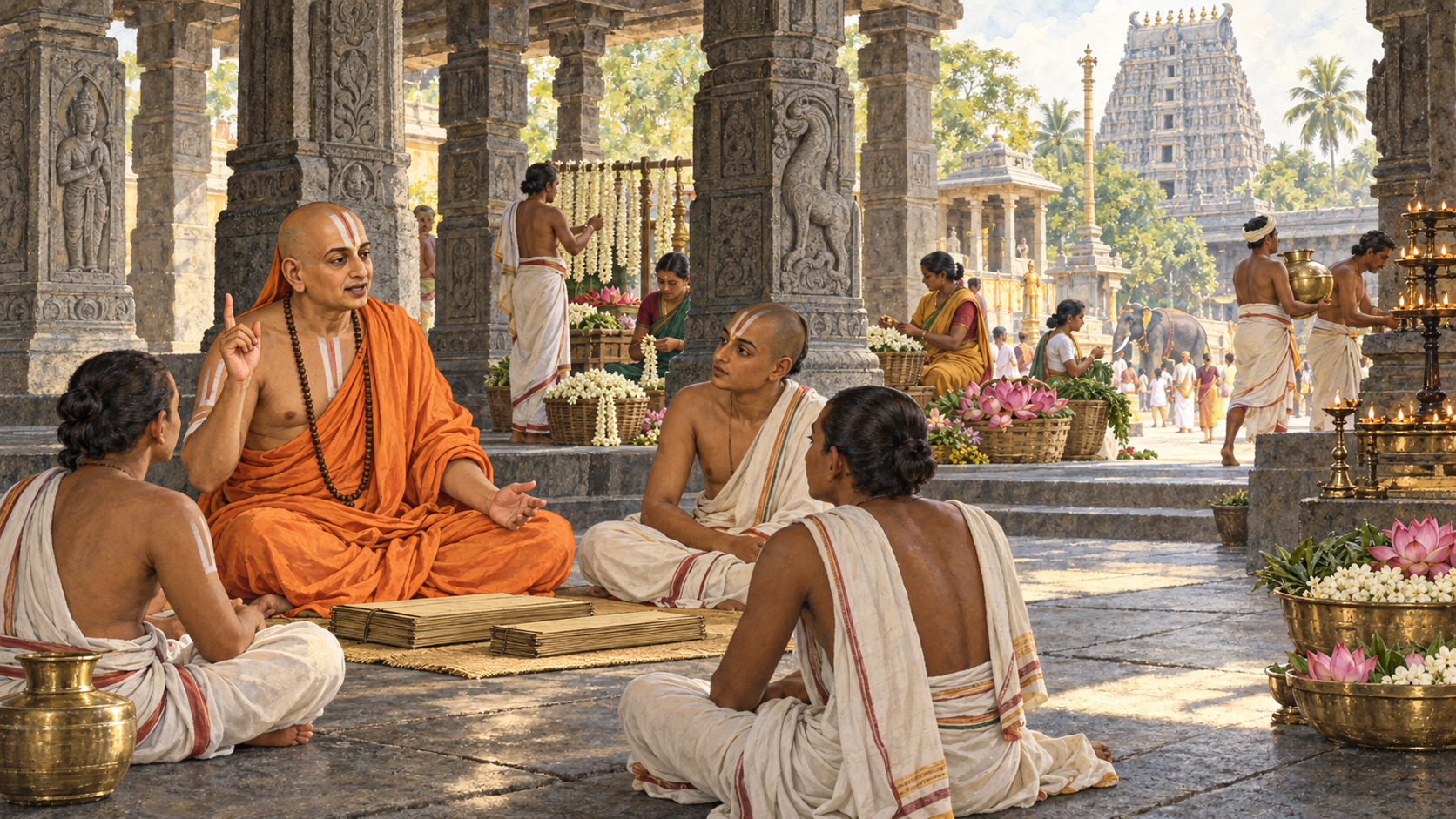
Ramanujacharya was born in 1017 CE at Sriperumbudur in present-day Tamil Nadu and lived until 1137 CE. He became a philosopher, theologian, and leading exponent of Vishishtadvaita. The central purpose of his life was not philosophy for its own sake. He directed learning, devotion, and religious practice toward service to God and the welfare of people.
His thought brought together the Vedas, Upanishads, Bhagavad Gita, and the devotional inheritance of the Alvars. That synthesis tells you how to approach him. He should not be reduced either to an abstract metaphysician or to a saint remembered only through devotional celebration. Reason, scripture, worship, surrender, and ethical conduct belong to one spiritual project.
- As a philosopher, he addresses the relationship between the one Supreme Being and the many souls and forms within creation.
- As a theologian, he presents Brahman as Bhagavan, possessing qualities such as knowledge, power, and compassion.
- As a spiritual teacher, he asks how that understanding should shape devotion, humility, service, and conduct toward other living beings.
Use those three lenses whenever you encounter one of his teachings. Grace, for example, is not merely a doctrine about liberation. It describes the soul’s dependence on Bhagavan, becomes trust in devotional life, and prevents spiritual discipline from turning into pride. If an explanation has no effect on worship or conduct, it has probably captured only part of Ramanujacharya’s purpose.
Vishishtadvaita preserves unity without erasing difference

Vishishtadvaita means qualified non-dualism. It begins with the unity of the Supreme Being but does not turn that unity into a featureless abstraction. Brahman is one and possesses real divine qualities. Individual souls do not stand outside this ultimate reality as completely independent beings; they belong within it. The universe, too, expresses divine energy.
This gives you a disciplined way to think about unity in diversity. Difference does not have to mean absolute separation, and unity does not require the erasure of every distinction. A soul can be intimately related to Bhagavan while still being capable of devotion, surrender, responsibility, and service. Creation can belong to the divine order without every finite being becoming simply interchangeable with Bhagavan.
Keep four convictions together when you study Vishishtadvaita:
- The Supreme Being is one.
- Bhagavan is characterized by knowledge, power, compassion, and other meaningful qualities.
- Individual souls possess spiritual worth and responsibility while remaining dependent on the Supreme Being.
- The world and its living beings are not spiritually disposable; they exist within an interconnected divine reality.
Each conviction protects the others. Bhagavan’s qualities make loving worship intelligible. The soul’s dependence makes grace intelligible. The reality of other souls makes seva and equality intelligible. The divine interconnectedness of life makes compassion and nonviolence more than optional sentiments.
A common practical mistake is to use spiritual unity as an excuse to ignore concrete differences and duties. Another person’s hunger, exclusion, or suffering does not become unreal because all beings belong within one divine order. Vishishtadvaita asks you to meet difference without imagining complete separation. If your understanding of unity makes worship, responsibility, or care for others seem unnecessary, something essential has been lost.
When reading a scriptural passage through this framework, ask three questions: What does it reveal about Bhagavan’s qualities? How does the soul respond to Bhagavan? What duty toward other beings follows from that relationship? These questions turn a difficult philosophical term into a usable method of study.
Bhakti, grace, and prapatti form one path

Ramanujacharya presents bhakti as a path to moksha, but bhakti is more than a passing religious emotion. It is the cultivation of a personal relationship with Bhagavan, sustained through remembrance, scriptural understanding, worship, and conduct. Feeling can belong to devotion, but feeling alone does not complete it.
Grace, or anugraha, keeps this path from becoming a spiritual transaction. Liberation is not something the ego manufactures by accumulating rituals, arguments, or achievements. Faith, sincere devotion, and the desire for liberation matter, but the soul still depends on Bhagavan’s grace.
Prapatti makes that dependence conscious. It means surrendering ego and self-centered desire to Bhagavan and relying on divine grace. This is not an excuse for passivity or negligence. The same framework requires study, devotion, charity, kindness, and service. You relinquish the claim that these actions make you spiritually self-sufficient; you do not relinquish the actions themselves.
- Bhakti without surrender can become attachment to one’s identity as a devotee.
- Surrender without disciplined devotion can become passive language with no change in conduct.
- Effort without grace can become a bargain in which ritual is treated as payment for liberation.
- Grace without seva can become a private idea disconnected from the welfare of other beings.
A simple daily cycle can keep the four elements connected:
- Remember a divine quality such as knowledge, power, or compassion. Do not begin only with what you want Bhagavan to provide.
- Read a short passage from the Bhagavad Gita, an Upanishad, the Vedas, or an Alvar composition with the aim of understanding the relationship between Bhagavan, the soul, and duty.
- Translate the passage into conduct. If it concerns compassion, identify the person or living being toward whom compassion is presently difficult.
- Perform seva without making recognition, gratitude, or status the condition for doing it.
- Release ownership of the result. Offer the credit, disappointment, and anxiety surrounding the action to Bhagavan.
Scriptural study has a defined role here. It gives devotion direction and provides guidance for ethical and spiritual life. It should not become the collection of quotations for defeating another person. Ramanujacharya’s emphasis on dialogue and respectful debate allows genuine disagreement, but it requires you to understand a position before answering it. Synthesis does not mean pretending that every doctrine is identical.
The ethical test is how you treat embodied life
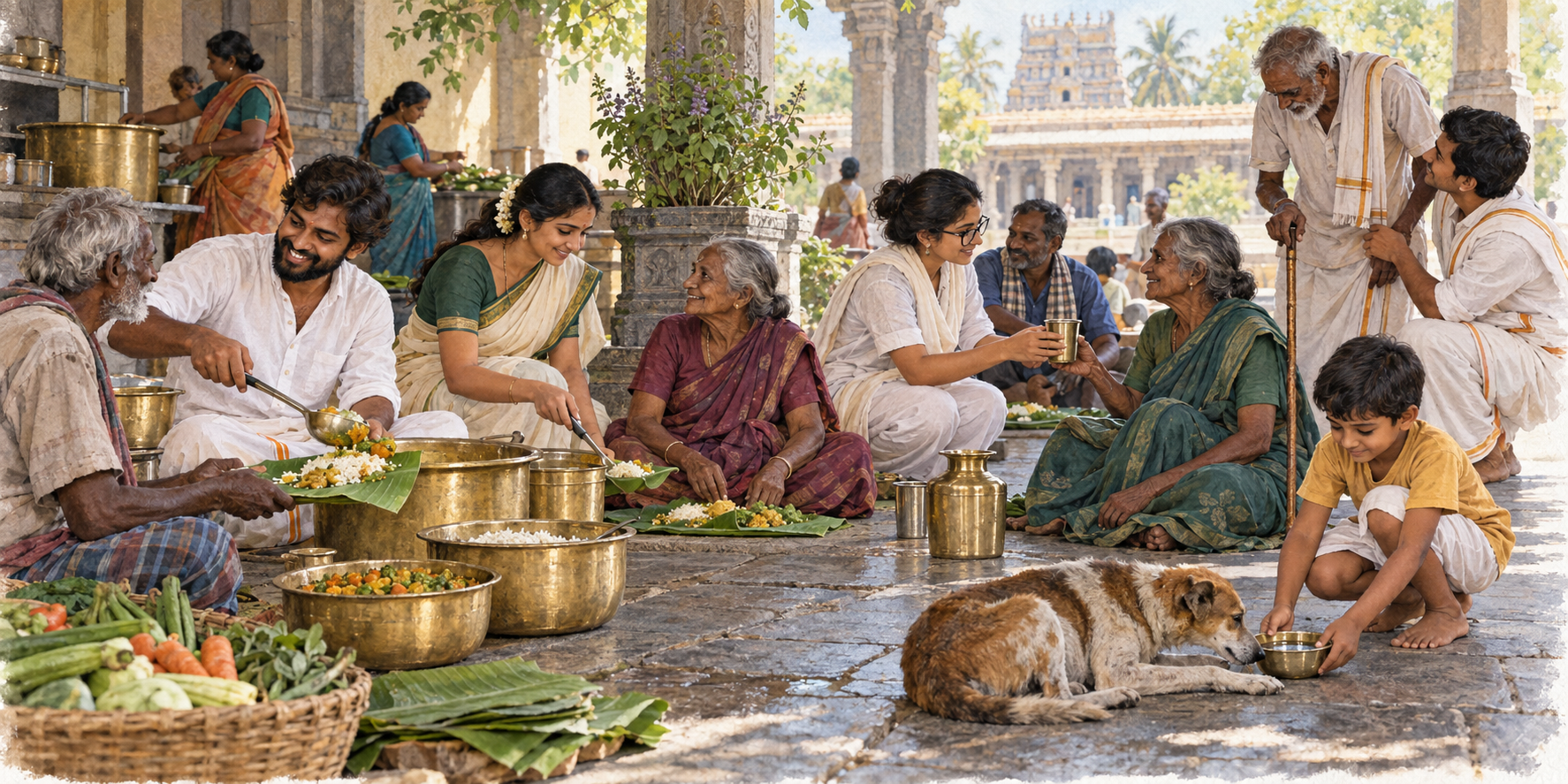
Ramanujacharya’s teaching assigns equal spiritual worth to jivatmas regardless of caste, gender, or social standing. Birth does not make one soul more valuable to Bhagavan than another. He opposed the idea that a hierarchy of birth should determine spiritual worth and encouraged wider participation in religious life.
This is not an ornamental social message added to his metaphysics. If souls belong within one divine reality, contempt for another person contradicts what you claim to believe. Equality before Bhagavan must affect access, respect, service, and the way religious communities treat those with less social power.
- In worship, notice whether participation is being confused with inherited prestige. Ask whether people are welcomed as souls or ranked primarily by social identity.
- In seva, examine who receives care and who performs the least visible work. Service should not reproduce the pride that surrender is meant to loosen.
- In charity, protect the dignity of the person being helped. Another jivatma is not a prop for displaying your virtue.
- In food and ritual, take nonviolence seriously. Ramanujacharya rejected animal sacrifice and advocated vegetarianism as expressions of compassion toward living beings.
- In ordinary conduct, look beyond formal ritual. Kindness, restraint from harm, and respect are places where theology becomes visible.
The interconnectedness of life also widens the field of responsibility. The universe is not merely a background for an isolated soul’s liberation. Living beings participate in a larger whole grounded in the divine. Compassion therefore belongs inside spiritual practice, not outside it as a separate charitable interest.
This standard can be uncomfortable, which is precisely why it is useful. A vegetarian offering does not by itself fulfill nonviolence if the people preparing or serving it are treated without dignity. A learned discourse does not fulfill devotion if it produces arrogance. A public ritual does not fulfill surrender if it becomes a means of excluding souls whose spiritual worth is affirmed in doctrine. Dharma here is devotion made visible in relationships.
Make Ramanujacharya Jayanti a renewal of practice
Ramanujacharya Jayanti is observed on Vaishakha Purnima, which falls during April or May. Celebrations are especially prominent in southern India. Temples hold prayers and rituals, devotees offer food and flowers, and communities organize bhajans, lectures, and discourses. The Ranganathaswamy Temple at Srirangam is among the temples associated with the observance.
A distinctive practice is the recitation of the Ramanuja Nootrandhadhi, a collection of 108 verses honoring Ramanujacharya. Recitation preserves devotional memory, but the occasion becomes more useful when praise leads into study and service.
You can structure a home or community observance around the movement of his teaching:
- Begin with a real question. Choose something you do not yet understand about Vishishtadvaita, grace, bhakti, or surrender.
- Study before discussing. Read from the Bhagavad Gita, Upanishads, Vedas, or the Alvar tradition alongside a careful explanation of Ramanujacharya’s framework.
- Recite and praise. Include the Ramanuja Nootrandhadhi where appropriate, or use devotional songs and prayers that keep attention on Bhagavan rather than on social display.
- Make an offering. Food and flowers can express devotion when they are given attentively rather than treated as automatic gestures.
- Connect worship to seva. Add an act of charity, kindness, inclusion, or care for living beings that answers an actual need.
- End with prapatti. Name the result, recognition, resentment, or desire for control that you need to surrender, and place it before Bhagavan.
If you are helping organize a temple or community event, let the discourse answer practical questions rather than merely repeating honorifics. Ask the speaker to explain how Vishishtadvaita changes worship, why effort and grace are not opposites, and what equality of souls demands from the community. A celebration becomes a living inheritance when participants leave knowing what to practise.
Key takeaways
- A sound understanding of Vishishtadvaita affirms one Supreme Being without making souls, divine qualities, or the world meaningless.
- Bhakti should deepen your personal relationship with Bhagavan, not merely intensify religious emotion.
- Grace makes liberation a gift rather than an achievement, while prapatti releases the ego’s claim to control the path.
- Seva, spiritual equality, compassion, and nonviolence are tests of whether philosophy has entered conduct.
- Jayanti observance is most faithful when praise is joined to study, service, and a renewed act of surrender.
Begin with a passage of scripture, an act of service that brings you no recognition, and one result you find difficult to surrender. Put all three into the same practice. That is where Ramanujacharya’s teaching stops being a subject you know about and becomes a way you live.
References
- DharmaRenaissance Blog – Ramanujacharya Jayanti: Celebrating the Life and Teachings of a Great Saint
