
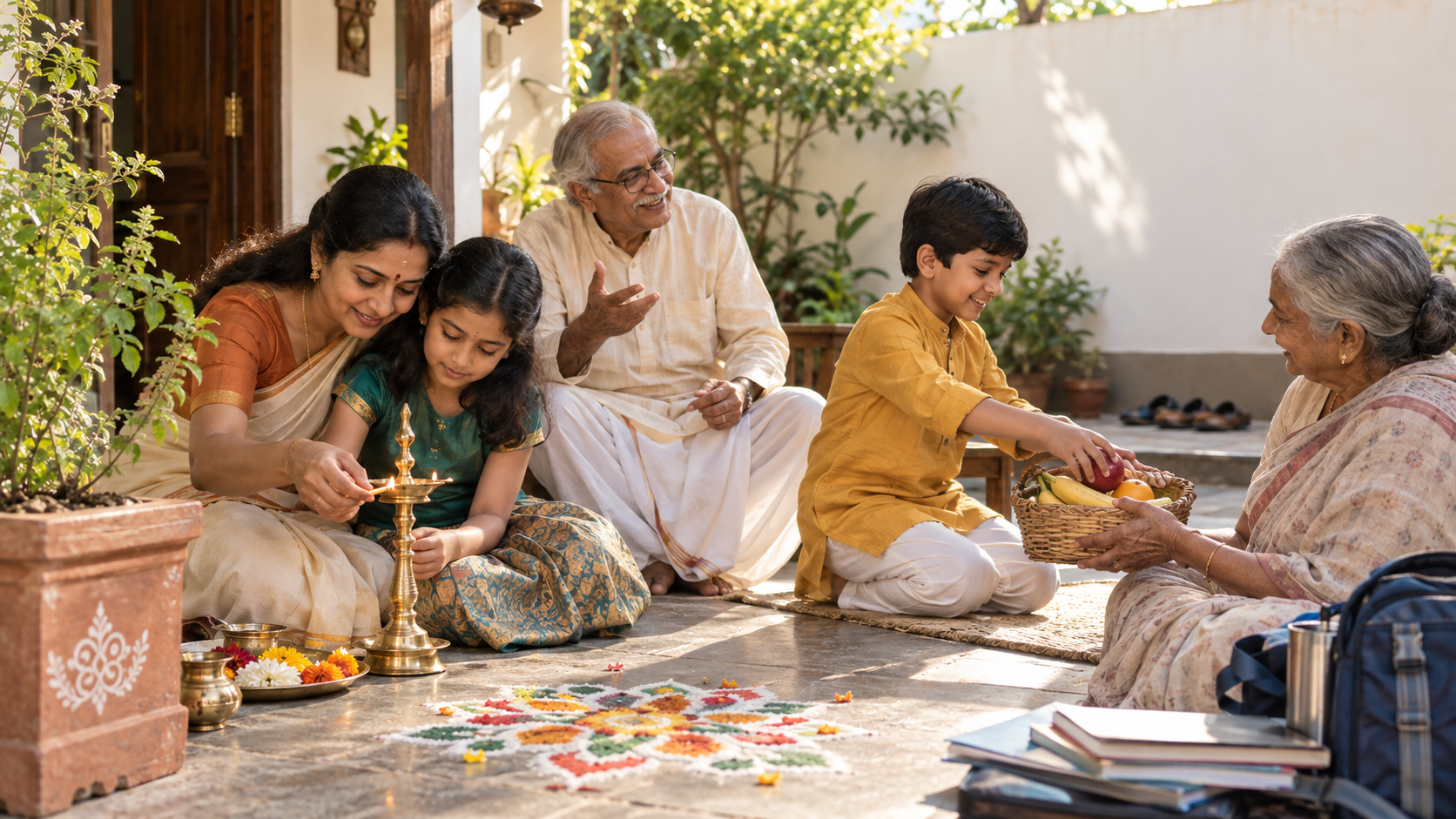
Your child may earn strong marks, remember festival names, and recite a prayer, yet still be unsure what to do when truth is costly, desire conflicts with duty, or disappointment becomes difficult to bear. That is the gap a Dharmic education must close.
If you are deciding what to teach at home, do not begin by adding another pile of religious facts. Begin by deciding what kind of person the education is meant to form. Then connect every word, story, observance, correction, and family responsibility to that purpose.
Choose formation, not merely religious information
The Sanatana maxim sa vidya ya vimuktaye describes education as that which liberates. This has an immediate horizon and an ultimate one. In daily life, education should give a child the inner resources to meet loss, trouble, dejection, pain, and failure without surrendering truth or duty. At the philosophical horizon, liberation points toward Moksha or Mukti.
That does not mean promising a child a life without distress. Nor does it mean treating ordinary emotional struggle as spiritual failure. It means giving the child a stable way to judge, act, seek help, repair mistakes, and return to what is right when circumstances become difficult.
The aim of education is not to inform the mind but to form it.
M. Hiriyanna
This distinction changes what you reward. Academic attainment, professional preparation, and intellectual competence still matter. They simply do not sit above character. The older Dharmic ideal placed the formation of the praja, the responsible citizen, before the later status of minister, professional, businessperson, or public figure. Respect was meant to follow conduct, not merely power, wealth, or title.
Write your educational goal in observable terms. Instead of saying, “We want our child to know Hinduism,” ask whether your child is gradually learning to:
- tell the truth when concealment would be easier;
- recognize a duty that does not come with praise or reward;
- share time, effort, or resources for a common good;
- restrain an immediate impulse long enough to reflect;
- accept responsibility and repair harm after a mistake;
- face a setback without abandoning ethical conduct.
These are not tests a child passes once. They are capacities to cultivate through ordinary family life. Definitions and recitations have value, but they become education only when the child can carry their meaning into a real choice.
Give six Dharmic ideas a visible place in family life
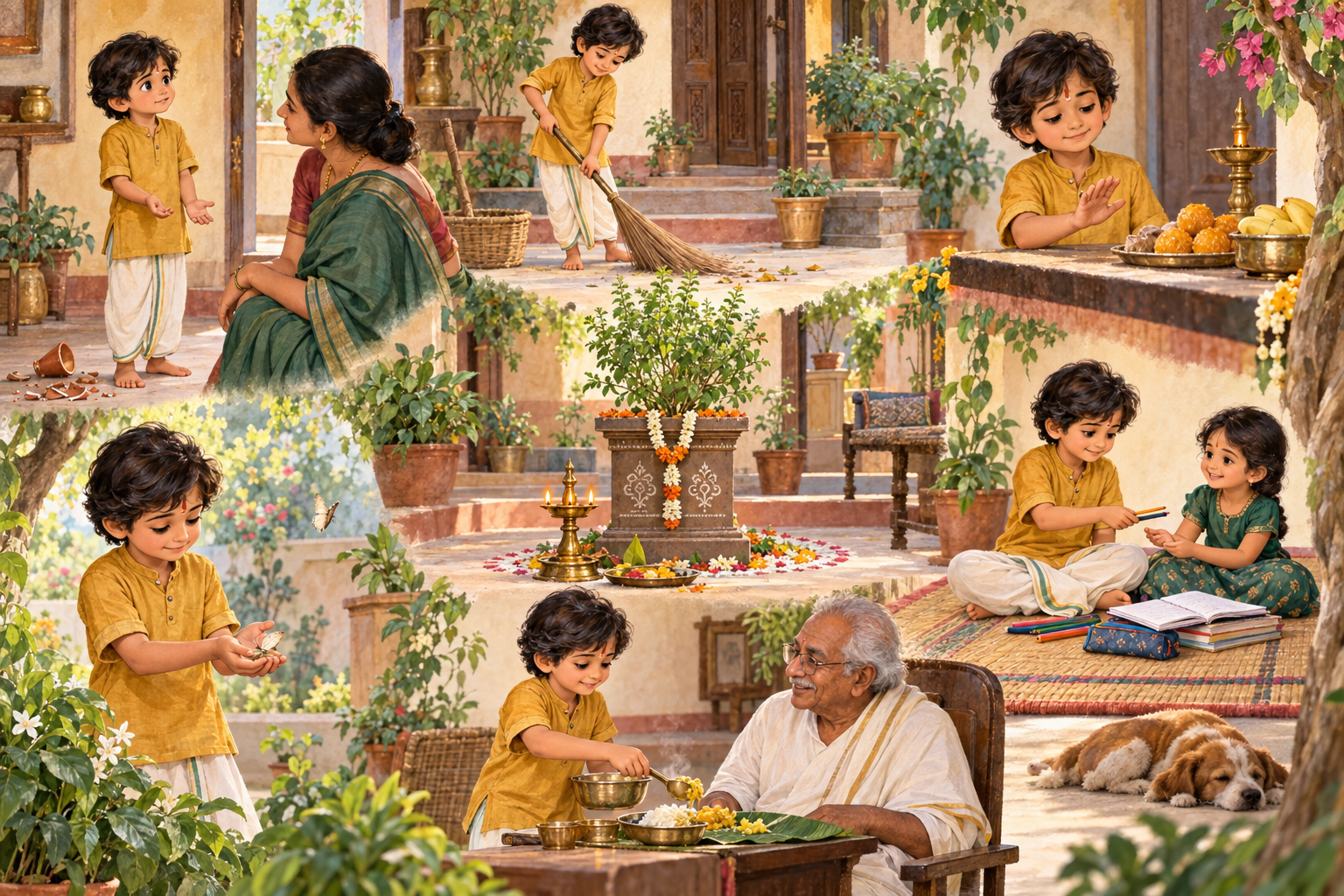
Rta, Satya, Dharma, Yajna, Daana, and Tapas should not remain vocabulary that appears only during a lesson. Each term can name something your child is already being asked to notice or practise. Introduce the Sanskrit word, give it a clear working meaning, and return to it when a relevant decision arises.
- Rta, cosmic order: Teach your child that personal preference exists within a larger order. Promises, shared routines, relationships, and responsibilities cannot be discarded merely because they have become inconvenient. When the family keeps a commitment, explain whose well-being that reliability protects.
- Satya, truth: Treat truth as a discipline of speech and action, especially when facts carry a cost. If an adult makes an error, admitting it promptly teaches more than a lecture about honesty. A child notices whether truth binds the powerful members of the household as well as the young.
- Dharma: Ask what right conduct requires in the situation at hand. Move the conversation away from “What can I get away with?” and toward “What responsibility belongs to me here?” The answer should account for truth, relationship, consequence, and the welfare of others.
- Yajna: In this educational setting, use Yajna to show that effort and resources can be offered for collective good. Give the child a genuine part in a shared family or community task. The child should experience belonging as contribution, not only as entitlement to receive.
- Daana: Let the child share wealth, useful objects, time, knowledge, or labour. Preserve the voluntary quality of the act. A compulsory transfer relabelled as generosity does not teach the same thing as choosing to give for another’s benefit.
- Tapas: Set aside room for reflection and inner refinement. A pause before reacting, honest examination after a conflict, or willingly completing a difficult responsibility can all train the child not to be ruled by the first impulse. Do not present reflection as humiliation or silent punishment.
The concepts support one another. Satya tells the child not to falsify what happened. Dharma identifies the responsibility created by what happened. Tapas helps the child tolerate embarrassment or discomfort without escaping into another lie. Daana may require giving time or effort to repair the damage. Rta places the entire choice within an order larger than immediate preference.
This is also how you keep culture, ethics, and spirituality connected. After a prayer, story, festival, or family custom, do not stop at names and procedures. Ask:
- What order or relationship is being honoured?
- What truth does this practice ask us to remember?
- What is being offered, shared, or restrained?
- What duty should remain after the observance is over?
Those questions reveal the invisible links within a Dharmic way of life. A ritual is no longer isolated from conduct, and a moral rule is no longer isolated from a larger vision of existence.
Use a teach, practise, reflect, and repair cycle
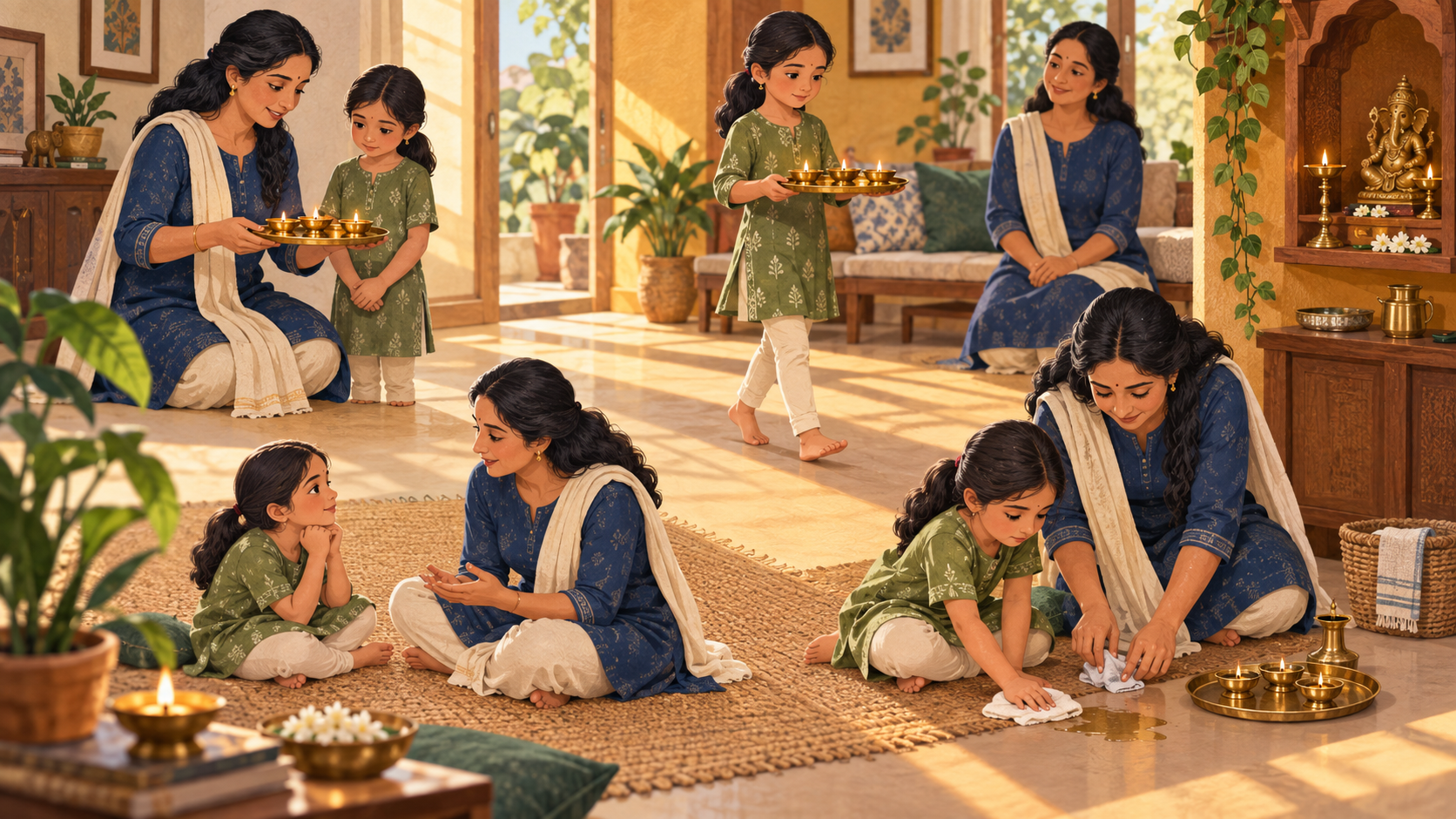
You do not need to recreate an ancient institution inside your home. You need a repeatable method that joins understanding to action. Use situations already present in family life: study, meals, household work, spending, conflict, hospitality, celebration, service, and care for shared belongings.
- Name one principle. Give the Sanskrit term and a plain working sentence. For example: “Satya means we do not change the facts to avoid a cost.” One clear idea is easier to practise than a cluster of abstract virtues.
- Show the principle under pressure. Let your child see an adult keep a promise, admit a mistake, give up convenience, or contribute without seeking credit. Briefly explain the choice without turning it into self-praise.
- Entrust a real responsibility. Give the child an action whose completion matters to somebody else. Symbolic exercises have limited force when the child never experiences trust, consequence, or contribution.
- Reflect after the action. Ask what the child wanted, what duty required, and what made the right choice difficult. Listen before supplying the approved answer. The purpose is to develop judgment, not merely produce familiar words.
- Repair and repeat. When the child falls short, identify the harm, restore what can be restored, and revisit the same principle in another situation. Failure can become instruction when it leads to truth and responsible action.
Suppose a child damages a shared object and hides what happened. A purely punitive exchange concentrates on detection and fear. A formative exchange establishes the facts, invites a truthful account, identifies the child’s duty toward the people affected, and requires an appropriate repair. Tapas enters when the child learns to remain present with embarrassment rather than flee from it. Satya enters when the facts are stated without alteration. Dharma enters when the child accepts the responsibility that follows.
The adult must submit to the same moral structure. If a parent demands truth while using anger, status, or selective memory to escape accountability, the child learns that power outranks Satya. If a parent speaks about Daana but treats every contribution as a transaction, the child learns to calculate a return. The household curriculum is therefore carried as much by adult conduct as by explicit teaching.
Keep the explanation close to the event. A long discourse delivered far from the choice often becomes information to recall. A short Dharmic question asked when desire and duty actually diverge gives the child a framework to use.
Correct with Dharma instead of governing only by fear
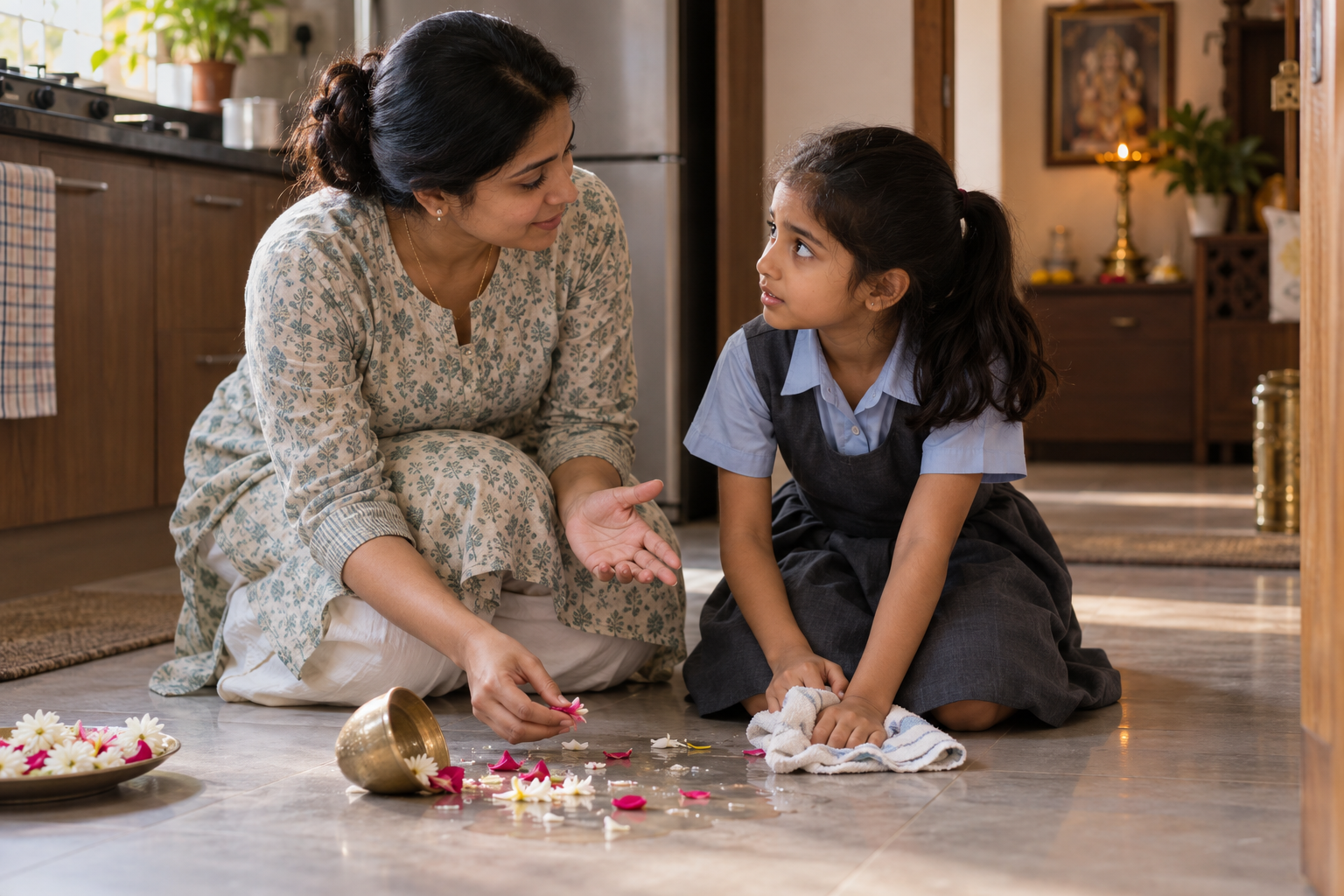
The crucial test of education is what a child chooses when nobody can force, reward, or observe the decision. This is why Dharma must remain prior to Danda, or punishment. External consequences can restrain conduct while authority is present. They cannot by themselves form the inner judgment needed when authority is absent.
This does not make household rules optional. It means that a consequence should serve understanding, responsibility, and repair rather than become the entire lesson. When correction is needed, guide the conversation through four questions:
- What actually happened?
- What was true, including the part that is uncomfortable to admit?
- What responsibility arose from the child’s role and action?
- What repair is now possible, and what should be done differently at the next choice?
Use a consequence that is connected to the action, proportionate to the situation, and clearly explained. Do not turn one failure into a verdict on the child’s worth or spiritual identity. A child should learn, “This action departed from what is right, and I must correct it,” not, “I am permanently bad and must conceal future failures.”
Voluntary obedience to Dharma must also be distinguished from blind obedience to every person who claims authority. The object of reverence is Rta, Satya, and Dharma, not an adult’s arbitrary will. A child who can respectfully ask whether a command is truthful, safe, and just is developing moral discrimination rather than rejecting discipline.
Do not measure progress only by asking for definitions. Notice the child’s conduct across different situations:
- Does truth appear before the evidence makes denial impossible?
- Can the child name who was affected and what duty followed?
- Does the child sometimes contribute without bargaining for a reward?
- Can the child pause, reconsider, and revise an impulsive response?
- After causing harm, does the child participate in repair rather than offering words alone?
- Can the child distinguish family convenience from a genuine Dharmic reason?
Look for a developing pattern, not perfection in a single incident. Do not make every generous or truthful act into a public performance. If approval becomes the only motive, the child may learn how to display virtue without learning why the action is worthy when nobody applauds.
Key takeaways for parents
- Define success as formation of judgment and character, not only academic achievement or religious recall.
- Teach Rta, Satya, Dharma, Yajna, Daana, and Tapas through choices the child can see and make.
- Connect stories, observances, and customs to truth, duty, offering, self-restraint, and conduct after the ritual ends.
- Model the principle before demanding it; adult exceptions teach children that power is more important than Dharma.
- Move correction from facts to responsibility and then to repair, keeping external punishment secondary to moral understanding.
- Watch what the child does without reward or supervision. That is where inner formation becomes visible.
At the next ordinary point of friction in your home, choose one Dharmic word. State its meaning plainly, embody it yourself, entrust your child with a real action, and return to the principle after the result. Carry that movement into study, service, celebration, conflict, and setbacks. You do not need a perfect syllabus before beginning. You need visible coherence between what your family reveres and how your family acts.
References
- DharmaRenaissance Blog – Why a Dharmic Education for Hindu Children in an Woke Pandemic Era is Urgent
