

If you are trying to decide whether medieval Bharat’s Islamic conquests were political wars, religious campaigns, or merely a communal story imposed on the past, refuse the forced choice. They were struggles for territory, revenue, prestige, and legitimacy conducted by rulers whose religious commitments could shape what they attacked, protected, taxed, and celebrated.
Your task is not to choose between historical amnesia and inherited hatred. It is to identify what happened, distinguish strong evidence from disputed estimates, recover the place of Dharmic resistance, and refuse to transfer a conqueror’s guilt to people living centuries later.
Begin with distinctions that slogans erase
The phrase Islamic conquest is useful only when it identifies a political power, a campaign, and the ideas invoked to justify or commemorate its actions. It becomes misleading when it treats every dynasty, century, region, and Muslim individual as interchangeable.
Start by separating Islam as a religion, conquering states that described themselves in Islamic terms, the conduct of particular rulers, and the lives of ordinary Muslims in India. Those categories sometimes intersect, but they are not identical. A court’s celebration of iconoclasm can reveal the ideals it advertised without making every subject of that court personally responsible for its wars.
You should also separate invasion from rule. A raid seeks portable wealth or prestige. A conquest establishes control. A regime then has to collect revenue, manage subjects, negotiate with local elites, and survive resistance. Cultural contact develops within that unequal political setting, sometimes producing genuine exchange and sometimes forcing adaptation. Calling all of this either pure persecution or harmonious synthesis hides more than it explains.
Use five questions whenever you encounter a confident historical claim:
- Who acted? Name the ruler, army, dynasty, court, or institution rather than assigning agency to an entire religious population.
- When and where? A claim about Sindh, Somnath, Delhi, or a Mughal court cannot automatically be extended to every region and century.
- What happened? Distinguish killing, enslavement, taxation, temple destruction, appropriation, conversion, administrative continuity, and cultural patronage.
- What evidence supports it? A court chronicle, inscription, excavated structure, revenue record, and demographic reconstruction answer different questions.
- How certain is the scale? A well-attested event and a subcontinent-wide estimate may both matter, but they should not be presented with the same level of confidence.
This method prevents two common evasions. The first reduces ideologically celebrated destruction to ordinary economics. The second treats religious language as proof that wealth, strategy, and dynastic ambition played no part. Political and theological motives can operate together.
The long chronology reveals the scale of Indian resistance
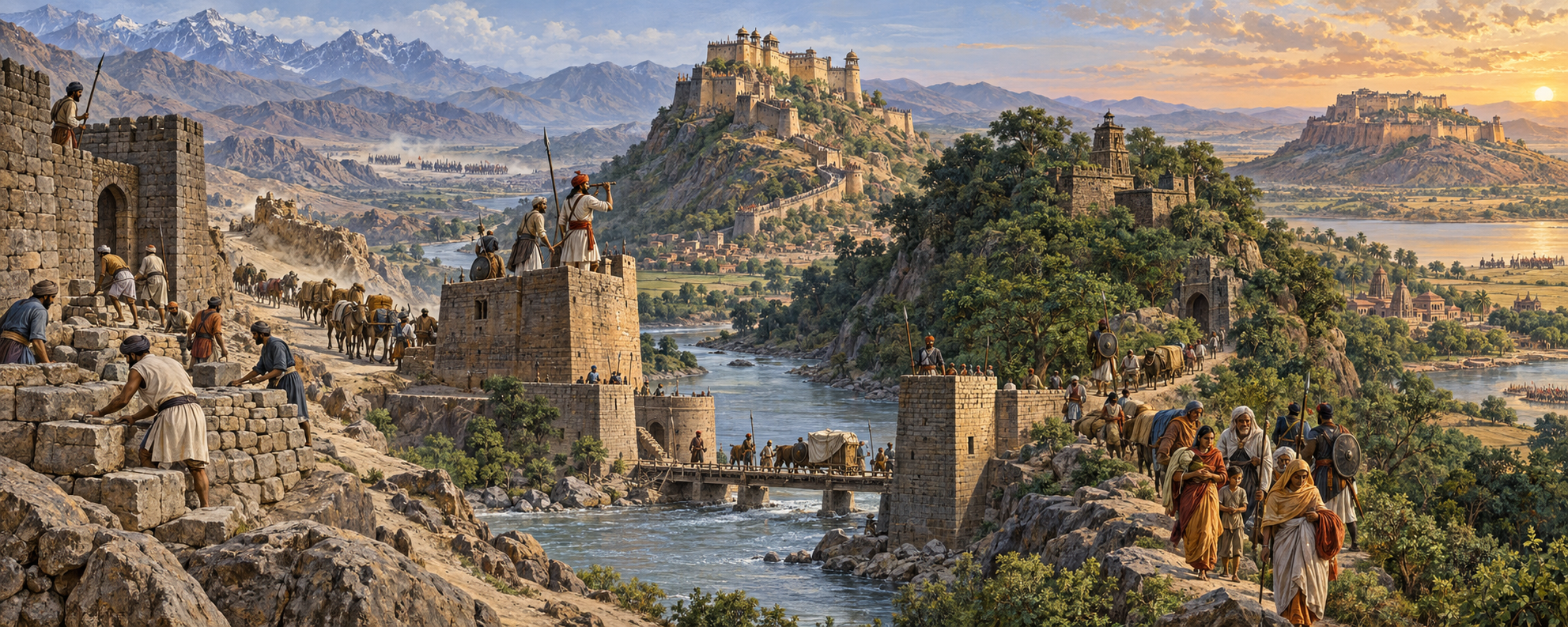
The chronology begins with an Arab campaign against India around 636 CE. Roughly 70 years passed before Muhammad bin Qasim established control over parts of Sindh. Even then, the conquest of Sindh did not amount to the conquest of Bharat.
Further waves followed, including campaigns associated with Mahmud of Ghazni, Muhammad Ghori, and Turkish powers. A durable Delhi Sultanate was established only in 1206, about five centuries after the earliest Arab attempt. During a period in which Islamic empires expanded rapidly across other parts of Asia and North Africa, Indian polities and communities repeatedly obstructed comparable consolidation in the subcontinent.
That interval matters. It overturns the image of Indians as a population that simply waited to be conquered. Dynasties could lose battles, territories could fall, and temples could be destroyed while resistance continued elsewhere or reappeared locally. Defeat in one campaign is not evidence of civilizational surrender.
Somnath shows why motive and resistance must be read together. Minhaj-i-Siraj portrayed Mahmud of Ghazni’s campaign as an iconoclastic achievement rather than merely a treasury raid. In his portrayal, the Chaulukya ruler had fled, about 50,000 armed local Hindus resisted for a week, and Mahmud rejected an offer of wealth to spare the deity because he preferred renown as a butshikan, or breaker of idols. The temple was destroyed and its sacred object carried to Ghazni.
The numerical and dramatic particulars come through a chronicling tradition that praised victorious rulers, so they require critical reading. Yet that very praise is evidence of the image the conqueror’s world wished to project. Economic value may explain why a wealthy temple attracted an army; it does not erase a proclaimed desire to destroy an idol and gain religious prestige. Nor should the ruler’s victory erase the defenders who treated protection of the shrine as worth their lives.
Measure the damage across people, temples, knowledge, and law
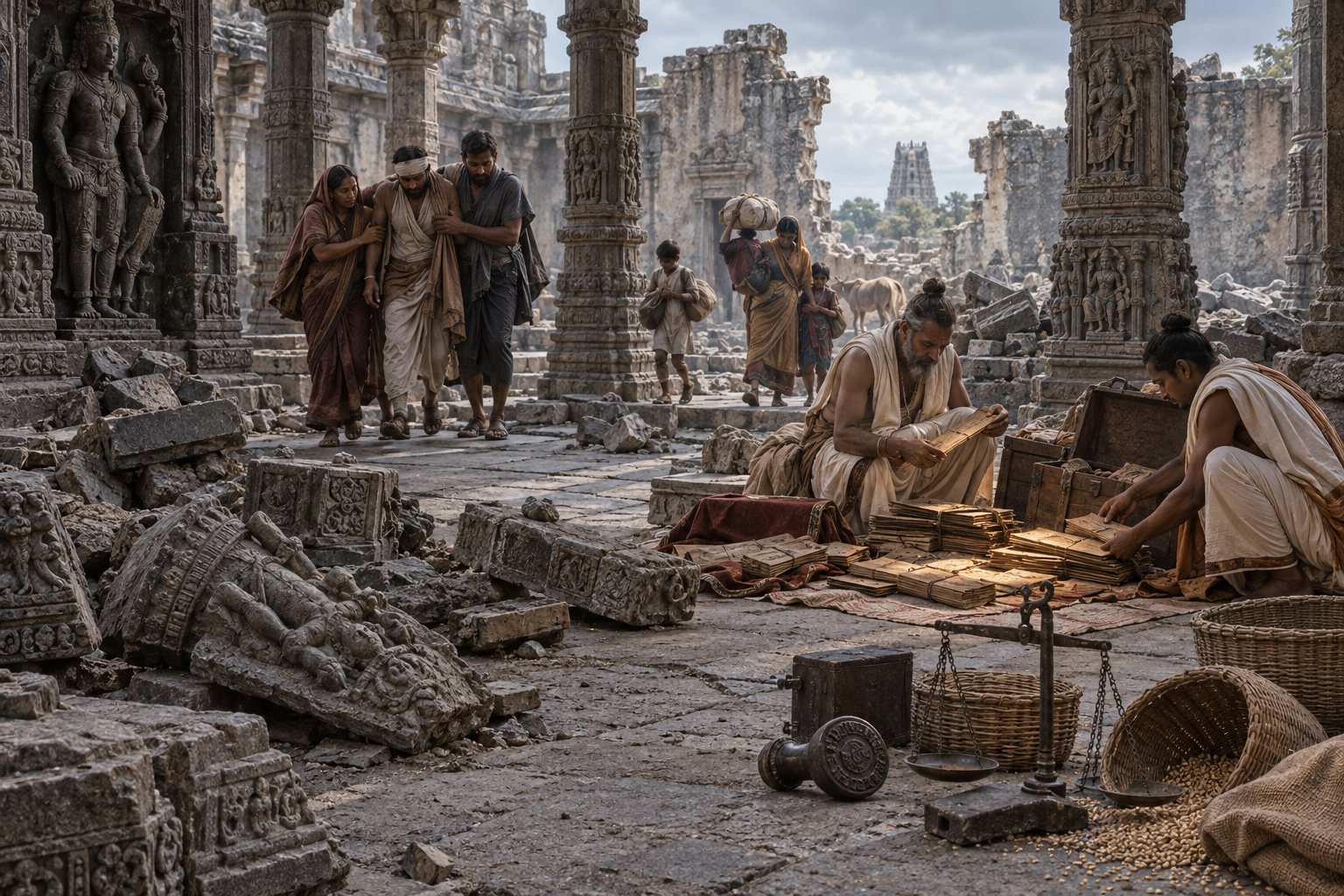
Historian Vikram Sampat frames the scale through several stark figures: at least 40,000 temples destroyed between 1000 and 1525, an estimated population decline of 80 million across the same broad period, and about 2.5 million women carried away into slavery and sexual exploitation. He characterises the temple figure as a consensus estimate among historians. He also places jizya at roughly 20 per cent of imperial revenue at its Mughal peak under Aurangzeb.
These numbers should not be treated as four entries from one audited ledger. A temple count, demographic reconstruction, enslavement estimate, and fiscal share depend on different kinds of evidence. The larger and more emotionally powerful a number is, the more important it is to retain its attribution, period, definition, and uncertainty. Historical honesty does not require you to discard grave estimates, but it does require you to stop presenting an estimate as an eyewitness total.
Temple destruction damaged an entire social ecosystem
A temple was not only a building containing an image. It could sustain ritual calendars, teachers, musicians, dancers, artisans, pilgrims, land endowments, food distribution, and a community’s relationship with sacred geography. Destroying or appropriating it could therefore interrupt far more than worship inside one structure.
You should still ask what happened at each site. Deliberate desecration, wartime damage, seizure of endowments, conversion of a structure, reuse of architectural material, and later rebuilding are distinct acts. Lumping them together weakens the case by making it easier to challenge. Site-level documentation gives a large civilizational claim its foundation.
Human loss cannot be reduced to a population estimate
The claimed decline of 80 million and estimate of 2.5 million enslaved women express the proposed scale of killing, capture, deportation, and slave trading. Medieval demographic totals are difficult to establish across several centuries, however, and a regional chronicle cannot by itself prove a subcontinent-wide number.
Do not make the reality of enslavement depend entirely on the largest available estimate. Ask which campaigns produced captives, where they were taken, how chroniclers described them, and whether an estimate counts only people transported abroad or also those retained within conquered territory. This moves the discussion from shock to historical accountability.
Destroying knowledge breaks chains of transmission
Bakhtiyar Khilji’s campaigns are associated in this historical memory with the devastation of major centres of learning, including Nalanda and Vikramashila. The frequently repeated claim that their manuscripts burned for six to eight months is best treated as a traditional description of immensity rather than a precise measurement of fire duration.
The deeper loss is easier to understand if you stop imagining a library as a warehouse of replaceable objects. A manuscript tradition depends on teachers, students, copyists, commentaries, institutional patronage, and access to earlier works. When those relationships are broken, even surviving texts may cease to circulate or be understood. Count buildings and manuscripts where evidence permits, but also look for interrupted lineages of teaching.
Fiscal and legal inequality made subordination routine
Jizya marked non-Muslims through a tax attached to religious status. The estimate that it supplied about one-fifth of revenue at its Mughal peak under Aurangzeb, if accepted, makes it more than a symbolic grievance. It points to discrimination embedded in the fiscal relationship between ruler and subject.
Some Hanafi prescriptions are described as listing roughly 18 to 20 degrading conditions under which non-Muslims could be tolerated. Here too, distinguish jurisprudential prescriptions, royal policy, and enforcement in a particular locality. A rule written by a jurist is evidence of a legal ideal; proof that every official enforced every condition requires another layer of evidence. That distinction tests the claim without sanitising the humiliating principle behind it.
Cultural survival can carry the marks of political pressure
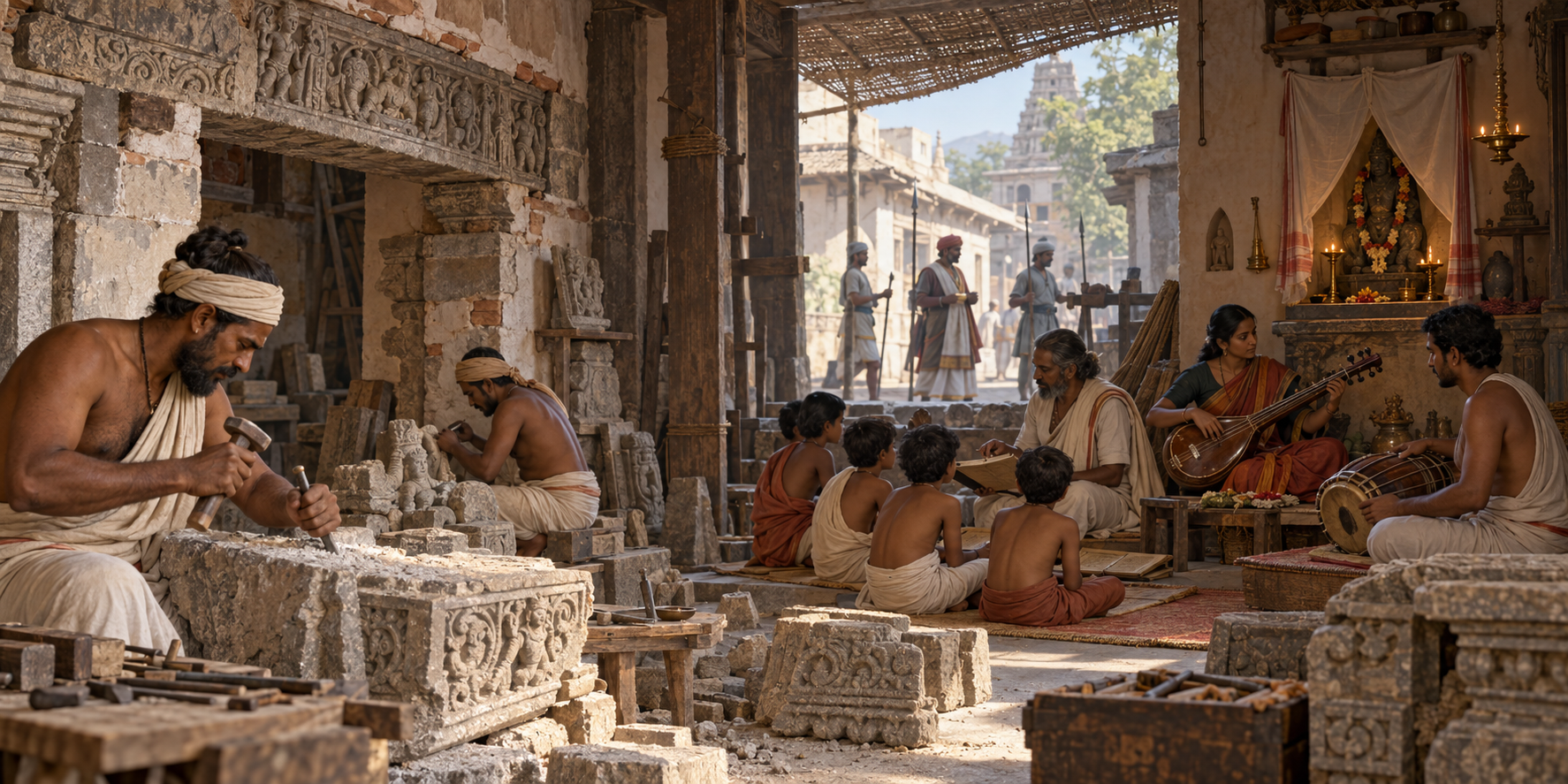
Architecture, music, language, and dance did not stop changing under conquest. But the existence of a beautiful hybrid form does not prove that the conditions producing it were equal, voluntary, or free of loss. People create under constraint as well as in freedom.
Changes attributed to North Indian dhrupad illustrate the point. A form with deep devotional content and compositions invoking Shiva and Vishnu entered court environments in which sacred references could recede while praise of the shahenshah and romantic shringar gained prominence. Kathak, rooted in the work of temple kathakaars who conveyed sacred narratives through movement and song, likewise developed a stronger court and courtesan setting in which shringar became more prominent.
This does not make the later forms alien or unworthy. It shows Indian artists preserving and developing their inheritance while patrons, venues, and permissible themes changed. Survival demonstrates agency. Altered content may reveal the pressure under which that agency operated. You need both truths.
When evaluating a claim of cultural synthesis, compare four features before and after the political transition: who paid the performer, where the work was presented, which sacred or royal figures it praised, and what material had to be removed or recoded. That comparison is more informative than labelling the result either contamination or harmony.
The idea of Ganga-Jamuni tehzeeb can name genuine shared practices, vocabulary, and artistic forms. It cannot serve as a veto against evidence of temple destruction, discriminatory taxation, or coercive hierarchy. Cultural borrowing and political domination can occur at the same time. One does not acquit or disprove the other.
Recover historical memory without assigning inherited guilt
A mature Dharmic account must make two refusals. It must refuse the whitewashing that turns declared iconoclasm into accidental damage and treats centuries of resistance as embarrassment. It must also refuse collective blame against present-day Indian Muslims, who are not medieval courts, invading armies, or hereditary defendants in a civilizational trial.
Historical responsibility belongs to the people and institutions that acted. Present responsibility belongs to all of us: preserve evidence, teach the victims and resisters by name, investigate disputed claims honestly, and ensure that commemoration does not become intimidation of living neighbours.
This principle is especially useful when judging proposals to rename a place, restore a shrine, revise a textbook, or add historical interpretation to a monument. Ask what is being commemorated, what evidence establishes the earlier history, which remedy fits that evidence, and whether the proposal restores memory without imposing civil penalties or social suspicion on people because of their faith.
Key takeaways
- Use Islamic conquests in the plural and identify the ruler, region, century, and action under discussion.
- Treat the roughly five centuries before the Delhi Sultanate’s establishment in 1206 as evidence of prolonged Indian resistance, not an empty prelude to defeat.
- Do not force economic and religious motives into an either-or choice when conquerors could seek wealth and celebrate iconoclasm simultaneously.
- Keep major numerical claims attached to their attribution and method; do not confuse a debated macro estimate with a documented local event.
- Measure temple destruction through lost ritual, learning, patronage, and community life as well as damaged stone.
- Recognise cultural adaptation without using later synthesis to erase the unequal conditions in which some adaptations occurred.
- Hold historical perpetrators accountable without assigning their guilt to modern people who merely share a religious label.
The next time you encounter a dramatic claim about this period, make a four-line evidence card: actor and date, act and place, evidence type, and level of certainty. If one line is missing, investigate before repeating the claim. If all four are present, state the history plainly. That discipline allows a wounded civilization to recover memory without turning memory into a weapon against the innocent.
References
- DharmaRenaissance Blog — What really happened to Bharat during the Islamic Invasions?
