

If you are a devotee worried about the conservation of Kolhapur’s Shri Mahalakshmi Devi Temple, the figure of ₹21 crore naturally commands attention. But the amount alone cannot tell you whether the temple received sound conservation work, whether every payment was justified, or whether anyone failed in an official duty.
A demand for an inquiry into alleged financial and technical irregularities has been placed before Maharashtra’s Law and Judiciary Department by the Hindu Vidhidnya Parishad. The allegations are serious enough to require a transparent examination. They are not, by themselves, findings of guilt. The useful response is to insist on records, qualified inspection and responsibility tied to evidence.
Start with the claim at its actual evidentiary level
An inquiry request and an inquiry finding are different things. The first identifies questions that deserve scrutiny. Only the second, supported by records and technical examination, can establish whether work was defective, money was mishandled or a particular official failed in duty.
That distinction protects both the temple and the credibility of those seeking accountability. Declaring every allegation false would close the door before the evidence is examined. Declaring a scam before the evidence is examined would replace accountability with accusation.
You should also keep the technical and financial questions separate. Unsuitable conservation work does not automatically prove financial dishonesty. A procurement or payment irregularity does not automatically prove physical damage to the temple. Either problem can exist without the other, and both could exist together. Each therefore needs its own evidence.
Key takeaways
- The ₹21-crore figure establishes the scale of the concern, not the nature or amount of any proven loss.
- A credible inquiry must examine technical quality and financial administration as connected but distinct matters.
- The strongest public demand is for project records, an independent inspection, reasoned findings and a corrective plan.
- Accountability should attach to documented decisions and defined official roles, not to names circulated without evidence.
- Temple conservation must be judged by preservation of the sacred and historic fabric, not merely by whether the finished surface looks new.
A proper inquiry needs two linked examinations
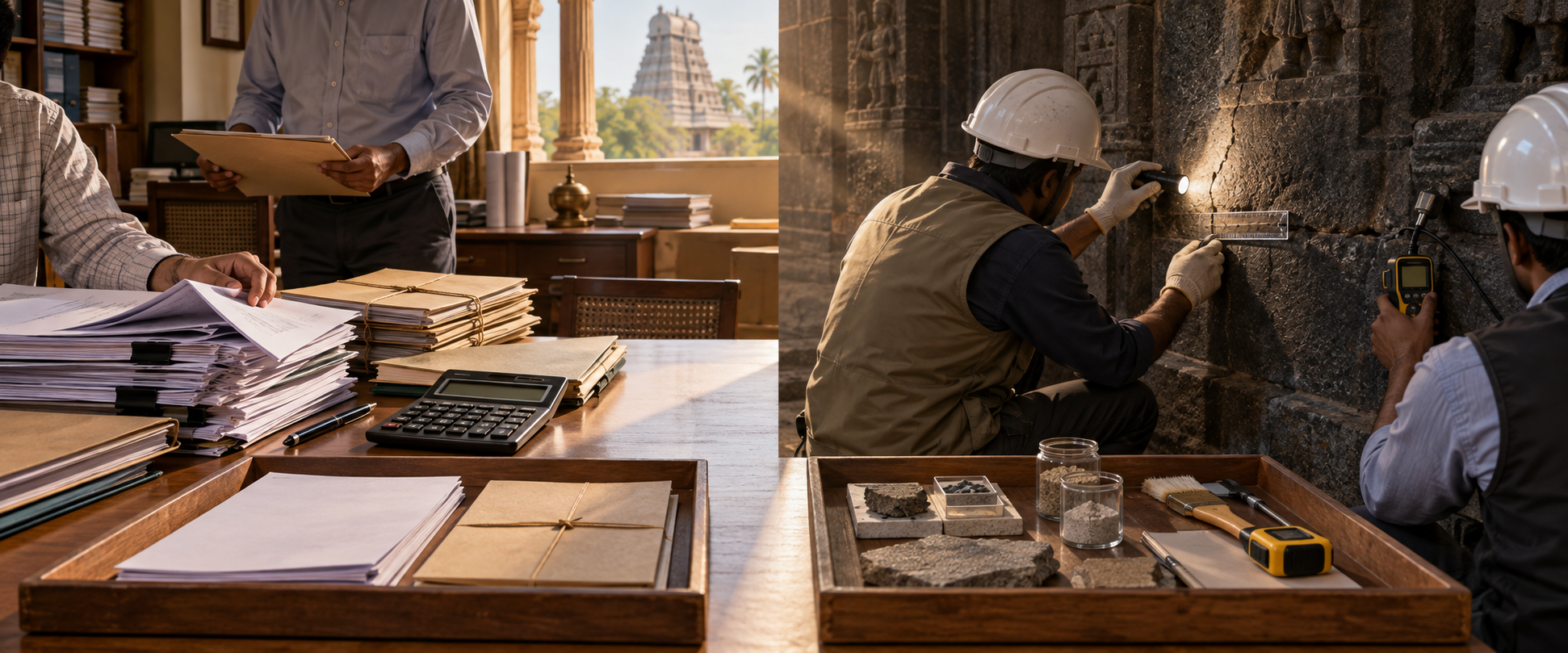
The phrase technical and financial irregularities can sound comprehensive while concealing what actually needs to be tested. A useful inquiry should divide the assignment into two workstreams and then compare their findings. The technical team determines what was necessary and what was executed. The financial team determines what was approved, measured, certified and paid.
The technical examination
Conservation is not the same as ordinary renovation. A newly finished appearance is not proof of good conservation. The relevant questions concern the condition of the existing fabric, the necessity of each intervention, compatibility of materials and methods, quality of workmanship, documentation of changes and the possibility of new damage.
A technical review should answer specific questions:
- Was the temple’s condition documented before work began, with dated photographs, drawings and an itemised assessment of deterioration?
- Did the approved plan identify which elements were to be preserved, repaired, replaced or left untouched?
- Were the selected materials and methods appropriate for the fabric on which they were used?
- Did the executed work match the approved drawings, specifications and conservation rationale?
- Were substitutions or additions recorded and approved before they were carried out?
- What defects are alleged, where are they located, and against which specification or conservation standard are they being judged?
- Can any defective intervention be safely corrected without causing further loss to historic or sacred fabric?
Because Shri Mahalakshmi Devi Temple is a living place of worship, the review should also record how work protected sacred spaces, accommodated active worship and controlled access to sensitive areas. Those obligations do not replace technical scrutiny. They add to it.
The financial examination
Before anyone treats ₹21 crore as the amount actually spent, the inquiry should identify what that figure denotes. A sanctioned estimate, accepted contract value, value of bills submitted, amount certified and amount released are not interchangeable numbers. Confusing them can exaggerate or conceal the real issue.
The financial review should trace the project from approval to payment:
- What scope and cost were originally sanctioned?
- How was the contractor or specialist selected, and what qualifications were required?
- What quantities, rates and specifications appeared in the accepted contract?
- What changes were ordered after work began, who approved them and why?
- Which quantities were physically measured and certified before each bill was passed?
- Do invoices, measurement records, inspection notes and payment releases describe the same completed work?
- Were defects identified before completion or payment, and if so, what money or contractual remedy remained available?
Comparing the total figure with the temple’s outward appearance is not enough. Essential conservation work can be visually unobtrusive, while conspicuous cosmetic work can still be unsuitable. The meaningful test is to match each billed item with its location, quantity, specification, approval and proof of completion.
Ask for the records that can answer each question

Calls for transparency become effective when they identify the records needed. A general demand to reveal everything makes it easier to answer with a general assurance. A document-based request gives officials and investigators a checklist that can later be tested against their response.
| Question to settle | Records that should answer it | What requires explanation |
|---|---|---|
| What was approved? | Administrative sanction, detailed estimate, approved scope, drawings and technical specifications | Vague descriptions, missing itemisation or major differences between sanctioned and executed work |
| Why was intervention necessary? | Pre-work condition survey, dated photographs, defect mapping and expert recommendations | Replacement or alteration without a documented baseline and conservation rationale |
| Who was selected? | Tender documents, eligibility conditions, bids, comparative evaluation, award decision and contract | Unclear criteria, unexplained departures from requirements or unresolved conflicts of interest |
| What was actually done? | Site records, measurement entries, material approvals, instructions, variation orders and progress photographs | Work that cannot be linked to an approved item, recorded location or verified quantity |
| What was paid? | Itemised bills, measurement-linked certifications, deductions and payment-release records | Payment unsupported by measurements, certification or proof of completed work |
| Was the work acceptable? | Inspection reports, test results where relevant, defect lists, rectification records and completion certification | A completion declaration that does not address recorded defects or departures from specification |
| Who made each decision? | Signed approvals, dates, delegated powers and defined roles of officials, consultants and contractors | Responsibility dispersed so widely that no decision-maker can be identified |
Some temple records may contain security-sensitive information. That does not justify treating every project record as untouchable. Where necessary, ask for redacted copies, summary schedules or an index stating what has been withheld and why. Financial totals, procurement decisions, certifications and the broad findings of a conservation inspection can still be disclosed without publishing a security blueprint.
Records also need to be read together. A bill may be genuine yet relate to work that was not performed correctly. A photograph may show completed work but not establish the quantity billed. A signed completion certificate may identify who approved the result but cannot, by itself, prove that the underlying inspection was adequate.
Press for accountability without prejudging guilt
You do not need to choose between silence and an unsupported public accusation. A disciplined representation can demand a rigorous inquiry while preserving fairness.
- Preserve the exact allegation, the ₹21-crore figure and the identity of the authority from which an inquiry has been requested. Do not add names or claims that are absent from the documented demand.
- Write to the relevant department and temple administration asking for acknowledgement of the representation, the body conducting the inquiry, its terms of reference and the form in which findings will be released.
- Ask officials to distinguish the sanctioned amount, contract amount, value billed, value certified and money actually released.
- Request a location-specific list of alleged or observed defects, supported by photographs and the approved specification against which each defect is assessed.
- Ask whether the technical reviewers have suitable conservation expertise and whether any reviewer, consultant or certifying official has a conflict connected with the original work.
- Keep a simple response log containing the date, office contacted, request made, acknowledgement received and next promised action.
- When discussing the case publicly, label allegations as allegations and findings as findings. Link to the underlying record whenever one is available.
Suggested wording: Please disclose the scope and status of the inquiry sought into the conservation work at Shri Mahalakshmi Devi Temple. Please identify what the ₹21-crore figure represents and provide the sanctioned scope, contract details, measurement-linked payment information, technical inspection findings and recorded defects, subject to lawful and security-related redactions. Please ensure that technical quality and financial administration are examined separately and that any finding of responsibility identifies the evidence, decision and official role involved. Please also publish the corrective action proposed for any confirmed defect.
Keep that request focused. Asking officials to prove or disprove named accusations that have not been documented can distract from the project records. Publicly alleging corruption or theft without supporting findings also creates a fairness problem and possible legal exposure. If you intend to seek compulsory disclosure or a court remedy, a qualified Maharashtra lawyer or information-access practitioner can advise which formal route applies to the temple’s governance structure.
What a credible outcome should contain

A one-line declaration that everything was proper would not resolve the concerns. Neither would a one-line declaration that irregularities occurred. A credible outcome should show how the conclusion was reached.
- A defined mandate: the locations, work packages, financial period and types of records examined.
- Qualified review: the relevant expertise of the technical reviewers and disclosure of conflicts connected with the original work.
- Finding-by-finding reasoning: each allegation classified as substantiated, partly substantiated, unsubstantiated or impossible to determine from the available evidence.
- Clear distinctions: workmanship defects, conservation incompatibility, documentation gaps, procurement lapses and unsupported payments should not be collapsed into one vague label.
- Evidence attached to adverse findings: the relevant specification, location, measurement, approval, payment or inspection record.
- A proportionate corrective plan: immediate protection where continued damage is found, careful rectification where intervention is safe and monitoring where removal could cause greater harm.
- Role-based accountability: responsibility attached to the person authorised to design, approve, execute, measure, inspect or pay for the disputed item.
- Follow-up verification: confirmation that ordered repairs, recoveries or administrative actions were completed rather than merely announced.
If wrongdoing is established, accountability should follow the evidence and the applicable process. If no wrongdoing is established, the reasoning and examined records should be sufficient to explain why. If the evidence is incomplete, that limitation should be stated plainly instead of being converted into either exoneration or guilt.
Your next useful step is a one-page, document-based request centred on the different financial stages and one technical question: what defect was observed, where was it found, who assessed it and against which approved requirement? That approach gives devotees something stronger than outrage. It creates a record that can lead to repair, disclosure and defensible responsibility while keeping the temple’s preservation at the centre.
References

Leave a Reply
You must be logged in to post a comment.