
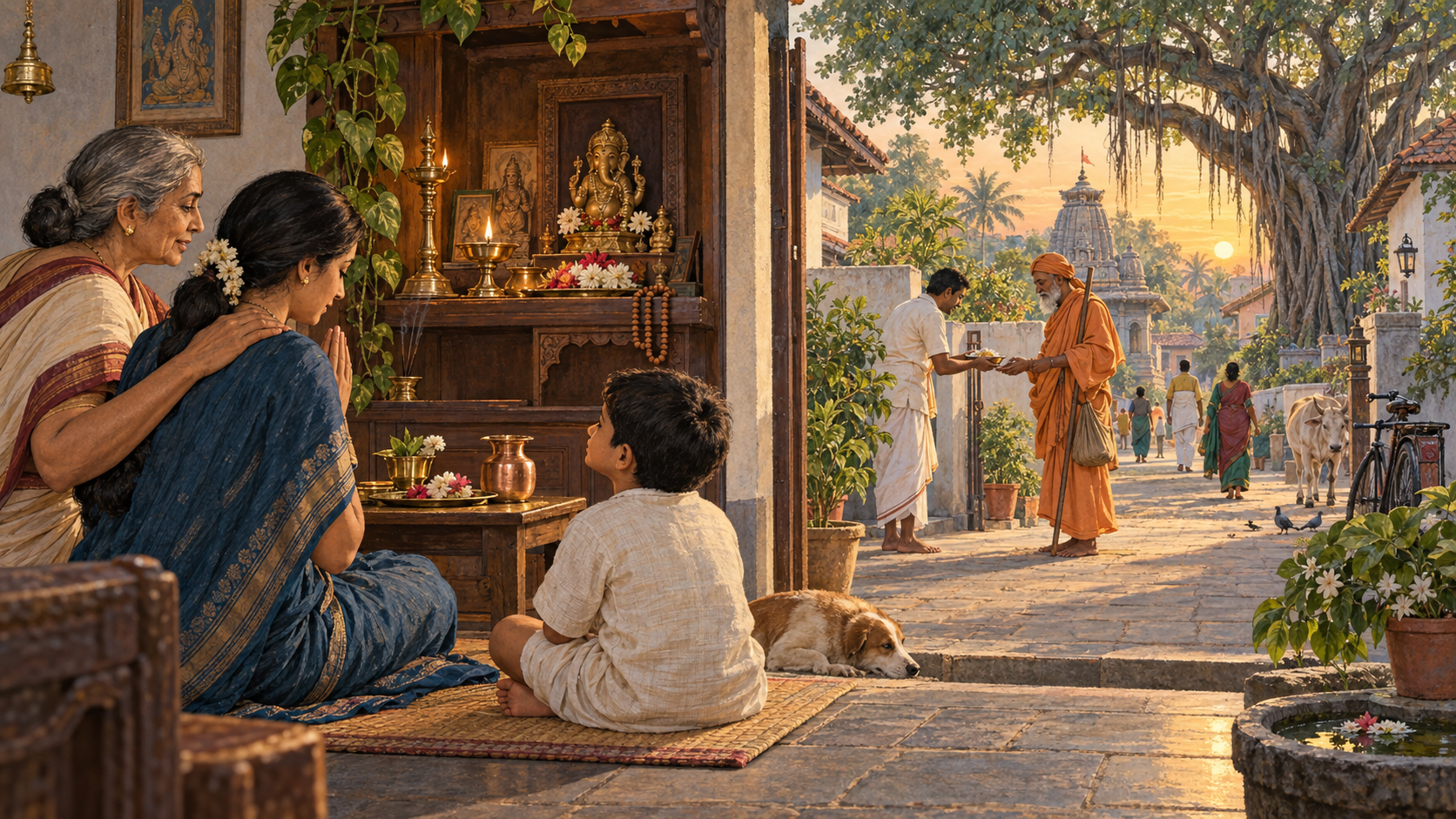
Your family may still have a puja shelf, festival photographs, sacred names and inherited food customs. Yet a vrata may now survive only as a change of menu, an elder’s discipline may disappear without explanation, and a renunciant may be treated as either a celebrity or a fraud. The outer forms remain visible while the culture that made them intelligible grows thin.
If you are wondering whether Hindu ascetic culture can be recovered, the answer is yes. But recovery does not mean persuading everyone to renounce the world or copying the harshest austerity you can find. It means rebuilding a way of life in which restraint, sacred vows, study, service, silence and renunciation have an understood place.
What has been lost is an ecosystem, not a costume
The saffron robe is the most visible image of Hindu asceticism, but the robe never sustained the tradition by itself. Renunciants depended on a larger spiritual ecology: householders who respected genuine discipline, families that knew the meaning of a vrata, temples that maintained continuity, teachers who explained inherited rules, and communities willing to support lives not organised around possession and consumption.
Sannyasa, formal renunciation, is not the same as the disciplined life of a householder. Nor do all Hindu sampradayas define the path in precisely the same way. Yet the paths meet around a recognisable principle: freedom requires some mastery over appetite, ego and attachment. The renunciant embodies that principle radically. The householder gives it a durable place in family and social life.
When that relationship breaks, two distortions appear. Renunciation becomes a spectacle judged by clothing, followers or dramatic feats. Household spirituality becomes passive because ordinary people assume that serious sadhana belongs only to exceptional ascetics. One side performs holiness; the other consumes it from a distance.
You can notice the weakening of the spiritual ecosystem without counting monasteries or debating whether the past was better. Look inside the home and community:
- A family observes a fast but cannot explain what desire, duty or remembrance the fast is meant to cultivate.
- Children receive ritual instructions without being told the names, meanings or sequence of what they are doing.
- An elder carries a complete practice in memory, but nobody asks about it until illness makes the conversation difficult.
- Sacred words are repeated without explanation, while translation is mistaken for disrespect.
- Public display receives more attention than quiet consistency.
- A guru or renunciant is judged by visibility and institutional size rather than conduct, teaching and accountability.
Treat these signs as an audit, not an accusation. Blame makes relatives defensive. Careful questions recover knowledge.
Ascetic discipline is not the worship of suffering

Hindu asceticism is often reduced to spectacular deprivation: severe fasting, isolation, exposure to discomfort or the abandonment of possessions. Such practices may belong to particular paths under proper guidance, but pain is not self-authenticating. A difficult act can still feed pride, irresponsibility or competition.
Tapas is better understood through its purpose. It places voluntary discipline between an impulse and its satisfaction. Vrata gives that discipline the form of a vow or sacred observance. Tyaga relinquishes a claim, possession or attachment. Abhyasa makes practice regular enough to shape character. Precise meanings and applications differ across traditions, so these terms should lead you toward instruction rather than become labels for improvised austerities.
For a householder, meaningful restraint may concern speech, consumption, attention, food, anger, entertainment, comfort or the need for recognition. The important question is not whether the practice looks severe. It is whether it places desire under dharma while preserving legitimate duties.
Before adopting an austerity, ask:
- What impulse is this practice meant to discipline?
- Which duty or sacred relationship will it strengthen?
- Does it make me more truthful, steady and considerate, or merely more impressed with myself?
- Can I explain its purpose without mentioning how difficult it is?
- Who has taught its rules, exemptions and proper completion?
- Will the burden fall on somebody who did not choose the vow?
The last question matters in family life. A personal austerity becomes adharma when it transfers neglected work, anxiety or coercion to a spouse, child, parent or caregiver. Household discipline must deepen responsibility rather than provide a sacred excuse to escape it.
Fasting and other physically demanding observances also require ordinary prudence. Children, pregnant people, frail elders and anyone managing illness or medication should not imitate severe practices casually. Seek tradition-specific guidance and appropriate medical advice. An exemption or safer form is not spiritual failure when health, care or duty requires it.
A dying woman’s request reveals what continuity looked like
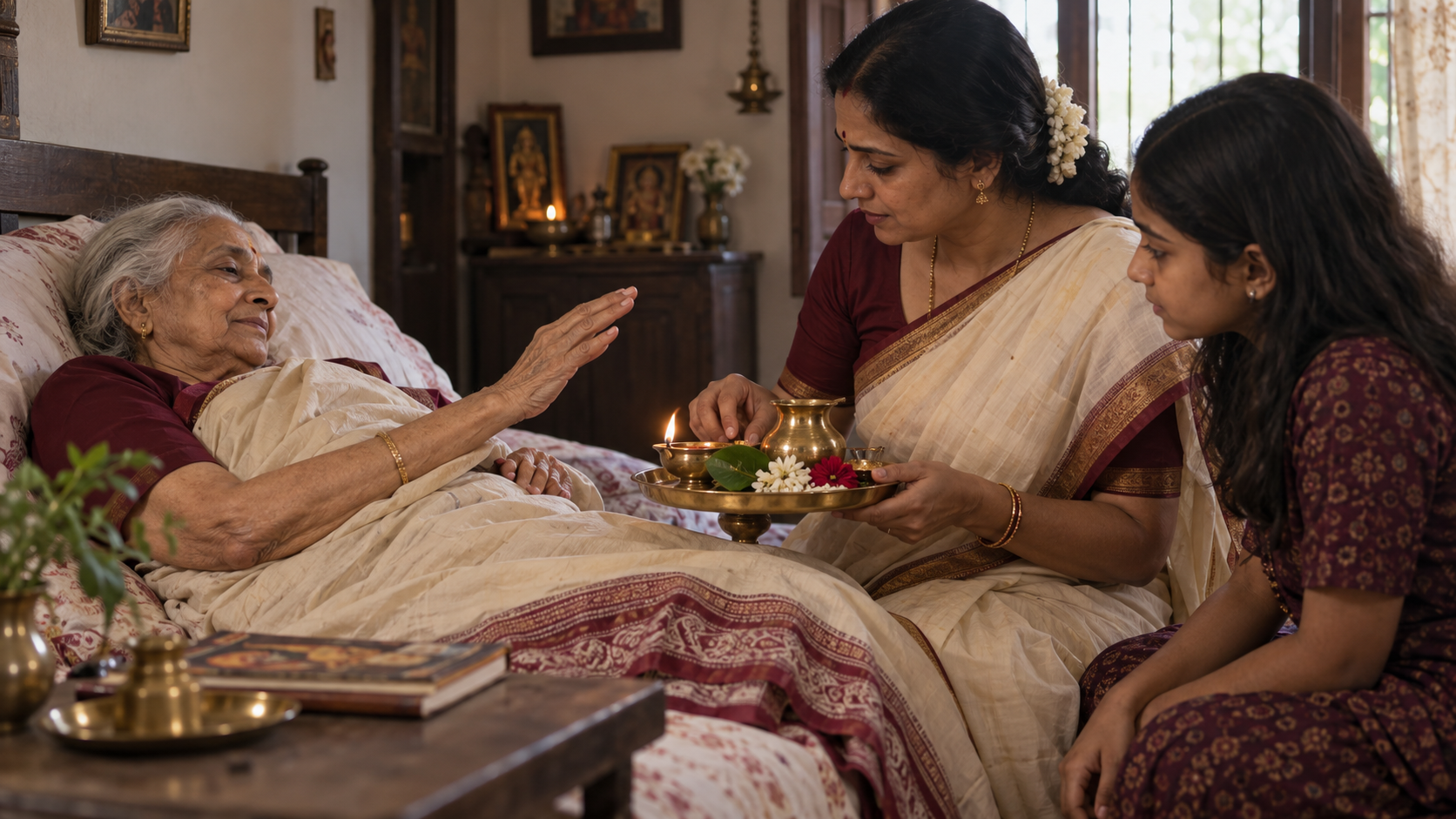
Channapattana Vasudevaiah was raised by an older woman who became a mother to him after he lost his own. In her old age, she became ill and bedridden. Sensing that her life was nearing its end, she gathered the family before Gokulashtami and made a precise request.
If she remained alive on the festival morning, she wanted the family to bathe her and place a drop of Deva-Tirtha in her mouth. She anticipated worsening pain and asked them not to press milk or fruit upon her out of pity. Vasudevaiah preserved the memory as an example of the mental strength and unforced piety he had seen in the generation that formed him.
The lesson is not that an ill person should refuse nourishment. Her decision cannot be turned into a medical rule or a compulsory model for somebody else’s final days. Its civilizational meaning lies elsewhere. The sacred calendar had become part of her moral reflex. She knew what mattered to her, her family understood the ritual vocabulary of her request, and care for the body remained connected to care for the soul.
This is how spiritual culture usually survives: not through constant public argument, but through people whose choices make dharma credible to those living beside them. Vasudevaiah did not encounter ascetic fortitude as an abstract theory. He saw it embodied in the person who had cared for him.
You can begin recovering this layer of culture by speaking to an elder before the next family observance. Ask for the exact name of the practice, who taught it, what was eaten or avoided, which prayer accompanied it, how it concluded, what exceptions were allowed and why the family considered it important. Record the answer in the language in which it is remembered, then add a careful translation. Do not correct the elder while gathering the memory. Verification can come afterward.
Restore practice without turning it into theatre
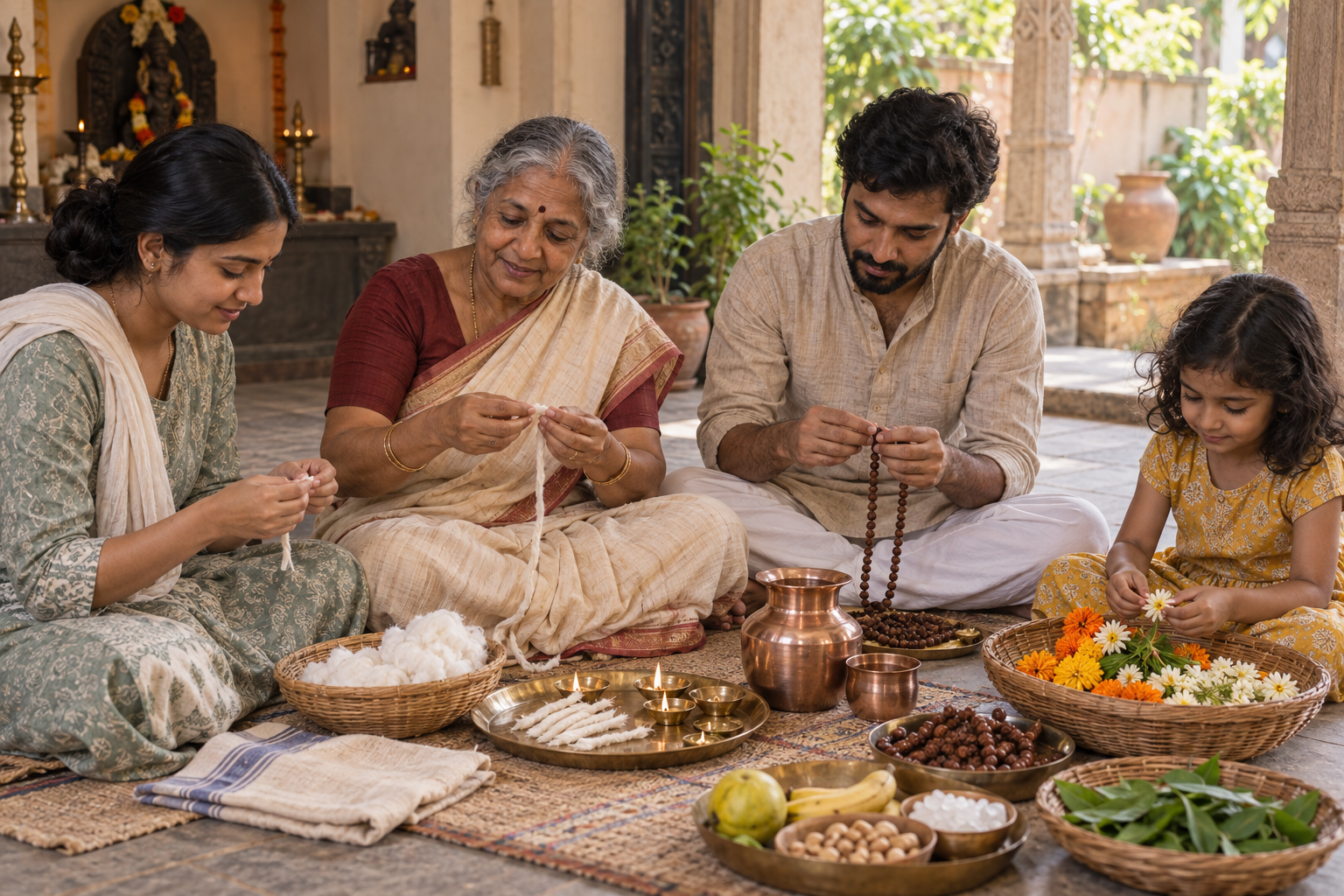
A living tradition needs more than nostalgia. It needs repeated acts with clear purposes, trustworthy instruction and a place in ordinary schedules. The following sequence is a practical way to begin.
- Recover the inherited vocabulary. Make a small family record of remembered vratas, pujas, festival duties, teachers, pilgrimage customs, prayers and forms of hospitality. Mark what is clearly remembered, what is uncertain and what has already disappeared. Honest gaps are better than invented continuity.
- Choose a load-bearing practice. Begin with an observance that already has a relationship to your family, temple or sampradaya. A regular lamp offering, nama-japa, scriptural reading, food restraint, festival preparation or act of seva can carry more culture than an impressive practice attempted briefly. Write down its purpose so that performance does not replace intention.
- Learn the rules before increasing the difficulty. Ask a trustworthy teacher or knowledgeable temple elder about eligibility, sequence, exemptions, completion and the relation of the practice to dana or seva. If reliable guidance is unavailable, keep the practice modest, safe and honest rather than constructing an extreme version from fragments.
- Give every participant a meaningful role. Children can prepare a clean space, learn the names of offerings, listen to the family account behind an observance or help with service. Explain why each action is done. Participation without meaning produces boredom; explanation without participation produces spectators.
- Support renunciant life with discernment. Look beyond charisma. Ask whether a teacher stands within an identifiable lineage or accountable institution, handles money transparently, answers sincere questions without intimidation, respects household duties and displays consistency between teaching and conduct. Support may take the form of food, hospitality, books, transport, temple upkeep or help with teaching. Reverence does not require surrendering judgement.
- Redirect what restraint releases. If a vrata saves money, time, food or attention, connect the saving to worship, study, hospitality or service. Otherwise austerity can shrink into private willpower. Renunciation becomes socially fruitful when what is relinquished creates room for something worthy.
Keep public narration proportionate. Sharing a festival explanation may help transmission. Broadcasting every fast, donation or act of simplicity can make recognition the hidden reward. Some disciplines need witnesses for support and accountability; they do not need an audience.
Adaptation should preserve meaning, not pretend nothing changed

Work schedules, migration, illness, smaller households and language loss can make an inherited form difficult to reproduce. Refusing every adaptation may cause a practice to vanish. Changing everything for convenience may preserve only its name. The responsible path is to distinguish the principle from the form without assuming that every form is disposable.
Preserve the stated purpose of the observance, its relationship to deity and tradition, the discipline freely undertaken, and the ethical duties that surround it. Adapt language, practical participation or physical intensity where the tradition permits and circumstances require. Consult someone who understands the practice before changing elements that may be constitutive rather than incidental.
Translation is often part of preservation. A child who hears a mantra can also learn what the prayer is doing, when it is used and how it shapes conduct. Keep the sacred wording where it belongs, teach its pronunciation with care, and explain its meaning in language the child understands. Unexplained repetition is not stronger merely because it remains untranslated.
Be equally honest about new household disciplines. If your family creates a digital fast, a restraint on unnecessary buying or a period of silence, do not present it as an ancient rule unless it truly comes through a recognised tradition. Call it a contemporary discipline inspired by ascetic principles. Accurate naming protects inherited practice from casual invention.
Reject adaptations that depend on coercion, conceal harm, commercialise access to grace, turn deprivation into a status contest or demand unquestioning obedience to an unaccountable person. Traditional language cannot convert exploitation into dharma. A worthy discipline should withstand questions about purpose, authority, money, safety and conduct.
Key takeaways
- The loss of ascetic culture is not merely a decline in formal renunciation; it is the weakening of families and institutions that understand, practise and support sacred restraint.
- Householders preserve ascetic values through disciplined desire, fulfilled duties, study, hospitality, seva and the transmission of meaningful observances.
- A modest practice received through trustworthy guidance is more valuable than an extreme austerity adopted for display.
- Adaptation is legitimate when it preserves purpose, names changes honestly and respects tradition-specific rules.
- Health risks, coercion, neglected duties, financial opacity and contempt for questions are warnings, not proofs of spiritual seriousness.
Before your family’s next observance, recover one piece of living memory. Write down its name, purpose, rules, exemptions and proper completion. Then give that practice an accountable home in your schedule and a clear explanation in your family. Spiritual culture returns when inherited restraint becomes understandable, practicable and worthy of transmission again.
References
- DharmaRenaissance Blog — The Last Days of a Sadhvi
