
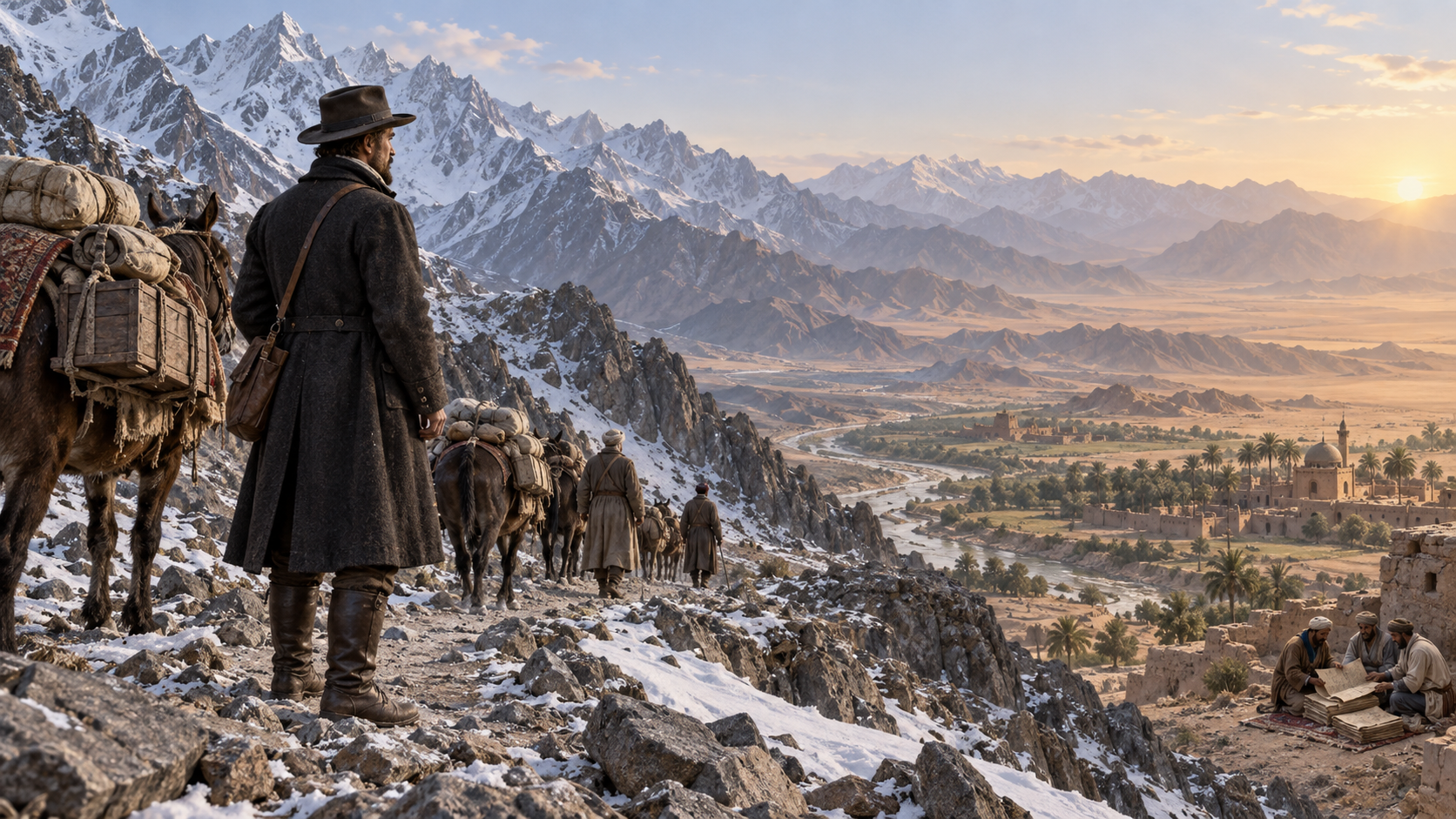
If you are trying to understand why Robert Barkley Shaw appears in the history of a second-century CE Sanskrit manuscript, begin with one correction: Shaw was not an archaeologist pursuing that manuscript, and the known sequence does not identify him as its finder. His role came earlier. He opened a commercial and political corridor whose consequences eventually reached the manuscript.
The connection runs through Indian tea, the Great Game, a heavily armed caravan, a young Scottish trader, a murder beyond the Karakoram Pass and the imperial manhunt that followed. Keeping those links separate gives you a more accurate history than the convenient claim that Shaw simply discovered an ancient Sanskrit work.
Shaw’s role began with a trade route, not an excavation
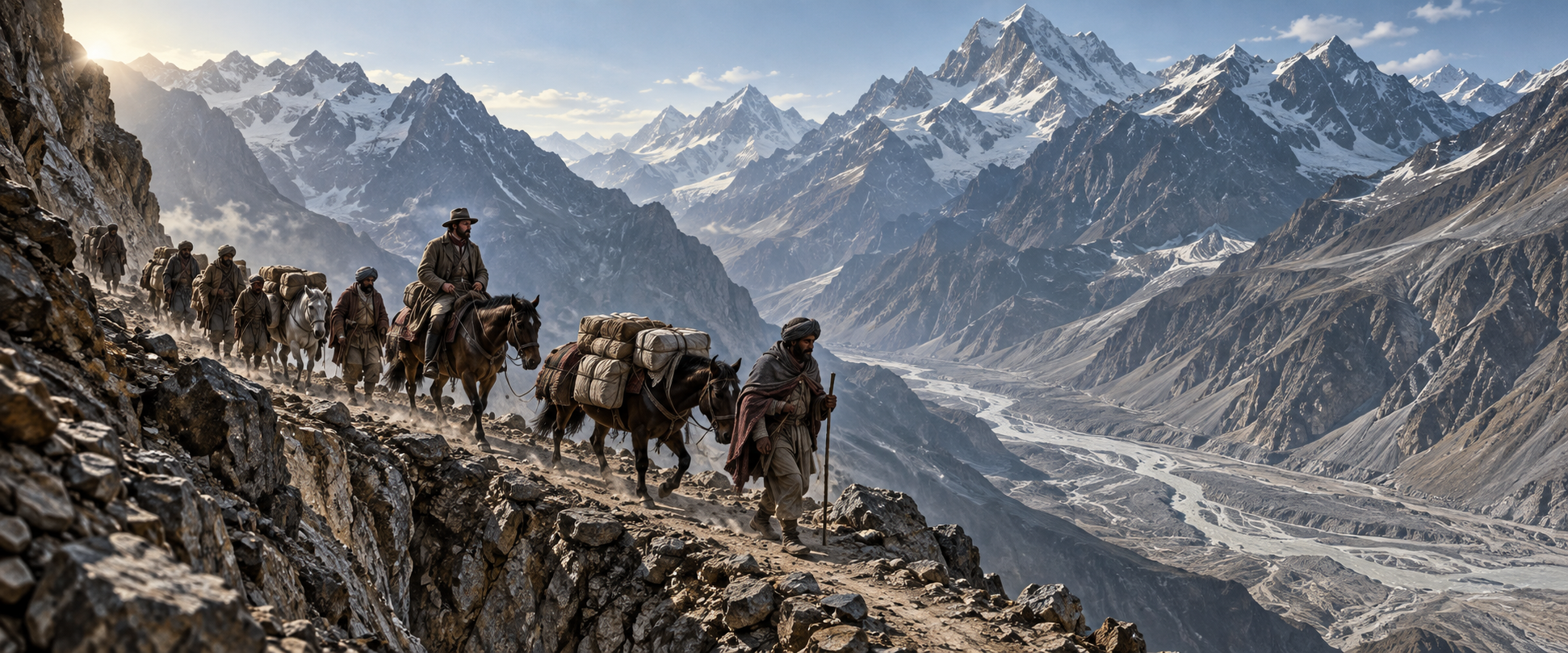
Robert Barkley Shaw entered Yarkand in 1869 while assessing its commercial possibilities. Yarkand, now in China’s Yarkant County, lay within the dominion of Kashgar, the major Silk Road trading centre then controlled by the Uzbek warlord Yaqub Beg. Shaw and his business rival George Hayward were the first Britons to reach this hostile and still-unmapped territory in the Pamir region.
Shaw understood that commercial access depended on political permission. He sent Yaqub Beg expensive gifts and obtained an audience on 11 January 1869. His proposal was direct: permit a trading post, and Indian tea could produce substantial revenue from what Shaw presented as a market of sixty million potential customers in the Kashgar region.
Yaqub Beg accepted the commercial proposal but placed Shaw and Hayward under house arrest. The apparent contradiction makes sense only when you recognise the Great Game behind the transaction. Britain and Russia were competing for influence in Central Asia, and Yaqub Beg had received intelligence that Russians were plotting to assassinate him. He wanted backing from the British Crown and the Viceroy of India. Trade was therefore inseparable from diplomatic leverage and physical security.
Shaw established the Central Asian Trading Company in 1873, primarily to sell Indian tea. From that year, it prospered across the trans-Karakoram region, while Leh and Ladakh developed into valuable trading outposts. This was Shaw’s foundational contribution to the later discovery chain: he created an organised route, recruited people to operate along it and connected British Indian commerce with the political world of Kashgar and Yarkand.
The trading network carried rifles as well as Indian tea
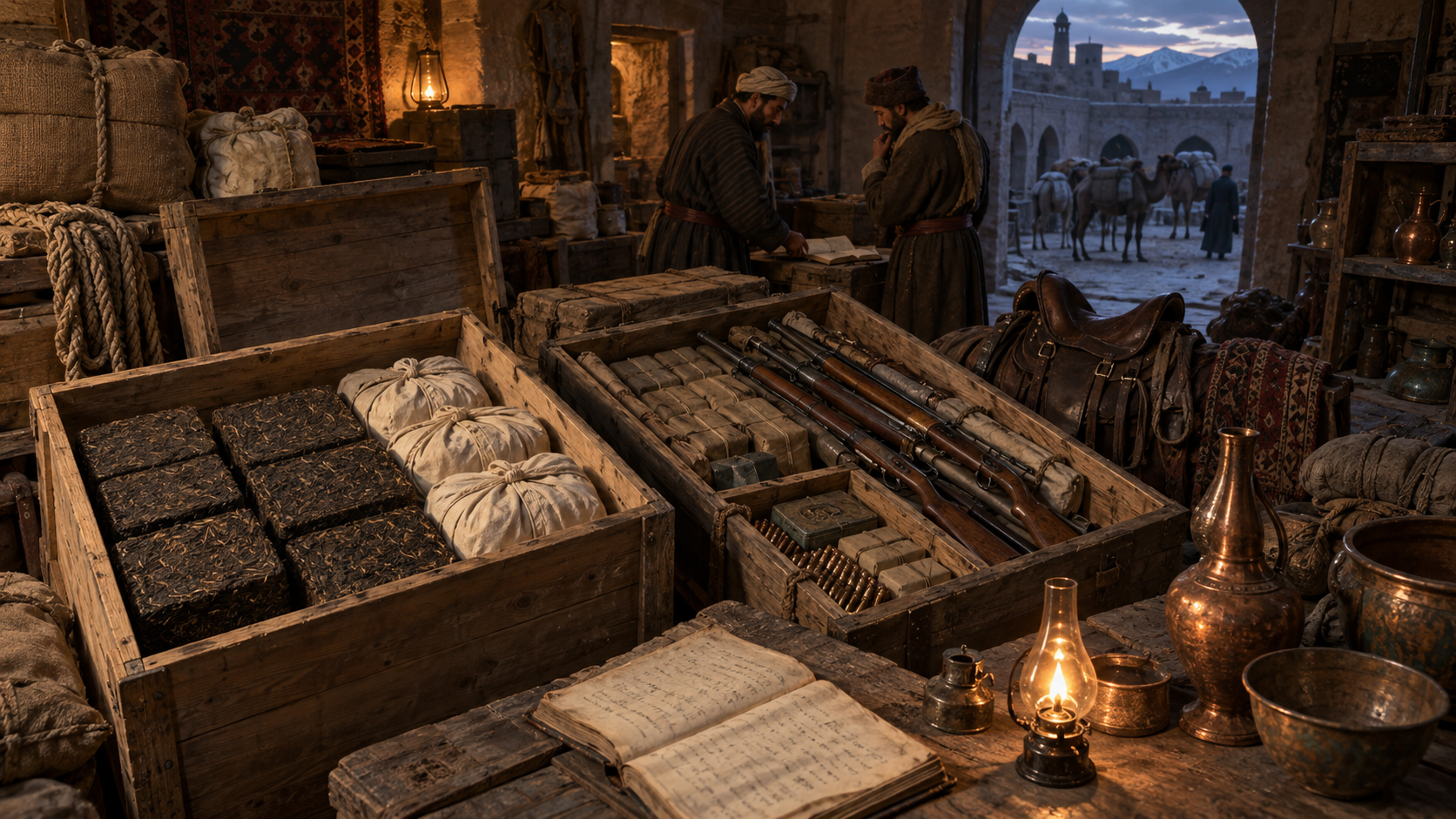
It would be misleading to picture Shaw’s enterprise as an ordinary tea business. Yaqub Beg wanted material support in return for allowing the company to operate. That support included rifles.
In 1874, Shaw recruited Andrew Dalgleish, a twenty-year-old Scot of modest background, for work from Leh and Ladakh. Dalgleish’s first major assignment was a caravan to Chinese Turkistan, Yarkand and Kashgar. It consisted of thirty men, twenty ponies and fifteen sheep intended to feed the party during the month-long journey. Manchester cotton formed a substantial part of the commercial freight, but large iron trunks contained the politically sensitive cargo: rifles for Yaqub Beg.
Shaw and Lieutenant Hopkirk led the expedition while heavily armed. Shaw kept the keys to the rifle trunks, and Hopkirk controlled the ammunition because bandits on the Himalayan route could kill to obtain the weapons. The caravan succeeded, and the mission established Dalgleish in the trans-Karakoram trading world.
This detail matters when you assess the manuscript story. The corridor that later enabled an accidental cultural discovery had been built for profit, diplomacy and strategic influence. Indian tea moved north, British manufactured goods crossed the mountains, weapons secured political favour, and information travelled in both directions. The eventual appearance of an ancient Sanskrit manuscript was not the intended purpose of this network.
Andrew Dalgleish became the human link in the chain
Dalgleish did not remain a temporary employee passing through an unfamiliar region. He settled into the larger world of Ladakh, Leh and the Karakoram Pass, learned Uyghur, married a Yarkandi woman and travelled continually. Merchants, travellers and hunters valued his knowledge of the routes. His familiarity with the terrain made him one of the people through whom Shaw’s commercial venture acquired a durable local presence.
Among Dalgleish’s associates was Daud Mohammed Khan, a volatile Pathan who traded between Yarkand and Ladakh. Their business association became a close friendship, although Daud also had a reputation for smuggling and dishonesty.
While Dalgleish was away on an expedition to Tibet, Daud neglected his business, lost his ponies and became bankrupt. He borrowed heavily from Hindu moneylenders and threatened them when they sought repayment. Their complaint reached the British Commissioner at Leh, who barred Daud from trading on the Yarkand-Leh road until he paid his debts.
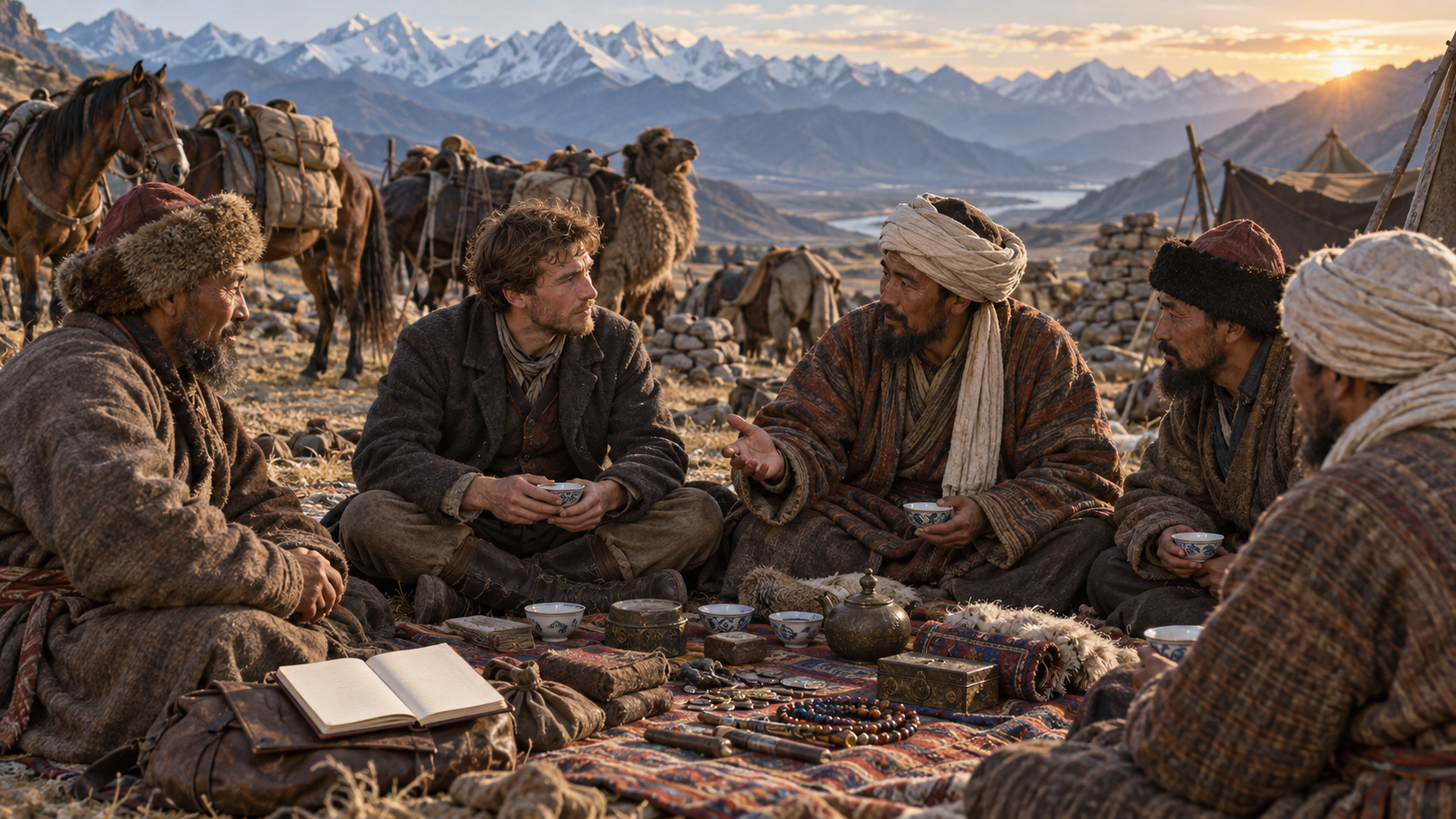
Dalgleish responded with misplaced loyalty rather than caution. After returning, he tried to help his fallen friend. In May 1888, he left Leh for Yarkand with pilgrims and servants and invited Daud to join the caravan. The two men met beyond the Karakoram Pass, where the party had stopped and pitched its tents.
Details of the confrontation vary slightly, so the uncertain points should not be presented as a verbatim reconstruction. The central sequence is clear. A discussion over Daud’s debts took place while the men drank tea. Daud left the tent, returned with a rifle and fired, wounding Dalgleish in the shoulder. When Dalgleish tried to escape, Daud pursued and killed him with a sword. Daud then remained at the camp long enough to eat, sleep in Dalgleish’s tent and depart the following day.
Dalgleish’s importance to the Sanskrit discovery is therefore tragic and indirect. Shaw recruited him into the Central Asian Trading Company; years on the route made him a prominent regional trader; his relationship with Daud ended in murder; and that murder activated the search machinery that carried the story to its next stage.
The 1888 manhunt opened the path to the manuscript
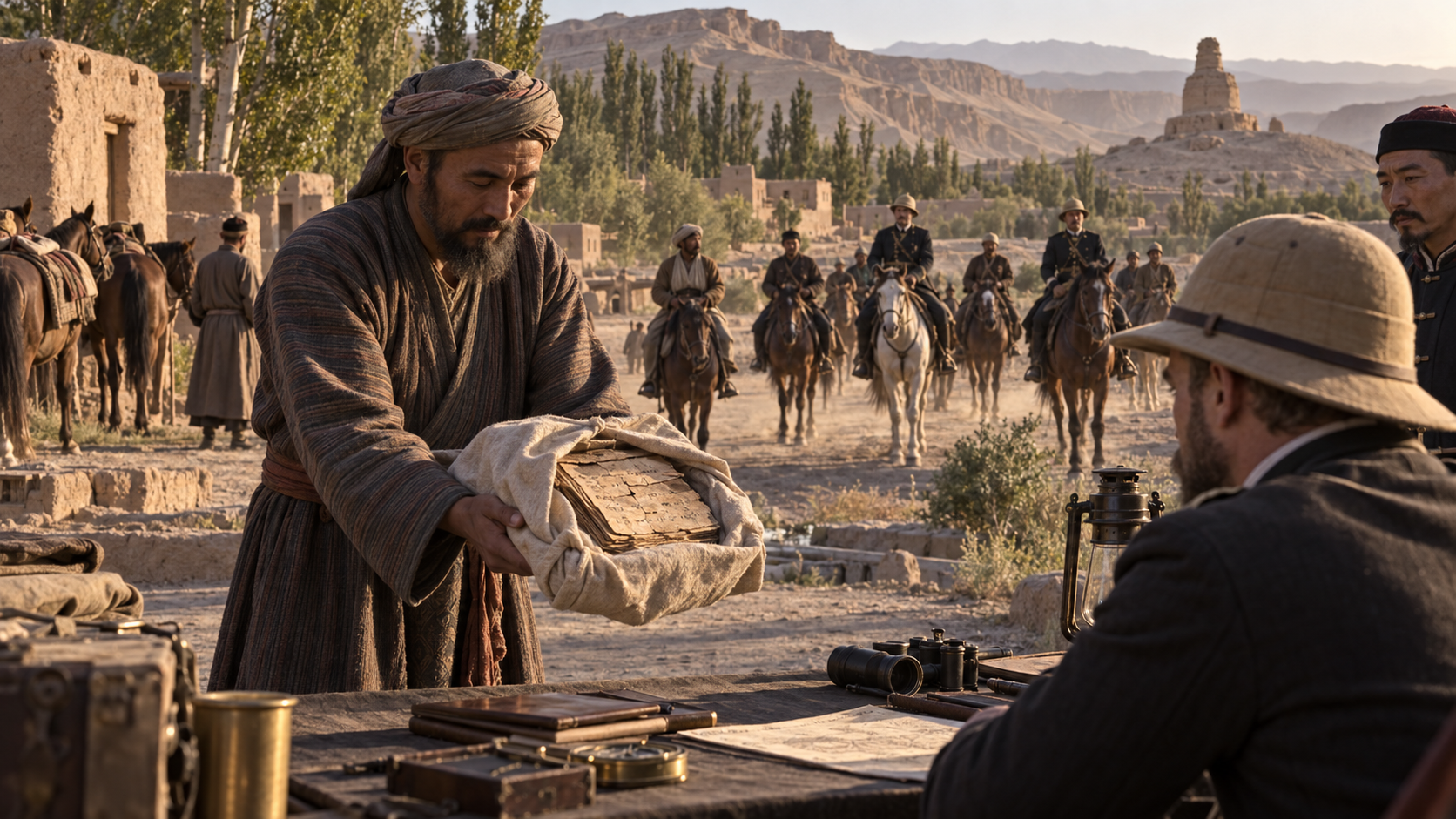
News of Dalgleish’s murder caused outrage among the British community in Yarkand. The British Raj treated the case as more than a private crime. Imperial prestige was considered to be at stake, government resources were committed to finding Daud, and a substantial bounty was offered for his capture.
The resulting manhunt generated messages, letters and official instructions across the region. One such communication reached Lieutenant Hamilton Bower, who was stationed in Kashgar. That bureaucratic handoff is the crucial bridge between Dalgleish’s murder and the accidental discovery of the second-century CE Sanskrit manuscript.
The distinction between cause and purpose is essential. Nobody in this chain began by organising a search for a Sanskrit treasure. Shaw pursued trade. Yaqub Beg pursued revenue, weapons and British support. Dalgleish built a career on the caravan route. Daud committed murder amid debt and personal collapse. The Raj pursued a fugitive. The manuscript emerged as an unforeseen consequence of those actions.
The precise steps after Bower received the communication, including the manuscript’s immediate circumstances of recovery, its material form, textual identity, exact findspot and chain of custody, are not established by the facts available here. You should not fill that gap with a plausible-sounding reconstruction. What can be stated securely is that the manhunt culminated in an accidental discovery that became consequential for Indology in the late nineteenth and early twentieth centuries.
Its description as a second-century CE manuscript refers to the age assigned to the object, not to the date of its modern discovery. Do not merge the two chronological layers. The modern chain begins with Shaw’s 1869 journey, takes institutional form with his company in 1873, brings Dalgleish onto the route in 1874 and changes direction with the murder in 1888. The manuscript itself belonged to a vastly earlier world.
For a reader concerned with Bharat’s intellectual influence, the wider implication is important but should remain precise. A Sanskrit manuscript surfacing through a Central Asian network shows why the textual history of Bharat cannot be studied as though it stopped at modern political borders. It does not, by itself, answer every question about who carried the text, where it was copied or how it survived. Those conclusions require the manuscript’s separately documented provenance and contents.
Key takeaways: how to state Shaw’s connection accurately
- Do not call Robert Barkley Shaw the manuscript’s finder. His securely established role was to create the Central Asian trading enterprise and recruit people who worked along the route.
- Keep the dates in their proper categories. Shaw entered Yarkand in 1869, founded the Central Asian Trading Company in 1873, recruited Dalgleish in 1874, and Dalgleish was murdered in 1888. The second-century CE date belongs to the manuscript, not its recovery.
- Recognise Andrew Dalgleish as the central human link. His career grew from Shaw’s company, and his murder triggered the official pursuit that eventually led to the accidental discovery.
- Treat commerce, diplomacy and empire as part of the mechanism. Indian tea, Manchester cotton, rifles, Yaqub Beg’s political insecurity and Anglo-Russian rivalry all shaped the network in which the later events occurred.
- Separate established causation from missing provenance. The path from Shaw to Dalgleish, the murder, the manhunt and Hamilton Bower is clear. The manuscript’s exact recovery and textual details need additional evidence.
If you need one defensible sentence for discussion or further research, use this: Robert Barkley Shaw founded the trading network that brought Andrew Dalgleish into trans-Karakoram commerce, and Dalgleish’s 1888 murder triggered the manhunt that eventually culminated in the accidental discovery of a second-century CE Sanskrit manuscript.
That formulation preserves every role without granting imperial commerce credit for creating the Sanskrit inheritance it happened to encounter. As you follow the story beyond Hamilton Bower, look next for the manuscript’s name, contents, physical description, findspot and documented passage into scholarly hands. Those facts will tell you what was discovered; Shaw’s network explains why the trail opened at all.
References
- DharmaRenaissance Blog — A 19th Century Murder that Excavated a Second-Century Sanskrit Manuscript: Episode One
