

You may have been handed a stark choice: Tamil or Sanskrit, regional dignity or Bharat, social reform or Sanatana Dharma. Before you accept either side of that choice, examine who constructed it. A forced binary can smuggle an entire political theory into what appears to be a simple affirmation of Tamil identity.
Useful cultural decolonization does not ask you to exchange a colonial hierarchy for ideological obedience. It gives you a method: distinguish language from race, follow claims back to evidence, recover local memory, and make room for genuine reform without treating Tamil Hindu civilization as something that must be dismantled.
Separate the four claims hidden inside Dravidian

The word Dravidian can do several different jobs. It can classify languages, identify a region, propose a history, or prescribe a political identity. Those uses are related only if evidence connects them. Linguistic difference by itself does not establish a separate biological race, an isolated civilization, or a religious duty to oppose Hindu tradition.
- A linguistic claim concerns grammar, vocabulary, sound patterns, and relationships among languages.
- A historical claim concerns when communities, texts, institutions, or identities emerged.
- A racial claim treats linguistic categories as biological populations with separate origins and inherited political interests.
- An ideological claim turns those categories into a program: who belongs, what must be rejected, and which institutions should control public memory.
The decisive error usually occurs between the first and third claims. A language can be structurally distinct from another language while its speakers participate in a shared religious and civilizational world. Contact, translation, borrowing, adaptation, and disagreement are all compatible with cultural continuity. None of them automatically proves conquest or cultural fraud.
Robert Caldwell published A Comparative Grammar of the Dravidian or South-Indian Family of Languages in 1856 and described Tamil in notably admiring terms, including its early cultivation and rich ancient forms. That linguistic work supplied later activists with an authoritative vocabulary for Tamil separateness. Yet Caldwell also advanced conclusions that did not serve every later Dravidian narrative: he regarded the principal Dravidian dialects as already separate around the beginning of the Christian era and placed the beginnings of Tamil literature no earlier than the 10th century CE.
This tension matters. Later ideological use was selective rather than a simple repetition of Caldwell. Praise that supported linguistic antiquity could be elevated, while conclusions that complicated a preferred chronology could be resisted or omitted. The decolonizing response is not to declare Caldwell entirely authoritative or entirely worthless. It is to accept or reject each claim according to its evidence.
| Claim offered | What it can establish | What it cannot establish by itself |
|---|---|---|
| Tamil belongs to a distinct language family | A linguistic relationship based on language evidence | A separate biological race or an anti-Hindu identity |
| A Tamil word resembles or derives from another language | Contact, borrowing, inheritance, or a question requiring further analysis | Political domination without independent historical evidence |
| A text has a proposed date | A position about that text or its surviving form | The beginning or end of an entire civilization |
| A community suffered a documented injustice | A need for truth, remedy, and institutional reform | That its complete religious inheritance is fraudulent |
When you encounter a slogan about Aryans, Dravidians, Tamil identity, or Hinduism, rewrite it as separate linguistic, historical, racial, and political propositions. Then ask what evidence supports each proposition. If the argument cannot survive that separation, it was relying on category confusion.
Recover the evidence trail, including what was omitted
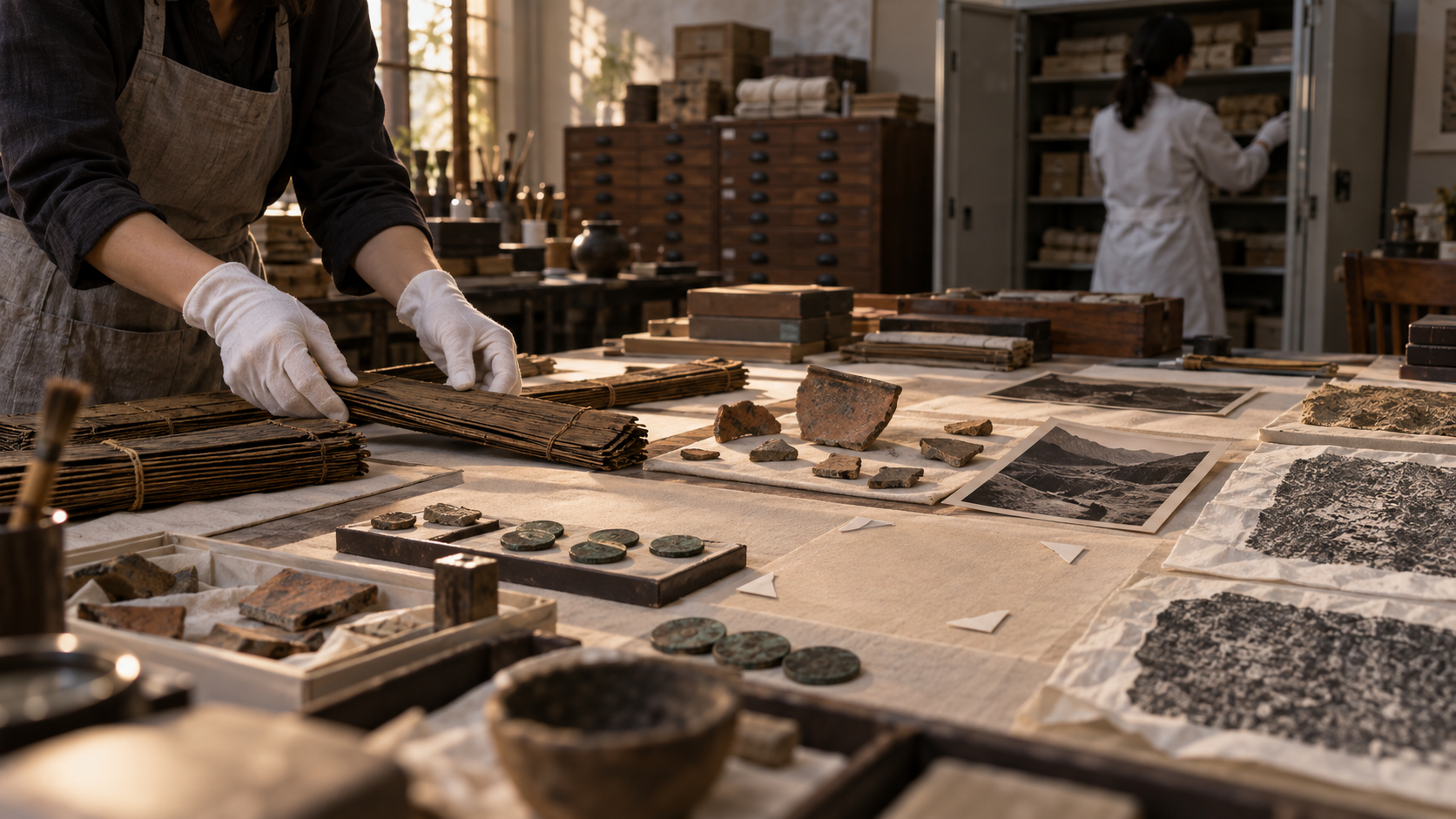
Mental colonization is not simply the presence of foreign books or the use of English. It is the surrender of authority over the questions you are permitted to ask. Colonial education explicitly sought graduates who would imitate the ruler’s standards and loosen their attachment to inherited religion. A movement that replaces that arrangement with a new set of forbidden questions has changed the approved answer, not the method of control.
The publication history surrounding Caldwell illustrates why editions matter. Madras University issued an abridged version in 1936. B. G. L. Swamy, a botanist who served at Presidency College, Madras, from 1953 to 1978 and observed the Dravidian movement at close range, alleged that portions of the long preface had been removed, that earlier copies became difficult to obtain, and that pages in some surviving library copies had disappeared or been blackened. He also described obtaining microfilm from the British Museum, only to have its authenticity rejected by ideological opponents.
Those are serious archival allegations, so repeat them with their status intact. Swamy’s account makes a strong case for inspecting catalogues, scans, physical copies, and edition histories; it does not relieve you of that inspection. Cultural advocacy loses credibility when an allegation is promoted from testimony to settled fact without an auditable trail.
Use the following claim ledger whenever a historical assertion carries political weight:
- Write the exact claim. Remove slogans and emotional adjectives. If the claim changes when stated plainly, you have already found a weakness.
- Identify the kind of claim. Mark it as linguistic, textual, archaeological, social, racial, religious, or political. Do not allow evidence from one category to settle another automatically.
- Find the earliest accessible wording. For the Caldwell dispute, start with editions dated 1856 and 1857, then compare the 1936 abridgment. Record the edition, year, section, and page rather than citing an unattributed quotation.
- Separate quotation from interpretation. Copy the relevant words accurately, then write your inference on a different line. This prevents an interpretation from acquiring the authority of the quoted material.
- Check the material surrounding the quotation. Prefaces, footnotes, qualifications, appendices, and omitted paragraphs can change what a sentence means.
- Record competing positions. A claim becomes more trustworthy when it states the strongest contrary reading instead of hiding it.
- Assign an evidence status. Use documented, directly quoted, inferred, contested, or unverified. Change the label when better evidence appears.
Keep the ledger even when the conclusion favors your own civilizational outlook. Decolonization requires the confidence to preserve inconvenient evidence. Otherwise, you are asking readers to trust a new gatekeeper rather than teaching them how to verify a claim.
Turn decolonization into a thirty-day Tamil practice

An archive can correct a false chronology, but it cannot by itself restore cultural competence. If Tamil Hindu heritage appears only as an argument on social media, the argument has already become detached from the life it is meant to defend. Recovery must reach the household, the local institution, and the next generation.
- Week one: make a household vocabulary map. Choose ten Tamil terms connected with worship, ethics, kinship, festivals, food, or the calendar. Ask the oldest available relative or community member how each term was used. Record the word, pronunciation, meaning, occasion, and the person who supplied the memory. Do not force an etymology. Mark an origin as unknown when you do not know it.
- Week two: document one living institution. Select a local temple, shrine, mutt, or community observance. Note the Tamil names used for the deity, ritual, festival, song, office, and offering. Record visible inscriptions or printed notices accurately, but do not photograph restricted rites or identifiable people without permission. Your goal is a usable record, not content collection.
- Week three: audit one contested claim. Choose a statement about Tamil, Sanskrit, Aryans, Dravidians, caste, or Hindu practice that you have heard repeatedly. Apply the seven-step claim ledger. If you cannot verify it, write unverified rather than filling the gap with confidence.
- Week four: create one small public inheritance. Turn the material into a two-page note, a short bilingual recording, or a reading-circle handout. Include edition details, competing interpretations, and unresolved questions. A modest item that another person can inspect is more valuable than a sweeping declaration with no trail.
Do not use this exercise to prove that every Tamil form came from Sanskrit, or that Tamil developed in sealed isolation from the rest of Bharat. Both conclusions begin with the answer and recruit evidence afterward. Record interaction wherever you find it. Cultural exchange does not make Tamil subordinate, and Tamil distinctiveness does not make its Hindu inheritance alien.
You will know the practice is working when your family or community possesses more than an opinion. It should have a growing body of words, memories, images, references, and carefully labeled uncertainties that another person can continue.
Demand reform without accepting civilizational erasure
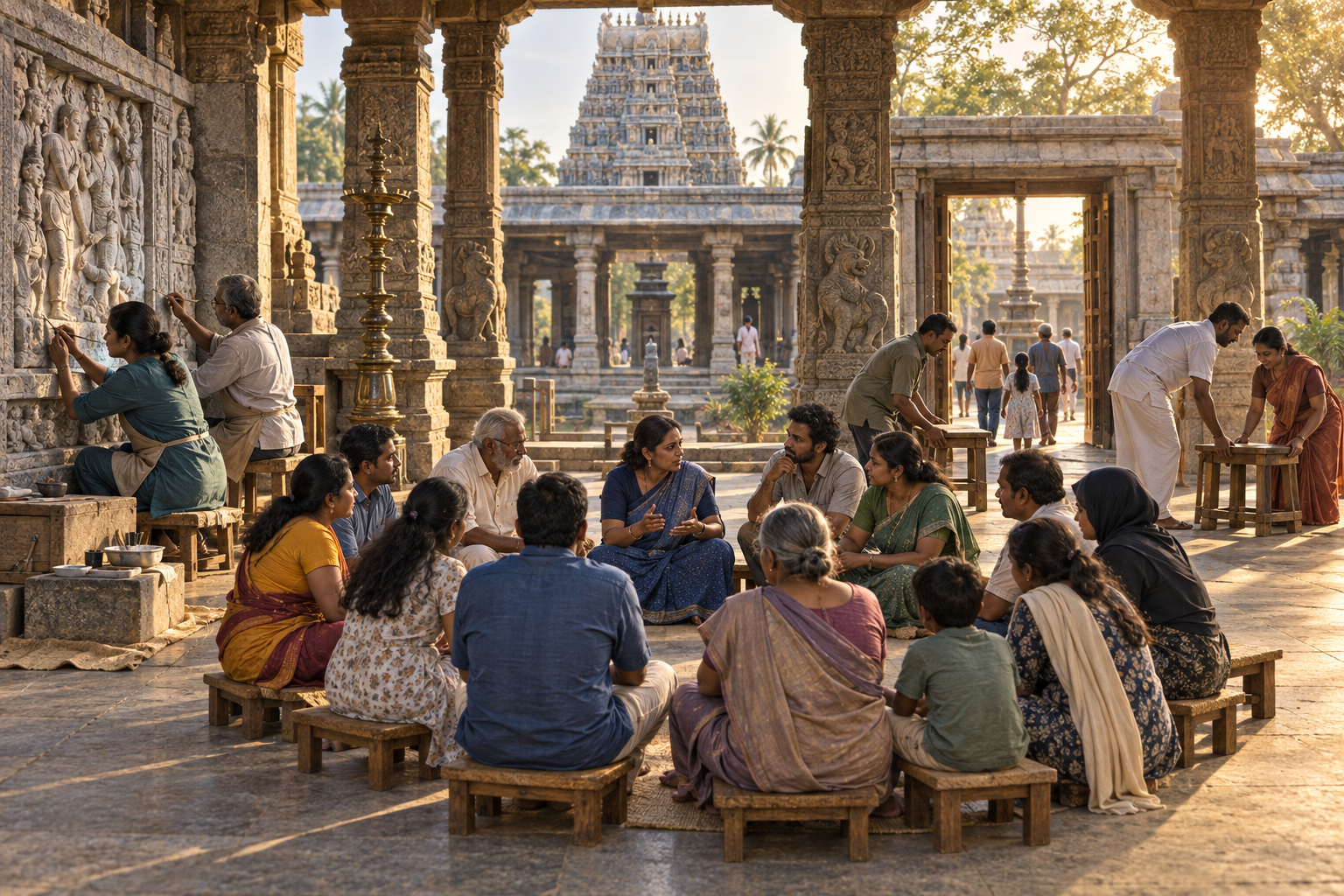
Protecting Tamil Hindu heritage does not require you to defend every custom, authority, or historical assertion. Social injury should be documented and corrected. A civilizational tradition that cannot examine its institutions will become brittle. But criticism of an injustice does not by itself validate a racial account of history, just as loyalty to Dharma does not make an injustice disappear.
The practical task is to separate grievance, explanation, and remedy. A grievance may be real while its ideological explanation is weak. A proposed remedy may be destructive even when the grievance is legitimate. Test each part independently.
Use six questions in classrooms and public debate
- What does the key category mean here? Ask whether Dravidian is being used linguistically, geographically, racially, politically, or religiously. Require one meaning at a time.
- What is the evidence? A grammatical comparison, literary passage, family memory, political speech, and social grievance have different evidentiary limits.
- Where does evidence end and inference begin? Make the speaker state the connecting argument instead of hiding it inside terms such as therefore, obviously, or merely.
- Is the chronology settled? If qualified scholars proposed different ranges, display the ranges and their proponents. Do not compress disagreement into one confident date.
- Has relevant material been selected or omitted? Check full editions, prefaces, appendices, translations, and contrary passages before accepting a quotation as representative.
- What does the proposed remedy preserve? Reform should name the injury it corrects. If its actual program is to sever language, family memory, temple practice, and civilizational belonging, the remedy exceeds the demonstrated problem.
The chronology of the Third Sangam is a useful discipline in uncertainty. M. S. Purnalingam Pillai placed it between 1750 BCE and 100 CE, while M. Srinivasa Aiyangar proposed a span from the 5th century BCE to the 6th century CE. Other proposals placed it around the 2nd century BCE or the 1st century CE. These divergent ranges should not be blended into an unlabeled date. You do not need to settle the entire question before recognizing that a curriculum must distinguish a proposed chronology from an established one.
Ask institutions for changes that can be verified
- Libraries should distinguish complete, abridged, revised, and translated editions in their catalogues.
- Teachers should define linguistic, racial, historical, and political categories before using them in the same narrative.
- Reading lists should include primary passages with edition details, not only modern summaries of what an earlier scholar supposedly meant.
- Competing dates should appear with proponents and evidence status rather than as interchangeable proof of antiquity.
- Tamil terminology should be preserved alongside translation so that an English label does not quietly replace the inherited concept.
- Programs addressing caste or other social injuries should identify the documented wrong, affected people, responsible institution, and proposed remedy. They should not use a real injury as a license for an unproved racial history.
This is a more demanding standard than replacing a colonial canon with a nationalist one. It requires civilizational authorship with accountability: the confidence to investigate from within the culture, the honesty to label disagreement, and the discipline to preserve material that complicates your preferred conclusion.
Key takeaways
- Do not let a linguistic category become a racial or religious conclusion without separate evidence.
- Tamil pride and Tamil Hindu continuity are not opposites merely because an ideology presents them that way.
- Audit politically useful quotations by edition, context, omitted material, competing readings, and evidence status.
- Treat archival-suppression allegations seriously but not as settled until the relevant copies and records can be inspected.
- Recover heritage through household language, living institutions, primary texts, and public material that others can verify.
- Correct genuine social wrongs without accepting civilizational erasure as the price of reform.
This week, choose one Dravidian-versus-Hindu claim from a textbook, speech, video, or family argument. Put it through the claim ledger and share the result with its uncertainties intact. Cultural decolonization becomes real when the next person can inspect your evidence, correct you where necessary, and still inherit more than a slogan.
References
- DharmaRenaissance Blog – How Dravidianists Savaged the Tamil Hindu Heritage and Gifted Tamil Nadu to the Global Church
- DharmaRenaissance Blog – Portraits of the Deracinated Indian Education System
