

When a textbook calls someone a reformer, revivalist, or anti-British fighter, you still need an answer to the harder question: what order did he intend to create after victory? Opposition to one empire does not automatically amount to a commitment to freedom, equal citizenship, or the civilisational interests of Bharat.
The most useful way to read post-Mughal Islamic revivalism is to follow the whole program: the religious order to be restored, the people marked as enemies, the authority claimed for coercion, the network assembled, and the state imagined at the end. That approach also prevents a different error. It holds named leaders responsible for their own programs without treating every Muslim, Sufi, or religious reform movement as interchangeable.
Revivalism named a political destination, not merely renewed devotion
Religious revivalism, by itself, means an attempt to recover what its advocates regard as an earlier and purer form of faith. It can remain within teaching, worship, personal discipline, or voluntary community reform. It becomes militant when the desired restoration depends on armed organisation, territorial sovereignty, or the coerced subordination of people outside the approved order.
| Question to ask | Religious renewal | Militant threshold |
|---|---|---|
| What must be restored? | Belief, worship, and voluntary discipline | A state enforcing a particular religious order |
| Who must change? | Willing followers | Dissenters, rival sects, or entire subject populations |
| How is change pursued? | Teaching, persuasion, and example | Recruitment, military preparation, and armed campaigns |
| How are outsiders treated? | As neighbours who may disagree | As enemies to be defeated, expelled, degraded, or subordinated |
The intellectual succession from Shah Waliullah to his son Abdul Aziz and then to Abdul Aziz’s disciple Syed Ahmad Barelvi makes this distinction unusually clear. After Mughal power declined following Aurangzeb’s death, letters attributed to Shah Waliullah urged Ahmad Shah Abdali to intervene in India and restore Muslim political strength. The desired remedy was not confined to spiritual renewal. It depended on an external conqueror and the recovery of political supremacy.
Abdul Aziz applied the same sovereignty-centred reasoning after British dominance became decisive. He declared Hindustan to be Dar-ul-Harb and presented faithful Muslims with a choice between migration and struggle to restore Muslim rule. The decisive fact is not simply that the British were his enemy. It is the political order for whose recovery he called people to fight.
Syed Ahmad Barelvi carried this logic into a movement conceived as religious, military, and political at the same time. He sought purification within the Muslim community, armed struggle against rival powers, and an Islamic state modeled on the order associated with Muhammad and the first four caliphs. In this case, militancy was not an accidental excess at the edge of a devotional project. It belonged to the stated method and destination.
Syed Ahmad Barelvi turned doctrine into an organised campaign
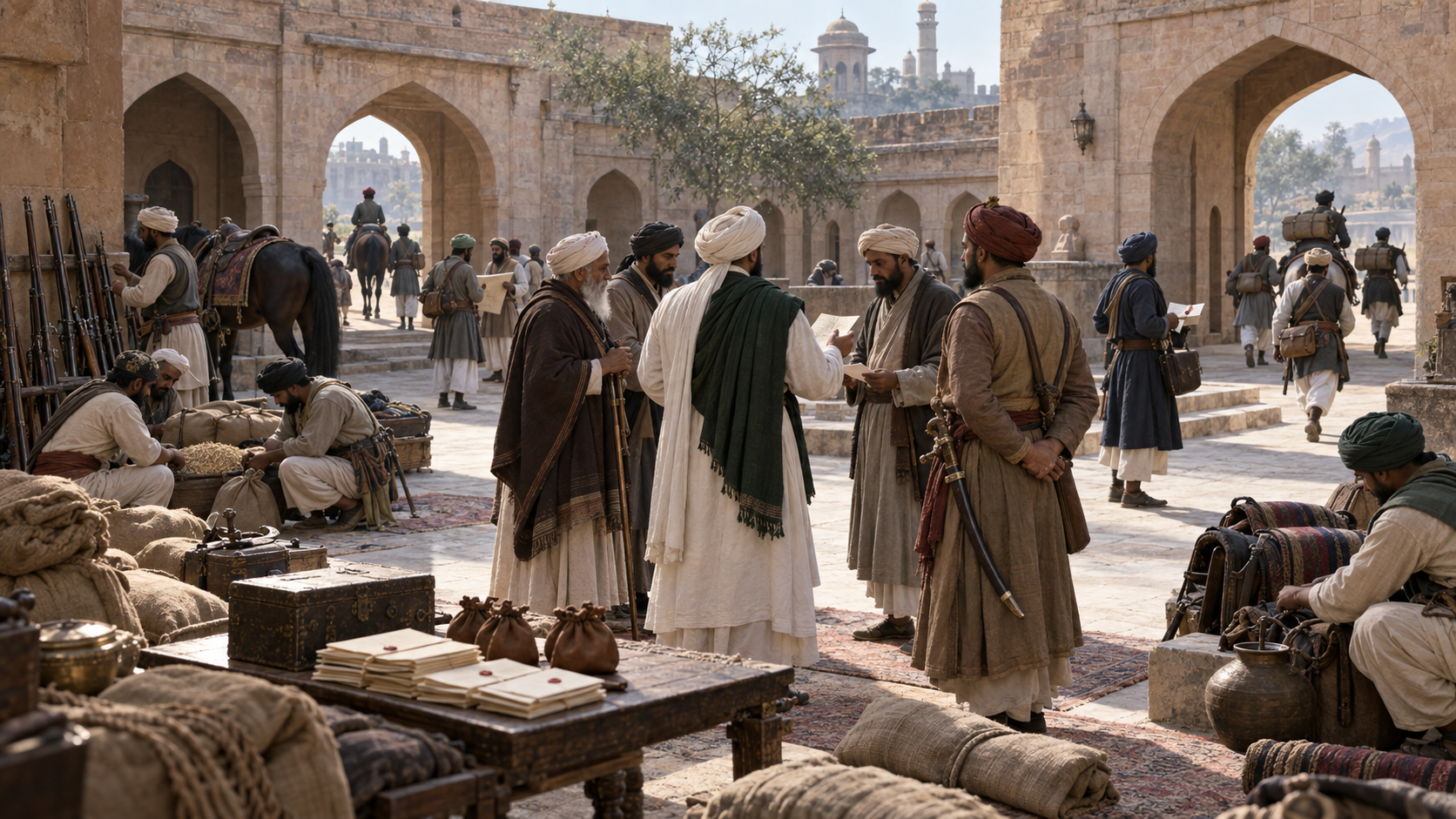
Ideas become historically dangerous when a movement develops the capacity to enforce them. Syed Ahmad’s career shows the stages by which a program of purification acquired military experience, clerical legitimacy, recruits, money, and a territorial enemy.
- Military apprenticeship came first. Acting on Abdul Aziz’s direction, Syed Ahmad joined the militia of the Pindari leader Amir Khan and remained there for six years. He left after Amir Khan surrendered to the British. This was practical preparation for warfare, not merely theological schooling.
- Religious authority reinforced the mission. Abdul Aziz later sponsored his journey to Mecca in 1822. Syed Ahmad also travelled in Arabia and visited Syria, encountering teachers associated with rigorous ideas of Islamic purification. He returned convinced that removing un-Islamic practices from Indian Muslim life was a divinely assigned task.
- Purification created boundaries inside the community. The condemned practices included those of heterodox Sufis and Shias, as well as customs borrowed from Hindus. Visits to Hindu sacred places, participation in Hindu festivals, consultation with Brahmins for omens, the use of Hindu religious symbols, and forms of dress or bodily adornment associated with surrounding society were treated as corruptions.
- Recruitment bypassed established elites. Instead of relying mainly on khans and ashraf nobles, Syed Ahmad appealed to the ulema and approached Muslim youth directly. Door-to-door mobilisation transformed an elite theological project into a prospective mass movement.
- A wide financial network supplied the movement. Donations came from Muslim businessmen and landholders across Patna, Hyderabad, Madras, Bengal, Uttar Pradesh, and Bombay. This matters because a movement with money and long-distance connections can move people, circulate instructions, and sustain armed activity.
- Religious categories identified territorial enemies. British ascendancy was one obstacle, but Sikh sovereignty under Maharaja Ranjit Singh was another. Syed Ahmad’s armed project concentrated on the Sikhs of Punjab and ultimately ended with his death at Balakot.
This sequence gives you a concrete test for militancy. Do not stop at fiery language. Look for the conversion of doctrine into capacity: training, authoritative sanction, purification campaigns, recruitment, finance, command, and an identified theatre of war. When those elements converge, revivalism has crossed from exhortation into an organised bid for power.
The intracommunity targets also matter. Syed Ahmad was not simply drawing a line between Muslims and non-Muslims. He was enforcing a narrower definition of acceptable Islam against Shias, heterodox Sufis, and Muslims whose daily lives reflected centuries of interaction with Hindu society. Purification movements often create their first boundary among people nominally inside the faith. Watch whom a leader expels from the definition of a legitimate believer before assessing what he promises everyone else.
Why fighting the British did not necessarily mean fighting for India

Anti-colonial action describes an enemy; it does not, on its own, describe a political ideal. A leader may resist British authority because he wants popular sovereignty, because he wants to restore a displaced dynasty, or because foreign rule obstructs a confessional state. Those aims are not equivalent.
Syed Ahmad’s correspondence reveals the importance of asking who was addressed. In a letter to Raja Hindu Rao, the brother-in-law of Maharaja Daulat Rao Scindia of Gwalior, he appealed to resentment against foreigners and promised that ranks, offices, and political authority would return to their seekers once the alien rulers had been removed. The language offered a basis for tactical cooperation with a Hindu prince injured by British expansion.
A letter addressed to a Muslim businessman defined the central objective differently:
My real object is the establishment of jihad against the Sikhs of the Punjab.
Syed Ahmad Barelvi, letter to a Muslim businessman
The divergence does not require speculative mind-reading. It shows audience-specific politics. One constituency received an appeal against foreign domination and the prospect of recovered office; another received an explicitly confessional explanation of the campaign against Sikh rule. That is enough to make the unqualified description of Syed Ahmad as an Indian freedom fighter inadequate.
You can test any supposedly anti-colonial leader with three questions:
- Who was supposed to inherit sovereignty? Removing British officials tells you little unless you know whether the proposed successor was a civic government, a dynasty, or a religious state.
- Who belonged to the political community? You need not demand modern constitutional language from an eighteenth- or nineteenth-century figure. You can still ask whether communities outside his faith were prospective partners, protected but subordinate subjects, targets for conversion, or enemies.
- Who else was marked for war? If indigenous Sikhs, Hindus, Shias, or heterodox Muslims remained enemies independently of their relationship to Britain, resistance to colonialism was only one part of a larger struggle for confessional power.
This distinction is especially important when commemorative history turns every opponent of the British into a nationalist. The modern nation cannot be projected backward merely from a shared enemy. Identify the intended successor order before attaching the language of freedom.
Sufi identity is not evidence of pluralism by itself
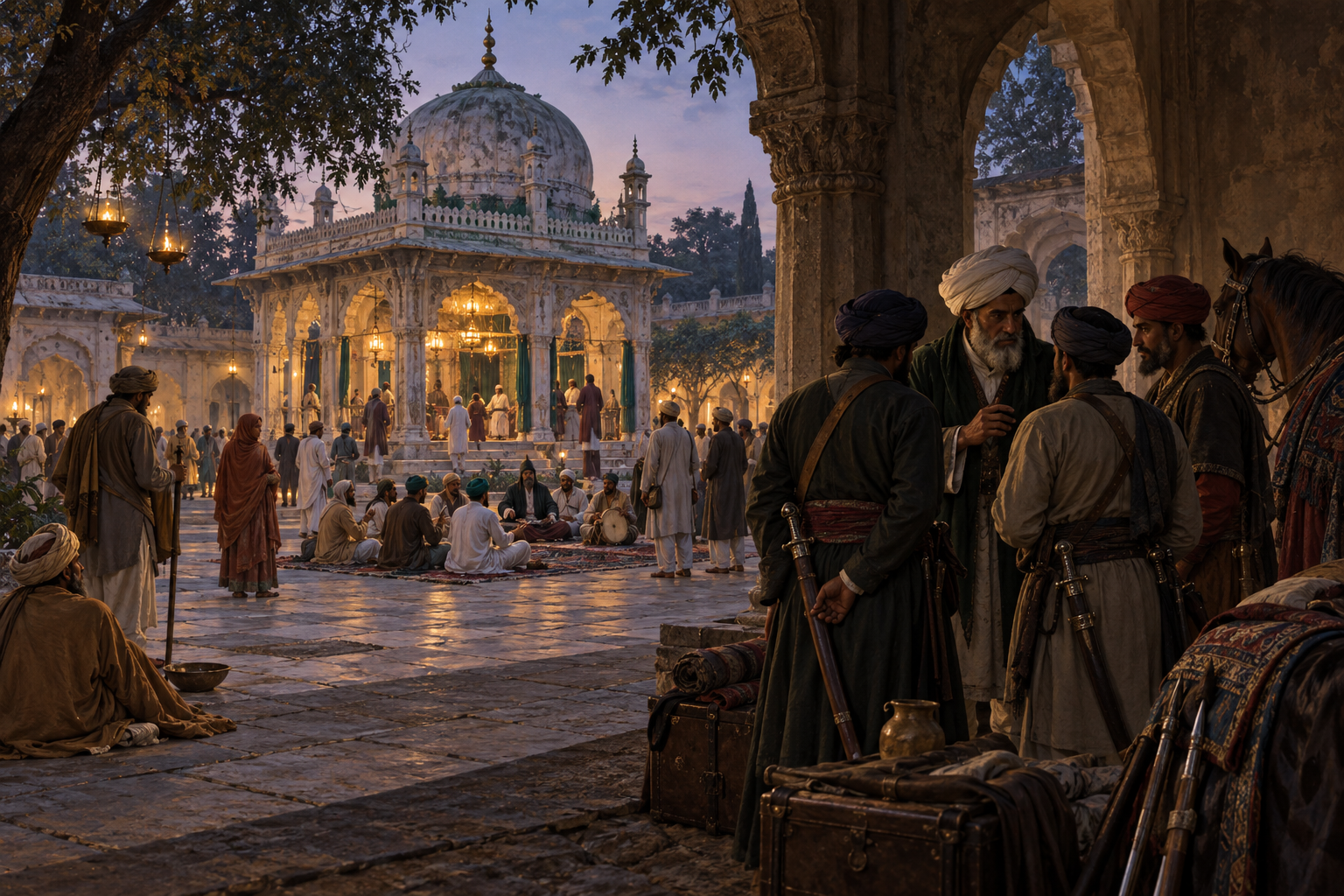
You may encounter an opposite shortcut when the discussion moves to Sufism: the assumption that a mystical affiliation automatically proves tolerance toward Hindu traditions. It does not. Mystical practice, missionary activity, political influence, and support for coercive religious policy can exist within the same historical institution.
Ahmad Sirhindi provides a direct warning against judging a figure by the reassuring associations later attached to the word Sufi. His political theology treated Islam and kufr as incompatible public orders, connected the strength of sharia with royal power, defended the humiliation of non-Muslims, objected to the abolition of jizya, and disparaged Ram and Krishna. His own formulation made the hierarchy explicit:
The glory consists in the humiliation and degradation of infidels and infidelity.
Ahmad Sirhindi
That language does not prove that every Sufi shared Sirhindi’s position. It does disprove the categorical claim that Sufi identity itself guarantees coexistence. The sound historical unit is the named person, lineage, institution, text, and policy. Neither romantic celebration nor blanket condemnation can replace that work.
The same rule applies to present-day devotional popularity. Hindu attendance at a dargah tells you something real about current practice, local memory, and the generous Sanatani capacity to recognise sanctity in many forms. It cannot, by itself, establish the political theology or conduct of the medieval person buried there. Contemporary reverence and historical evaluation answer different questions.
When you assess a Sufi figure or institution, use this evidence order:
- Identify the exact words attributed to the named person, preferably with the type of text: letter, theological instruction, court advice, or hagiography.
- Establish the intended audience. Private counsel to a ruler, instructions to disciples, and public preaching may reveal different parts of the same program.
- Extract the requested policy. Look for positions on jizya, temples, conversion, relations with non-Muslims, rival Muslim sects, and the authority of the ruler.
- Compare instruction with institutional conduct. Political access, missionary networks, court influence, and cooperation with military power carry more weight than a later reputation for gentleness.
- Keep later memory in its proper period. A shrine’s modern culture may deserve study and respect without being used to erase an earlier documentary record.
This method also protects you against weak polemics. A harsh sentence should be attributed to the person who wrote or transmitted it, not projected onto millions of people across centuries. Precision makes a civilisational critique stronger because it leaves less room for evasion and less room for unjust collective accusation.
Key takeaways for reading revivalist movements

- Translate every label into a program. Reformer and revivalist are incomplete descriptions until you know what was to be restored, who would rule, and how dissenters would be treated.
- Separate devotion from coercion. A call for stricter personal observance is not the same as a campaign to impose religious law through political or military power.
- Follow the organisational chain. Clerical sanction, military training, youth recruitment, fundraising, and territorial command show when doctrine is acquiring the means of enforcement.
- Read messages to different audiences side by side. Promises made to potential allies may conceal or soften objectives stated more openly to committed supporters.
- Do not mistake a shared enemy for a shared nation. Opposition to the British becomes Indian nationalism only when the intended political community extends beyond the restoration of sectarian supremacy.
- Reject both romance and collective guilt. Sufi, reformer, and freedom fighter are not moral certificates, but the conduct of particular leaders does not license indiscriminate claims about all Muslims.
The next time you encounter a sanitised label, make a four-column note: declared end state, designated enemies, means of mobilisation, and statements made to separate audiences. Keep the label only if it still describes the movement after those columns are filled. If it does not, replace it with the more exact account. Historical memory serves Dharma best when it is candid, specific, and disciplined.
References
- DharmaRenaissance Blog — The Awful Record of the Sufis in India told in their Own Words
- DharmaRenaissance Blog — How the Fanatic Syed Ahmad Barelvi Met his Maker at Balakot
