
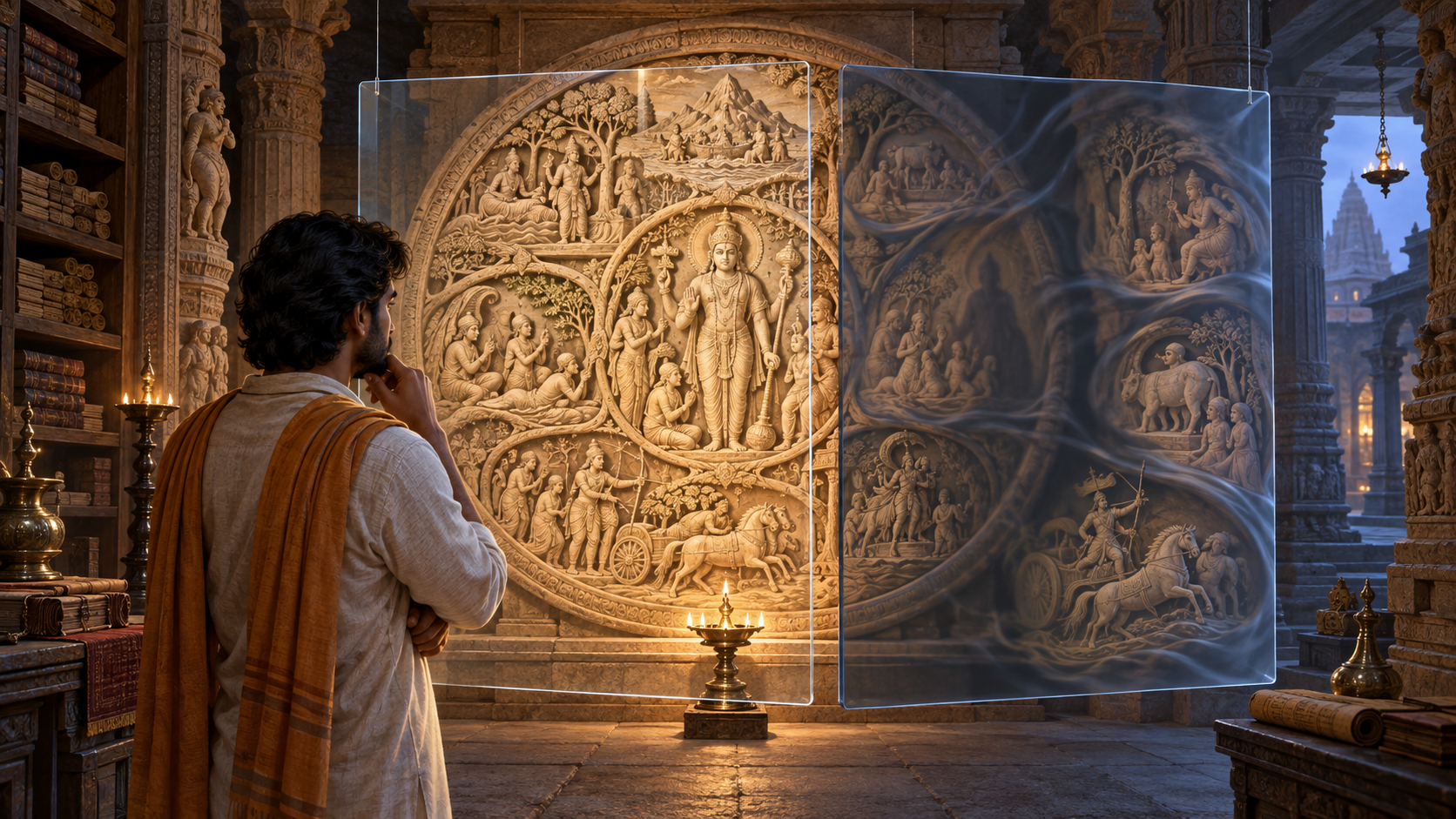
You hear a confident new explanation of a familiar katha. Vamana becomes a jealous oppressor. Rama becomes a flawed politician, while Ravana inherits the moral centre. Or a film keeps sacred names but removes the character that made those names sacred. If you have not recently read the relevant passage, the rewrite can sound convincing simply because it is tidy.
You do not have to reject every regional telling or demand that every film reproduce an ancient text scene by scene. You do need a reliable way to distinguish a living adaptation from a distortion. The method is straightforward: identify the claim, restore the sequence, recover what was omitted, and ask whether the changes merely shorten the story or reverse its moral structure.
First ask what kind of claim is being made
Many arguments become confused before anyone examines the narrative. A devotional custom, a translation, a cinematic adaptation, and a political claim are not the same kind of statement. Each carries a different burden of fidelity.
- A recitation or translation claims to transmit an identifiable textual or oral tradition. Its wording may vary, but its attribution, sequence, agents, and outcome should be traceable.
- A regional devotional telling may connect a sacred figure with a local festival or landscape. That association can have religious meaning without proving that every event in the older narrative occurred in that location.
- An adaptation may compress time, combine scenes, update dialogue, or create a new visual language. It should be presented as an adaptation, especially when it changes motives or outcomes.
- A historical or political thesis makes a stronger claim. If someone says a divine-asura conflict was really a modern caste struggle or an invasion narrative, resemblance is not enough. The proposed identification needs evidence from the relevant narrative and from history.
This distinction protects both artistic freedom and intellectual honesty. A filmmaker is free to reinterpret a character, but that freedom does not turn invention into scriptural testimony. A festival community may cherish Mahabali without being required to defend every modern political explanation attached to him. Your first question should therefore be: Is this being offered as scripture, local devotion, art, or history?
Use a seven-part test before accepting a dramatic retelling

A distortion rarely announces itself with a completely fabricated plot. It usually preserves familiar names and memorable scenes, then changes the moral conclusion by removing context. Test the claim in seven places.
- Name the authority. Ask which text, recension, commentary, sampradaya, or oral tradition is being represented. A vague statement that scripture says something is not enough when the conclusion depends on a particular detail.
- Restore the order of events. What happened immediately before the famous scene? What earlier action created the conflict? Divine intervention is often presented as an unprovoked beginning when it was a response to a developed sequence.
- Identify the actual petitioner and decision-maker. Replacing the person who asks for help can completely change the apparent motive. Jealousy, maternal concern, vengeance, protection, and restoration are not interchangeable causes.
- Check place and chronology separately. A later festival association does not automatically relocate an older narrative. A claim about geography should agree with the place named in the telling, while a claim about chronology should fit the sequence in which the tradition places events and avatars.
- Read character across the narrative. One action cannot be interpreted responsibly after deleting the virtues, faults, duties, warnings, and prior choices through which the character has been developed.
- Follow the outcome to the end. Was the apparent punishment final? Was it followed by protection, a boon, restoration, liberation, or a new responsibility? Stopping the story one scene early is one of the easiest ways to turn grace into cruelty.
- Test imported social categories. If a modern category such as race, caste class, colonial subject, or revolutionary hero is placed over an ancient genealogy, ask where the equivalence is established. A political analogy may be proposed as interpretation, but it should not be smuggled in as an uncontested fact.
One altered detail may be harmless compression. A cluster of alterations becomes more serious when every one pushes judgement in the same direction: the beneficiary becomes a victim, prior aggression disappears, surrender becomes humiliation, and a boon becomes exile. At that point, you are no longer looking at a shorter version of the same moral account.
Onam shows how omission can reverse an entire narrative
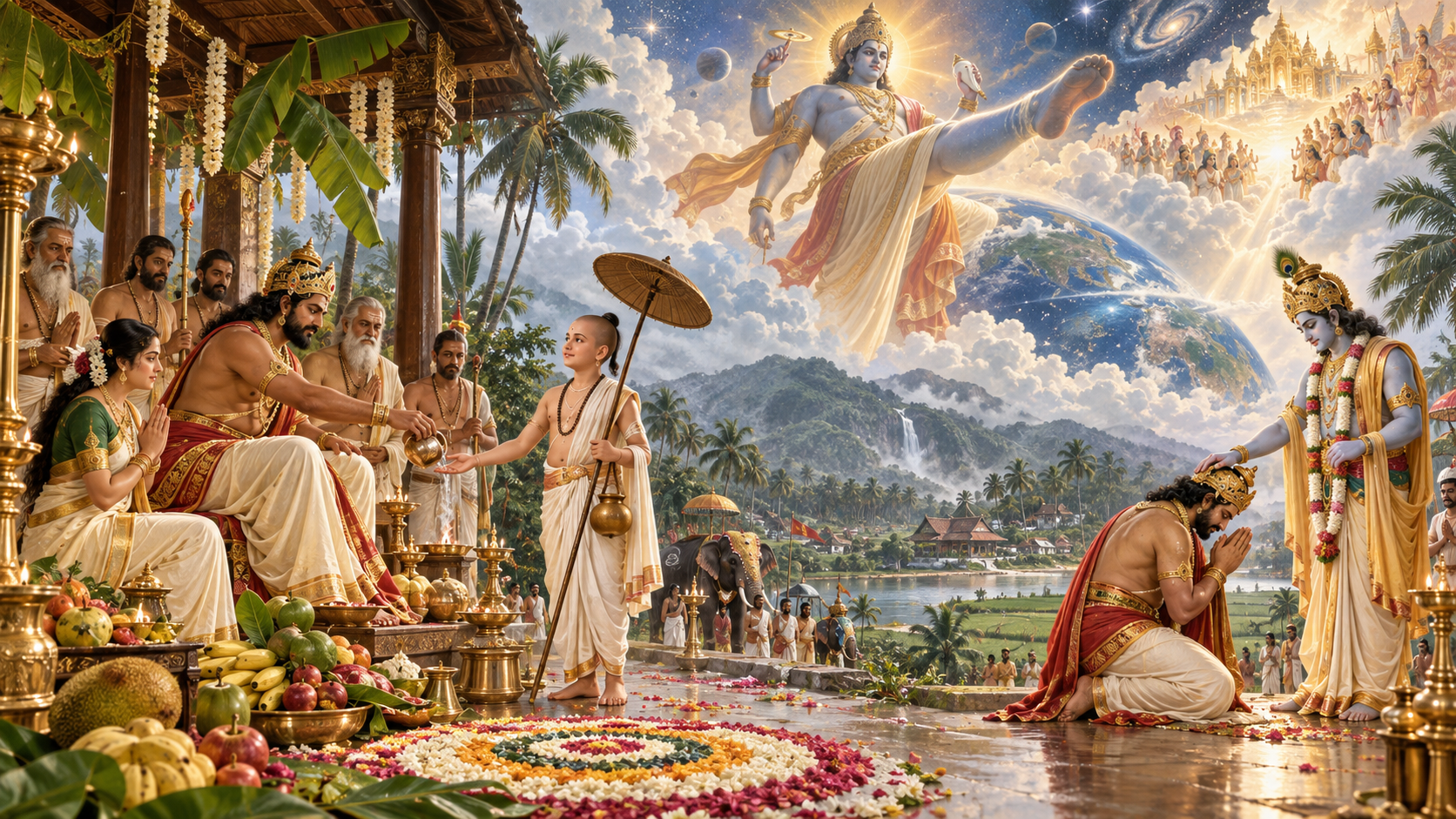
The familiar compressed account of Onam retains several important elements. Mahabali is generous. Vamana asks for three paces of land. The dwarf assumes a cosmic form. Bali offers his head when no space remains. The annual remembrance of Bali continues. The distortion appears when these surviving elements are arranged around a new cause and a truncated ending.
The fuller Bhagavatam sequence changes what you are being asked to judge:
- Mahabali belongs to the lineage of Prahlada through Virochana. After Bali loses his life in an earlier war with Indra, Shukracharya revives him. Supported by his guru and strengthened for renewed conflict, Bali later defeats Indra and takes control of devaloka.
- Vishnu does not immediately intervene on behalf of the devas. Their own arrogance has also required correction. The decisive appeal comes from Aditi, Indra’s mother, after her son has lost his realm. Following Kashyapa’s instruction, she undertakes a vrata and appeals to Vishnu.
- Vamana approaches Mahabali while the king is conducting a sacrifice on the bank of the Narmada. He asks for three paces of land. Shukracharya recognises the visitor and advises Bali to withdraw his promise, but Bali chooses to honour it.
- When members of Bali’s force attempt to resist Vamana, Bali stops them. He recognises that the divine power which had permitted the asuras to prevail is now moving events in another direction.
- After the cosmic strides, Bali offers his head. Prahlada appears and intercedes. Bali is not discarded in a dreaded abyss; he is granted Sutala, receives divine protection, and is given access to the Lord.
This is not the story of a perfectly innocent Kerala ruler removed because Indra could not tolerate his popularity. It is a narrative about sovereignty, the consequences of pride, fidelity to a vow, surrender, restored order, and grace. Bali’s generosity remains worthy of honour. His admirable act does not erase the conflict that preceded it, just as his earlier ambition does not erase the spiritual elevation that follows.
The geography supplies another check. Vamana appears before Parashurama in the traditional avatar sequence, while Parashurama is credited in Kerala tradition with bringing forth the land of Kerala. Mahabali’s sacrifice is placed on the Narmada. That does not invalidate the later devotional bond between Onam, Kerala, and Mahabali. It does prevent that bond from being used as automatic proof that the entire Vamana encounter was originally a political event in Kerala.
The destination matters just as much. Within the cosmology of fourteen worlds, Sutala and Patala are distinct subterranean realms. Sutala is presented as a realm of extraordinary comfort, and Bali receives it together with Vishnu’s protection. Reducing this conclusion to Vamana kicking Bali into a hellish Patala removes the boon and changes surrender into degradation.
The same care is needed when a modern caste map is placed over the devas and asuras. They are described as related through Kashyapa, with Aditi and Diti as their respective mothers. Their different dispositions and conflicts do not, by themselves, establish that Vamana represents a present-day dominant caste and Bali a present-day Dalit identity. Anyone making that historical equivalence must demonstrate it rather than treating a contemporary slogan as translation.
You can therefore correct the textual claim without attacking Onam or those who welcome Mahabali. The festival’s affection for Bali and the fuller account of Vamana can coexist. The false choice between devotion to Bali and reverence for Vishnu arises only after the narrative has been edited to make one of them morally illegitimate.
Ramayana distortion often begins by shrinking Rama
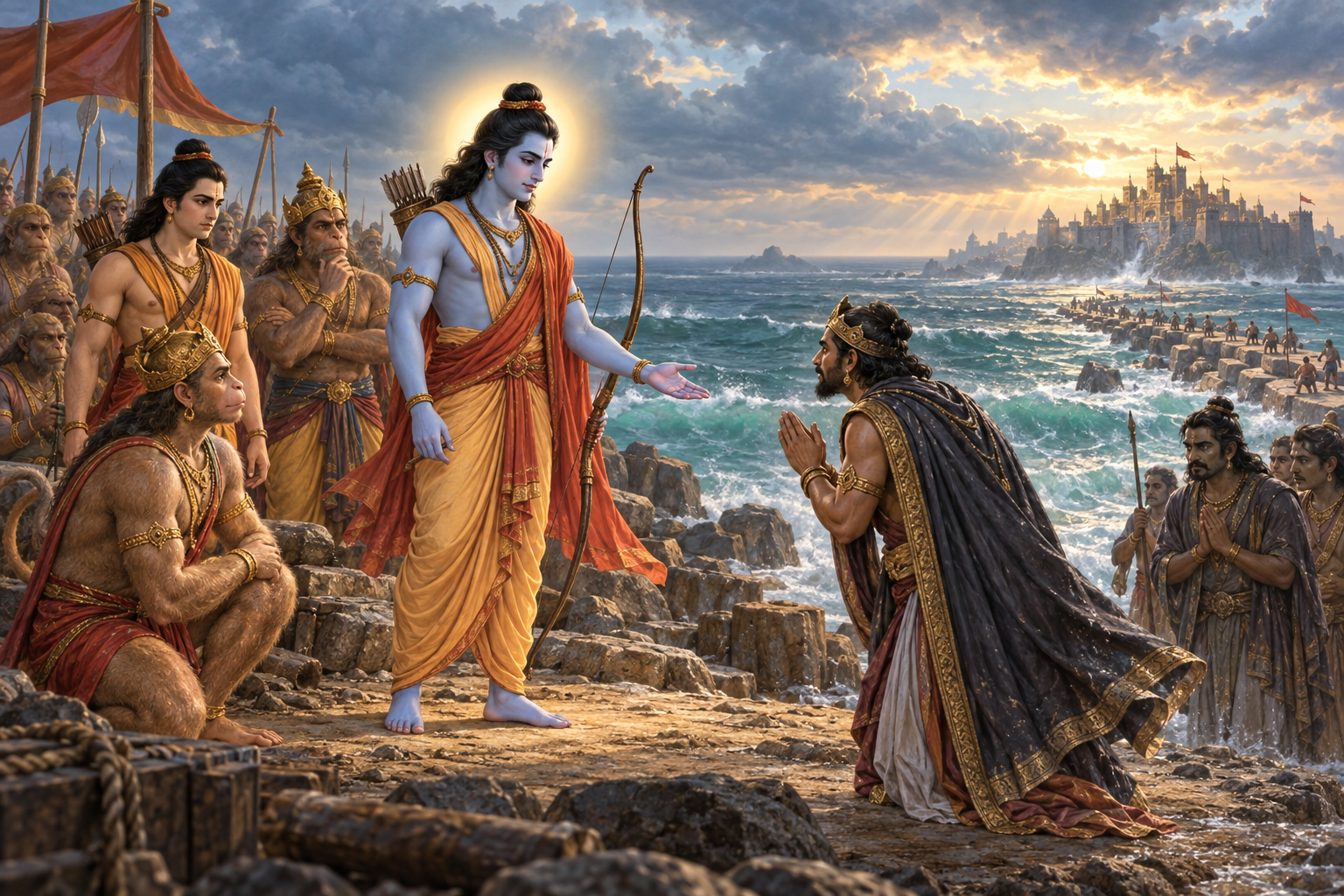
A second technique does not depend primarily on relocating an event. It reduces a sacred character until only a modern psychological sketch remains. Rama is first treated as an ordinary political individual governed by familiar appetites and insecurities. Selected incidents are then detached from the epic’s wider account of his character. The resulting gaps are used to declare that Rama was never an ideal son, brother, husband, or ruler, and that Ravana deserves the moral centre instead.
If a claim is specifically about Valmiki’s Rama, the test must begin with Valmiki’s narration. The first sarga of the Ayodhya Kanda contains a twenty-eight-verse character portrait of Rama. That sustained description is not decorative material to be discarded before interpreting later actions. It establishes the character whose choices the rest of the narrative asks you to understand.
This does not prohibit difficult questions about particular episodes. It does require the critic to interpret an episode within the characterization, duties, relationships, and narrative movement supplied by the epic. Isolating a scene may create a legitimate question. It cannot, without further argument, cancel the narrator’s explicit presentation of the person acting in it.
Cinema adds another layer because visual form also interprets. Costume, colour, bodily movement, dialogue, music, and the treatment of violence tell you whom to revere, fear, pity, or admire. In a sacred narrative, aesthetics are not a neutral wrapper around the plot. They participate in its moral meaning.
Adipurush illustrates why recognisable labels are not sufficient. Raghav, Shesh, Janaki, Bajrang, and Lankesh are alternate names, but names alone establish neither fidelity nor distortion. You have to ask whether the conduct, relationships, atmosphere, and moral direction remain recognisable as those of Rama, Lakshmana, Sita, Hanuman, and Ravana. A screen adaptation can preserve the cast list while emptying the characters of their inherited nature.
Use five medium-specific questions when you assess a sacred film or series:
- Does each major character act from motives that the named tradition actually supplies?
- Does the adaptation preserve the causal relationship between conduct and consequence?
- Do the images and dialogue cultivate an appropriate sacred, heroic, tragic, or devotional register, or do they merely borrow the surface language of fantasy spectacle?
- Are substantial inventions disclosed as creative liberties, or promoted as corrections to the inherited narrative?
- After all the changes, does the moral centre remain where the claimed tradition places it?
Modernisation is not automatically desecration. New pacing, accessible language, unfamiliar visual design, and selective compression may serve a new medium well. The decisive line is crossed when an adaptation changes who bears guilt, why an action occurs, or what the action means while continuing to trade on the authority of the sacred name.
The Telugu tradition of devotional Ramayana cinema offers a useful working principle. Filmmaking can be approached as puja: not as a ban on craft or creativity, but as a discipline that places creativity in the service of the katha’s sacred centre. Technical ambition and reverence need not be enemies. Reverence tells ambition what it must understand before it begins to transform.
Correct distortions precisely without flattening tradition
A forceful correction is not necessarily an effective one. Abuse can advertise outrage, but it cannot establish chronology, identify an omitted agent, or restore a missing conclusion. If you want a family member, student, or online reader to reconsider a distorted claim, give them the smallest decisive fact first.
- Preserve the exact claim. Save the wording, image, scene, or timestamp. Do not answer a stronger or weaker version invented during the argument.
- Classify it. Decide whether it claims to be textual narration, local custom, artistic adaptation, or political history. State that distinction before disputing details.
- Find the moral hinge. Look for the one omission that changes the judgement. In the Onam example, Aditi rather than a jealous Indra initiates the appeal; the Narmada rather than Kerala is the named setting; Sutala with divine protection rather than a hellish expulsion is the conclusion.
- Read beyond the viral scene. Recover the events before and after it, as well as any explicit description of the character involved. A quotation without its narrative unit is rarely enough.
- Retain what is true. Bali is generous and worthy of remembrance. Regional devotion is real. A modern work may be an adaptation. A correction becomes more credible when it does not deny these points merely to defeat an ideological conclusion.
- Ask for honest labelling. A creator who changes the moral architecture should call the result a reinterpretation. The problem is not imagination itself; it is borrowing scriptural authority for an undisclosed invention.
- Respond in proportion. Offer a textual correction, a critical review, or a better retelling. Threats and personal abuse neither defend dharma nor help another person see what was altered.
A useful correction of the Onam claim can be brief: the fuller narrative does not present Indra asking Vishnu to destroy a blameless Kerala king; it places the sacrifice on the Narmada, makes Aditi’s vrata and appeal central, and concludes with Bali protected in Sutala. That single clarification restores cause, place, and outcome without demanding that anyone abandon the festival.
Key takeaways
- The existence of multiple tellings does not make every textual, historical, or political claim equally grounded.
- Omission can distort more effectively than fabrication because familiar names and scenes conceal the changed moral structure.
- Always check attribution, sequence, agency, geography, characterization, outcome, and imported modern categories.
- A local devotional association can remain meaningful even when a claim about the original location or chronology fails.
- In cinema, visual atmosphere and characterization interpret the sacred narrative as surely as dialogue and plot do.
- Precise corrections serve dharma better than rage: restore the missing fact, preserve what is true, and name invention honestly.
The next time a retelling turns a revered figure into a convenient villain or converts a complicated king into a spotless political symbol, pause at the reversal. Write down who acted, what came before, where it occurred, and how it ended. Once those four parts are restored, most manufactured certainties become much easier to recognise.
References
- DharmaRenaissance Blog — The Origin of Onam
- DharmaRenaissance Blog — Adipurush: The Outcome of a Century of Artistic Perversion
