
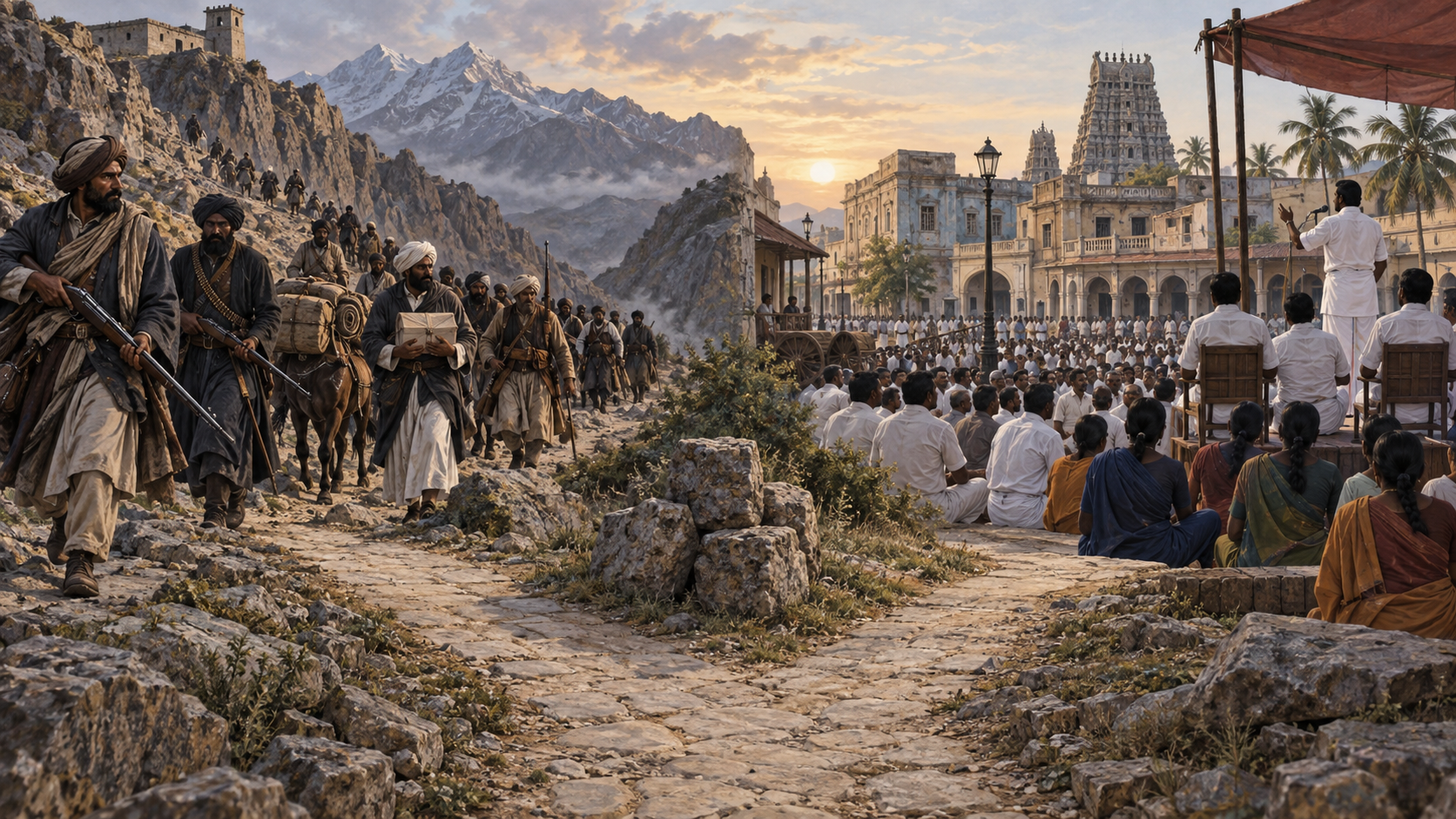
If you are trying to decide whether a movement is a reform campaign, an anti-Hindu agitation, a separatist project, or an armed religious insurgency, do not start with the grievance it advertises. Start with the political order it wants to build.
That approach matters because familiar labels can conceal incompatible aims. The nineteenth-century Wahhabi network associated with Syed Ahmad Barelvi and the twentieth-century Dravidian campaign led by E.V. Ramaswamy Naicker were not the same kind of movement. One organized religious war through clerical and military networks. The other moved from anti-Brahmin social politics to an explicit demand for a sovereign Dravidian state while sustaining a broad attack on Sanatana Dharma. The point is not to merge them. It is to notice how very different ideologies can turn separation into an operating programme.
A grievance is not yet a separatist programme
Movements often begin with a recognizable grievance: foreign rule, unequal representation, linguistic anxiety, caste discrimination, economic domination, or fear of religious decline. A grievance can be valid even when the political remedy proposed for it is destructive. It can also be exaggerated or manufactured. You therefore need to evaluate the grievance and the programme separately.
Five categories help keep the analysis precise:
- Religious reform seeks to change belief, worship, discipline, or community practice. It is not necessarily political or separatist.
- Social reform seeks changes in status, law, representation, or custom while accepting a shared political community.
- Communal mobilization organizes people primarily as a religious community. It may remain electoral and constitutional, or it may develop separatist aims.
- Separatism seeks a sovereign territorial unit, rejects the legitimacy of the common political order, or defines another section of the population as an alien people that cannot share the same nation.
- Armed insurgency adds organized violence, military training, territorial bases, raids, or parallel authority. In the Wahhabi case considered here, armed jihad supplied the religious authorization for that violence.
A movement can occupy more than one category. It may advocate a legitimate reform in one field and separatism in another. It may begin with cultural protection and later demand sovereignty. It may oppose an occupying power while rejecting cooperation with the other peoples of the occupied country. Labels such as reformer, rationalist, patriot, or freedom fighter cannot settle these questions by themselves.
The reliable evidence is the combination of four things: the movement’s declared destination, its boundary between insiders and enemies, the methods it authorizes, and the organization it builds. Once those four elements are visible, the movement is much harder to disguise with a sympathetic slogan.
The Wahhabi case: when revival becomes a war project
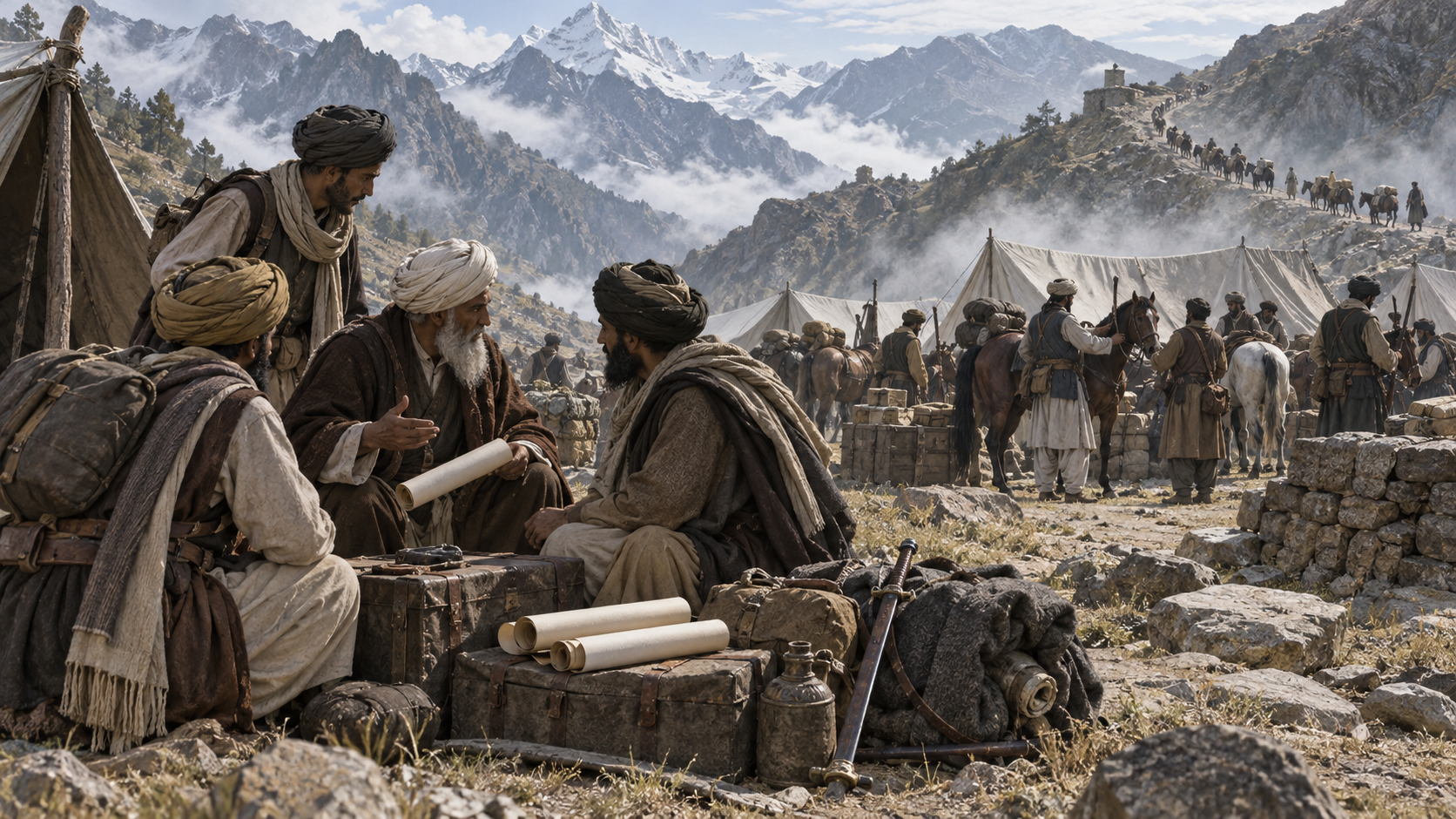
Syed Ahmad Barelvi treated Indian territories governed by the Sikh Empire, the British, and Hindu dynasties as Dar-ul-Harb, a domain of war. The practical consequence was stark: Muslims were called either to migrate or to fight the rulers classified as infidels. This was more than a demand for stricter personal observance. It converted a theological division into a territorial and military programme.
Syed Ahmad also appointed khalifas across India. Those deputies gave the movement something that fiery preaching alone could not provide: continuity. They could recruit men, gather money and supplies, maintain communication, and preserve the programme after the founder’s death. The Sikh army killed Syed Ahmad at Balakot, but the network survived him.
After Maharaja Ranjit Singh died in 1839, Syed Ahmad’s followers captured territory to the left of the Sindhu. British forces suppressed them there in 1847. The territorial setback did not end the movement because its distributed structure could regenerate leadership and resources elsewhere.
Inayat Ali, the khalifa based in Patna, subsequently prepared another jihad. His programme included both military action and entry into the colonial administration by supporters who would use state machinery from within. Meerut, Bareilly, Delhi, Bihar, and Bengal became important points in this network. An armed campaign launched in 1853 against Jahandad Khan, the British-aligned ruler at Amb, was defeated, but preparations continued.
By 1857, Inayat Ali’s men were capable of a successful night attack on Lieutenant Horne at Sheikhjahana, followed by plunder of the settlement. Yet the movement did not merge itself into the wider uprising that erupted that year. Its leaders instead issued a specifically religious call for Muslims to arm and wage religious war. Cooperation with Hindus was rejected on doctrinal grounds.
This distinction is crucial. Opposition to the British did not by itself make the Wahhabi project an Indian national struggle. A national movement must be capable of recognizing people beyond its own religious boundary as members of the political community. A project that treats them as infidels, refuses common action with them, and reserves sovereignty for its own creed is pursuing a different end even when it fights the same foreign ruler.
Sittana became the movement’s principal base. Between 1850 and 1863, the British sent about twenty expeditions against the Wahhabis, involving a total force of up to 60,000. In October 1863, Wahhabi fighters defeated a force led by Neville Chamberlain at the Ambeyla Pass and then attacked British pickets and outposts. Those details show that the movement had passed well beyond theological dissent. It possessed logistical depth, a defensible base, fighting capacity, and territorial intent.
When you encounter a claim that this activity was simply an early war of Indian independence, test it against three features: the declared religious end, the exclusion of non-Muslims from the legitimate political community, and the independent clerical-military apparatus. Anti-colonial action can be part of Indian nationalism, but anti-colonial action is not sufficient proof of it.
The conclusion must remain properly bounded. It concerns named leaders, their doctrine, and their organized network. It does not license a judgment about Indian Muslims as a whole. A clerical vanguard may claim to represent an entire community without actually doing so. Serious criticism becomes weaker, not stronger, when it abandons that distinction.
The Dravidian case: when social politics adopts secession
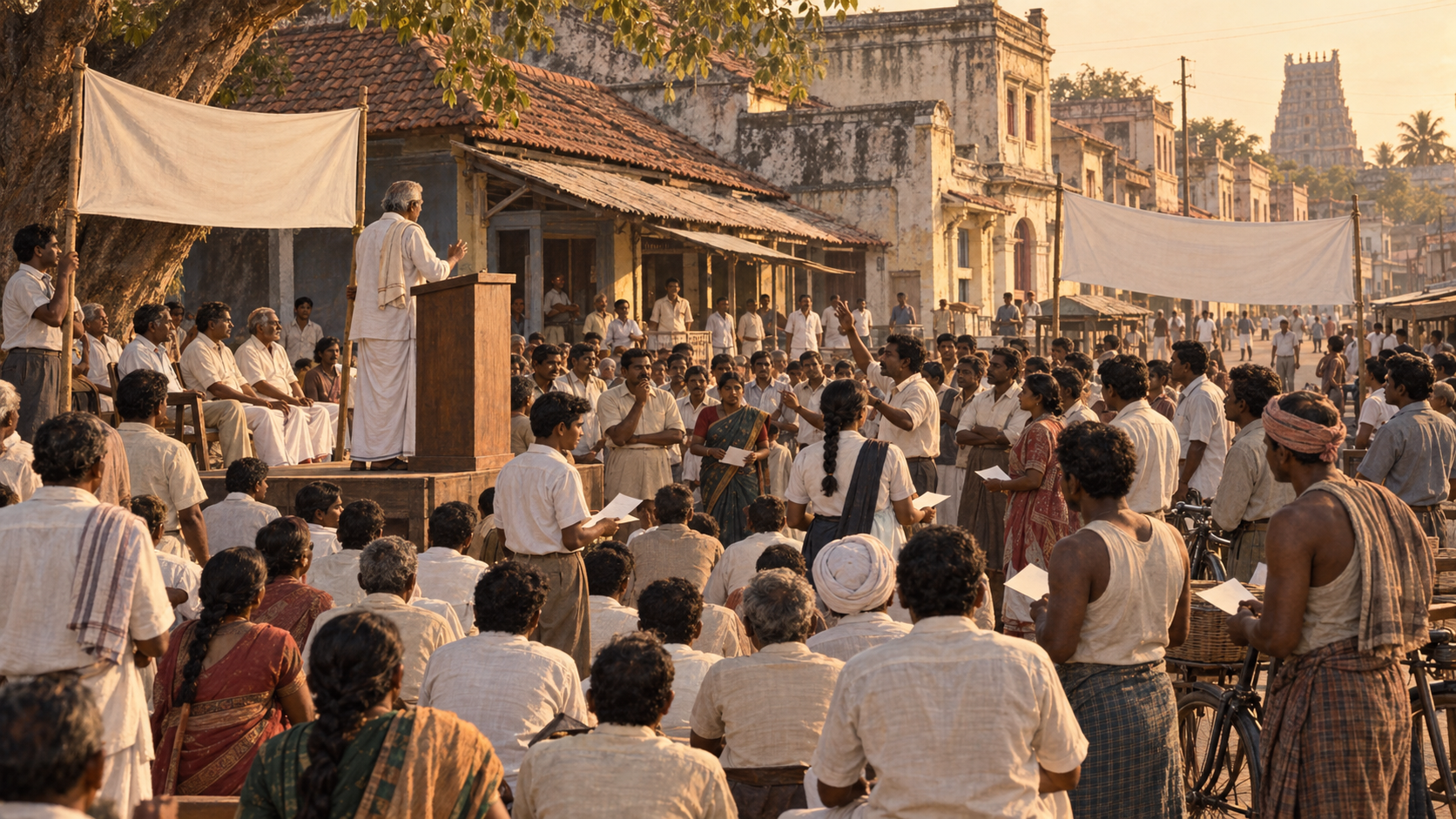
E.V. Ramaswamy Naicker’s political career presents a different analytical problem. It combined demands that could be pursued within a constitutional order with increasingly explicit attacks on the Indian nation and Sanatana Dharma. If you classify the whole career by its earliest social claims, you miss the later separatist programme. If you treat every demand for Tamil rights or social representation as separatism, you commit the opposite error.
In 1924, E.V.R. supported communal reservation in education and government employment. In 1925, after leaving the Congress, he declared the destruction of Brahmin dominance to be his principal task. He opposed Hindi imposition through a resolution at Kanchipuram in 1936. Reservation, opposition to discrimination, and protection of a language do not in themselves prove a secessionist intention.
The evidence changed in 1937. At a Tamil conference in Tiruchirappalli, E.V.R. argued that the answer to Hindi dominance was "a separate Sovereign State" and "Tamil Nadu for Tamils." The destination was no longer merely a change in language policy or social representation. It was separate sovereignty.
The demand persisted. E.V.R. revived the call for a separate Dravida Nadu at the Thiruvarur conference in 1940. In 1944, the Justice Party became the Dravidar Kazhagam and defined itself as a movement for a Dravidian race allegedly oppressed by Brahmins. The language of race did political work: it recast fellow Indians as an alien ruling people rather than participants in a common civilization with internal disputes.
Independence did not reconcile this programme with India. E.V.R. treated 15 August 1947 as a day of mourning because power had supposedly passed from the British to Brahmins and North Indian merchants without producing a sovereign Dravidian state. A Dravida Nadu separation conference followed at Cuddalore on 14 September 1947. He likewise designated the approaching Republic Day of 26 January 1950 as a mourning day for Tamils.
The anti-Hindu dimension was related to, but distinguishable from, the territorial demand. E.V.R. attacked the Vedas, Dharmashastras, the Ramayana, the Mahabharata, the Bhagavad Gita, the Puranas, major Hindu deities, revered authors, temples, and image worship. K. Veeramani attributes to him a 1973 speech calling for temple images to be broken and for lethal violence against Tamil Brahmins. That is not merely criticism of caste practice or a philosophical rejection of image worship. It is incitement against people and sacred institutions.
You should therefore keep three judgments separate. A person can support representation for disadvantaged groups without accepting E.V.R.’s racial theory. A Tamil speaker can oppose compulsory Hindi without seeking secession. A rationalist can criticize a religious proposition without calling for the destruction of temples or violence against worshippers. The separatist and anti-Hindu conclusions follow from E.V.R.’s stated sovereign objective, his construction of an alien racial enemy, and the destructive methods he endorsed, not from Tamil identity itself.
Key takeaways: five questions that expose a movement’s character

- What is the declared destination? Look for the difference between reform within India, greater regional authority, and a separate sovereign state. The word sovereign is not a decorative expression; it changes the classification.
- Who is allowed to belong? A movement becomes more dangerous when it divides permanent inhabitants into a chosen people and an irredeemable enemy: believer and infidel, native race and alien race, liberated group and population marked for removal.
- Which methods are authorized? Separate argument, elections, lawful protest, and institutional reform from infiltration, idol destruction, collective intimidation, raids, military training, and murder. A just grievance does not cleanse an unjust method.
- What organization has been built? Map leaders, local deputies, recruitment, money, supplies, training, territorial bases, and communications. A slogan becomes an operational threat when durable infrastructure can carry it through defeat or a change of leadership.
- How does the movement treat wider cooperation? Watch what happens when people outside the movement share one of its immediate goals. Refusal to cooperate solely because they have the wrong religion, language, caste, or ancestry exposes a boundary deeper than the advertised grievance.
Do not turn these questions into a mechanical score. A single offensive remark does not prove a complete separatist programme. Conversely, an explicit demand for sovereign separation or a functioning armed apparatus should not be diluted merely because the movement also performs social, educational, or religious work. Weight the evidence according to what it reveals about the intended political order.
Duration matters as well. E.V.R.’s sovereign demand appeared repeatedly from 1937 through the years surrounding independence. The Wahhabi structure continued after battlefield defeats and after its founder’s death. Persistence across turning points is evidence of a programme, not a momentary rhetorical excess.
Build a defensible judgment before you repeat a historical claim

Keep ideology, organization, and population separate
Ideology is what leaders say the world should become. Organization is the machinery built to pursue that vision. Population is the much larger body of people whom the movement claims to represent. Confusing these levels produces two common failures.
The first failure is collective accusation: treating every Muslim as responsible for a Wahhabi network or every Tamil as an adherent of Dravidian separatism. The second is collective exoneration: refusing to criticize an ideological organization because criticism might offend the wider community it invokes. You can avoid both errors by naming the leader, organization, declaration, date, and act under examination.
Apply the same discipline to Hindu society. Criticism of a particular custom is not automatically hatred of Dharma. The conclusion changes when a campaign treats Hindu texts, deities, temples, worshippers, and civilizational continuity as things to be eradicated. Specificity allows you to defend reform where it is warranted and recognize ideological hostility where it is explicit.
Use this five-step method
- Define the unit. Write down whether you are judging a person, faction, organization, period, or entire tradition. Do not let the unit silently expand as your argument proceeds.
- Extract the end-state language. Identify exact demands concerning sovereignty, territory, citizenship, religious rule, or the removal of another group. Distinguish those demands from later attempts to soften their meaning.
- Build a dated sequence. Place speeches, resolutions, organizational changes, attacks, defeats, and renewed campaigns in order. Chronology shows whether the programme was abandoned, intensified, or merely renamed.
- Map capacity as well as rhetoric. Record deputies, money, recruitment, training, bases, publications, conferences, and political alliances. Capacity tells you whether leaders could translate doctrine into action.
- State the conclusion with its limit. Say why the named movement qualifies as reformist, communal, separatist, or insurgent, and then say whom that judgment does not include. This makes the argument both firmer and fairer.
Before relying on a dramatic quotation in public, verify its speaker, date, setting, wording, and textual location. A quotation reproduced in a sympathetic biography can still be damaging evidence, but an academic or political argument should identify the edition and page wherever possible. The more consequential the allegation, the more precise the citation should be.
Also resist retrospective laundering. Fighting the British cannot erase an exclusivist religious objective. Campaigning against caste hierarchy cannot erase a sovereign separatist demand or incitement against temples and Brahmins. Good intentions attached to one part of a movement do not cancel explicit aims and methods found in another part.
The next time someone calls a movement patriotic, reformist, rationalist, communal, or separatist, pause before forwarding the label. Write one sentence naming its desired political order, one naming whom it excludes, and one naming the machinery it built. If those sentences cannot be supported, the judgment is premature. If they can, you will have an argument grounded in programme and conduct rather than inherited reputation.
References
- DharmaRenaissance Blog — A Fanatical Wahhabi Movement of 1857 that Nobody Told you about
- DharmaRenaissance Blog — A Quick Reference Guide of E.V. Ramaswamy Naicker’s Career of Anti-Hindu and Separatist Activism: From his Own Biography
