
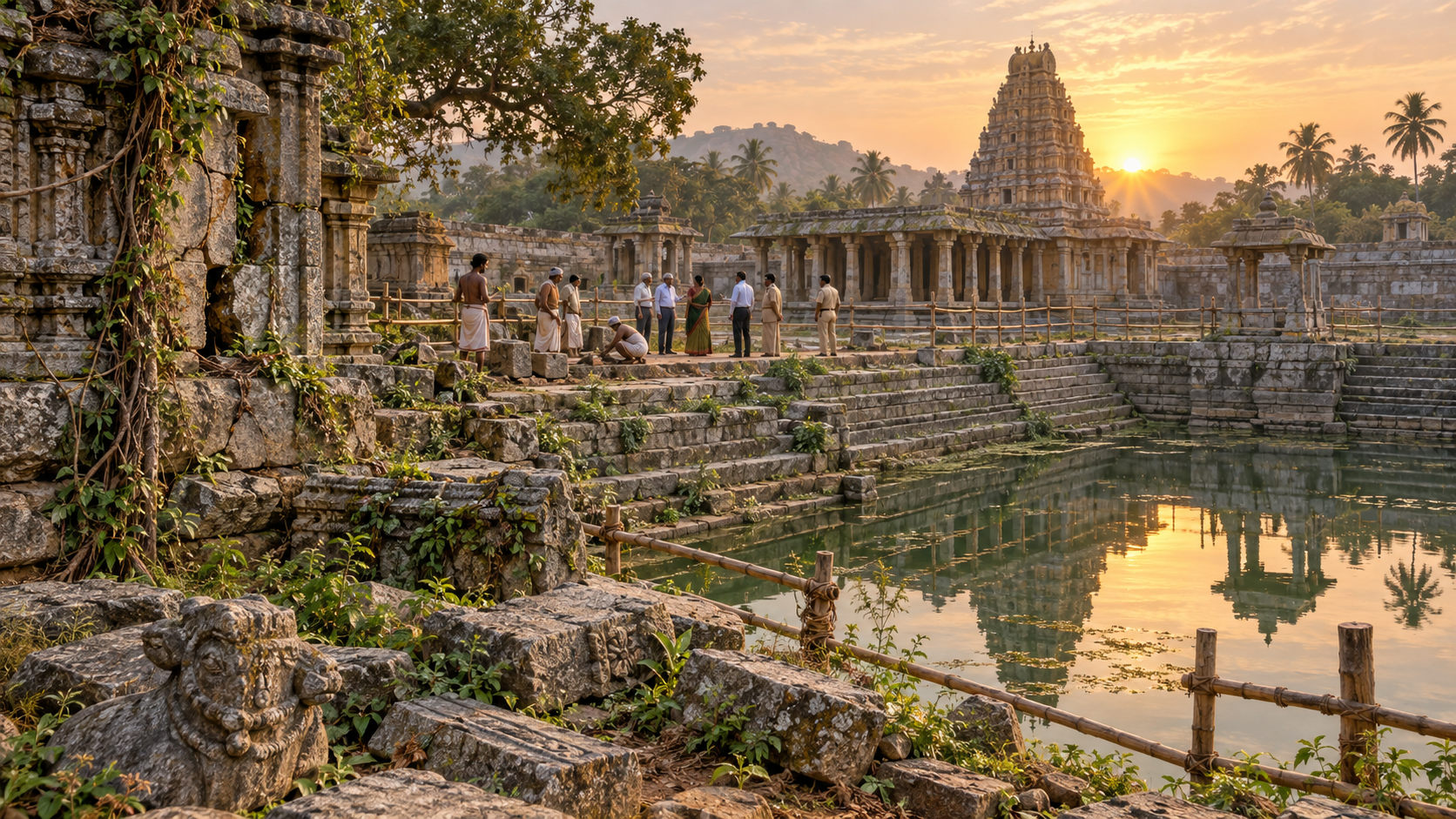
If you want to help restore Sukra Theertham, do not mistake official attention for rescue. The decisive work now is to turn public sympathy into a written scope of work, a visible timeline, and responsibility that cannot quietly pass from one office to another.
You can contribute even if you do not live near the temple. But your support should reinforce a disciplined local campaign: verify before donating, distinguish sacred tradition from medical advice, and keep asking for evidence of completed work rather than another assurance that renovation will happen.
Why official attention is only the first milestone
At 73, devotee Vasai Jayaraman has spent 45 years seeking the restoration of Sukra Theertham, approaching as many as 11 MLAs as well as ministers and officials. His decision to cover his body with mud from the neglected tank finally brought the matter to the attention of a newly formed administration.
That history reveals the campaign’s central problem. Many people have heard the demand, but no clearly stated completion date has emerged. Attention, acknowledgment, administrative approval, physical commencement, and completed restoration are five different milestones. A campaign that treats the first as though it were the fifth makes another long delay easier.
The place at stake is associated with a Shiva temple described as 1,450 years old. Local tradition holds that Sage Agastya and Sukra Bhagavan worshipped there. That makes the tank more than an abandoned water feature: it belongs to the sacred identity and ritual memory of the temple.
Campaigners should nevertheless label different kinds of claims accurately. Describe the temple’s age as reported unless a dated inscription, archaeological assessment, or other primary record is available. Present the connections to Agastya and Sukra Bhagavan as local sacred tradition. This precision does not diminish faith. It prevents avoidable disputes from distracting attention from the visible need for restoration.
The restoration demand needs a finish line
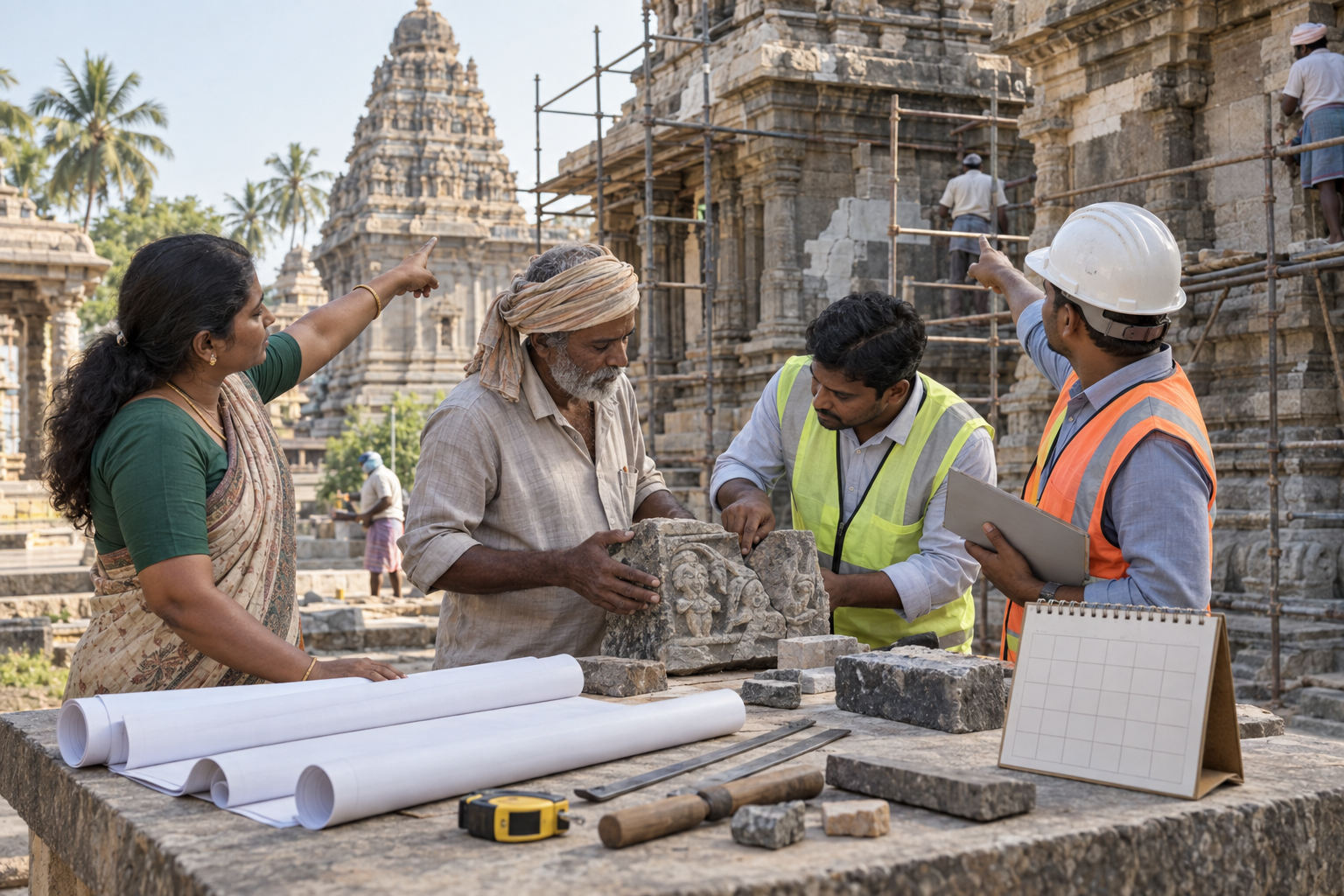
Asking officials to renovate the site is no longer specific enough. The word “renovation” can cover anything from an inspection to complete reopening. The next demand should be a short public restoration brief containing six items:
- Administrative ownership: Name the department, institution, or temple authority responsible for execution, together with the designation of the officer who must report progress.
- Recorded condition: Publish a dated baseline showing the present condition of the temple and tank. Photographs should be taken only from lawful, safe locations.
- Defined scope: List temple work and tank work separately. For the tank, clarify whether assessment, cleaning, desilting, repair of steps or retaining structures, water management, or access work is proposed. Do not assume that all of these tasks are required; require the responsible technical team to say which are.
- Approvals and supervision: Identify any structural, heritage, environmental, safety, or ritual approvals required and the qualified people overseeing the work.
- Milestone dates: State target dates for assessment, sanction, procurement or appointment, commencement, major phases, inspection, and completion. If a date slips, publish the reason and a replacement date.
- Financial visibility: State whether funds have been sanctioned, how execution will be procured or assigned, and how expenditure and progress will be reported publicly.
Temple and tank work must remain distinct in this brief. Completion of a minor temple task should not be used to imply that the theertham has been restored, and preliminary tank cleaning should not be presented as completion of structural or water-management work.
You can send one precise request instead of a broad appeal: Please provide the responsible office, approved scope, funding status, current procedural stage, milestone dates, and the date of the next public progress update for the restoration of Sukra Theertham and its associated temple.
Use an official grievance, correspondence, or information-request route available in the relevant jurisdiction. Preserve the submission date and acknowledgment number. Maintain a simple public log with the office contacted, the exact question, the response received, the promised next step, and the next follow-up date. Eleven elected representatives hearing the issue did not produce timely restoration; another list of names alone will not solve the accountability gap.
How to support the campaign without creating new risks

A heritage campaign can lose credibility when fundraising, physical volunteering, and public claims run ahead of authorization. Keep each form of support tied to evidence.
- Verify any fundraiser before sending money. Look for the beneficiary’s legal identity, written authority connecting the appeal to the temple or restoration body, the restricted purpose of the funds, a receipt, a reporting method, and a stated process for unused money. If those elements are absent, contribute through documentation and advocacy instead of transferring funds to a personal account.
- Do not begin independent cleaning or repair. Old masonry, tank steps, drainage paths, and sacred structures can be damaged by well-intentioned work. Physical volunteering should begin only after the responsible authority and qualified supervisors define safe tasks.
- Do not imitate entry into the tank as a protest. A neglected tank should be treated as unsafe unless competent authorities have assessed it. Jayaraman’s act conveyed the depth of his desperation; it should not become a challenge that places other devotees at risk.
- Coordinate around one written demand. Give supporters the same short request for scope, owner, funds, milestones, and updates. Consistent questions are easier to track than many unrelated messages.
- Share evidence, not rumours. Publish dated acknowledgments, official replies, sanctioned plans, and milestone photographs. Remove private phone numbers, home addresses, bank details, and other personal information before sharing documents.
- Amplify progress as carefully as delay. When a milestone is completed, identify exactly what was done and what remains. This rewards real action without declaring victory before the temple and tank are ready.
If you are sharing the campaign from outside the locality, link people to the verified status log rather than composing a new version of the story. Local devotees should control ritual context and on-site coordination; wider supporters can help keep the administrative record visible.
Protect both sacred meaning and public trust

Local belief associates bathing in Sukra Theertham and worshipping the deity with relief from mental illness. This should be presented as a devotional belief, not as a clinically established cure.
Never advise someone to stop medication, discontinue therapy, or postpone qualified medical care in favour of a ritual bath. A pilgrimage or act of worship may be meaningful spiritual support alongside treatment, but it is not a substitute for diagnosis or care. If someone may harm themselves or others, or cannot remain safe, seek immediate help from local emergency services or a qualified mental-health professional.
The same discipline applies to conservation. Devotion establishes why the place matters; competent assessment determines how physical work should proceed. Pressure for an accountable timetable is necessary, but pressure for hurried, unsupervised alteration can endanger the very fabric the campaign seeks to preserve. Ask who has approved each intervention, what condition it addresses, and how completion will be inspected.
A responsible campaign therefore holds three commitments together: respect the sthala tradition, tell the public exactly what is verified, and insist that every physical intervention be authorized and competently supervised. None of these weakens the others.
Key takeaways
- Sukra Theertham has gained administrative attention, but attention is not a completed restoration.
- The immediate goal is a written brief naming the responsible office, approved scope, funding status, milestones, and next update date.
- Track the temple and tank as separate workstreams so partial work cannot be mistaken for full completion.
- Verify legal authority, financial controls, and reporting arrangements before donating; otherwise support the campaign through evidence-based advocacy.
- Do not enter, clean, desilt, or repair the neglected tank without a safety assessment and authorized supervision.
- Describe healing claims as local devotional belief and never encourage anyone to replace mental-health treatment with pilgrimage or ritual.
If you take one action now, send the six-part written request and preserve its acknowledgment. Jayaraman has already made the neglect difficult to ignore. The next task is to make every promise traceable until the temple and Sukra Theertham are restored through safe, appropriate, and publicly verifiable work.
References
