
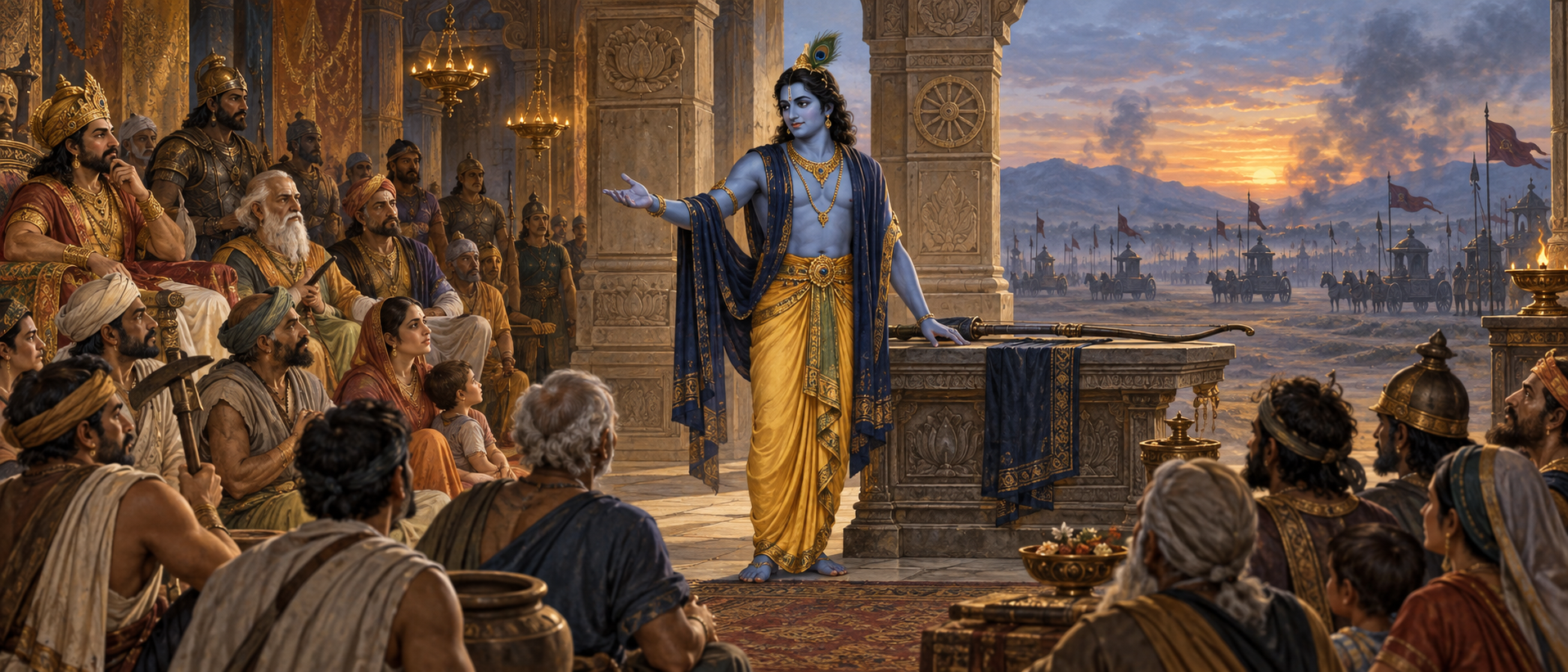
If you are asking whether patriotism requires loyalty to a party, ruler, clan or every decision made in the nation’s name, Krishna’s political ethics give a demanding answer: no. National duty begins when attachment stops deciding whom you excuse and whom you condemn.
You can judge a leader, policy or civic obligation through three connected demands: a dharmic public purpose, the least-destructive effective strategy and accountability that reaches your own side. Strength without those restraints is merely power wearing sacred language.
Start with the real object of national duty

Krishna’s political setting was not a modern nation-state with a constitution, elections and fixed administrative borders. Applying his conduct to contemporary rashtra-dharma is therefore an interpretation, not a claim that every feature of modern nationalism can be read directly into the Mahabharata.
The bridge between the two is lokasangraha in Bhagavad Gita 3.20: action directed toward sustaining, protecting and elevating the larger social world. Leadership is exemplary under this principle. What a person in authority normalizes will shape the conduct of others.
This places the welfare of the people, the protection of justice and the preservation of a workable moral order above a ruler’s prestige. Sovereignty matters because a society must be able to defend that order. Territory matters because people need a secure home. Neither becomes an idol for which the population may be needlessly sacrificed.
That distinction gives you an immediate test. Whenever someone invokes the nation, ask what tangible public good is being protected. A serious answer should identify people, institutions, security, justice or civilizational continuity. If the answer reduces to the ruler’s image, partisan victory, revenge or the honor of an elite, national duty has probably been confused with factional interest.
A policy can call itself patriotic and still be adharmic. It becomes suspect when it protects insiders from consequences, applies one moral standard to friends and another to opponents, or spends innocent lives for symbolic glory. Krishna’s model is demanding precisely because it does not permit the word “nation” to erase the question of dharma.
Four episodes that turn principle into political judgment
Kinship never creates immunity
Krishna belonged to the Yadava clan, but clan supremacy was not the purpose of his statecraft. When the Yadavas descended into arrogance, adharma and internal conflict, he did not preserve them merely because they were his own. The Yadava catastrophe places moral integrity above hereditary solidarity.
The lesson is not that a leader should passively permit social collapse. It is that belonging must never confer impunity. If misconduct becomes acceptable when committed by your community, party or family, you are no longer defending dharma. You are defending possession of power.
Apply this before criticizing an opponent. Name the standard you intend to use, then test a comparable action by your own side against the same standard. If your judgment reverses only because the name or affiliation changes, attachment is doing the work that principle should do.
A ruler earns support through fitness, not lineage
Krishna’s support for Yudhishthira can be read as a judgment about the quality of rule rather than an entitlement bestowed on a favored relative. Dhritarashtra’s attachment compromised his judgment, while Duryodhana’s greed made power an end in itself. Yudhishthira was supported as the candidate associated with justice, accountability and rule according to dharma.
This makes political support conditional. A leader is not the nation, and loyalty to a leader is not automatically national service. Support remains dharmic only while authority is being used for the public purpose that justified it.
When you assess a leader, look past devotional language, ancestry and displays of decisiveness. Ask whether the leader accepts restraints, appoints capable people, applies rules to allies and makes the security of citizens more important than personal survival in office. A ruler who demands sacrifice but rejects scrutiny has reversed the proper direction of duty.
Strategic withdrawal can be an act of courage
Jarasandha attacked Mathura seventeen times. Although Krishna repeatedly defeated him, continued conflict was draining resources and exposing the population to danger. Rather than fight an eighteenth battle for royal reputation, Krishna relocated the people of Mathura to the coastal city of Dvaraka. The withdrawal brought him the name Ranchhod, yet it preserved the population and created strategic depth.
The political lesson is sharp: defending every position is not the same as defending the nation. A piece of ground, a slogan or an institution may have symbolic value, but symbolism cannot by itself settle whether holding it is wise. The duty of leadership is to protect the society that gives the symbol meaning.
When retreat is proposed, do not judge it by appearance alone. Ask whether it protects lives, preserves long-term capability and improves the position from which society can act later. Then ask whether those claims are supported by a credible plan. Strategic patience without a plan can conceal failure, but tactical withdrawal with a clear protective purpose can be wiser than a glorious loss.
Precision is morally better than spectacle
Kamsa, Jarasandha, Shishupala and Narakasura are presented as rulers whose power reinforced a wider oppressive alignment. Krishna did not answer every threat with an indiscriminate war. In the campaign against Jarasandha, he guided Bhima toward a direct contest that removed the ruler while limiting destruction among the population.
A modern reader should take the ethical principle, not treat an epic episode as an operational license. Contemporary coercive action must remain subject to law, legitimate authority and institutional review. The relevant principle is that force should be directed as narrowly as possible toward the source of the threat. A strategy that punishes an entire population for the conduct of a ruler or armed network fails that test.
When leaders advertise a dramatic response, ask what makes it precise. Which capability or responsible actor is being addressed? What exposure does the action create for ordinary people? What narrower options were considered? Political theatre seeks applause for visible force; responsible statecraft measures what the force actually protects.
Use power in sequence, with force at the end

Krishna’s statecraft is associated with four upayas: sama, dama, bheda and danda. They can be understood as peaceful accommodation, incentives or material leverage, separation within a harmful alignment and coercive force. The sequence expresses more than tactical flexibility. It places a burden on the leader to seek an effective solution without leaping immediately to maximum destruction.
The peace mission to Hastinapura makes that burden concrete. Krishna traveled as an envoy in an effort to avert war. Only after negotiation failed did he support battle, showing that peace was attempted before force but was not allowed to become a cover for continuing injustice.
For present-day judgment, turn that approach into an escalation ladder:
- Establish the public purpose. Identify the wrong to be stopped and the people or institutions to be protected. A vague appeal to strength is not an objective.
- Begin with sama. Put a concrete and verifiable peaceful proposal on the table. Negotiation should contain terms, duties and a way to determine whether the agreement is being honored.
- Use dama carefully. Legitimate incentives, trade choices and calibrated costs may change conduct without open conflict. Judge them by their effect on decision-makers as well as the burden they place on ordinary people.
- Apply bheda to the threatening coalition, not to society. Isolate committed wrongdoers from reluctant partners and create an honorable path away from the harmful alignment. Deliberately inflaming communal hatred is not prudent coalition-splitting; it damages the society being defended.
- Consider repositioning. Dvaraka shows that evacuation, dispersal, delay or a change of strategic ground may protect the population better than immediate confrontation.
- Reserve danda for necessity. If force becomes unavoidable, insist on legitimate authority, a defined objective, protection of noncombatants, a stopping condition and an account of the political order that should follow.
This is not a mechanical formula. An urgent threat may compress the time available for earlier measures. Urgency, however, should increase the demand for a clear objective and accountable authority, not eliminate it. If operational details must remain confidential, leaders can still explain the legal basis, intended result, oversight and general measures for limiting harm.
The same logic applies below the level of war. In a political dispute, community conflict or institutional crisis, do not begin by asking how to defeat the other side. Begin with the outcome needed for justice and social continuity. Then choose the least coercive instrument capable of reaching it.
Nishkama karma is not a blank cheque for power
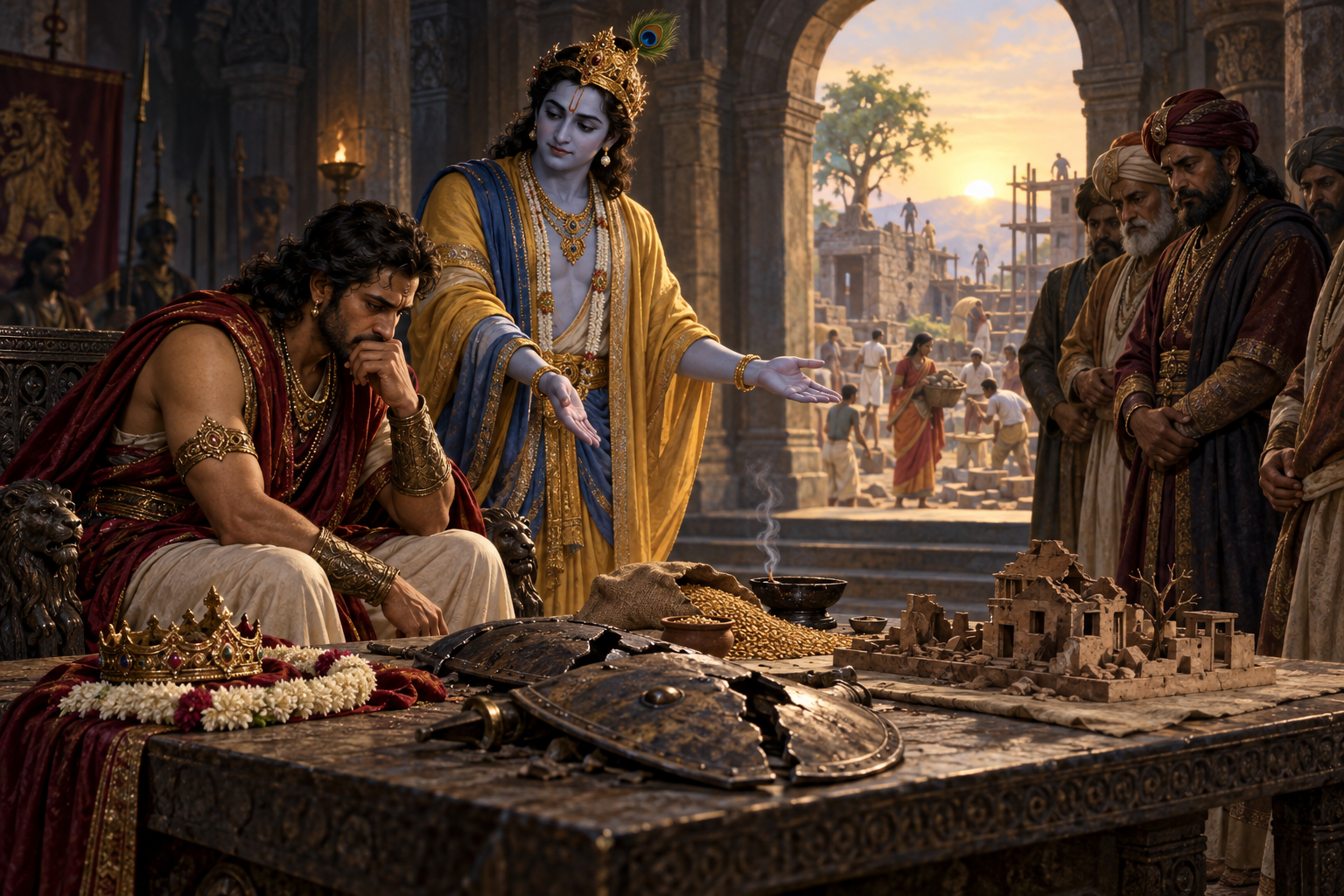
Arjuna’s paralysis arose from a real moral conflict. He saw teachers, elders and relatives across the battlefield and recoiled from acting against them. Krishna did not tell him that relationships were worthless. He taught him not to let personal attachment determine whether a public duty would be performed.
Within a political reading of the Gita, Arjuna was not being sent to pursue private revenge or personal enrichment. He was called to act as an instrument of justice when withdrawal would leave oppressive power intact. This is why nishkama karma connects freedom from personal reward with responsible public action. It is one important reading of the teaching, not a claim that political duty exhausts the Gita’s spiritual meaning.
Several distinctions prevent this teaching from being misused:
- Detachment from reward is not detachment from consequences. You must still examine who will be harmed, what the action will preserve and whether the means fit the purpose.
- Duty is not blind obedience. A title, uniform or party instruction cannot transform an adharmic command into righteous action.
- Firmness is not cruelty. Necessary resistance should remain directed toward restoring justice, not humiliating an enemy or satisfying anger.
- Peace is not appeasement. Negotiation is dharmic when it seeks a just settlement. It becomes evasion when it merely postpones confrontation while preventable oppression continues.
- National service is not self-glorification. A person who uses sacrifice chiefly to acquire status, wealth or moral immunity has not escaped attachment.
This standard changes ordinary civic conduct. A voter should evaluate outcomes rather than treating political allegiance as permanent. A public servant should test an instruction against law and public responsibility rather than partisan advantage. A community leader should correct misconduct within the community instead of hiding it for fear of embarrassment. A member of the diaspora can advocate for Bharat while still distinguishing civilizational loyalty from automatic endorsement of every government decision.
The inward test is as important as the outward one. Before calling an action your national duty, identify what you personally hope to gain or fear losing. Reputation, belonging, resentment and the desire to appear uncompromising can all disguise themselves as principle. Nishkama karma asks you to notice those pressures so that they do not quietly choose your position for you.
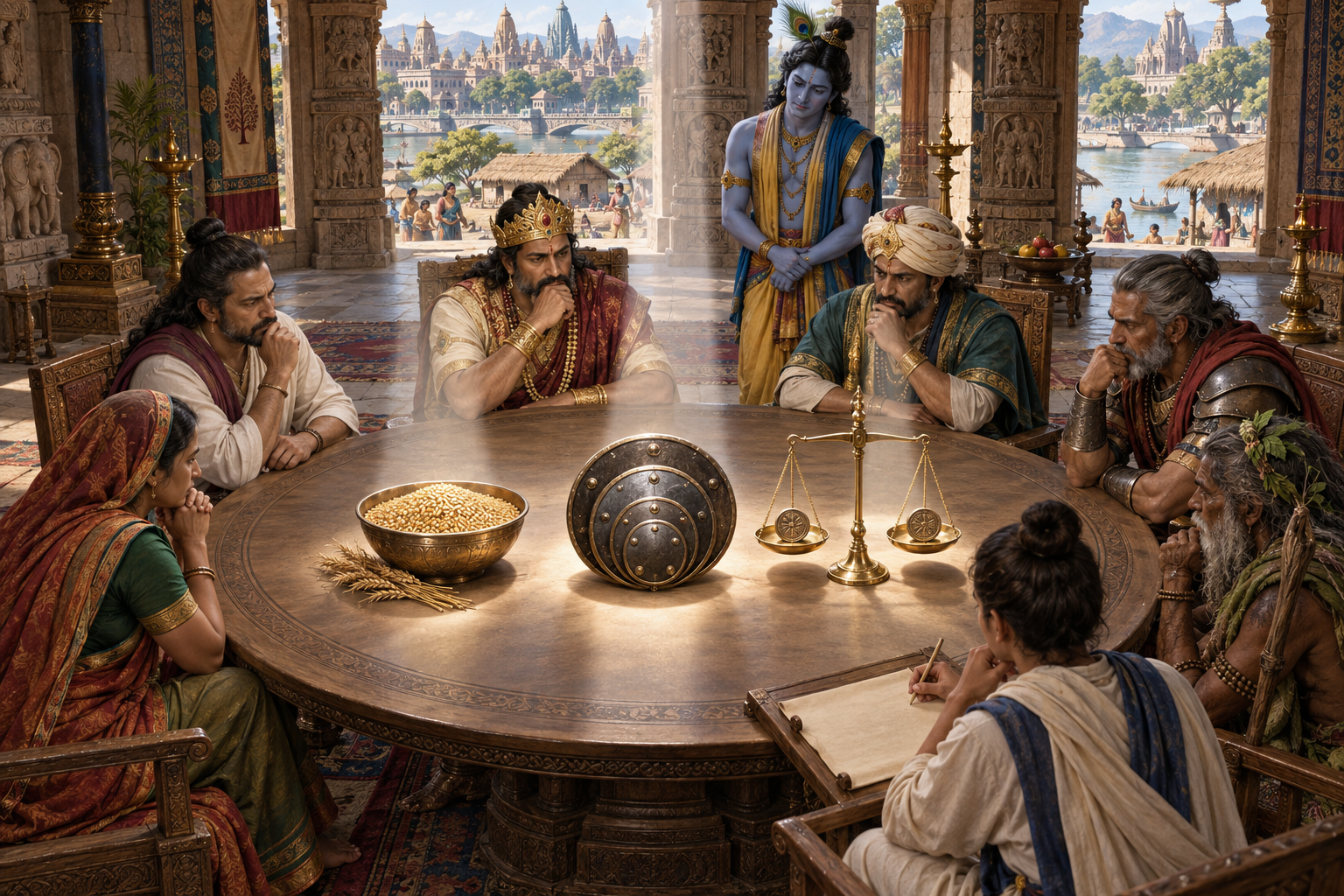
Put a live political choice through a dharmic audit
Key takeaways
- National duty serves lokasangraha: the protection, cohesion and elevation of the larger social order.
- Dharma must govern national interest; invoking the nation cannot make favoritism, revenge or needless harm righteous.
- Your own clan, party and allies must face the same standards you apply to opponents.
- Negotiation, incentives, coalition separation and strategic repositioning should be considered before force.
- Retreat may be responsible when it protects people and preserves long-term capacity; prestige alone is not a sufficient reason to fight.
- Nishkama karma removes private attachment from duty but never removes moral judgment, lawful restraint or responsibility for consequences.
Questions to answer before lending your support
- What exactly is being protected? Write the answer in terms of people, justice, security, institutions or civilizational continuity. If you can name only prestige or victory, the public purpose is incomplete.
- Have the nation and the incumbent been separated? Ask whether the policy serves society even if a different party receives the credit. If its justification depends on one leader being treated as indispensable, scrutinize it more closely.
- Would you accept the same conduct from your opponent? Reverse the party, community or family names in the case. A principle that collapses after this substitution is probably factional loyalty.
- Which upaya is being used, and why? Identify whether the action is negotiation, leverage, coalition-splitting or force. Then ask what happened at the earlier, less destructive stages and why they were insufficient.
- Who bears the cost? Look beyond the immediate target. Consider civilians, soldiers, displaced families, social trust, institutional legitimacy and the society’s future capacity to act.
- Is the action narrower than the threat? A justified objective does not validate unlimited means. Demand a connection between the identified wrong and the people, institutions or capabilities being targeted.
- Who authorizes, reviews and stops the action? In a modern state, dharmic intention cannot substitute for constitutional process. Look for lawful authority, oversight, a stopping condition and consequences for abuse.
- What order follows success? Removing a threat is only part of political duty. Ask how justice, accountable administration and public welfare will be secured after the immediate contest ends.
- What attachment may be shaping your own answer? Name the identity, reward, fear or grievance that makes one conclusion emotionally attractive. You need not become emotionless; you need to keep emotion from impersonating dharma.
Use the audit on one question already in front of you: a candidate, a border policy, a community controversy or an institutional appointment. Write one sentence for each answer. Where the evidence is missing, withhold moral certainty and identify what you would need to learn before committing your support.
Krishna’s political ethics do not ask you to become reflexively militant or emotionally cold. They demand a harder discipline: love of people strong enough to abandon prestige, commitment to peace serious enough to attempt it, courage firm enough to confront adharma and integrity strict enough to judge your own camp.
At the next invocation of national duty, do not begin with whom you have been asked to follow. Begin with what protects people, justice and social order. Then demand the least-destructive effective means and the same accountability for everyone. That is where patriotic feeling becomes dharmic service.
References
