
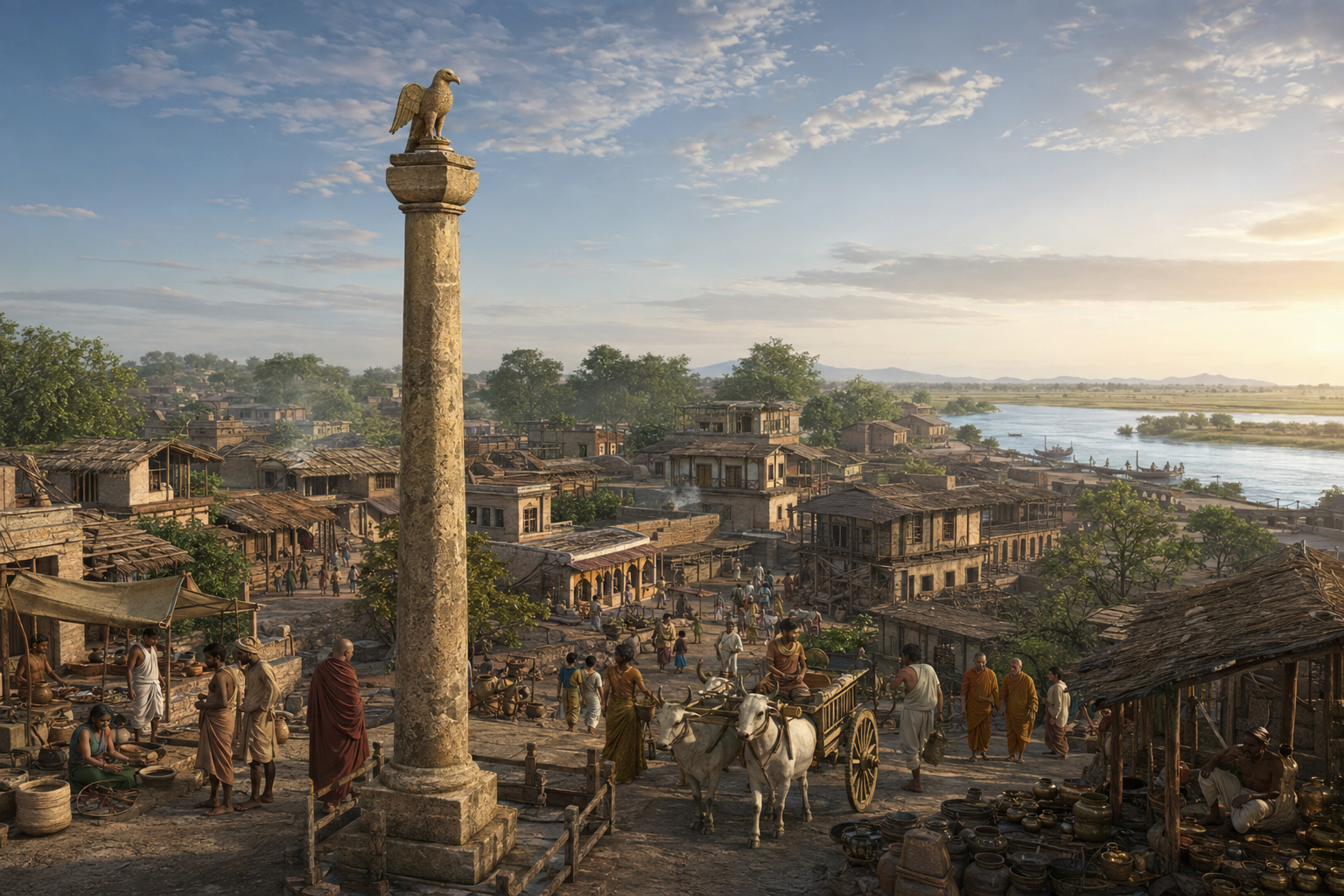
If you know Heliodorus only as the man who became a Bhāgavata, you know the memorable name but not yet the history that gives it meaning. Taken in isolation, his devotional identity can look like a curious exception. Put him back in Vidisha, and the episode becomes far more intelligible.
Vidisha was a meeting place of rivers, roads, rulers, artisans, teachers, pilgrims and several Dharmic traditions. Seeing that whole landscape helps you understand what the Heliodorus legacy can reasonably establish, what it cannot establish, and why it belongs within the history of Bharat rather than at its margins.
Restore the city before interpreting the devotee
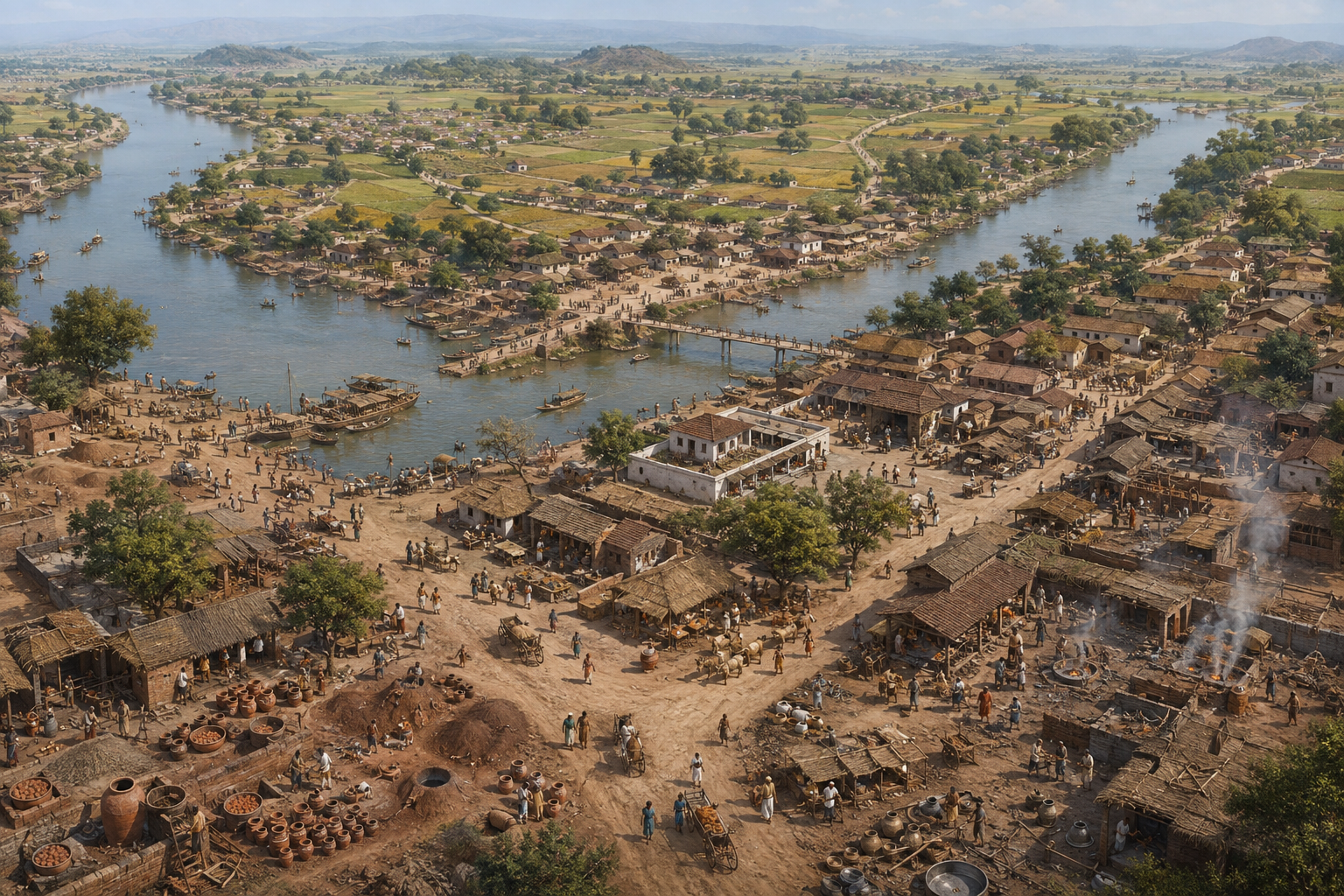
Begin with the physical setting. Ancient Vidiśā stood at the meeting of the Vidiśā, now called the Bes, and the Vetravatī, now called the Betwa. The city was also remembered under names including Vaidīśa, Vaiśyanagar and Besnagar. These names are not decorative variants. They preserve different layers of a settlement whose identity continued through political and cultural change.
Its position was strategic. Vidisha served at different times as a capital of eastern Malwa and as the capital of the Daśārṇa country. Under Puṣyamitra and the Śuṅgas, it displaced Ujjayinī as a gubernatorial headquarters and retained that standing through the dynasty. During Aśoka’s rule, its location also made it important enough to function as one of his capitals.
The city’s stature also survived in sacred and literary memory. In the Uttarakāṇḍa of the Rāmāyaṇa, Vidisha is bestowed upon Śatrughna by Śrī Rāma. Vidisha appears in the Garuḍa Purāṇa as a prosperous city filled with wealth, jewels, mansions, people from different regions and several Dharmas. In the Meghadūta, it is a renowned capital beside the Vetravatī, approached through the lush country of Daśārṇa. The Skanda Purāṇa treats it as a tīrtha to be visited after Somanātha.
These memories do not all describe one historical moment, and you should not compress them into a single snapshot. Their value lies in showing how persistently Vidisha remained present in Bharat’s civilizational geography: as kingdom, capital, sacred destination and poetic landscape.
This changes the first question you should ask about Heliodorus. Do not begin with, “Why did this unusual person appear in an obscure place?” Begin with, “What kind of city made encounters with Bhāgavata Dharma possible?” Vidisha was not an isolated religious outpost. It was an urban centre with the routes, institutions and communities through which a devotional identity could be encountered and embraced.
Trade routes carried ideas as well as merchandise
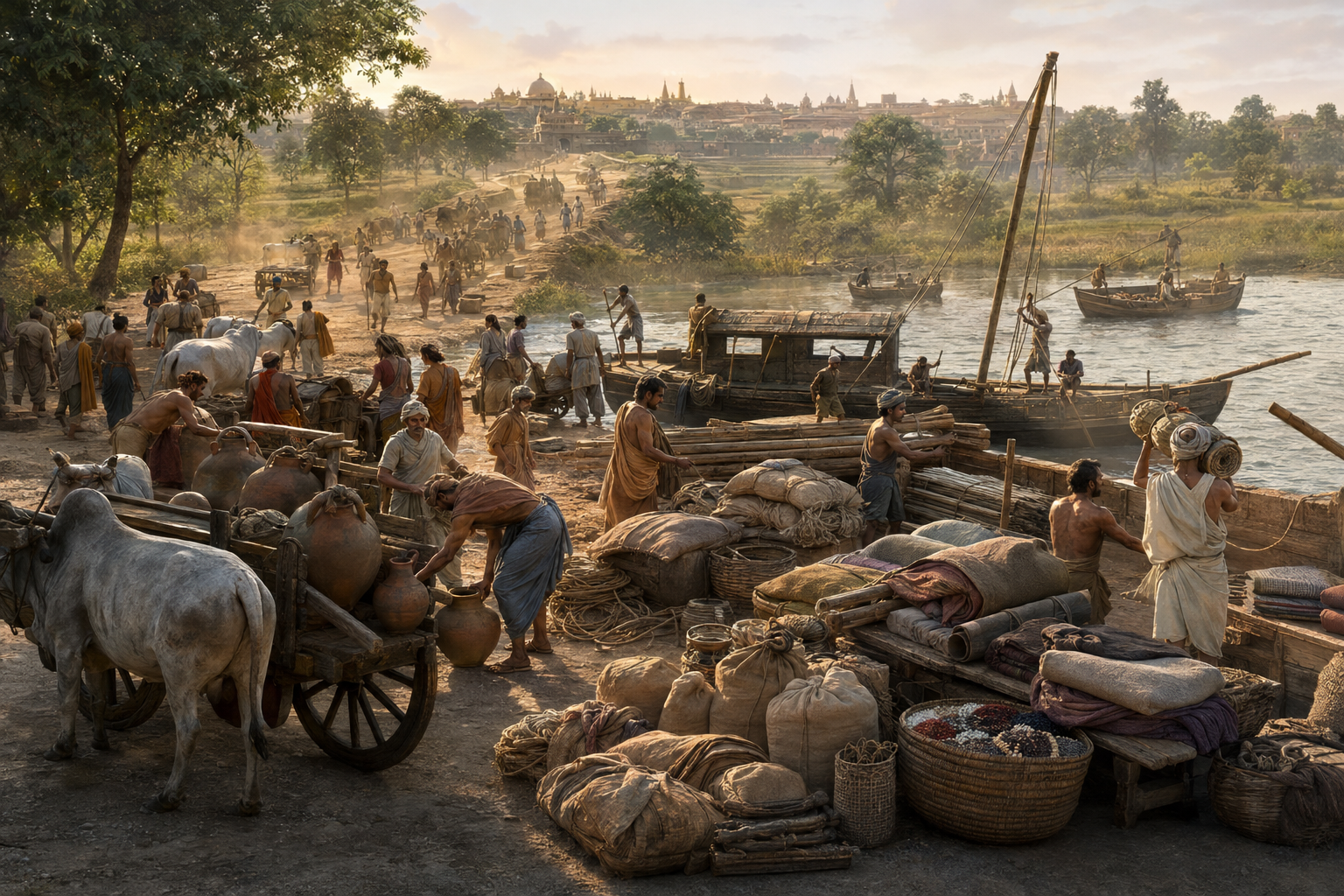
Vidisha sat on the route connecting Pāṭaliputra with Ujjayinī. It also occupied the middle of communication lines between eastern and western seaports and served as a stopping place on the way to Dakṣiṇāpatha. Goods moved through this network, but goods never travel alone. Merchants, artisans, officials, teachers, pilgrims and religious communities move with them.
The local economy was not generic. Vidisha became celebrated for ivory work and sharp-edged swords. Artisans from the city contributed to the sculptural world of nearby Sāñchī. Vidisha’s ivory acquired the name “Dosarenic” among Greek maritime traders, connecting the product with Daśārṇa, or Dosarene. Near Vidisha, three inscribed labels at Sāñchī identify Kārpāsigrāma, a village whose name points to cotton production and trade.
Those details give you a practical way to reconstruct the city. Place four things on your mental map: the Bes-Betwa confluence, the Pāṭaliputra-Ujjayinī route, the southward connection to Dakṣiṇāpatha, and the production network linking cotton, ivory and Sāñchī. Heliodorus then appears within a connected society rather than against an empty background.
The proximity of Sāñchī makes this especially clear. The two centres are only about ten kilometres apart. If you visit or teach this history, do not treat Sāñchī as a self-contained Buddhist island and Vidisha as an unrelated footnote. Read them as parts of one regional landscape. The patrons and artisans named around Sāñchī belonged to the commercial and social world of Vidisha.
This does not prove why Heliodorus made his personal commitment. Geography cannot explain an individual’s inner conviction. It does explain how contact became possible and why the presence of a Bhāgavata community in Vidisha should not surprise us. A connected city creates repeated opportunities for encounter; a sustained religious community turns encounter into belonging.
Several Dharmas flourished without becoming interchangeable
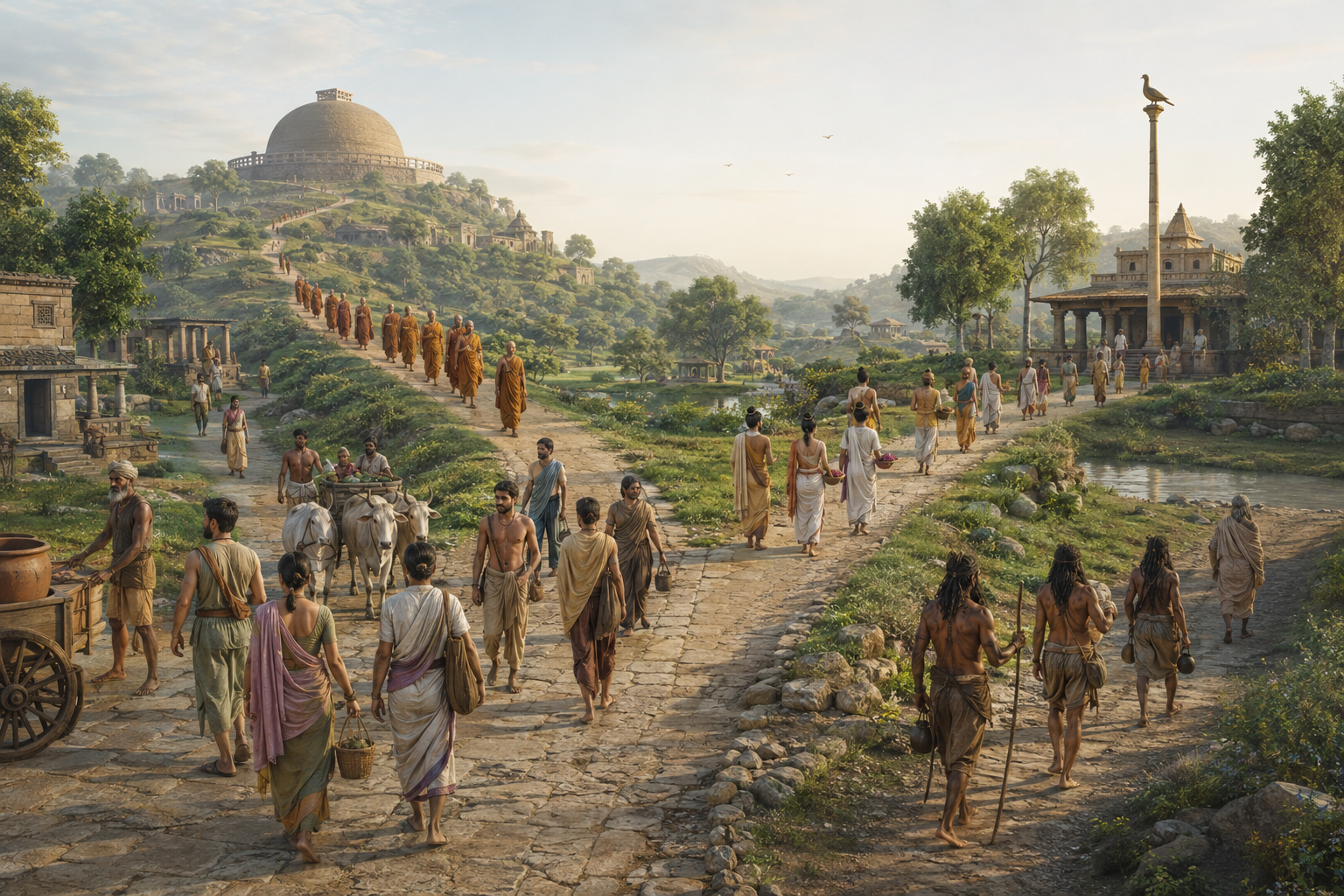
Vidisha’s plurality is often described too loosely. Calling it a “melting pot” can hide more than it reveals. Its traditions were not nameless expressions of a single civic spirituality. They possessed their own teachers, patrons, sacred places, practices and forms of affiliation.
Bāvari, a Brahmana ācārya, came to Vidisha with sixteen Brahmin pupils. The city also developed into an important centre of Bauddha Dharma during Aśoka’s reign. Vidisha and nearby Sāñchī contained numerous Buddhist structures, while patrons from Vidisha supported religious works in the wider region. Eighteen donors associated with Vidisha contributed to Buddhist edifices at Bhilsa. At Bharhut, votive records preserve gifts connected with people from Vidisha, including Cāpādevī, wife of Revatimitra, and Vāsiṣṭhī, wife of Veṇimitra.
Bhāgavata devotion therefore belonged to a region containing vigorous Buddhist patronage, Brahmanical learning, tīrthas and other sacred institutions. The important word is “vigorous.” Plurality did not require anyone to abandon a definite commitment. Heliodorus became a Bhāgavata, not merely an observer interested in a vaguely spiritual city.
A Bhāgavata is a devotee oriented toward Bhagavān, within a recognisable Vaiṣṇava devotional current. That identity should not be flattened into either a modern census category or a casual appreciation of Indian thought. It names a relationship of allegiance and belonging. The Heliodorus legacy matters because a specific person could enter that relationship in a city where several well-formed Dharmic paths were simultaneously visible.
This is a more demanding idea of pluralism than mere tolerance. It asks you to recognise difference accurately, allow serious traditions to remain serious, and still understand that contact across communities need not erase conviction. Vidisha’s civic richness arose from the presence of identifiable paths, not from their dissolution into sameness.
What the Heliodorus legacy proves, and where to stop
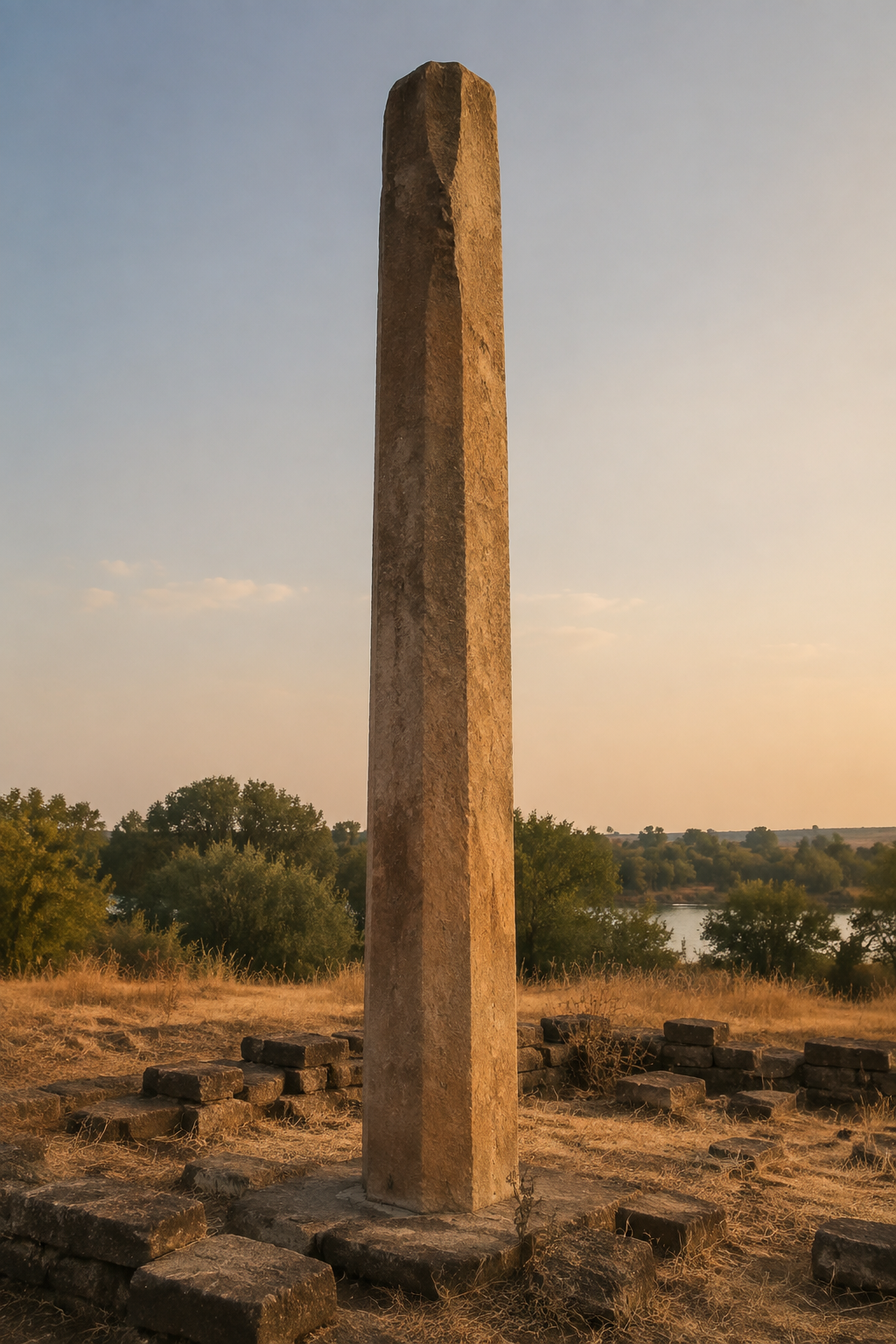
The safest interpretation begins with a modest fact: Heliodorus became associated with Bhāgavata identity at Vidisha. That fact gives us a named human point of entry into a much larger religious world. It also shows that the boundary of Bhāgavata belonging could encompass someone called Heliodorus.
The surrounding history supports a second conclusion. His affiliation occurred in a city where long-distance movement, political authority, skilled production and religious patronage met. The setting was conducive to meaningful contact with an established tradition. Calling the episode inexplicable would require ignoring the character of Vidisha itself.
Beyond that, caution is necessary. One individual cannot tell you how common such affiliations were. Heliodorus cannot stand for every traveller, every political visitor or every resident of Vidisha. Nor does his Bhāgavata identity prove that the whole city followed one Dharma. The abundant Buddhist record alone prevents that simplification.
Keep different kinds of evidence distinct
You can read Vidisha more accurately by separating three layers of evidence. Sacred and literary memory tells you how the city was imagined within Bharat’s cultural world. Political and geographical information tells you why rulers and travellers valued its location. Inscriptions, donor names and artisan records reveal people acting through material institutions.
Each layer answers a different question. The Rāmāyaṇa association with Śatrughna does not perform the same historical work as an inscribed donor label. Kālidāsa’s poetic Vetravatī is not an administrative route map. An artisan’s contribution at Sāñchī is not merely a literary symbol. You do not have to discard one layer in order to respect another; you have to stop asking one kind of evidence to do another kind’s job.
Use a five-part test when sharing the story
- Place Heliodorus geographically. Name Vidisha and the Bes-Betwa confluence before discussing the devotional legacy.
- Establish the routes. Connect the city with Pāṭaliputra, Ujjayinī, the seaports and Dakṣiṇāpatha.
- Show the institutions. Mention artisans, patrons, sacred centres and the nearby landscape of Sāñchī.
- Name the commitment precisely. Call Heliodorus a Bhāgavata rather than reducing him to someone vaguely influenced by India.
- State the limit. Treat his case as evidence of possible belonging, not as a statistic about an entire population.
This sequence is useful whether you are writing, teaching, making a short video or explaining the episode to your family. It prevents two common distortions at once: turning Heliodorus into an isolated curiosity and inflating one person’s story into an unsupported civilizational slogan.
Key takeaways
- Heliodorus makes better historical sense when you first understand Vidisha as a major political, commercial and sacred centre.
- The city’s river confluence and long-distance routes created the conditions for sustained encounters among people, institutions and Dharmic traditions.
- Vidisha and Sāñchī should be read as one connected regional landscape, especially when tracing artisans and religious patronage.
- Several Dharmas flourished in Vidisha without losing their distinct identities; plurality and firm devotional commitment coexisted.
- Heliodorus demonstrates that Bhāgavata belonging could include him, but one case does not establish how widespread such affiliation was.
- Literary memory, political geography and inscriptions illuminate different aspects of Vidisha and should not be treated as interchangeable forms of proof.
The next time you encounter the Heliodorus story, give Vidisha the first minute. Name the confluence, the roads, Sāñchī, the artisans and the city’s many Dharmas. Then introduce the Bhāgavata. That small change turns a detached curiosity into a legible chapter of Bharat’s civilizational history.
References
