
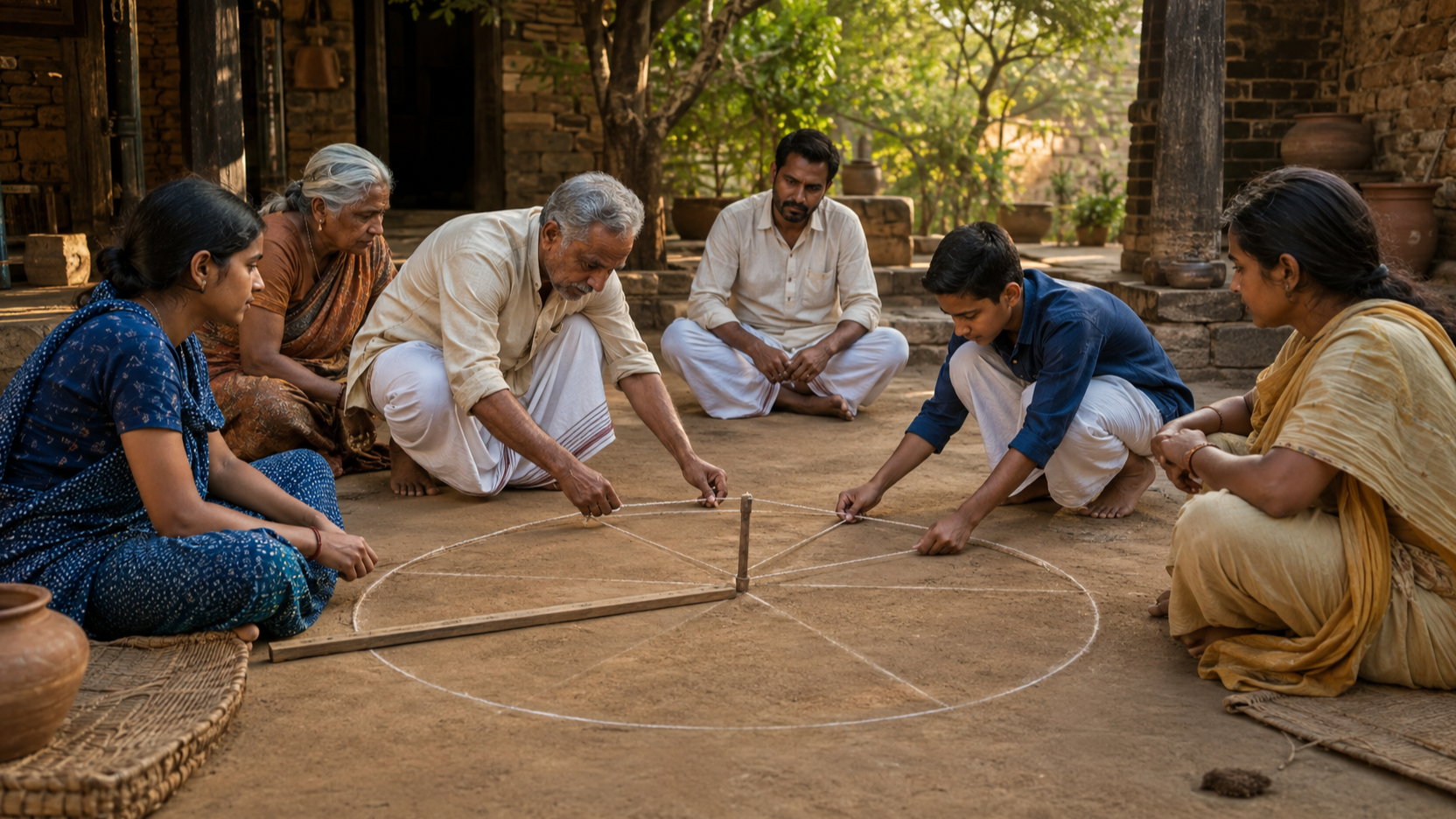
You may have reached Indian Knowledge Systems through a university course, a family practice, or frustration with histories that reduce Bharat to invasions and political dynasties. The immediate problem is the same: how do you separate a living knowledge tradition from a pile of proud claims, translated terms, and disconnected achievements?
Use a demanding test. Ask what the tradition considers a good human life, how it relates conduct to natural and social order, how insight becomes disciplined action, how competence passes between people, and which institutions keep that transmission alive. Those questions turn civilizational heritage into something you can study, practise, teach, and evaluate.
Stop treating heritage as a cabinet of curiosities
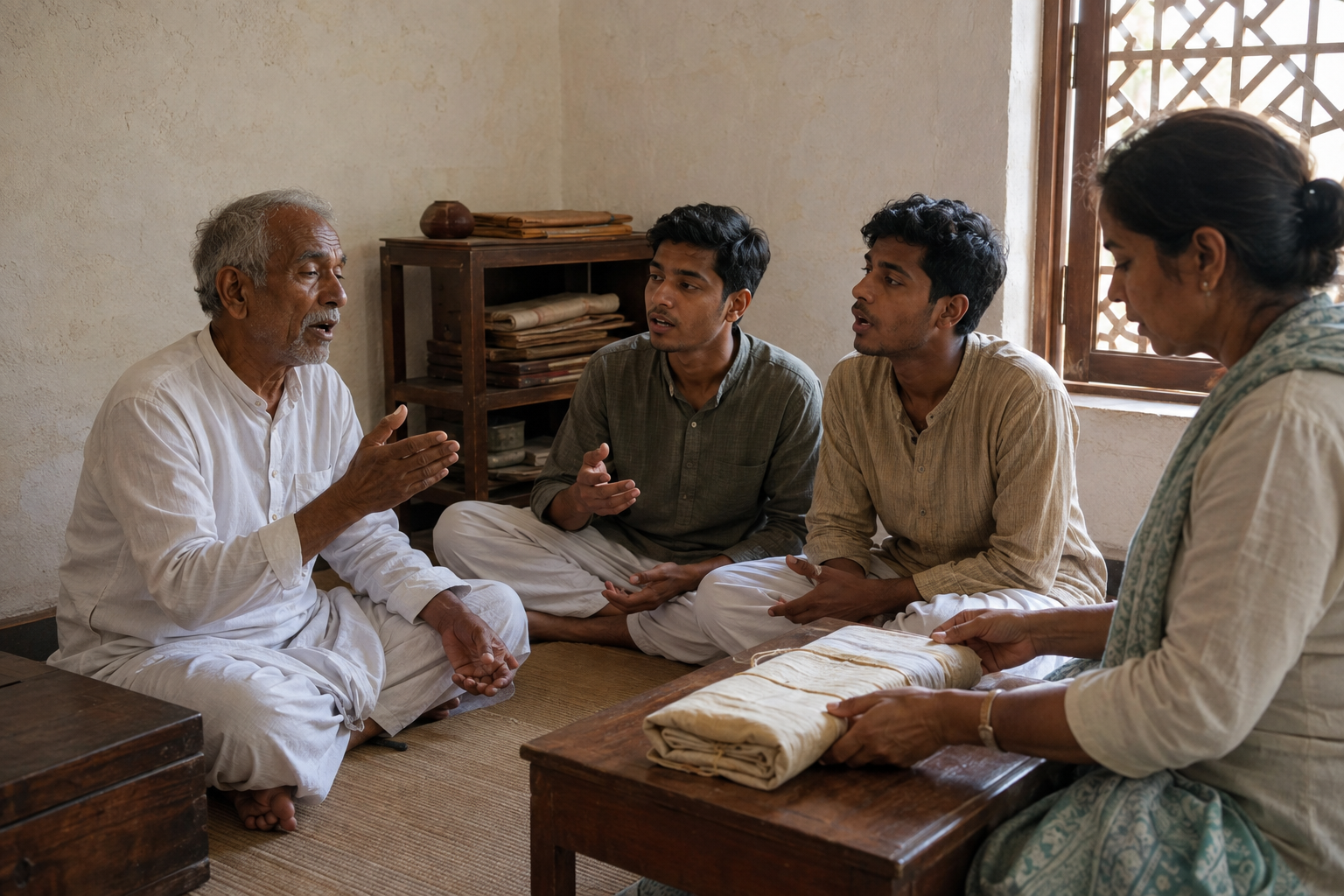
Indian Knowledge Systems, often shortened to IKS, are easily presented as an inventory: texts, sciences, philosophical schools, artistic forms, rituals, temples, mathematical achievements, medical traditions, and famous teachers. Each item may be valuable, but an inventory does not reveal a system. A system appears only when you can see the relationships among its aims, methods, practices, teachers, institutions, and expected human qualities.
This changes the first question you should ask. Do not begin with, “What can we claim Bharat invented?” Begin with, “What problem of life is being addressed, and how is a person trained to address it?” The first question invites competitive boasting. The second reveals a knowledge tradition on its own terms.
Consider the traditional curricular map of four Vedas, six Vedangas, four Upangas, and sixteen kalas. Memorising those classifications can provide orientation, but the deeper questions concern function. What kind of understanding does each field cultivate? What must be heard, reasoned about, performed, observed, or embodied? Who is qualified to correct a learner? What happens to the field when its language survives but its community of practice disappears?
A civilizational approach also requires restraint. Hindu, Buddhist, Jain, Sikh, regional, and sampradaya traditions developed within connected civilizational worlds, but proximity does not make their doctrines interchangeable. Do not silently make a concept from one lineage speak for every Dharmic tradition. Name the lineage, preserve its vocabulary, and compare traditions only after each has been represented in its own categories.
Key takeaways
- Study relationships among knowledge, conduct, practice, transmission, and institutions rather than collecting isolated facts.
- Treat dharma as a question about sustaining order in context, not as a loose substitute for “religion” or a fixed list of commands.
- Preserve distinctions such as dharma and dharmashastra, vidya and kala, and rajas, tamas, and sattva; the distinctions do practical work.
- Judge preservation by whether disciplined competence can still pass from teacher to learner, not merely by whether terminology has been archived.
- Compare Dharmic traditions without erasing their disagreements, distinctive goals, or lineage-specific methods.
Read knowledge as a set of protected cycles

A useful entry into IKS is the cycle rather than the isolated object. Air, sunlight, lunar movement, nitrogen, digestion, respiration, attention, emotion, teaching, household life, and political order all involve recurring relations. The important question is not simply what a thing is. It is what the thing participates in, what keeps that participation in balance, and what follows when the relation breaks.
This gives dharma a sharper meaning. Imagine a plant growing by itself and then imagine the same plant crowding a bed of roses. Whether you protect or remove it depends on the wider cycle you are responsible for sustaining. The analogy does not supply a mechanical moral formula. It teaches you to examine relationships and consequences before declaring an act intrinsically right merely because it resembles a rule.
A particular Indic formulation describes the sustaining order as rtam-satyam and treats dharma as protection of that order. This is why dharma cannot be understood solely through translated definitions. You must ask what is being protected: a bodily rhythm, ecological continuity, a learner’s development, a family obligation, a lineage of knowledge, social trust, or the conditions required for spiritual discipline.
The same cyclical lens reaches inward. Waking, dreaming, and deep sleep are familiar states; the Indic map also attends to a fourth state identified here as turiya or samadhi. Its significance is not that it adds an exotic item to a list. It changes the horizon of education. If unbounded awareness or bliss is considered a genuine human possibility, training cannot be limited to acquiring information or maximising consumption. Attention, identity, conduct, and the quality of consciousness become educational concerns.
You can apply the cyclical lens to any practice you are studying. Write down its inputs, rhythm, participants, feedback, intended result, and failure conditions. Then identify the custodian of the cycle. A festival, for example, is not preserved merely because its name remains on a calendar. Its cycle may include calendrical knowledge, seasonal timing, narrative memory, household preparation, temple observance, artistic expression, food, kinship, and transmission to children. If most of those relations vanish, public celebration alone may preserve visibility while losing much of the knowledge system.
The cycle also prevents a common mistake in discussions of heritage: confusing continuity with immobility. A living cycle repeats, but it does not remain frozen. It responds to conditions while preserving its governing relation. When evaluating an adaptation, ask whether it enables the cycle to continue or replaces its purpose with something unrelated. That is a more useful test than declaring every change modern and every old form authentic.
Preserve the distinctions that make the system usable
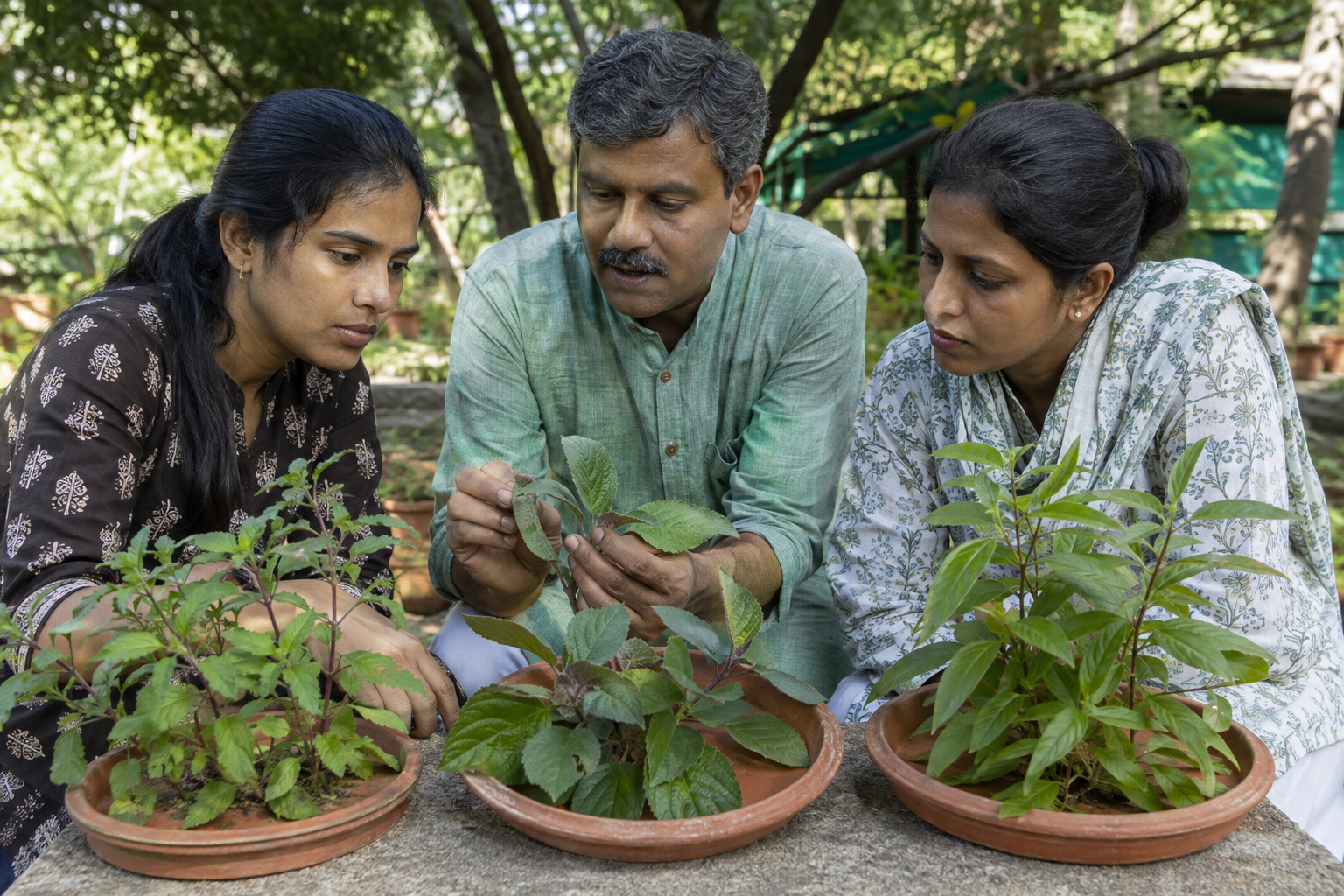
Translated vocabulary can create false simplicity. Dharma becomes “religion,” yoga becomes “exercise,” karma becomes “fate,” and sattva becomes “goodness.” Once the distinctions collapse, you may remember the words while losing the reasoning they were meant to support.
| Distinction | Common misreading | Better question |
|---|---|---|
| Dharma and dharmashastra | Dharma is treated as nothing more than a rulebook. | What order is being sustained, and how does a codified instruction help protect it in a particular setting? |
| Yoga and bhoga | Both are reduced to techniques for feeling better. | Is the practice training freedom from compulsive identification, or merely refining consumption and sensory enjoyment? |
| Gyana, karma, and bhakti | Different paths are collapsed into interchangeable lifestyle preferences. | Is the discipline working primarily through insight, action, or devotional orientation, and how are these joined in this lineage? |
| Rajas, tamas, and sattva | People are labelled as good, bad, or spiritually inferior. | Which function is operating now: activation, restraint, or balance, and what does the complete cycle require? |
| Vidya, kala, and vigyan | All knowledge is treated as information that can be stored in notes. | What must be communicated orally, demonstrated aesthetically, designed, practised, or embodied? |
The three gunas are especially easy to moralise. A more functional analogy is a bicycle: stillness resembles tamas, movement resembles rajas, and balance resembles sattva. The rider needs motion to travel, restraint to stop, and balance to remain upright. Even restorative sleep requires the restraining function associated with tamas. The practical lesson is to stop using the gunas as permanent personality badges. Observe how their functions change across an activity.
Try this when examining your own study routine. Restlessness and constant switching may show activation without balance. Dull repetition may show restraint without sufficient movement. Quiet clarity allows effort to become directed. The purpose is not to diagnose yourself through a simplified typology. It is to notice which condition supports the work and which condition distorts it.
The distinctions among gyana, karma, and bhakti yoga perform similar work. Gyana directs attention toward knowledge and the loosening of identification with the isolated “I.” Karma engages disciplined action. Bhakti directs action and attachment toward the beloved so that self-centred identity is transformed. These paths can interact, but interaction is not sameness. When a teacher or course invokes “yoga,” ask which discipline is meant, what its goal is, and what qualifies someone to teach it.
The result should also be visible in character. A person established in stable wisdom is described as a sthitaprajna, and the expected qualities include daya, or compassion, and anayasa, freedom from agitated overactivity. This gives you a standard more demanding than verbal fluency. If learning produces impressive terminology but increases vanity, agitation, or contempt, something has gone wrong in the movement from information to formation.
Judge preservation by whether knowledge can still be transmitted

An archive can preserve words, images, and recordings. It cannot by itself preserve correction, timing, judgement, disciplined attention, or the subtle coordination between a teacher and a learner. Those capacities live in transmission.
The guru-shishya relationship is therefore more than a respectful name for classroom teaching. It depends on a coupling process through which the learner’s attention and action become aligned with what the teacher can demonstrate. Oral instruction can carry vidya. Gesture, mudra, drawing, performance, and other aesthetic action can carry kala. Vigyan can be understood as the organised preservation and application of such cycles, including understanding and design, while remaining directed by dharma.
This does not mean that every traditional teacher is beyond scrutiny or that digital learning has no place. It means you should identify what a medium can and cannot transmit. A recording can preserve pronunciation for repeated listening, but it cannot hear your error. A diagram can preserve the shape of a mudra, but it cannot always show pressure, timing, intention, or contextual use. A translation can introduce a concept, but it may not preserve the semantic relations carried by the original language.
A robust pedagogy also uses more than one voice. The prabhu, mitra, and kanta modes distinguish instruction that speaks with authority, teaching that approaches as a friend through Itihasa and Purana, and learning that works through kavya, rasa, and the intimacy of aesthetic experience. A principle can tell you what matters. A narrative can show the principle under pressure. Poetry, music, or performance can make its emotional form perceptible.
If you teach children, this immediately improves lesson design. Do not deliver only a definition of dharma. Pair a clear principle with a situation from Itihasa or Purana, then ask the learner to notice the rasa, competing obligations, consequences, and restoration of order. The learner should have to judge, not merely repeat.
Transmission also needs institutions at several scales. At the individual scale, purusharthas and ashramas connect aims of life with stages and responsibilities. At the family and social scale, work must sustain other people’s cycles while allowing a person to remain on a legitimate path. At the wider social and political scale, institutions coordinate increasingly large communities. The enduring insight is not that every historical arrangement must be reproduced unchanged. It is that individual cultivation, household continuity, social function, and public order cannot be designed as unrelated projects.
Use the following test before calling a tradition “preserved.” Can a learner perform the practice under correction? Can the learner explain its purpose without relying on a slogan? Can the teacher state its limits and lineage? Does the practice cultivate the qualities it claims to cultivate? Can the learner eventually transmit it responsibly? If the answer is no across most of these questions, what survives may be documentation or cultural branding rather than the full knowledge cycle.
Turn civilizational curiosity into a disciplined practice
You do not need to master the whole civilizational inheritance before beginning. You need a method that prevents enthusiasm from outrunning understanding.
- Begin with a live question. Ask how dharma guides a conflict, how a daily observance trains attention, how a festival joins calendar and community, or how a particular art transmits knowledge. A real question gives your study a standard of relevance.
- Name the lineage and scale. Record whether the concept belongs to a particular sampradaya, text family, art, region, or wider civilizational vocabulary. Then identify whether it primarily concerns the person, teacher and learner, household, community, institution, or polity.
- Build a concept card. Include the original term, the context in which it is used, its paired contrast, the practice associated with it, the quality it is meant to cultivate, and the person qualified to correct misunderstanding. Do not let an English equivalent replace this map.
- Pair explanation with enactment. If you study nitya karma, examine an authentic daily practice already present in your family or lineage. Record its timing, preparation, sequence, intention, and relation to other responsibilities. If it requires initiation or expert correction, learn from an appropriate teacher rather than reconstructing it from fragments.
- Use several teaching modes. Study a principle, find a narrative that places it in a difficult situation, and notice how poetry, music, image, gesture, or ritual gives it aesthetic form. This prevents abstract doctrine from becoming detached from lived judgement.
- Look for the complete cycle. Identify origin, transmission, practice, correction, result, renewal, and the conditions that allow the cycle to continue. Missing links tell you where preservation work is actually required.
- Evaluate the human result. Ask whether study is producing steadier attention, sounder judgement, compassion, disciplined action, and less compulsive self-importance. Do not confuse cultural confidence with mastery.
This method also helps you evaluate an IKS programme. A serious syllabus should do more than assemble celebratory claims. It should define terms in context, distinguish shared civilizational patterns from lineage-specific doctrine, connect concepts to practices, use more than one pedagogical form, identify transmission requirements, and show how learning changes conduct. Claims of antiquity cannot substitute for those elements.
Begin with the next inherited practice you already encounter. Instead of asking only what it symbolises, map the cycle it protects, the distinction it teaches, the mode by which you learned it, and the quality it is meant to cultivate. That small act moves heritage out of display and back into disciplined continuity.
References
