
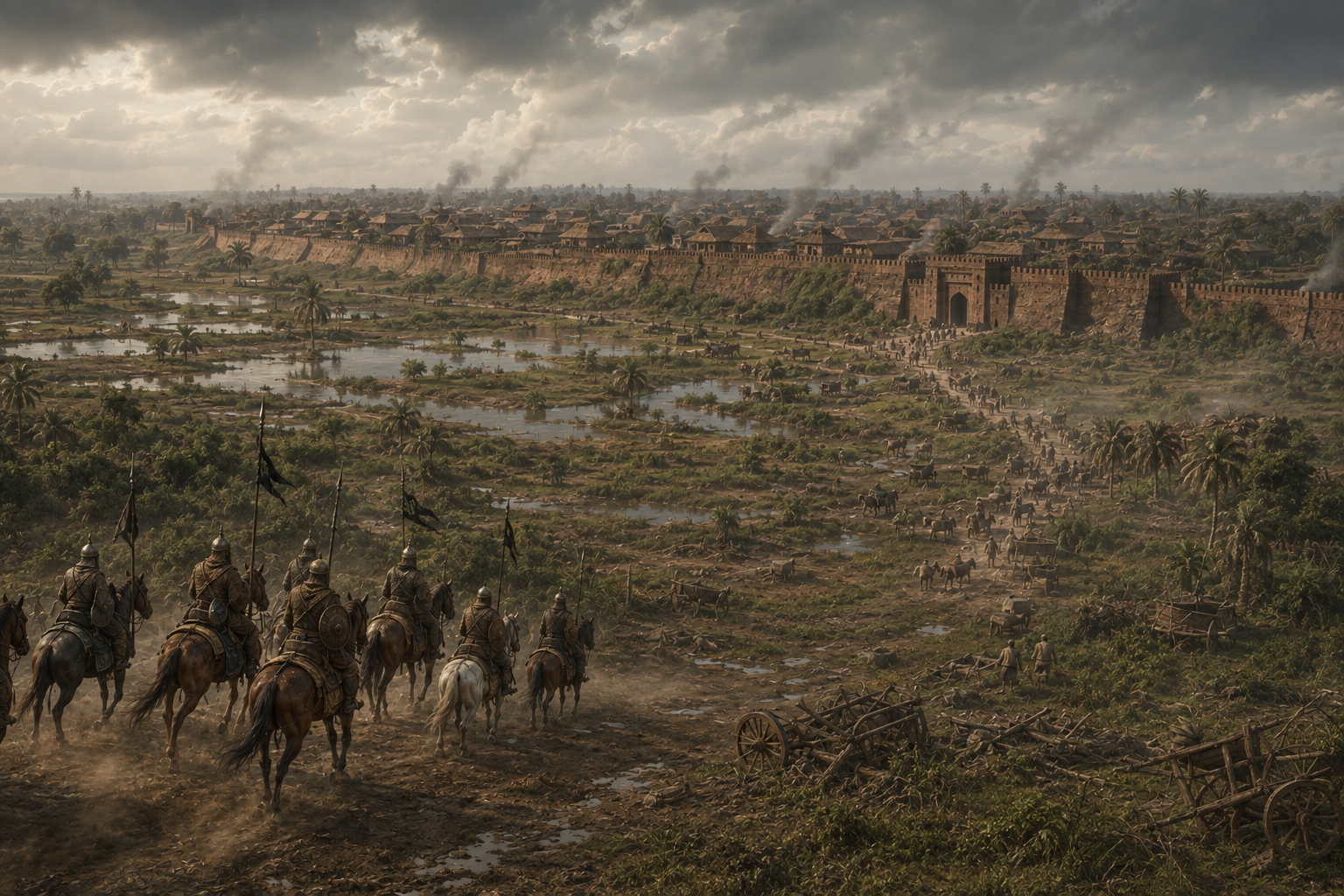
If you arrived with a simple question – did Bakhtiyar Khalji capture Gauda, or did he destroy it? – the answer depends on a distinction that is often missed. Gauda-Desha was a wider civilisational region, Gaur was its historic metropolis, and Lakhnauti could refer to a later capital created near the ruins.
Once you keep those places and phases separate, the scale of the rupture becomes clear. Khalji did not merely replace one ruler in an otherwise continuous capital. His campaign devastated the surrounding country, overwhelmed Gaur, dismantled its Sanatana institutions, and established a new political and religious order nearby.
Start by separating Gauda, Gaur and Lakhnauti
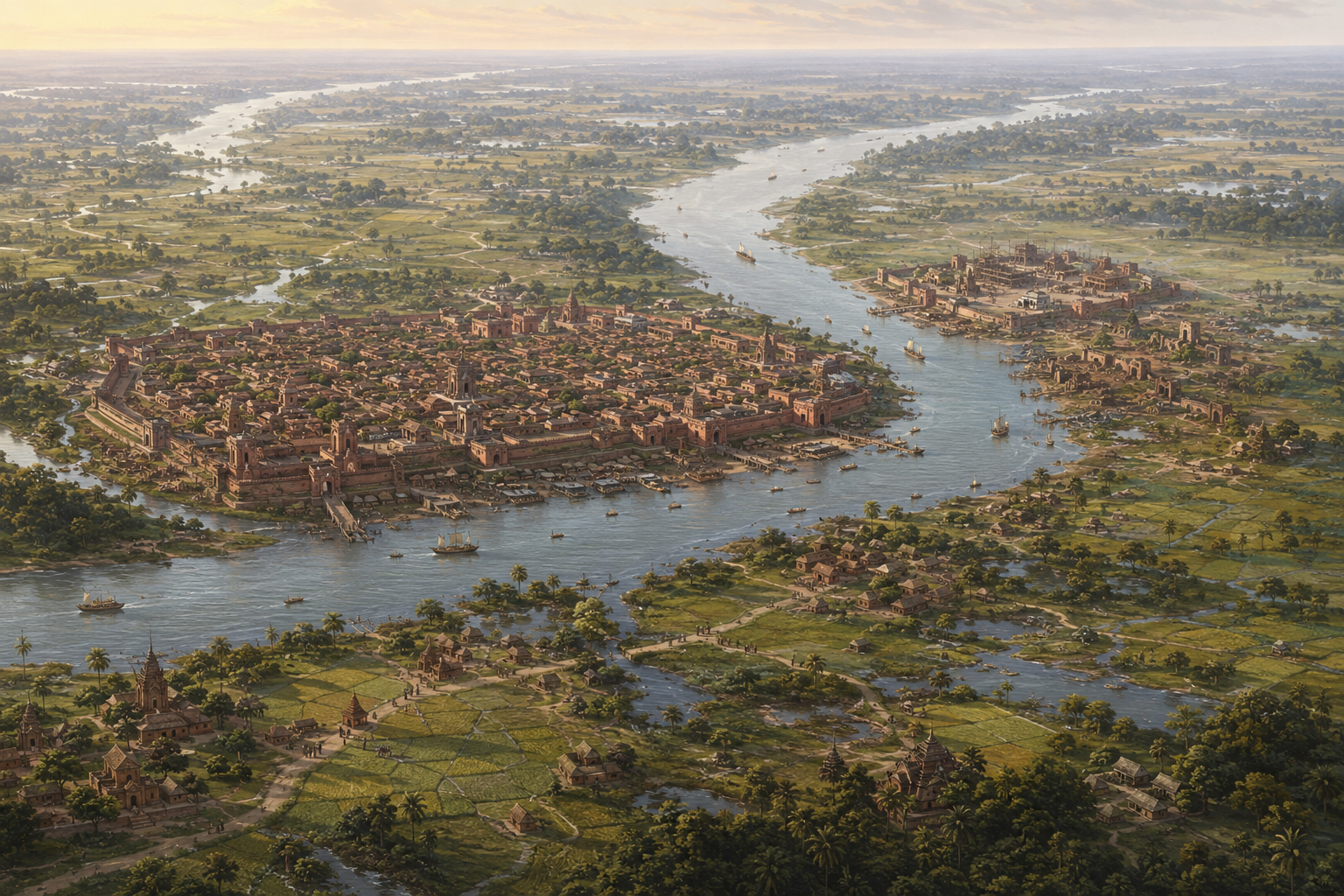
Gauda-Desha was larger than a single city. It was an old name for the Bengal region, including territory that now lies in Bangladesh. Gaur served as its political and cultural nerve centre and prospered for centuries as a metropolis under Hindu kings.
The city was also known as Lakshmanavati, a name associated with Lakshmanasena. Muslim chronicles rendered that name as Lakhnauti. This linguistic continuity can be misleading because Khalji later established a new capital a few miles from the ruined city and gave that settlement the inherited name Lakhnauti.
A familiar name, therefore, does not prove an unbroken city. Whenever you encounter Lakhnauti in a chronicle or modern retelling, ask which place is meant: the Hindu metropolis associated with Lakshmanasena, or Khalji’s new capital near its remains. Confusing the two turns a civilisational break into what looks like an ordinary change of dynasty.
Even under colonial rule, local memory retained several older identities for Gaur. Adisur recalled King Adisura; Ballal Sen recalled the Sena ruler Ballalasena; and Lakshman recalled his son Lakshmanasena. These names were not interchangeable labels without history. Each connected the landscape to an older layer of kingship and cultural memory.
What Bakhtiyar Khalji was actually destroying
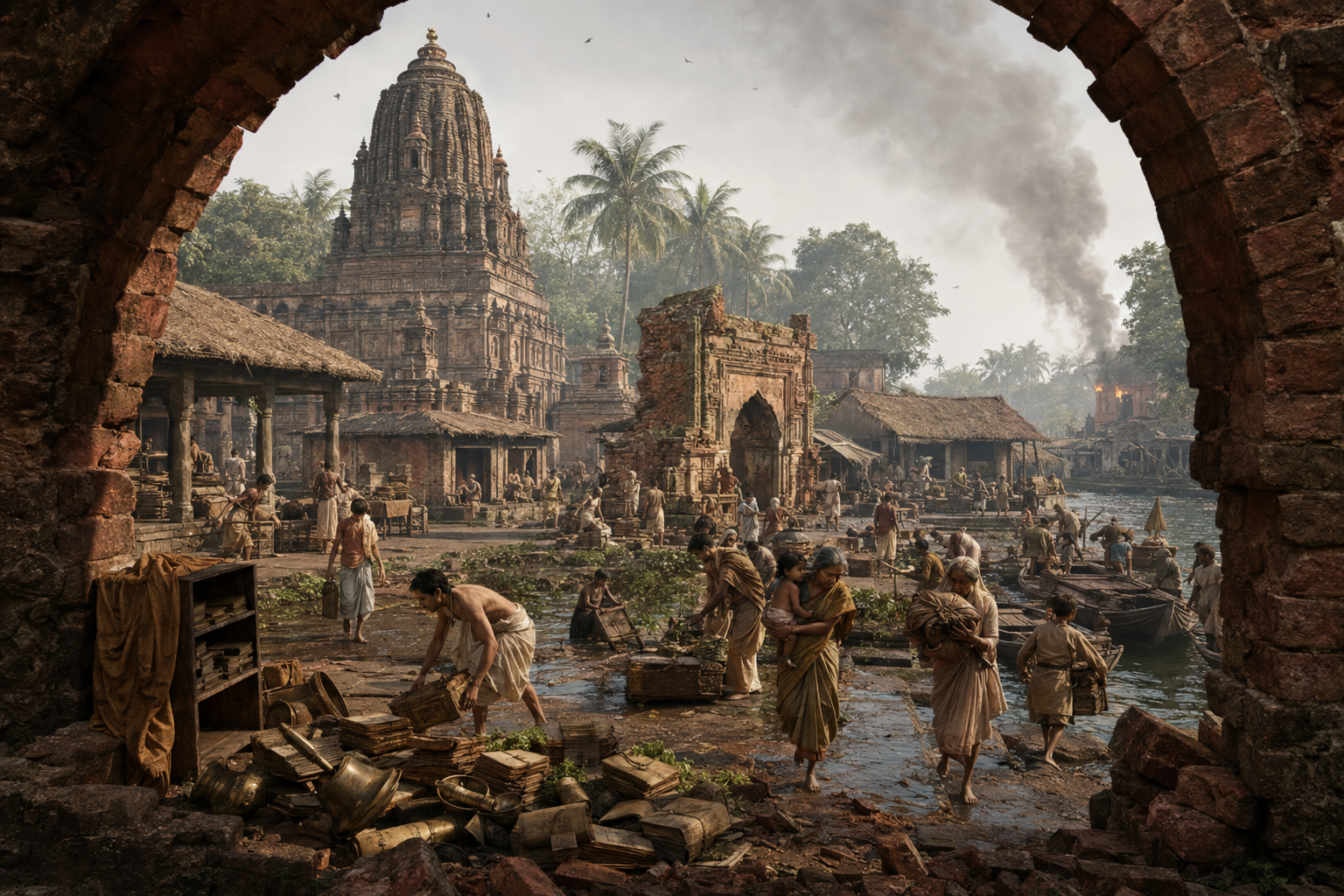
Gaur’s importance cannot be measured only by palaces, fortifications or political control. It was also a centre of Sanskrit learning, literature, ritual life and Brahmana scholarship. Its prestige belonged to an ecosystem: rulers who supported learning, teachers who transmitted knowledge, temples and yajnas that sustained sacred practice, and households that carried those traditions across generations.
The traditional account of Bengal’s Five Kulin Brahmanas places Gaur at the centre of that learned world. King Adisura invited five distinguished Brahmanas from Kanyakubja, or Kanauj, to perform a grand yajna. The foremost among them was Bhatta Narayana, remembered as the author of the Sanskrit play Venisamhara. They subsequently made Gaur their home.
The wider memory of Gaudiya Brahmanas points in the same direction. Repeated migrations dispersed communities associated with Gauda toward Goa, Maharashtra and Karnataka. The name Gauda Sarasvata Brahmanas preserves that association in communities far beyond Bengal. A city may lose its buildings while displaced lineages continue carrying fragments of its identity elsewhere.
This is why the destruction of a learned city cannot be reduced to a tally of damaged structures. A centre of knowledge ceases to function when its teachers scatter, patronage ends, sacred sites are demolished and the institutions that reproduce learning are replaced. Physical destruction and institutional destruction reinforce each other.
The assault began outside the walls of Gaur

After plundering Navadvipa, Khalji turned toward Gaur. His army did not begin with a direct attack on the metropolis. It first devastated the open country across the rich alluvial tract between the main channels of the Ganga and Brahmaputra.
First ravaged the open country without making [a direct] attempt on Gaur.
Acharya Jadunath Sarkar
That sequence matters. Ravaging the countryside exposed settlements outside the city’s protection, broke the surrounding territorial order and stripped the metropolis of the landscape on which it depended. What followed was not an isolated palace coup. The campaign reached Gaur only after violence had already spread across the region around it.
- Khalji’s forces wasted and captured the open alluvial country.
- They then advanced into the metropolis of Gaur.
- Inhabitants encountered as infidels were killed, while temples were destroyed.
- Mosques and other structures were erected as the conquered space was remade.
The visible Sanatana fabric of Gaur was dismantled so comprehensively that it no longer defined the site. Yet it is more precise to say that the old metropolis was erased than to say that Gauda literally vanished. The region and its names continued; the Hindu urban and institutional order centred on Gaur did not.
Conquest continued after the battlefield victory
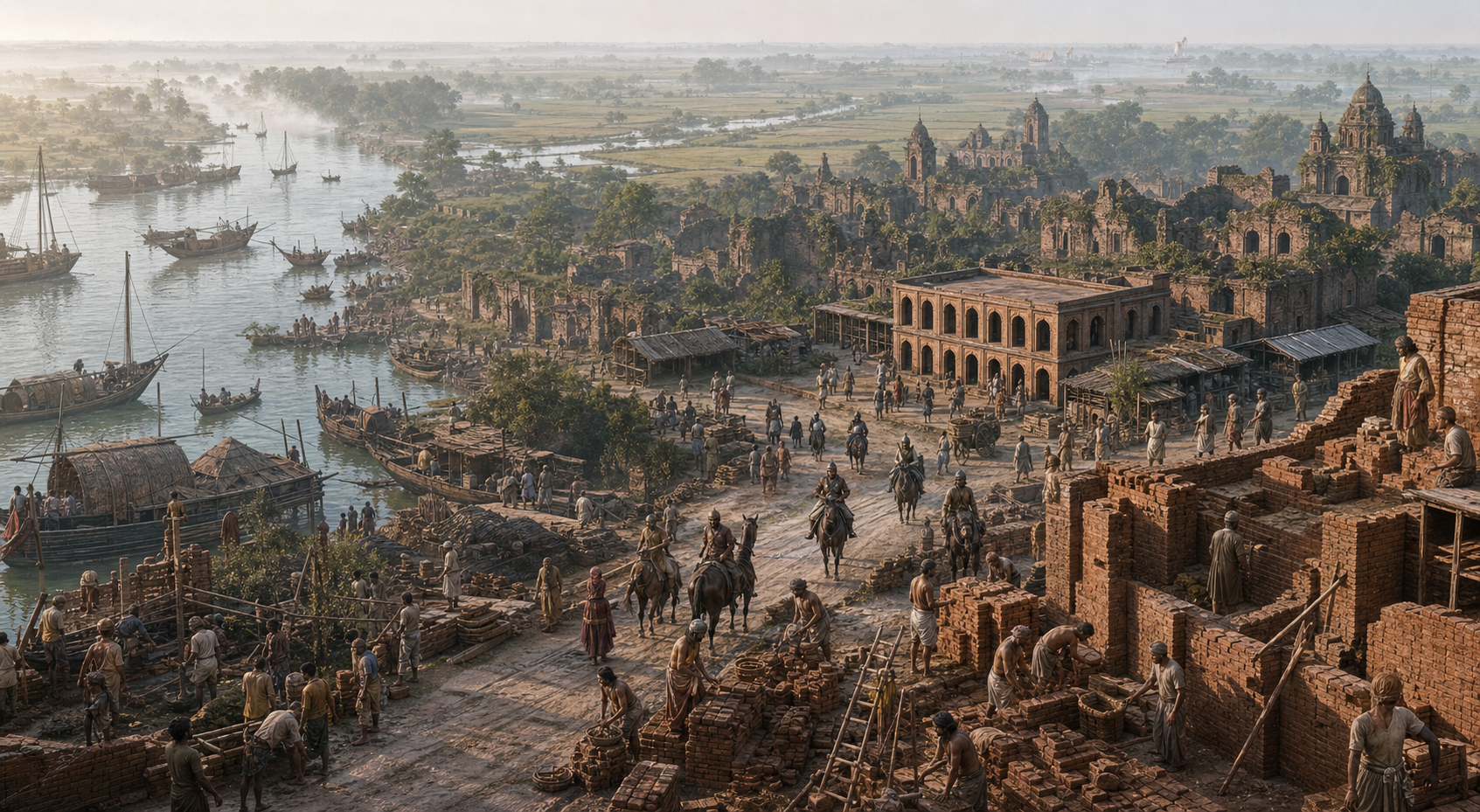
Khalji’s work did not end when resistance collapsed. An empire needed a capital, an administrative structure and institutions capable of reproducing the conqueror’s order. He established his new capital a few miles from the ruins and called it Lakhnauti, adapting the older name Lakshmanavati.
During the following couple of years, consolidation included the demolition of the few remaining temples. Their material was reused in mosques and madrasas. Mazhars and khanqahs also spread through the conquered region, while Khalji’s amirs sponsored further seminaries and colleges. The Islamic clergy regarded this institutional expansion as evidence of his religious zeal and commitment to Islamising conquered territory.
The reuse of temple debris was more than convenient construction. It joined material appropriation to institutional replacement: sites associated with Sanatana worship and learning supplied the fabric for buildings serving a different sacred and political order. The new capital was therefore not simply an administrative successor to Gaur. It embodied the victory that had made the older city expendable.
The transformation could also be heard. Khutba and azaan occupied a public soundscape once sanctified by Vedic mantras. A triumphalist couplet attributed to Badauni expressed the intended contrast without ambiguity:
Here, where was heard before, the clamour and uproar of the Kaffir; now, here is heard resounding the shouts of "Allaho Akbar!"
Badauni
The value of that verse is ideological rather than statistical. It tells you how an admirer of the conquest understood its meaning: not merely as the acquisition of revenue or a throne, but as the replacement of one religious order by another.
The consequences endured. Bengal remained under Islamic rule for the next three centuries, while Gaur passed through further changes of fortune and nomenclature. The pre-conquest Sanatana character of the metropolis was not restored, and the Islamic imprint established through Khalji’s conquest remained embedded in the region.
Key takeaways for reading this history accurately
- Map the names before judging the claim. Gauda-Desha was the wider region, Gaur was its historic metropolis, Lakshmanavati was an older royal name, and Lakhnauti was also used for Khalji’s new capital near the ruins.
- Treat the destruction as a sequence. The campaign moved from Navadvipa to the open countryside, from the countryside into Gaur, and from military conquest to administrative and religious consolidation.
- Do not reduce the loss to buildings. The destruction of temples, dispersal of learned communities, end of older patronage and creation of new religious institutions together broke cultural continuity.
- Match each kind of evidence to what it can establish. Local memory preserves older royal names; military reconstruction clarifies the order of attack; and triumphalist verse reveals the ideological meaning attached to victory.
- Do not mistake a reused name for an unchanged city. The continuation of Lakhnauti in later history does not cancel the destruction of the earlier Hindu metropolis.
If you teach, discuss or write about Gauda, make one practical correction first: place old Gaur and Khalji’s Lakhnauti on separate lines. Then include the devastation of the surrounding countryside and the institutional rebuilding that followed. That simple chronology prevents both exaggeration and minimisation, while keeping the civilisational nature of the loss in view.
References
- DharmaRenaissance Blog – When Bakhtiyar Khalji Wiped out Gauda-Desa from Existence
