
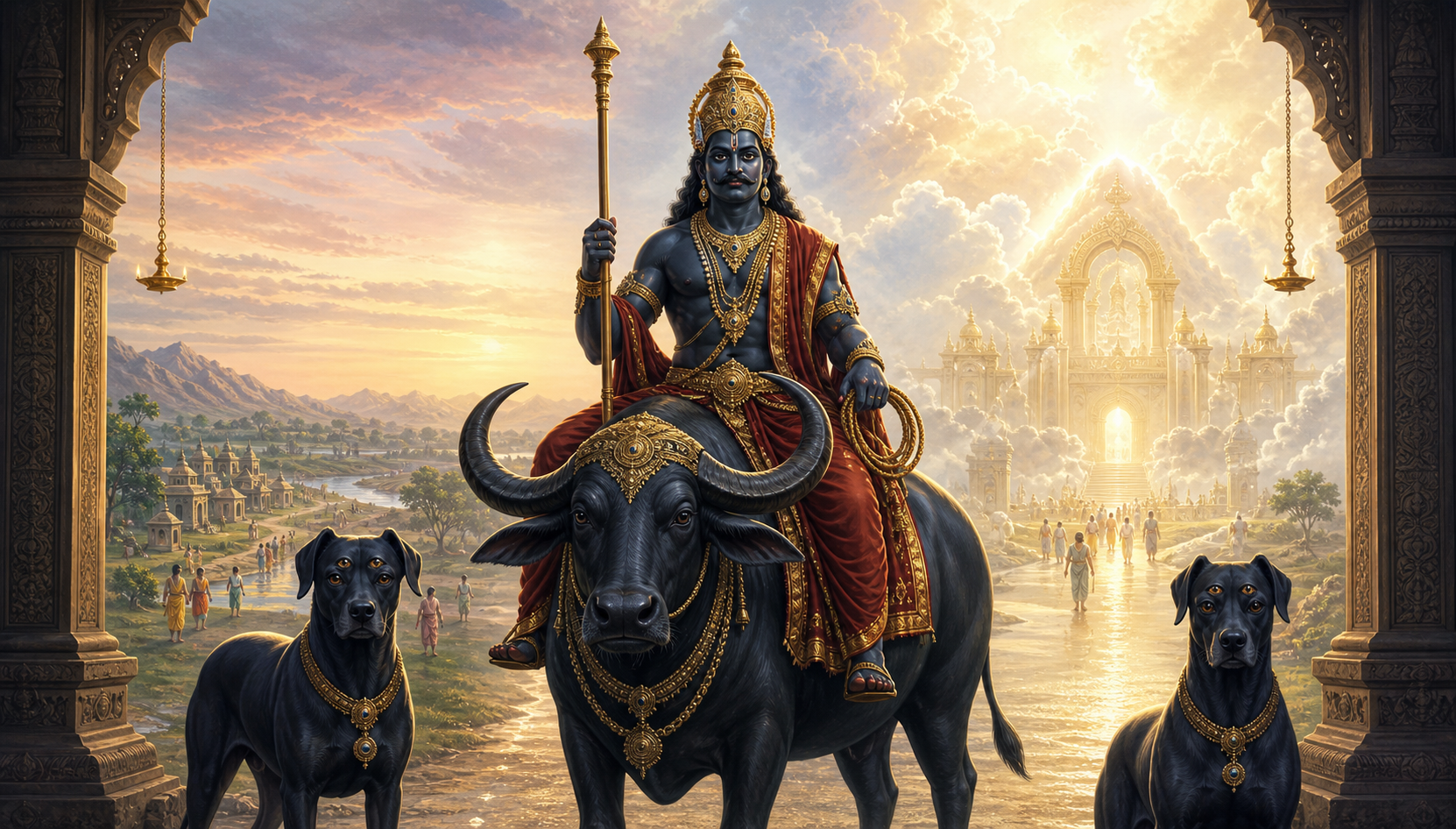
If hearing Yama’s name makes you uneasy, you are already standing at the doorway of his teaching. The question is not whether you can avoid death. It is whether awareness of death can make your life more truthful, responsible, and aligned with dharma.
You do not need to turn Yama into a comforting figure, and you do not need an elaborate ritual to approach him respectfully. Begin by correcting the central misunderstanding: Yamadharmaraja is not an evil power to be kept away by refusing to say his name. He represents divine authority, moral consequence, and the limit that makes every human choice matter.
Yama is a guardian of order, not a divine villain

Popular imagination often reduces Yama to the frightening figure who arrives when life ends. That image preserves one part of his office while obscuring the theology behind it. Hindu tradition does not place him outside sacred order as an enemy of the devas. Yama belongs among the Vedic devas and has the standing to receive oblations offered through sacred fire.
That ritual standing matters. A malevolent intruder is resisted; a deva is approached with reverence. Yama’s association with death therefore does not make him the Hindu equivalent of an adversarial power from another theology. His role belongs within a lawful cosmos.
Later Hindu narratives commonly present Yama as the ruler or judge connected with the dead and the consequences of their deeds. Details differ across texts, regions, and sampradayas, but the recurring theological point is clear: actions are not erased merely because nobody around you noticed them. Human cleverness may conceal a deed from society, but it cannot turn adharma into dharma.
When you encounter a frightening description of Yama, ask what function the image serves. Does it encourage truthful conduct? Does it warn against cruelty, deception, or neglected duty? Does it remind the listener that status and wealth cannot cancel mortality? Reading the image through those questions reveals more than treating it as supernatural horror.
Keep three theological distinctions clear
Death is inevitable, but adharma is a choice
Yama’s connection with death does not mean that every death should be interpreted as punishment. Mortality is a condition of embodied life; moral consequence concerns how life is lived. Confusing these two ideas can lead to harsh and careless judgments about another person’s suffering.
Use Yama’s presence to examine your own conduct, not to speculate about the hidden karma of someone who has died. The first use produces humility and correction. The second easily produces pride while offering no reliable knowledge.
A divine office is not the same as ultimate supremacy
Honoring Yama does not require every Hindu school to place him at the summit of its theology. Hindu traditions describe the relationships among devas, karma, rebirth, grace, liberation, and ultimate reality in different ways. Yama’s authority over death or judgment can be affirmed without forcing all sampradayas into one doctrinal scheme.
If a general description conflicts with the teaching of your own sampradaya, consult its recognized acharya, texts, and ritual authorities. Do not solve the tension by declaring every other Hindu account false, and do not discard your inherited framework merely because an isolated explanation online sounds confident.
Reverence is different from panic
Fear can alert you to consequence, but panic is a poor basis for worship. Panic asks how to bargain with reality. Reverence asks how to live properly within it. Yama worship becomes spiritually intelligible when it moves you from avoidance toward responsibility.
There is also a linguistic distinction worth noticing. Yama as a deva is not automatically identical to every use of the word yama. In discussions of Yoga, the term can refer to ethical restraints. Context tells you whether the word names the deity, an ethical discipline, or another related concept. Do not build a theological conclusion from the shared word alone.
Approach Yama without inventing a ritual
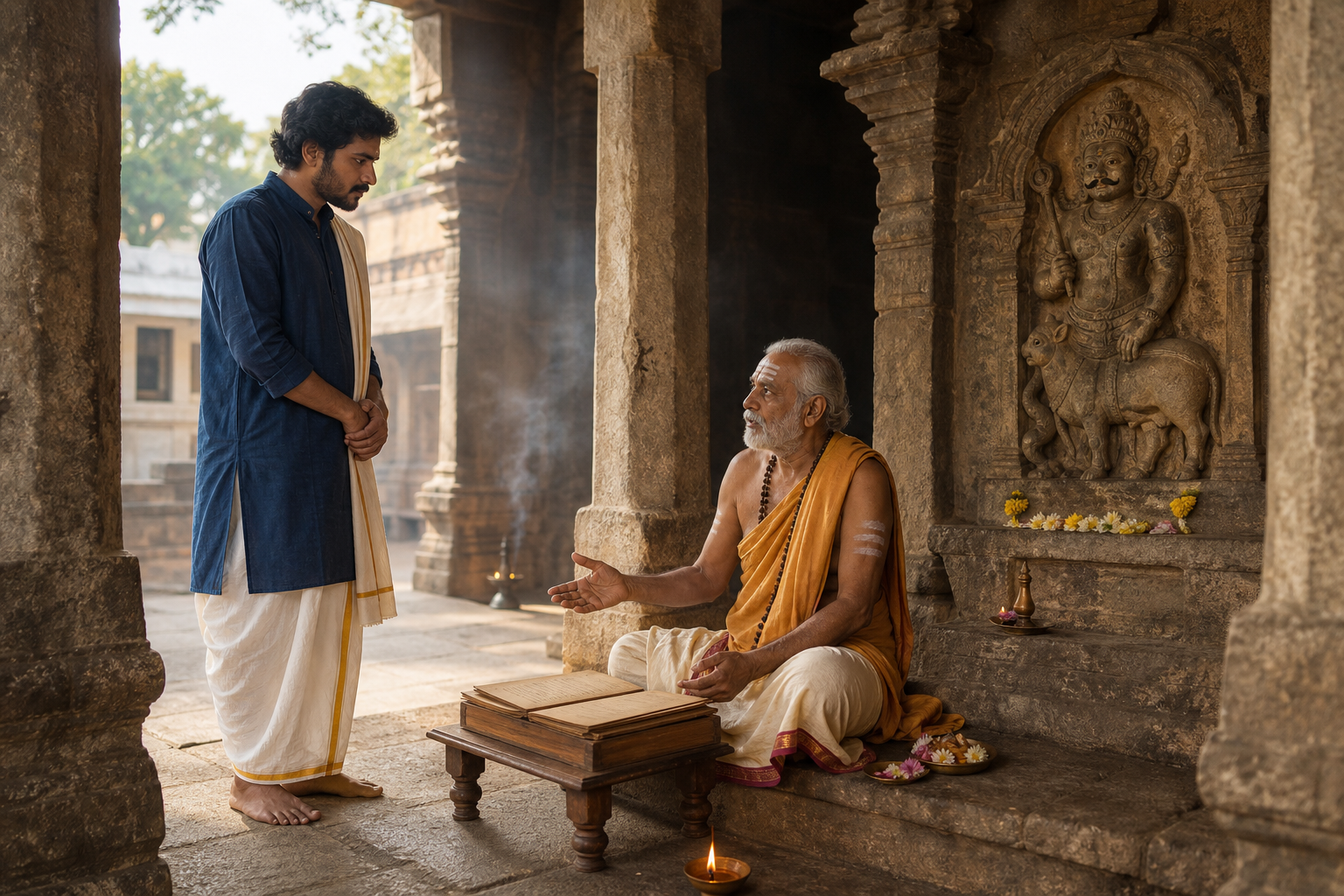
The most reliable starting point is to distinguish personal remembrance from a formally prescribed observance. A respectful act of devotion can be simple. A mantra practice, vrata, homa, or inherited household rite may carry requirements that cannot be reconstructed from a few disconnected instructions.
- Name your intention. Approach Yama to cultivate truthfulness, moral courage, remembrance of mortality, or willingness to correct a wrong. Do not begin with a promise that worship will make death disappear.
- Offer a simple namaskara. In a clean and quiet place, join your hands, bow, and address Yamadharmaraja respectfully. This is personal remembrance, not a claim that you are performing a complete traditional ritual.
- Pray in language you understand. A plain intention may be expressed as: Yamadharmaraja, let remembrance of death make my life truthful. Give me the courage to fulfill my duties and repair the harm I have caused. This is not presented as a scriptural mantra; it is an honest prayer in your own words.
- Connect devotion to one correction. Identify a neglected duty, false statement, unpaid obligation, or unresolved injury that lies within your power to address. Choose a concrete repair instead of making a vague promise to become better.
- Use qualified guidance for formal practice. If you want a Sanskrit mantra, vrata, fire offering, or festival procedure, ask a knowledgeable elder, purohit, or acharya within the relevant tradition. Confirm the sequence, pronunciation, offerings, and method of completion before beginning.
This approach avoids two opposite errors. The first is refusing any remembrance of Yama because his name feels frightening. The second is assembling a supposedly ancient rite from unrelated fragments. Where your family or regional tradition already preserves an observance, learn its internal logic before altering it. Where no such tradition is available, a sincere namaskara is more honest than fabricated ritual authority.
Material offerings should be handled with the same restraint. Customs can differ by temple, household, region, and occasion. A universal shopping list would conceal those differences. Ask what your actual tradition prescribes, why each item is used, and how it should be respectfully disposed of afterward.
Let Yama worship change conduct while life remains
The practical measure of this devotion is not how intensely you fear the end of life. It is whether remembrance of Yama removes an excuse you have been using to postpone dharma. A worshipper who asks for protection while knowingly continuing an injustice has missed the sharper lesson.
You can turn remembrance into a recurring examination of conduct:
- Choose one action you would find difficult to defend before an impartial judge.
- Name the duty or value you violated without disguising it as bad luck or someone else’s fault.
- Identify the person, relationship, or responsibility affected by the deed.
- Make the smallest complete repair now available: tell the truth, apologize without excuses, correct the record, restore what is owed, or fulfill the neglected duty.
- Add a practical safeguard so that repentance changes your next decision rather than merely changing your mood.
This examination should produce responsibility, not theatrical self-condemnation. Declaring yourself irredeemably bad can become another way to avoid the work of repair. Yama’s moral seriousness leaves no room for excuses, but it also directs attention to what you can still do while life and agency remain.
You will also understand Yama more clearly if you identify the kind of claim you are hearing before accepting it as universal Hindu doctrine.
| Type of claim | How to read it | What to do next |
|---|---|---|
| Yama receives an offering in a fire sacrifice | This concerns his standing within Vedic ritual order. | Learn the rite from a qualified ritual authority rather than improvising the offering. |
| A narrative describes Yama judging or punishing a person | Look for the deed, consequence, and moral instruction carried by the story. | Do not assume every narrative detail is a household ritual rule. |
| A family or region uses a particular offering or observance | Treat it as a living tradition with its own context. | Ask practitioners who inherited the custom before generalizing it to all Hindus. |
| A teacher interprets Yama psychologically or symbolically | Recognize this as an interpretation that may illuminate practice without exhausting the deity’s theological identity. | Keep symbolic insight distinct from claims about scripture, mantra, or formal ritual. |
This classification protects you from a common mistake: turning one valid layer of Hindu tradition into the only permissible layer. Vedic ritual status, devotional reverence, moral narrative, regional practice, and philosophical interpretation may illuminate one another, but they are not interchangeable.
Key takeaways for your next encounter with Yama
- Yama is a Vedic deva within sacred order, not a malevolent rival to it.
- His association with death should direct your attention toward accountability, not toward judging the karma of the dead.
- Personal worship can begin with a respectful namaskara, a plain-language prayer, and one concrete act of repair.
- Formal mantras, vratas, homas, and inherited observances should be learned within their actual ritual and sampradaya context.
- The soundest result of Yama worship is a life with fewer concealed wrongs, fewer postponed duties, and less dependence on the illusion that there will always be more time.
The next time Yama’s name produces discomfort, do not rush to suppress it. Pause, offer respect, and ask one immediate question: what does dharma require from you while you can still act? Then complete one honest repair before the question becomes abstract again.
References
