
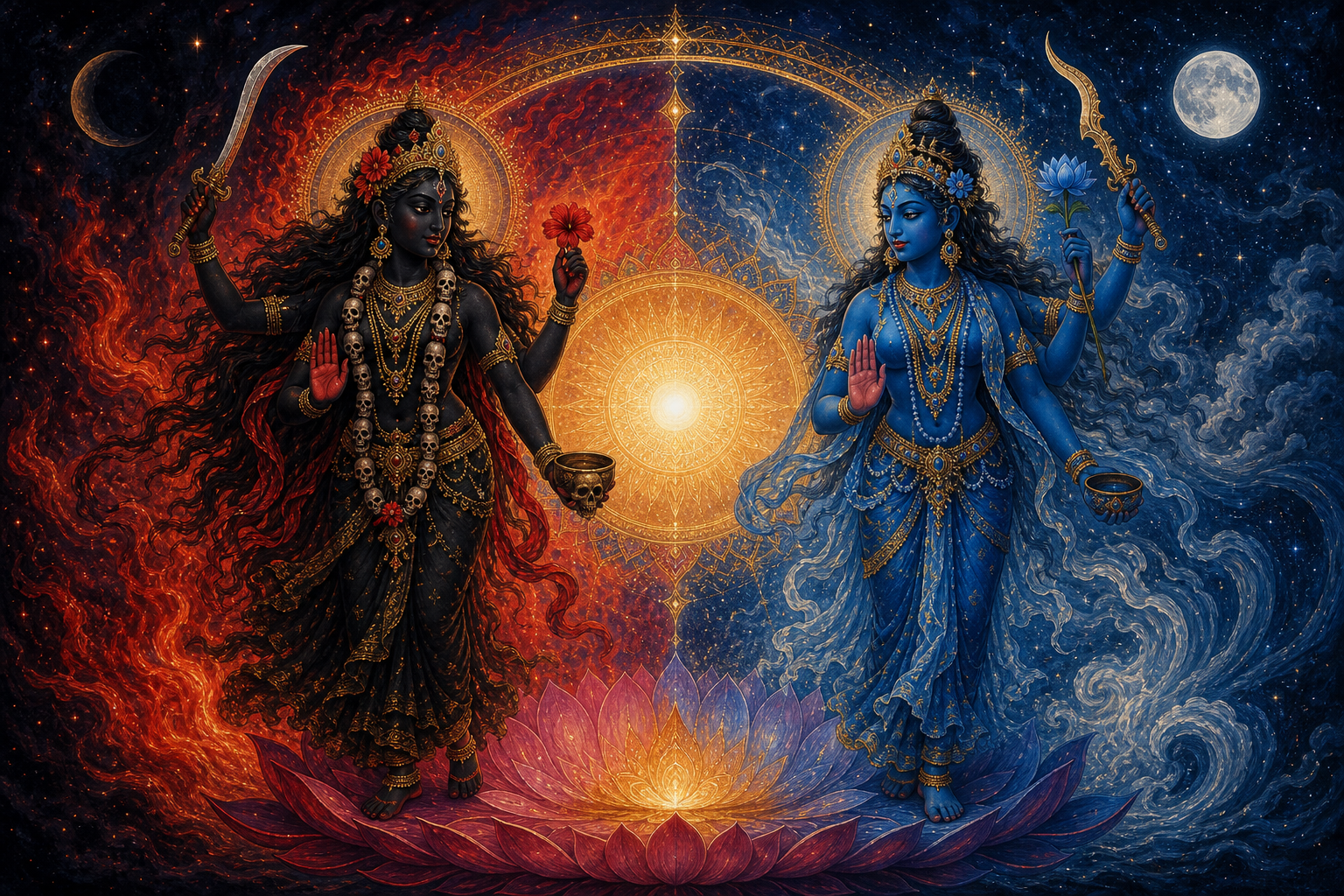
You may have arrived here after seeing Kali and Tara set against each other: Which Goddess is more powerful? Which one stands higher? If you use Mahavidya theology to answer, the contest dissolves. Neither is a lesser divinity waiting beneath the other.
The useful distinction is not greater versus smaller. It is ultimate identity versus manifest form. Keep those two levels clear, and you can understand the theology, commit to a chosen form, and discuss either Goddess without diminishing the other.
Supremacy is not a contest between two independent powers

Ordinary comparisons assume separate competitors. If one person comes first, another must come second. That logic fails when applied to Kali and Tara within the Mahavidya framework because the two are not treated as independent beings competing for possession of divine power.
Kali and Tara are both regarded as supreme, non-different manifestations of Adya Shakti, the primordial feminine power, and they stand as the first two among the Dasha Mahavidyas, the Ten Great Wisdom Goddesses. The explicit textual basis named for their non-difference includes the Tantraraja Tantra and Todala Tantra.
Here, calling both supreme is not careless language. Supremacy refers to their divine ground, not to two separate quantities of power. Kali does not own one portion of Adya Shakti while Tara owns another. Nor does one borrow divinity from the other. Each is a complete manifestation of the same primordial Shakti.
This gives you a quick test for any claim about their relative status. If an explanation makes one Goddess inherently dependent, partial, or metaphysically inferior, it needs school-specific evidence beyond their placement among the Mahavidyas. That conclusion cannot be extracted from the shared Mahavidya framework itself.
Non-different does not mean indistinguishable
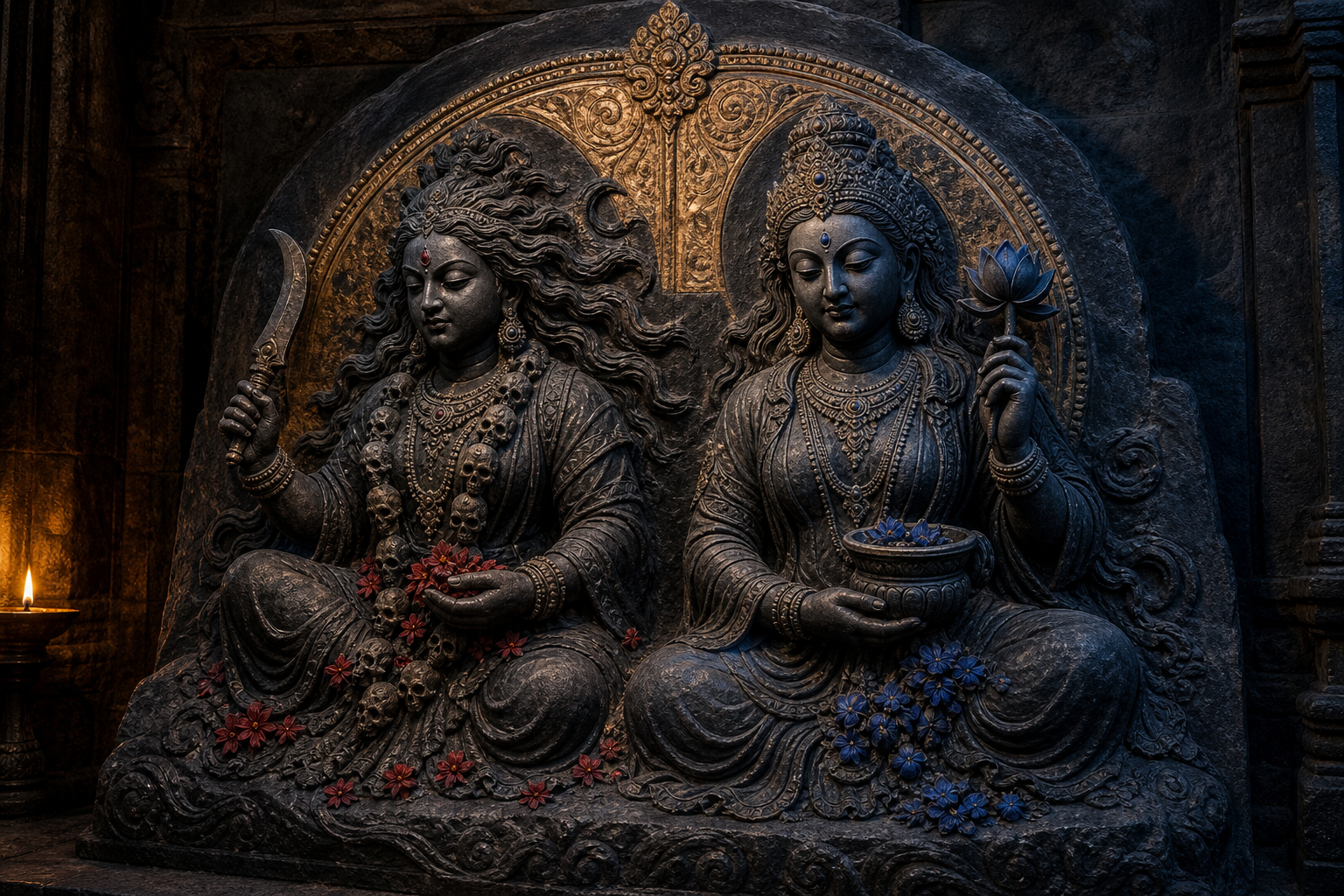
The opposite mistake is to hear that Kali and Tara are non-different and conclude that their names and forms do not matter. But unity at the level of Adya Shakti does not erase distinction at the level of manifestation and devotion. Kali remains Kali; Tara remains Tara. Otherwise, there would be no reason to preserve them as distinct Mahavidyas.
A precise formulation is: Kali and Tara are distinct as Mahavidya forms and non-different as Adya Shakti. The first half protects the integrity of each form. The second prevents their distinctions from becoming a rivalry between separate ultimate powers.
When you read a hymn, teaching, or devotional claim about either Goddess, ask which level is being discussed:
Is the claim about ultimate nature? Then the identity of both with Adya Shakti is decisive.
Is it about a particular name, form, or devotional relationship? Then their distinction remains meaningful.
Is one form being praised as supreme within worship? Do not automatically turn devotional praise into a universal declaration that the other form is inferior.
This distinction lets you take form seriously without dividing Shakti. It also avoids a common false choice: either every Goddess must be treated as interchangeable, or one must defeat the rest. Mahavidya theology requires neither conclusion.
First and second describe an order, not a league table

Kali is identified as the first Mahavidya and Tara as the second. It is tempting to turn that sequence into a ranking, but an ordinal position does not establish unequal divinity. In this case, the same theological frame that gives them those positions also regards both as supreme. The sequence therefore cannot, by itself, mean winner and runner-up.
Whenever you encounter a numbered presentation of the Mahavidyas, separate three different questions:
Does the number merely identify a place in the traditional sequence?
Does a particular tradition give one form special devotional emphasis?
Does the teaching actually assert that one manifestation possesses a lower ultimate status?
Only the third would establish a theological hierarchy, and it cannot be inferred merely from the words first and second. Numbering tells you where a form appears in an enumeration. It does not tell you how much of Adya Shakti that form contains.
This matters beyond terminology. Treating sequence as superiority turns a sacred arrangement of wisdom forms into a contest the theology does not require. When someone argues that Kali must be greater because she is first, or that Tara must surpass Kali for some other devotional reason, ask for the actual theological premise. A preferred form is not automatically a superior form.
Key takeaways
Within Mahavidya theology, neither Kali nor Tara is inherently greater; both are supreme manifestations of Adya Shakti.
Their ultimate non-difference does not make their names, forms, or devotional relationships meaningless.
Kali’s first position and Tara’s second position identify their sequence among the Ten Great Wisdom Goddesses; those numbers do not prove a hierarchy.
A claim of superiority should identify its theological framework instead of presenting a form-specific preference as the universal Mahavidya position.
You can worship one Goddess with complete commitment without describing the other as incomplete, dependent, or inferior.
Choose your devotional focus without manufacturing an inferior

The equality of Kali and Tara does not force you into identical devotion toward both. Theology answers what the forms ultimately are. Devotional life asks where your disciplined attention belongs. Those are related questions, but they are not the same decision.
If you are deciding which form to approach, use a concrete anchor: your sampradaya, guru, household tradition, temple practice, or the teaching you have actually received. That gives your devotion a coherent setting. An online argument over which Goddess is stronger does not.
You can also speak about your commitment more carefully. Say, “Kali is the form central to my worship,” rather than, “Tara is lower.” Say, “I follow a Tara-centered practice,” rather than, “Kali has less power.” The first statement describes a real devotional relationship. The second makes a universal theological claim that the Mahavidya framework does not support.
If a discussion becomes contentious, ask one clarifying question: Are we talking about personal devotion, a particular lineage’s emphasis, or the ultimate status of Kali and Tara in Mahavidya theology? That question usually exposes the category mistake. Deep commitment to one form does not require an insult to another manifestation of the same Adya Shakti.
Let your next step be specific. Identify the tradition that will guide your practice, give your chosen form undivided attention, and keep the theological language exact: distinct in manifestation, non-different in primordial Shakti.
References
