
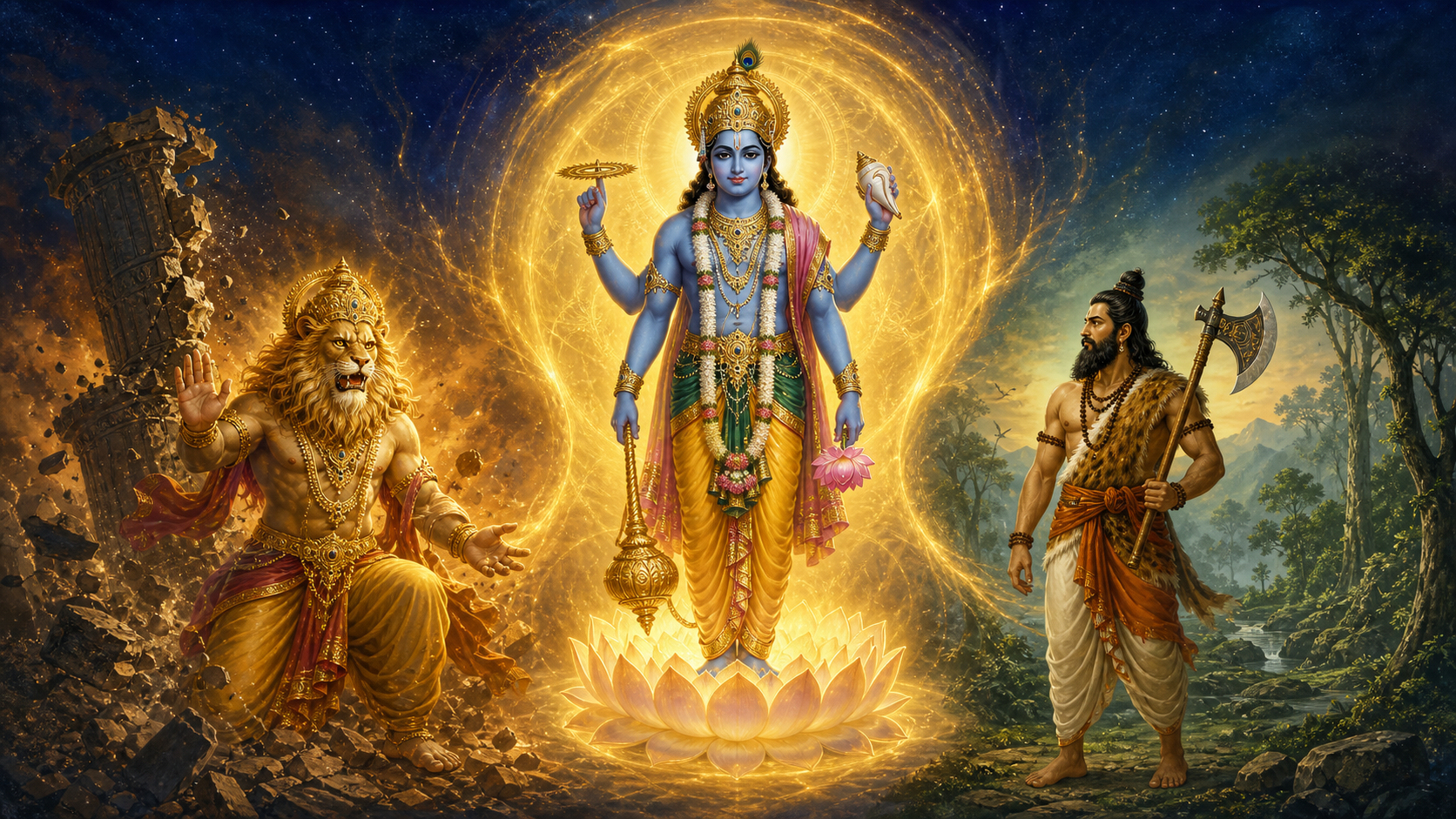
Have you ever wondered why Narasimha and Parashurama, both avatars of Vishnu, do not appear equally prominent in temple life? If the divine source is one, it can seem reasonable to expect every manifestation to have the same temperament, public presence, and mode of worship.
That expectation confuses identity with assignment. An avatar reveals the same divine reality through a role suited to a particular confrontation with adharma. Once you separate essence, function, devotional relationship, and historical reception, the differences stop looking like contradictions. They become a practical way to understand how dharma responds to different conditions.
Key takeaways
- Vishnu’s avatars can share one divine source without repeating one personality, form, or assignment.
- A difference in role is not a difference in divine worth.
- Temple prominence tells you about living devotional practice; it does not automatically establish a theological hierarchy.
- A forceful divine intervention is not a general permission for human anger, coercion, or retaliation.
- To understand an avatar, ask what disorder is confronted, what aspect of dharma is revealed, and what relationship the form offers the devotee.
One divine identity does not require one repeated form

Avatara is commonly understood as divine descent or manifestation. Within Vaishnava traditions, the idea allows Vishnu to become present in forms appropriate to different circumstances. Difference among those forms need not imply division within Vishnu.
Keep two questions separate. The identity question asks, “Who is this?” The role question asks, “Why this form, in this situation, acting in this manner?” Saying that two avatars are manifestations of Vishnu answers the first question. It does not erase the second.
This distinction matters because form carries meaning. If every avatar displayed the same mood, responded in the same way, and produced the same devotional relationship, the plurality of manifestations would communicate very little. Distinct forms allow worshippers to encounter divine protection, correction, discipline, sovereignty, instruction, or restoration without reducing all of these functions to one emotional register.
When an avatar seems unlike the form you know best, replace the question “Why is this avatar not more like my preferred form?” with “What becomes visible because this form is different?” That shift moves you from comparison to interpretation.
Narasimha and Parashurama reveal two kinds of difference
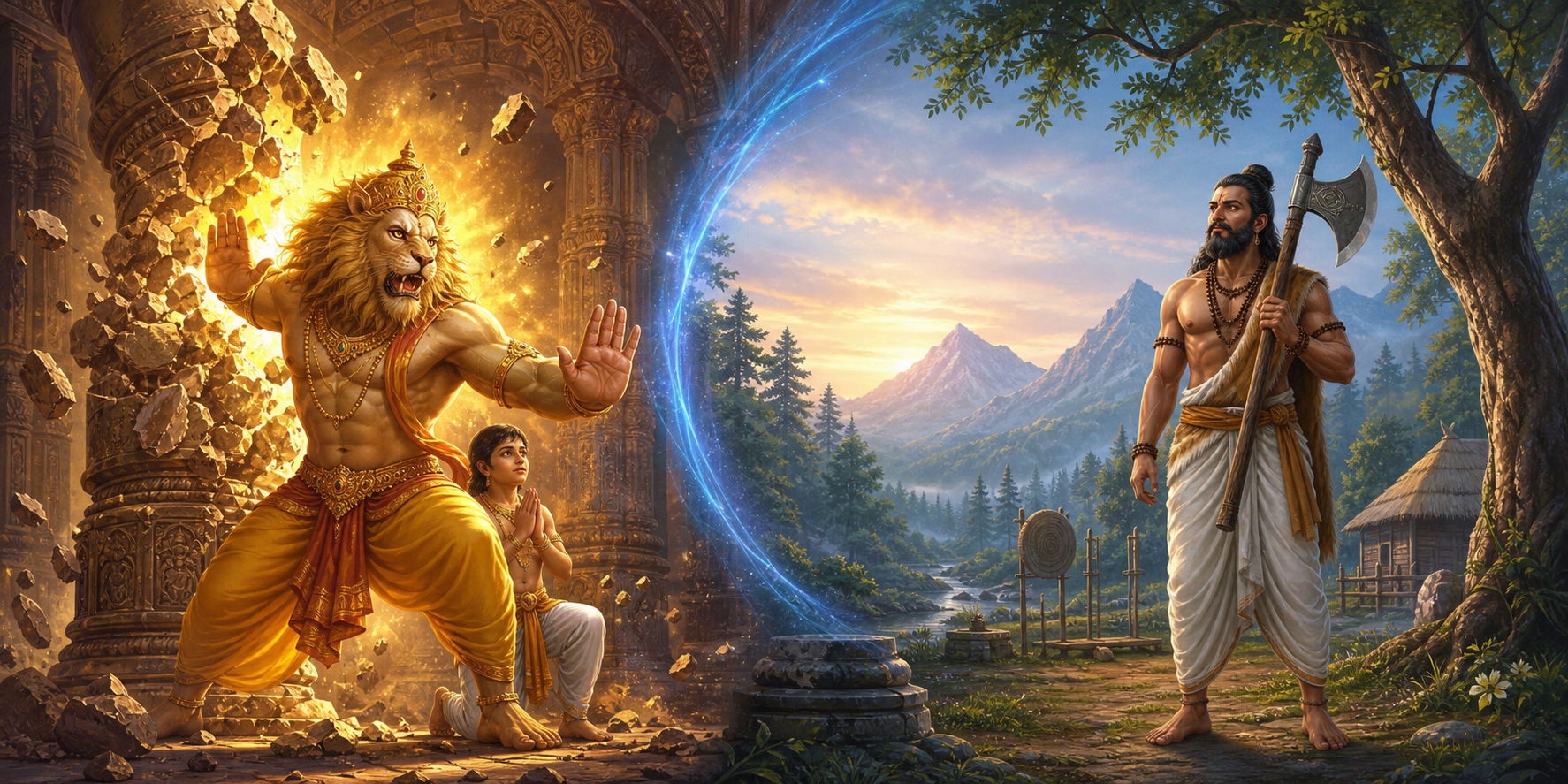
The contrast between Narasimha and Parashurama is especially useful. Both are recognised as avatars of Vishnu, yet Narasimha is widely worshipped as a powerful deity with many dedicated temples, while Parashurama has comparatively few. That is a genuine difference in public devotional presence. It is not evidence that one contains more divinity than the other.
Temple visibility is easy to mistake for theological rank because it is measurable in everyday experience. You can visit a shrine, observe regular worship, and see a community’s attachment to a form. A less visible avatar can therefore seem less important. But the observation and the conclusion belong to different categories.
- Divine identity concerns the relation of the avatar to Vishnu.
- Narrative role concerns the condition the manifestation addresses and the aspect of dharma made visible.
- Devotional relationship concerns how worshippers approach the form and what spiritual disposition that worship cultivates.
- Temple presence concerns the communities, institutions, and inherited practices that sustain public worship.
These dimensions can overlap, but they are not interchangeable. A strong temple presence may show that a particular form has become central to a community’s living worship. Fewer independent temples establish only a smaller institutional presence. They do not, by themselves, prove lesser sanctity, reduced authority, or an inferior place within the divine order.
Apply this rule whenever someone ranks avatars by popularity: identify what the evidence actually measures. Numbers of temples, frequency of household worship, prominence in a regional tradition, and theological status are four different claims. Do not move from one to another without justification.
Four distinctions that prevent common misreadings
Essence is not the same as expression
When devotees affirm that different avatars are manifestations of Vishnu, they are making a claim about divine identity. They are not saying that every manifestation must be visually or emotionally interchangeable.
Form is expressive. Mood is expressive. The manner in which an avatar is remembered and worshipped is expressive. Treat these differences as part of the teaching rather than as awkward details to be explained away. Ask what the form permits you to recognise about the demands of dharma in that setting.
Role is not rank
A role answers what a manifestation accomplishes within its sacred setting. Rank asks whether one manifestation is greater or lesser. The first question can illuminate the avatar. The second often imports a competition that the difference itself does not require.
You can honour a distinctive role without turning the avatars into rival claimants. In practice, say, “This form reveals this function,” rather than, “This form matters more because its function looks more dramatic.” Intensity, familiarity, and popularity are not reliable measures of metaphysical worth.
Divine intervention is not automatic permission for human imitation
Sacred narratives can include decisive and forceful responses to adharma. That does not give an individual a blank cheque to sanctify anger, cruelty, or personal retaliation. Divine action within a sacred role and ordinary human conduct under conditions of limited knowledge are not equivalent.
When you draw an ethical lesson from an avatar, look first for the principle being protected. Ask what was restored, what limit was placed on adharma, and what virtue a human being can responsibly practise. Do not assume that copying the outward intensity of an act reproduces its dharmic purpose.
A sampradaya’s teaching is not automatically a universal formula
Hindu traditions do not always organise, emphasise, or interpret every avatar in an identical way. A temple lineage may cultivate one devotional mood, while another community approaches the same form through a different theological emphasis.
Precision is a form of respect. Say “within this sampradaya” or “in this temple tradition” when that is what you mean. Before making a universal claim, check whether it belongs to a particular lineage, region, ritual practice, or commentary. This prevents a local truth from being inflated into an unsupported statement about all Hindus.
A practical method for approaching any avatar
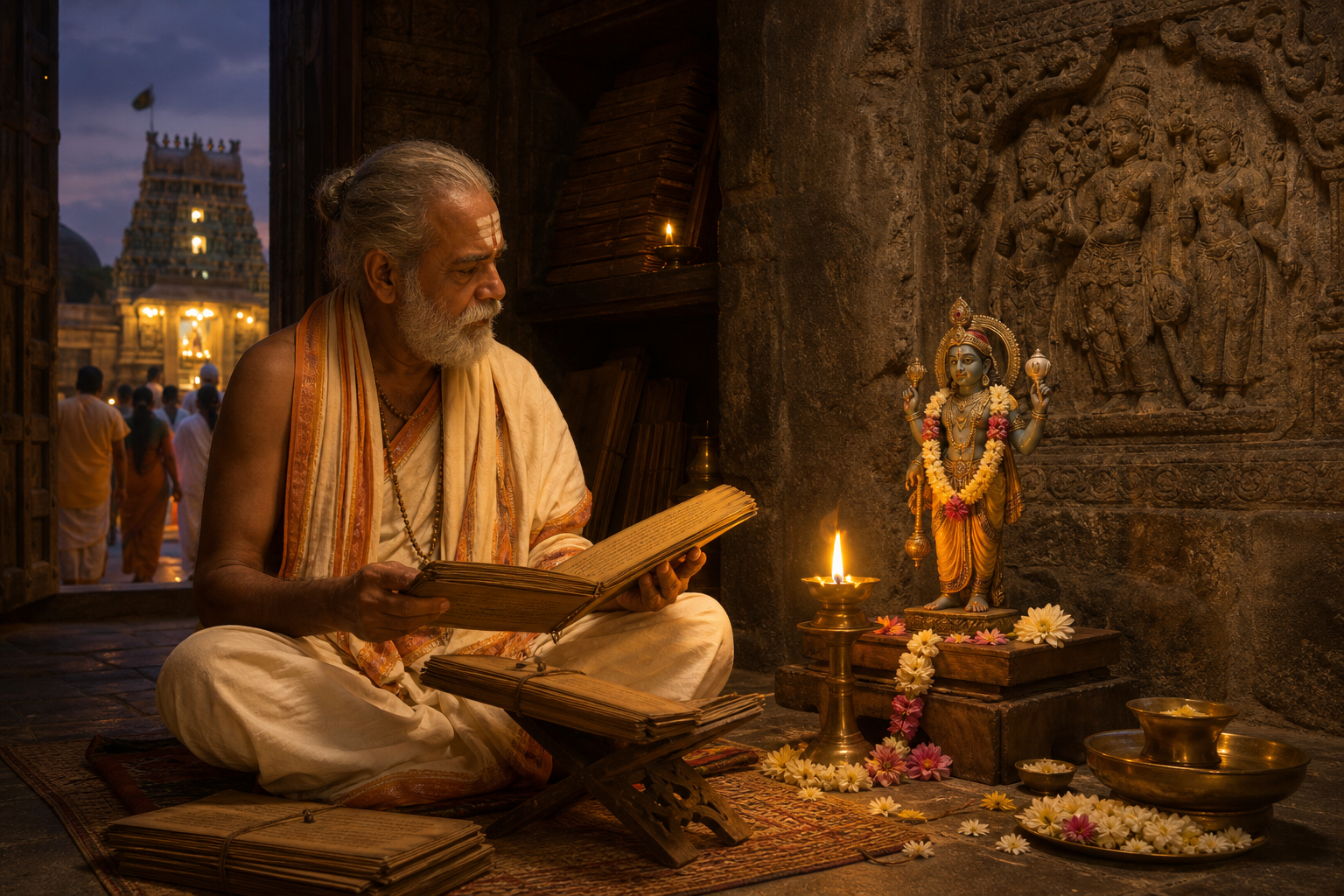
You do not need to resolve every theological question before approaching an avatar with reverence. You do need a disciplined way to separate what you see from what you assume. We would begin with the following sequence.
- Name the question you are actually asking. Is it about divine identity, the avatar’s role, iconography, personal worship, regional history, or temple prevalence? A clear category prevents a partial answer from being treated as a total one.
- Meet the form on its own terms. Notice the mood, posture, gestures, setting, and qualities emphasised in worship. Do not begin by measuring the form against another avatar.
- Locate the adharma being addressed. Ask what kind of disorder makes this manifestation meaningful. The answer may concern a sacred narrative, a devotional need, or both.
- Identify the dharmic response. Look beyond outward drama. Determine what is protected, corrected, taught, restrained, or restored.
- Separate observation from inference. “This avatar has fewer temples here” is an observation. “This avatar is less divine” is an inference, and the first statement does not establish the second.
- Consult the living tradition before adopting a practice. If your question concerns a mantra, vrata, initiation, or household ritual, seek guidance from a qualified teacher or priest within the sampradaya you intend to follow. Visual impressions alone cannot supply ritual authority.
Suppose your region has a prominent Narasimha temple but no independent Parashurama shrine. The warranted conclusion is that Narasimha has a stronger local temple presence. Stop there unless you have further evidence. Do not turn local visibility into claims that Parashurama is obsolete, less sacred, or less worthy of reverence.
If you are deciding how to direct your own worship, begin with any sound family or inherited tradition already available to you. Then consider the guidance of a living temple or teacher and the form toward which you can sustain reverence rather than momentary fascination. An ishta-devata relationship does not require contempt for other manifestations of Vishnu.
The plurality of avatars also gives you a demanding lesson about dharma: the right response must fit the disorder. Steadiness is not passivity, force is not automatically righteousness, and popularity is not proof. Discernment lies in recognising which principle is at stake and responding without turning personal impulse into divine authority.
The next time you encounter an unfamiliar avatar, complete one sentence: “In this form, Vishnu makes ______ visible so that ______ can be restored.” Then test your answer against the teaching and worship of the relevant sampradaya. That small discipline will take you further than ranking avatars by fame, appearance, or numbers of temples.
References
