
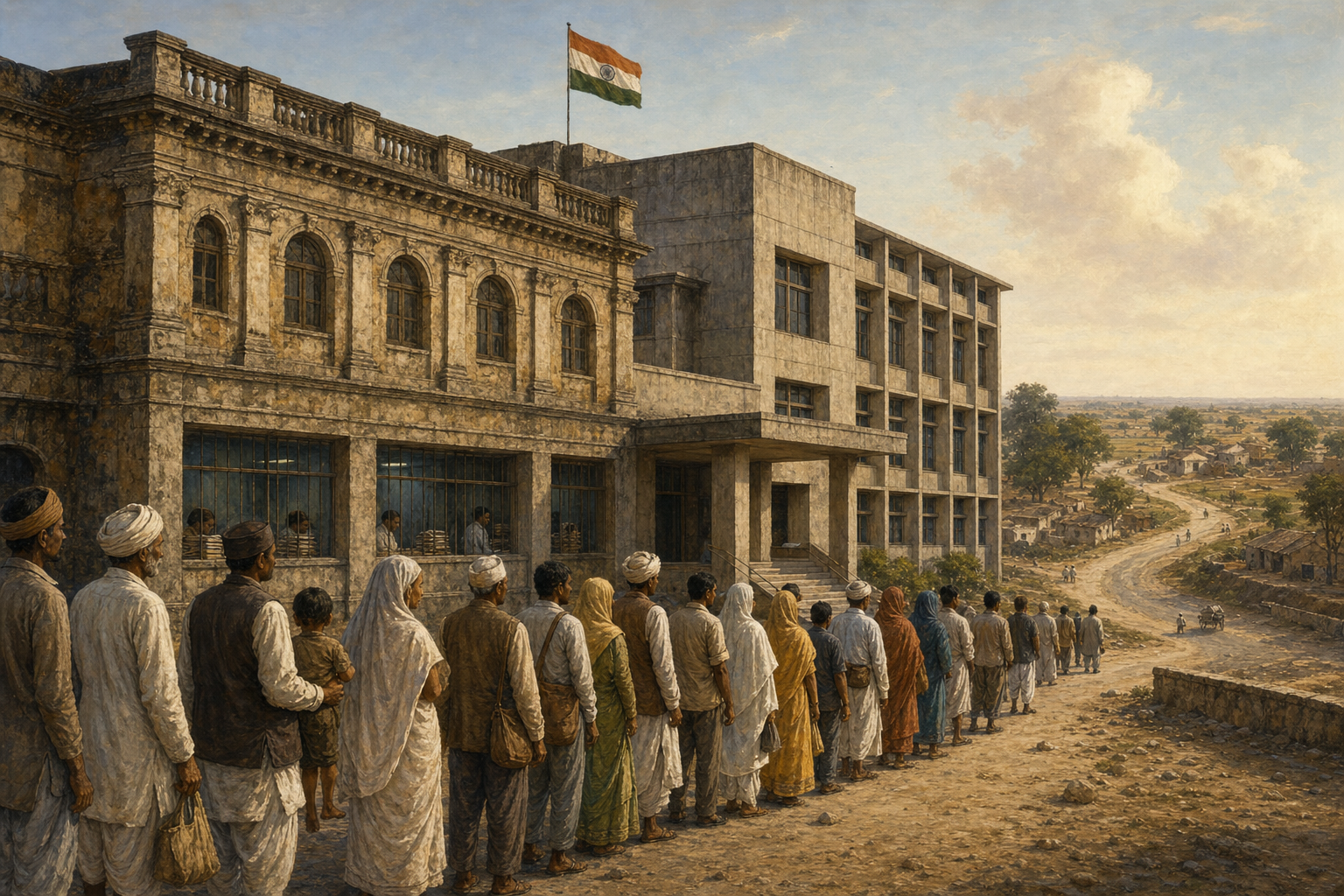
If you are trying to understand Uttar Pradesh’s administrative weakness after independence, the usual political debate offers two unsatisfying choices: blame the colonial inheritance for everything, or blame Congress for everything. You will get closer to the truth by asking a narrower question: which burdens were inherited, what power did the new government possess, and where did that power fail to produce an answerable administration?
This approach matters because intentions, integrity and institutional performance are different things. Congress entered government with the legitimacy of the freedom movement and the machinery of a modern state. Yet good intentions at the top could coexist with structures that remained distant from the people they were supposed to serve.
What Congress inherited, and what it was responsible for changing

At independence, Uttar Pradesh was the most populous state in the Indian Union. That scale made it more than another provincial administration. If representative government could improve life amid UP’s difficult conditions, it would validate a central promise of independent Bharat. If it could not, the resulting weaknesses would affect an enormous population and weigh on the Union as a whole.
The starting conditions were severe. The economy was overwhelmingly agrarian. Landed and feudal hierarchies shaped rural power. Literacy was limited across much of the peasantry. Infrastructure had suffered persistent under-investment. The state also inherited a colonial revenue administration oriented toward extracting wealth from the countryside.
These were not four unrelated disadvantages. They reinforced one another. Rural hierarchy made formal equality harder to realise. Limited literacy increased the cost of opaque rules and distant offices. Poor infrastructure restricted the reach of administration. A revenue-first bureaucracy was poorly suited to a democratic promise in which the villager was no longer merely governed, but was also a citizen to whom the state owed duties.
The colonial inheritance therefore belongs at the beginning of the explanation, not at its end. A new government cannot be blamed for the conditions awaiting it on its first day. It can be judged by whether it identified those conditions accurately, changed the machinery that reproduced them, and created a way to detect failure. Congress possessed unusual popular legitimacy, so inherited difficulty cannot by itself excuse an inadequate institutional response.
When you assess a claim about this period, keep four entries separate:
- Inherited condition: What social, economic or administrative burden already existed?
- Political choice: What did the government decide to preserve, replace or prioritise?
- Administrative conversion: Which office, rule, responsibility or correction mechanism turned that choice into practice?
- Experienced result: What changed for the person dealing with the state?
The first entry prevents anachronistic blame. The remaining three prevent colonial history from becoming a permanent alibi.
Four faultlines between political promise and state performance
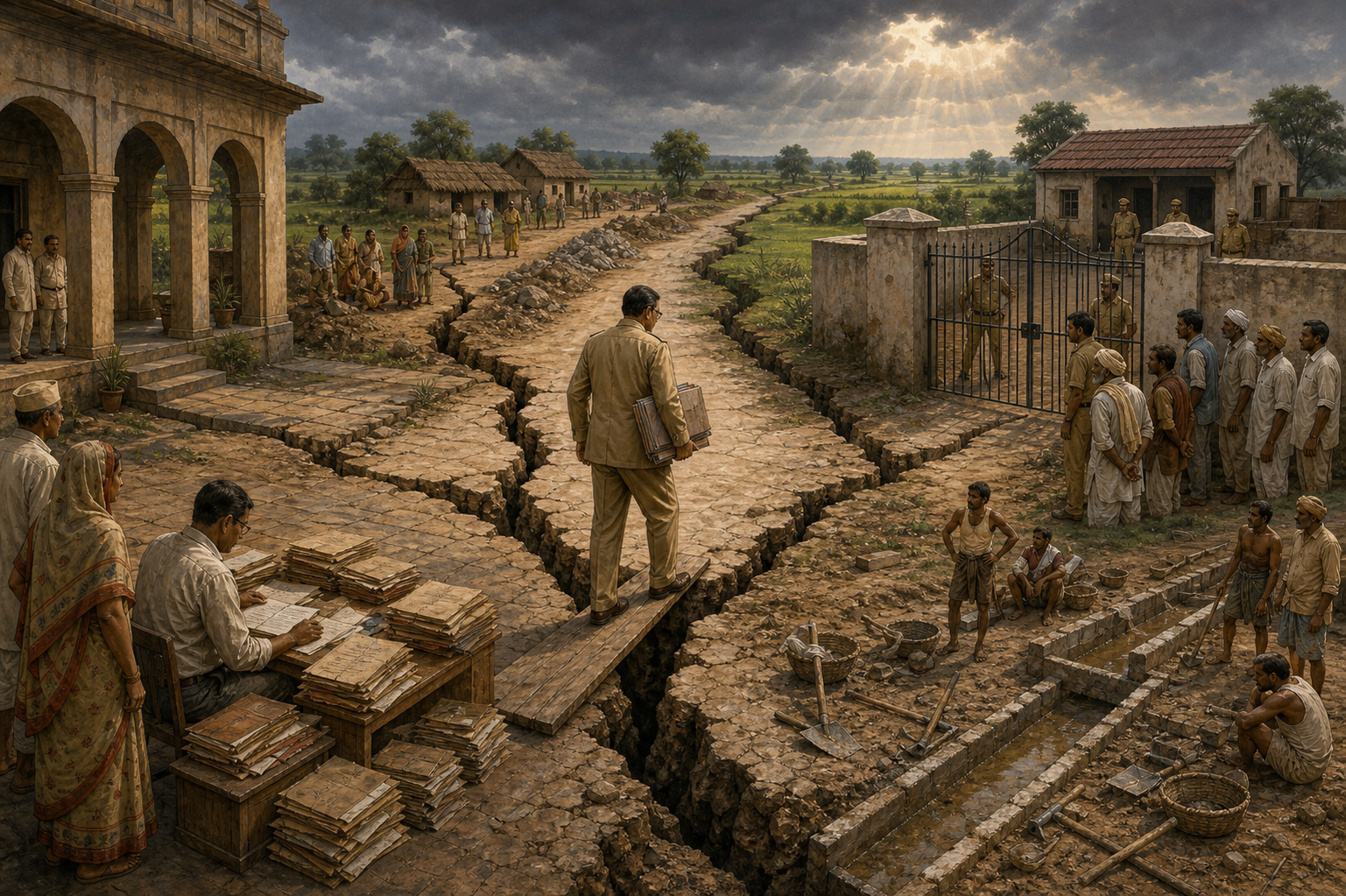
The central problem was not simply that Uttar Pradesh was poor or administratively difficult. The deeper problem lay in the joints between political authority, institutional design and local life. Four faultlines help you see it clearly.
- Legitimacy versus capability: The freedom movement gave Congress moral authority and public goodwill. Neither automatically supplied competent execution, clear responsibility or an effective way to correct an office that failed.
- National vision versus local fit: Industrialisation, scientific temper and a modern nation-state were large objectives. They did not, by themselves, explain how government should work within UP’s agrarian economy, social hierarchies or regional conditions.
- Democratic sovereignty versus colonial machinery: Indian leaders replaced colonial rulers, but a change in political sovereignty did not automatically change the habits, incentives or citizen-facing character of the inherited administration.
- Policy declaration versus institutional learning: A government may announce a worthy objective while lacking reliable feedback from the level where it is implemented. Without correction, a design error can survive behind the language of progress.
The sharpest criticism of Nehruvian statecraft is therefore not that modernisation was an illegitimate ambition. It is that a European model of the modern nation-state could be treated as sufficiently universal without enough engagement with caste, religion, region and other durable features of Bharatiya society. This remains an interpretation, not a mathematical proof. It should be tested by examining how institutions were adapted and how they behaved, rather than accepted merely because it fits a preferred political narrative.
You can test any administrative claim with four practical questions. Who had the authority to decide? Who was responsible for execution? Where could an affected person challenge a failure? What information travelled back to the decision-maker? If an account cannot answer those questions, it may identify a noble policy or a painful outcome, but it has not yet explained the machinery connecting them.
Why honest leaders could still preside over a failing system

Govind Ballabh Pant served as Uttar Pradesh’s first chief minister from 1946 to 1954, followed by Sampurnanand from 1954 to 1960. Both are presented as men of personal integrity. Yet the administrations of this founding period were already displaying structural weaknesses that would outlast individual officeholders.
That distinction is essential. If your explanation depends entirely on corrupt or malicious leaders, it cannot explain poor performance under personally upright leadership. An official can obey the rules while the rules assign responsibility badly. A minister can sincerely support reform while the chain of execution remains opaque. A chief minister can be honest while information reaching the top is late, filtered or too general to expose failure.
Personal virtue still matters. Integrity reduces one obvious form of abuse and can set expectations for subordinates. But integrity is not a substitute for administrative design. Rajya does not become capable merely because the person at its summit is respectable.
To determine whether a structural diagnosis is warranted in a particular case, look for evidence of four things:
- A defined duty: Was a broad political promise converted into a specific obligation for a named part of the administration?
- Answerability: Could responsibility be located when that obligation was not fulfilled, or could each level pass blame elsewhere?
- Ground-level feedback: Could local conditions alter implementation, or did information move only downward as instructions?
- Correction: Did repeated failure change the rule, allocation of authority or method of delivery?
These questions also prevent overstatement. The coexistence of honest leaders and administrative weakness makes a structural explanation plausible, but it does not establish every proposed mechanism. You still need to show where responsibility, feedback or correction broke down. A serious history names the institutional joint; a partisan history is satisfied with praise or accusation.
The Nehruvian contradiction appeared at the point of delivery
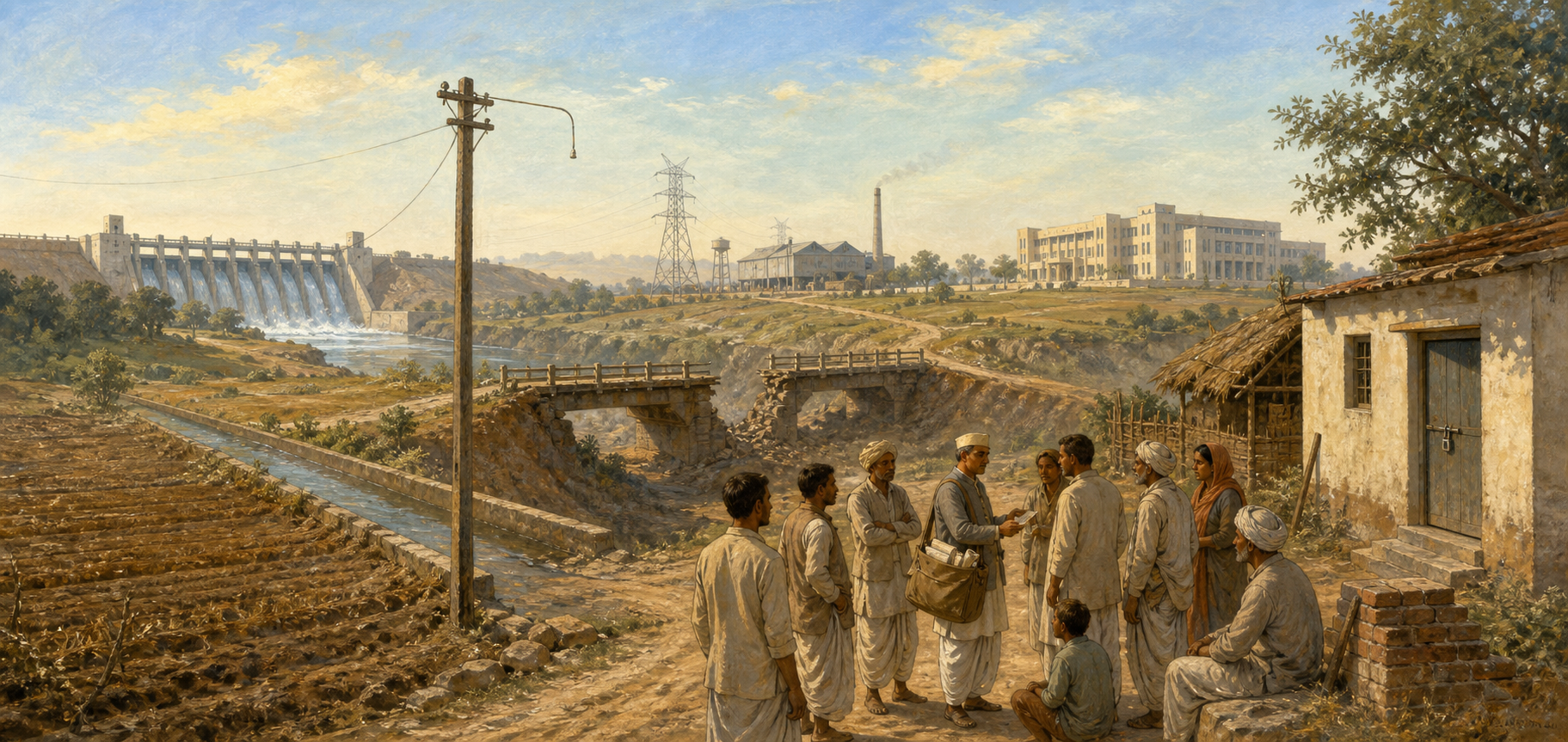
Nehru’s programme associated national development with industrialisation, scientific temper and construction of a modern state. Each ambition addressed a real dimension of national power. The contradiction appeared when an abstract national objective was treated as though it already contained an administrative method suitable for Uttar Pradesh.
| Aspiration | What it could address | What you must still verify |
|---|---|---|
| Industrialisation | Productive capacity and national development | Whether priorities fitted an overwhelmingly agrarian state and reached marginalised communities |
| Scientific temper | Reasoned inquiry and technical capability | Whether ground-level knowledge entered decisions and whether failed methods were corrected |
| Modern nation-state | Common institutions and equal citizenship | Whether inherited offices became accessible, answerable and responsive to local realities |
This is why inputs and outcomes must not be confused. Creating an institution is not the same as making it accessible. Announcing equality is not the same as neutralising a hierarchy at the point where a villager meets an official. Invoking science is not the same as building a system that detects and corrects its own errors.
A Dharmic reading sharpens this distinction through rajadharma. Authority is vindicated by duty discharged, protection provided and justice made real. Grandeur of intention cannot compensate indefinitely for failure at the point of service. Nor does a ruler cease to be responsible because the disorder was inherited. The duty is precisely to understand the inherited condition and act upon it without losing sight of the people who bear its cost.
We should also resist the inverse simplification that an institution is defective merely because its form came from Europe. The relevant question is adaptation. Did the institution recognise the society in which it operated? Did it preserve useful administrative capacity while discarding an extractive relationship with the population? Could local experience correct central assumptions? Origin may alert you to a problem of fit, but performance supplies the judgment.
Key takeaways: a test you can apply to political history
- Begin with the colonial and social inheritance, but do not let the inheritance erase the choices made after independence.
- Separate political legitimacy from administrative capability. Public trust can authorise a government; it cannot execute policy for it.
- Test national visions at the citizen-facing office. That is where equality, accessibility and accountability either become real or remain slogans.
- Do not use the integrity of a leader as proof that the system worked. Ask how duties were assigned, failures exposed and errors corrected.
- Treat caste, religion, region and agrarian structure as implementation realities, not inconveniences that an abstract model can simply declare obsolete.
- Demand a complete chain from inherited condition to political decision, administrative mechanism and experienced consequence.
The defensible conclusion is bounded but important. Early Congress governments confronted formidable structural conditions in Uttar Pradesh. They also possessed exceptional legitimacy and control of the state’s administrative instruments. The critical case against their governance is that these advantages did not produce an adequate transformation of the inherited machinery, allowing dysfunction to accumulate. That conclusion does not prove that Congress caused every later failure in UP, that every Nehruvian ambition was misguided, or that later governments bear no responsibility of their own.
When you next encounter a speech or essay invoking Nehru, Pant, colonialism or the Congress legacy, write down four headings: inheritance, decision, mechanism and consequence. If the argument can fill only the columns for praise and blame, it has told you very little. If it identifies who owed a duty, why delivery failed, how people could seek correction and whether the institution learned, you have an explanation worth taking seriously.
References
