

You may have encountered Kandalur Salai through one striking description: the “Takshashila of the South.” If you are trying to decide whether that label is history or exaggeration, the sound answer lies between easy dismissal and uncritical repetition.
Kandalur belongs in the history of higher learning in southern Bharat. The Takshashila comparison can help restore it to our civilizational map, but it cannot substitute for details about dates, teachers, curriculum, patronage, enrolment, or organisation. Read the comparison as a claim about importance, not as proof that two institutions were identical.
What the Takshashila comparison actually establishes
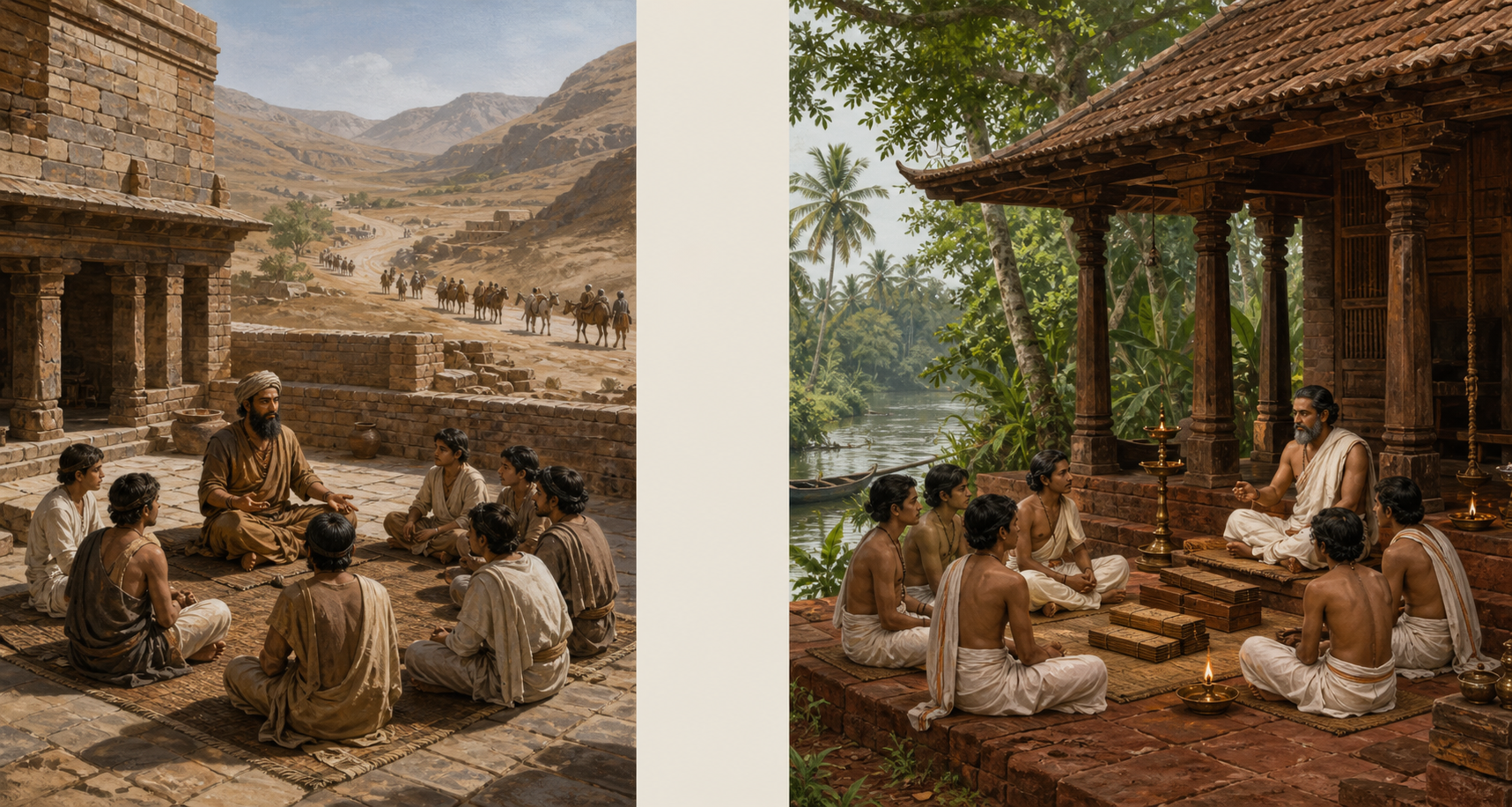
Historical analogies work by connecting something unfamiliar to something already recognised. Takshashila occupies a prominent place in public memory as a centre of advanced education. Calling Kandalur its southern counterpart therefore makes one useful claim: major centres of learning were not confined to northern Bharat.
The comparison becomes unreliable when it is treated as an institutional specification. Takshashila’s side of the analogy contains concrete claims, including admission limited to 500 students and instruction in law, Ayurveda, astrology, astronomy, and the sciences. Those particulars cannot simply be transferred to Kandalur. A comparison of stature does not establish a matching enrolment, syllabus, campus, administrative system, or historical period.
The responsible reading therefore has two layers:
- The historical claim: Kandalur was counted among centres of higher learning south of the Narmada, alongside Madurai, Kanchi, and Thanjavoor.
- The interpretive claim: “Takshashila of the South” presents Kandalur as an institution of exceptional regional importance.
- The limit: the interpretive claim does not prove that Kandalur reproduced Takshashila’s subjects, scale, methods, buildings, or admissions process.
This distinction lets you retain the civilizational significance of Kandalur without turning a memorable phrase into unsupported data. It is a smaller claim than institutional equivalence, but it is also a sturdier one.
Kerala’s educational history is a network, not a single-site story
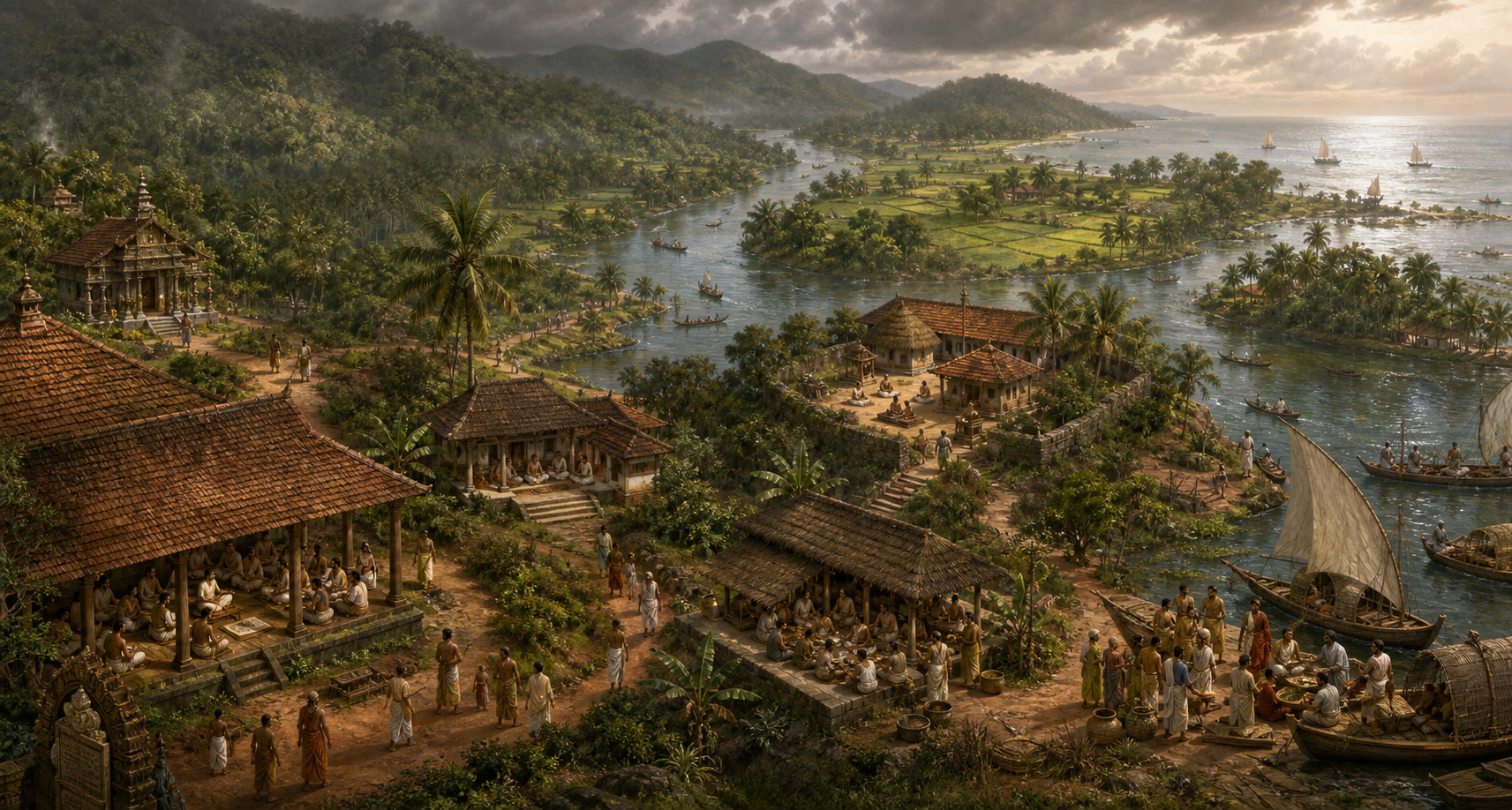
Kandalur becomes more intelligible when you stop treating it as an isolated wonder. The larger geography places centres of learning at several levels:
- Across Bharat, learning was associated with places such as Kasi, Videha, Panchalam, Rajagriha, Mithila, Ujjain, Kosala, and Kuru, as well as Takshashila.
- South of the Narmada, Madurai, Kanchi, Thanjavoor, and Kandalur formed another recognised constellation.
- Within Malabar, Thirunavaya on the Bharatapuzha, Trissur, Thrikkannamathilakam, and Kadavalloor were connected with mahabrahmanayogam settings in which education was imparted.
The practical implication is important. Kerala’s educational past should not be narrated as though knowledge suddenly arrived with the modern school, college, or colonial university. The named centres point to an older and more geographically distributed culture of learning.
They should not, however, be flattened into one standard model. A list of centres does not prove that every institution flourished at the same time, taught the same subjects, served the same communities, or operated under a common authority. “Network” is useful here as a way of seeing multiple locations on the intellectual map, not as a claim that they belonged to a single administered system.
If you are teaching this history, draw three nested maps rather than making a ranking. Begin with the all-Bharat landscape of learning, narrow it to the major southern centres, and then mark the Malabar locations. Students can then see Kandalur as both a regional institution and part of a wider Bharatiya educational world. That exercise corrects the map without requiring you to invent a league table of ancient universities.
Why the modern word “university” needs careful handling
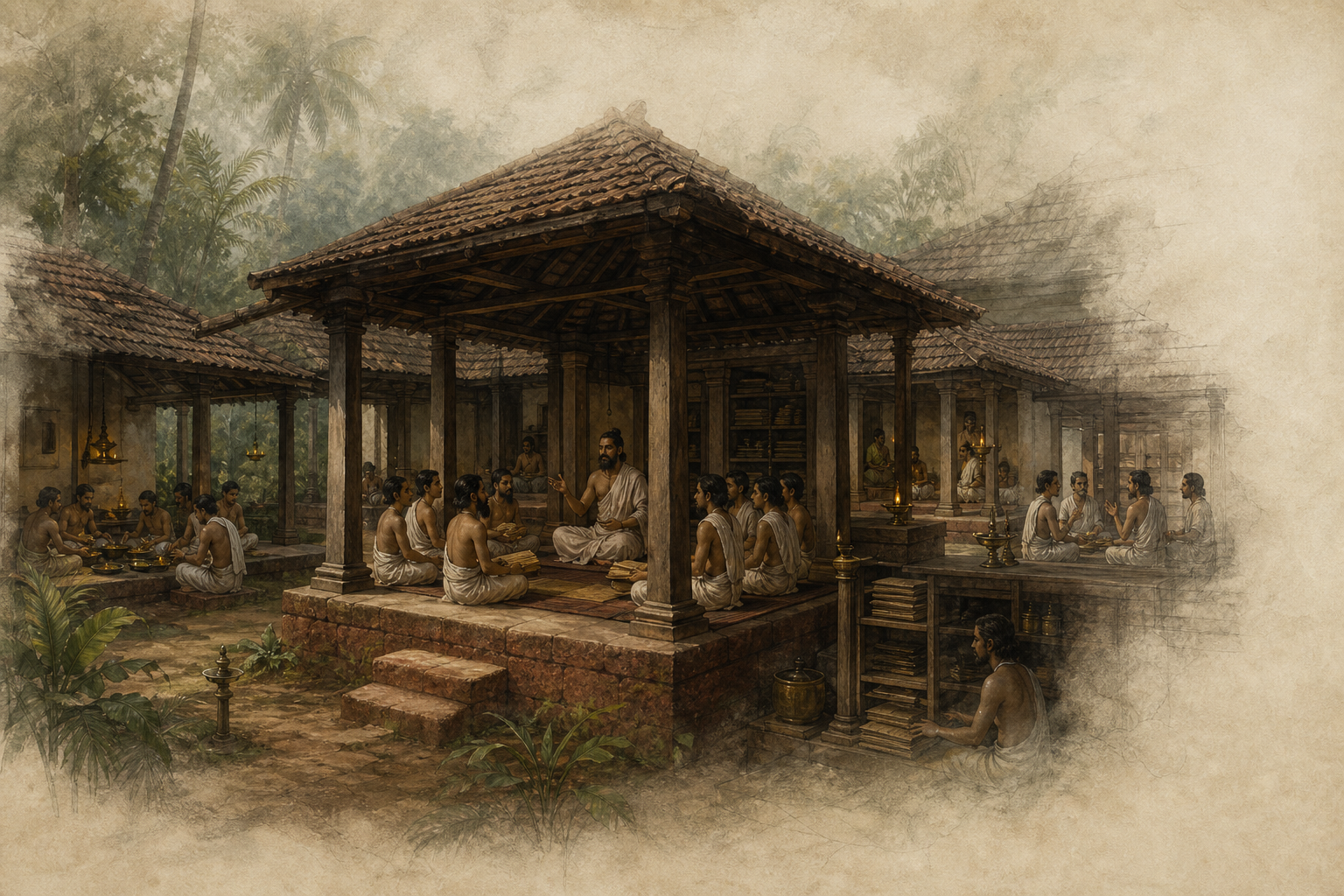
Calling Kandalur a university is understandable shorthand, but the modern word carries expectations that may not belong to a premodern institution. A present-day reader may imagine a legally chartered body, central administration, permanent departments, standard degrees, published admissions rules, and a bounded residential campus. None of those features follows automatically from the fact that a place was a centre of higher learning.
This does not make the older institution less serious. It means that educational importance should not be measured only by resemblance to today’s bureaucracy. A place can sustain advanced teaching, preserve knowledge, train scholars, and shape a region’s intellectual life without looking like a contemporary university.
When you encounter a strong claim about Kandalur, test it with three distinctions:
- Function versus form: Does the claim establish that advanced learning occurred, or does it also establish how the institution was organised?
- Evidence versus analogy: Does a specific detail come from evidence about Kandalur, or has it been borrowed from Takshashila because of the comparison?
- Regional importance versus exact equivalence: Does the label mean that Kandalur mattered greatly in the South, or is someone claiming that the two centres were identical?
Until the stronger questions are answered, “centre of higher learning” is the safer description. If you use “university,” explain that it is a modern comparative term rather than an assertion that Kandalur possessed every feature of a present-day university.
How to write or teach the Kandalur story responsibly
You do not need to weaken the history to make it credible. You need to keep each claim at the level supported by its evidence. A reliable presentation can be built in five steps:
- Begin with the grounded core. State that Kandalur is placed among centres of higher learning south of the Narmada, alongside Madurai, Kanchi, and Thanjavoor.
- Explain the analogy immediately. Say that “Takshashila of the South” communicates perceived stature; do not leave readers to assume identical institutions.
- Restore the Kerala context. Name the other Malabar learning locations so that Kandalur is not presented as a solitary exception.
- Mark what remains unestablished. Do not supply a founding date, student population, course list, degree structure, architectural plan, or named faculty unless you can attach evidence specifically about Kandalur.
- Make the evidence traceable. Link the factual claim, identify whether a detail comes from an inscription, archaeological report, literary record, or later historical reconstruction, and keep interpretation visibly separate from documentation.
A careful two-sentence formulation is: “Kandalur Salai holds an important place in accounts of higher learning in southern Bharat and belongs to a wider Malabar landscape of educational centres. The label ‘Takshashila of the South’ is best understood as a comparison of historical importance, not as proof that the two institutions had identical dates, curricula, scale, or organisation.”
That wording is suitable for a classroom introduction, heritage caption, social-media explanation, or opening paragraph. It gives the reader a meaningful conclusion while leaving room for further historical work.
Before accepting a more detailed version, ask five concrete questions: What is the proposed period? What evidence identifies the place as an educational institution? What does that evidence say was taught? Who maintained or patronised the institution? How was Kandalur connected to other centres in Malabar and southern Bharat? A claim that cannot answer one of these questions may still be plausible, but it should be labelled as an inference rather than repeated as a settled fact.
This standard matters especially for Dharmic history. Replacing an old omission with a new exaggeration leaves the history vulnerable. A precise claim, clearly linked to evidence and honest about its limits, is much harder to dismiss.
Key takeaways
- Kandalur belongs on the map of higher learning in southern Bharat, not outside the history of Indian education.
- “Takshashila of the South” is most defensible as an analogy of importance, not a claim of identical curriculum, scale, chronology, or administration.
- Kerala’s older educational landscape included several Malabar locations, so Kandalur should be read as part of a regional culture of learning.
- The word “university” needs a definition when applied to a premodern institution; “centre of higher learning” makes fewer unsupported assumptions.
- Dates, enrolment figures, subjects, buildings, teachers, and patronage must be established for Kandalur itself rather than copied from a better-known institution.
- A pro-Dharmic account becomes stronger, not weaker, when it separates documented fact from civilizational interpretation.
The next time you see Kandalur reduced to a slogan, add one sentence of scope and place it on the larger Malabar map. That small act turns a memorable comparison into responsible historical understanding, and it gives you a firmer foundation from which to recover Kerala’s educational inheritance.
References
