
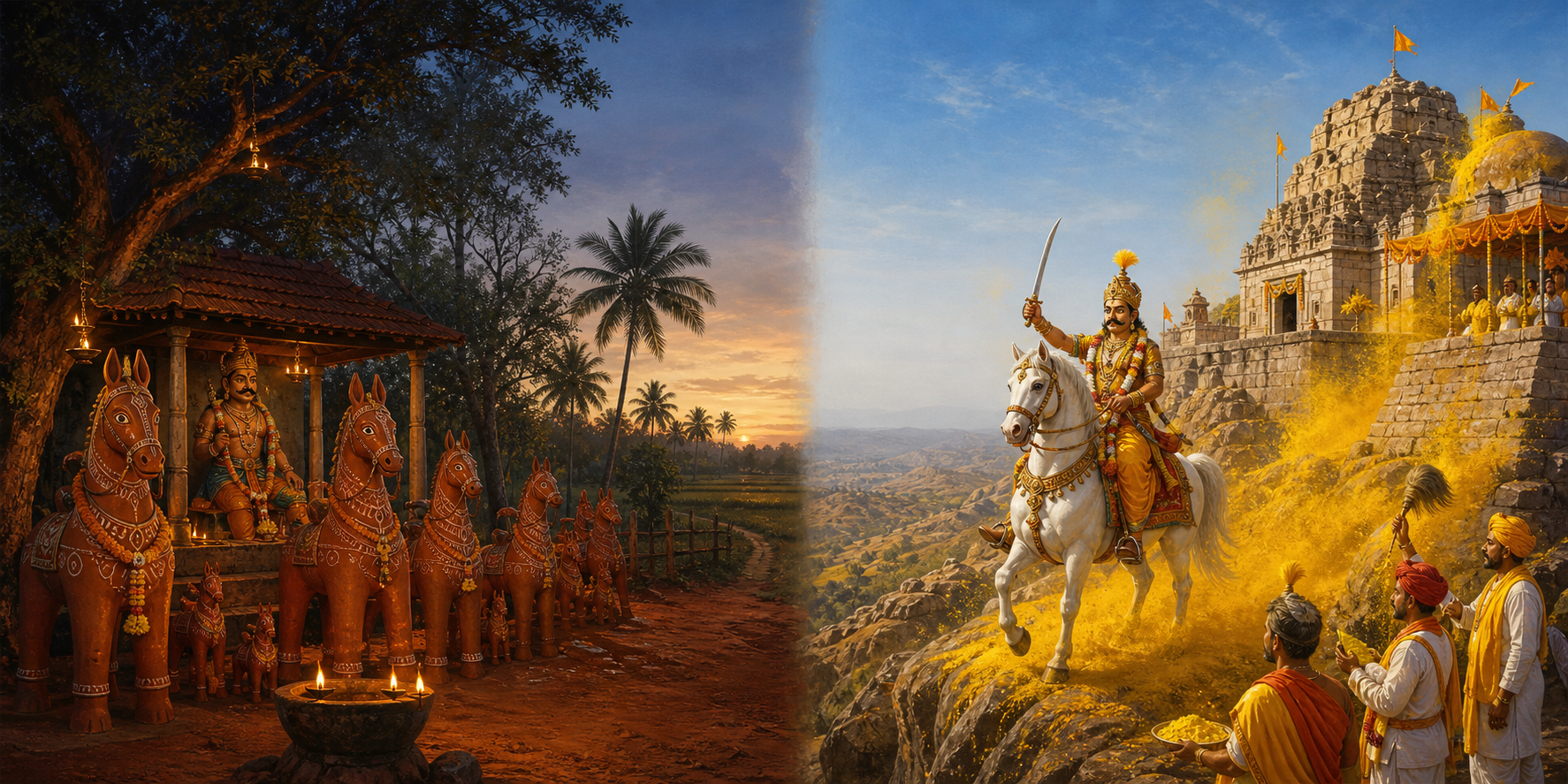
You may have seen two striking images from different parts of Bharat: a guardian associated with horses in a Tamil village, and a mounted warrior covered in the yellow of turmeric in the Deccan. The resemblance raises a reasonable question. Are Ayyanar and Khandoba regional names for the same deity?
The careful answer is no. They share the role of warrior-protector, but role is not identity. If you learn to compare their sacred geography, theology, imagery, and relationship with local communities, you can recognize a deep Dharmic pattern without erasing either tradition.
The useful comparison begins with role, not identity
Ayyanar belongs primarily to the Tamil sacred landscape. He is commonly encountered as a guardian of a village and its limits, with shrines often placed near the settlement’s edge, a grove, a road, or land understood as a threshold. His presence declares that the inhabited community is not spiritually unguarded.
Khandoba belongs to the wider Deccan, especially Maharashtra and northern Karnataka. He is commonly understood as a regional manifestation of Shiva, yet his identity is not exhausted by that theological statement. He is approached as a mounted warrior, ruler, family deity, and protector whose worship joins temple pilgrimage with the lives of pastoral, agricultural, and other local communities.
This is the first distinction you should retain: Ayyanar’s identity is anchored in the protective life of Tamil villages, while Khandoba’s identity combines regional guardianship with an explicit Shaiva frame and a broader pilgrimage world. Their similarity lies in the work of protection, not in a claim that one is merely the translated name of the other.
That distinction matters because Hindu unity does not require uniformity. A deity can participate in a recognizable Dharmic pattern while retaining a particular name, history, sacred landscape, ritual language, and community of devotees. Comparison is fruitful when it reveals that pattern. It becomes careless when it converts resemblance into sameness.
They share a Dharmic grammar of protection
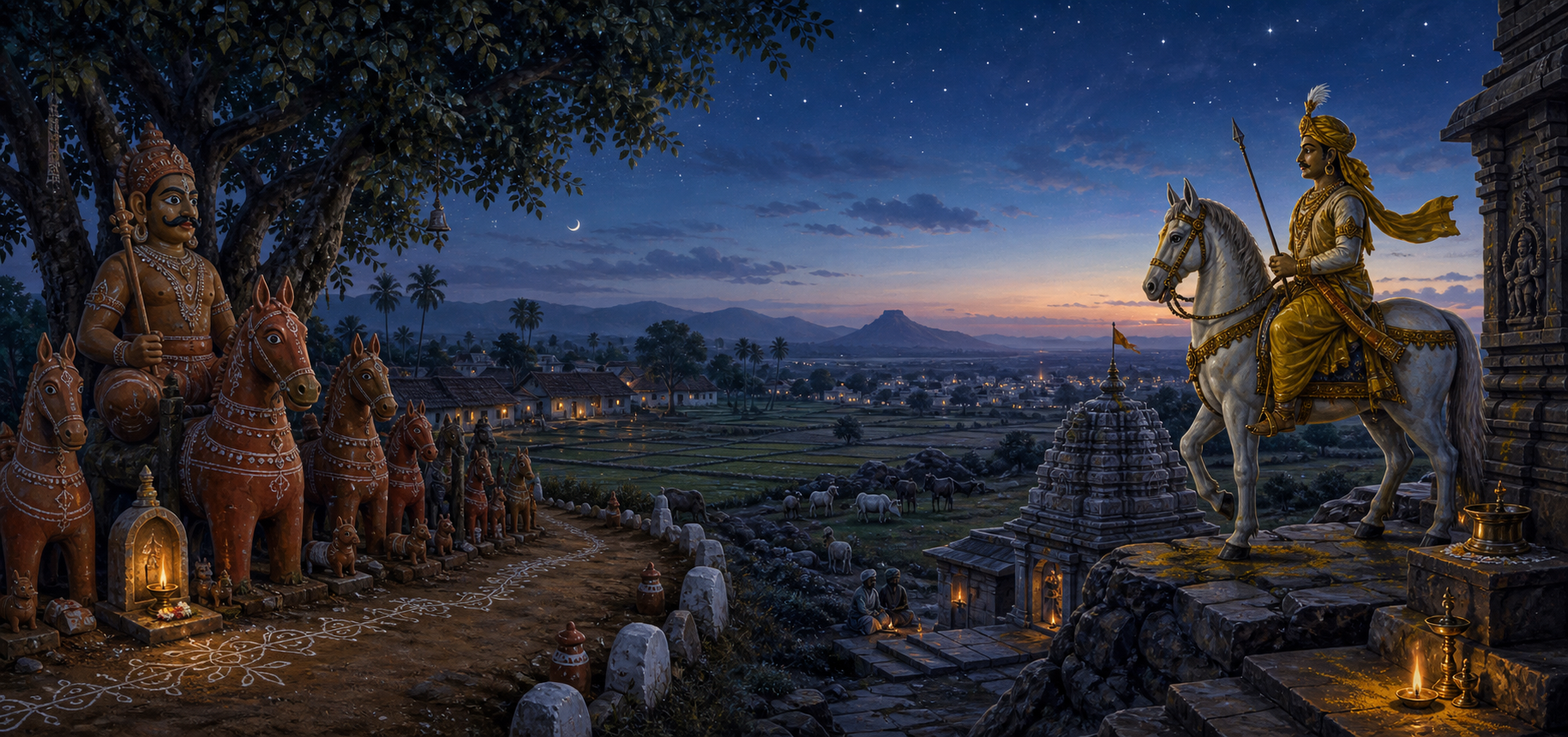
Neither deity presents protection as a distant abstraction. Protection appears in a form that a community can locate: at a shrine, on a route, near a boundary, in a temple, or within the obligations of family and village life. The divine is not confined to a remote cosmic realm. It stands where order can be disturbed and where people must repeatedly restore it.
The warrior imagery should therefore be read as more than aggression. A weapon can signify the authority to restrain disorder. A horse can signify speed, reach, vigilance, and the ability to move across territory. A commanding posture makes guardianship visible. These signs tell the devotee that dharma must be defended in the lived world, not admired only as an idea.
The boundary under protection is also more than a line on a map. It may separate cultivated land from wilderness, settlement from road, ordinary space from a sacred precinct, or social order from forces understood to threaten it. A guardian at that threshold gives religious form to a practical truth: communities endure when somebody remains responsible for their limits.
When you encounter either tradition, look for three connected layers:
- Sacred territory: Notice where the deity is placed and what area that placement appears to guard.
- Visible readiness: Look at the mount, weapons, posture, attendants, and direction of the image rather than treating the figure as isolated sculpture.
- Community obligation: Ask who maintains the shrine, returns for vows or festivals, and regards the deity as a protector. A guardian’s meaning is carried by this continuing relationship.
This three-layer reading keeps you from reducing Ayyanar or Khandoba to a museum label. Their images make sense within a living network of land, memory, duty, offering, and belonging.
Where the resemblance ends
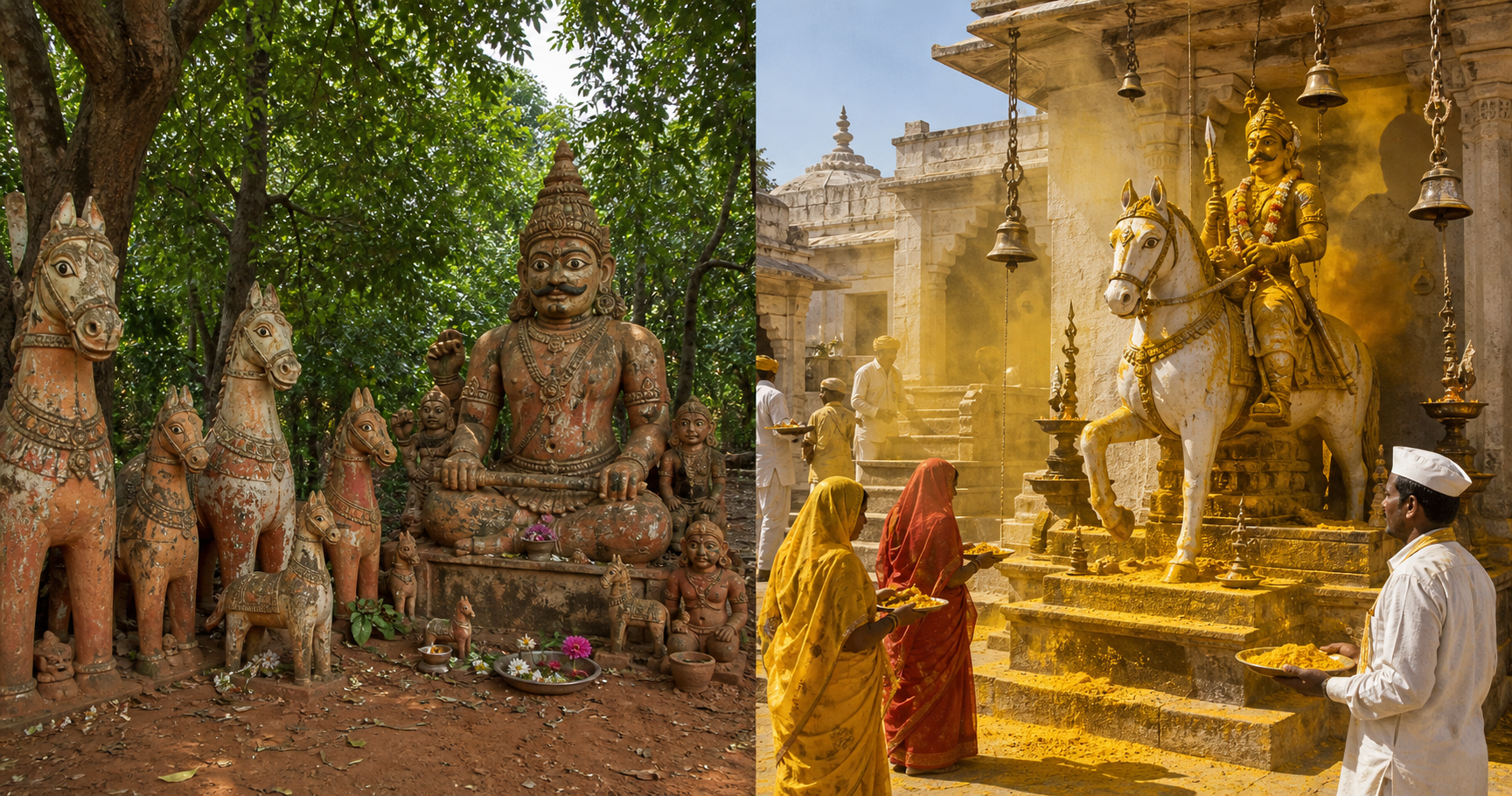
The clearest way to avoid a false equivalence is to compare the same dimensions on both sides. The table below gives you a practical field guide.
| Dimension | Ayyanar | Khandoba | What you should notice |
|---|---|---|---|
| Sacred region | The Tamil country and its village landscapes | The Deccan, especially Maharashtra and northern Karnataka | Begin with place. Regional setting is part of the deity’s identity, not incidental background. |
| Theological frame | A distinct village guardian whose stories, associations, and ritual forms can vary locally | Commonly revered as a regional warrior manifestation of Shiva | Do not infer identical theology merely because both deities perform protective work. |
| Typical sacred setting | Often associated with village margins, groves, roads, and territorial thresholds | Worshipped in local shrines as well as major public temples and pilgrimage centres | Ask whether the shrine primarily marks a local boundary or participates in a wider pilgrimage network. |
| Horse symbolism | Horses, including conspicuous terracotta horses, belong prominently to his guardian landscape | The mounted warrior is a central expression of martial authority and mobility | The horse is a shared symbol, but its material and ritual setting is not interchangeable. |
| Distinctive material language | Terracotta figures and votive horses can make the protected landscape itself visually legible | Turmeric, often called bhandara in this devotional setting, gives worship a recognizable yellow visual language | Read materials as part of worship. Do not treat clay or turmeric as decoration detached from local practice. |
| Social reach | Closely bound to the collective life and memory of particular villages | Connected with multiple communities across a larger regional devotional world | Find out who says “our deity” and what kind of belonging that phrase expresses. |
| Common misreading | Reducing him to a generic version of another mounted guardian | Calling him only Shiva and overlooking the distinct Deccani tradition | Preserve both levels: the wider Dharmic family and the deity’s irreducibly local form. |
The most important row is the theological one. Khandoba’s Shaiva identity is a central part of how devotees understand him. Ayyanar should not be forced into that same formula simply to produce a neat match. Local accounts of Ayyanar can connect him with wider Hindu divine worlds, but those connections do not cancel his particular standing as a Tamil guardian.
The same discipline applies in reverse. Calling Khandoba “just a village god” misses his wider regional reach, established temples, pilgrimage traditions, and conscious identification with Shiva. Calling him “just Shiva” misses the form in which people actually meet him: mounted, martial, regional, and woven into the histories of particular communities.
How to approach a shrine without flattening its tradition
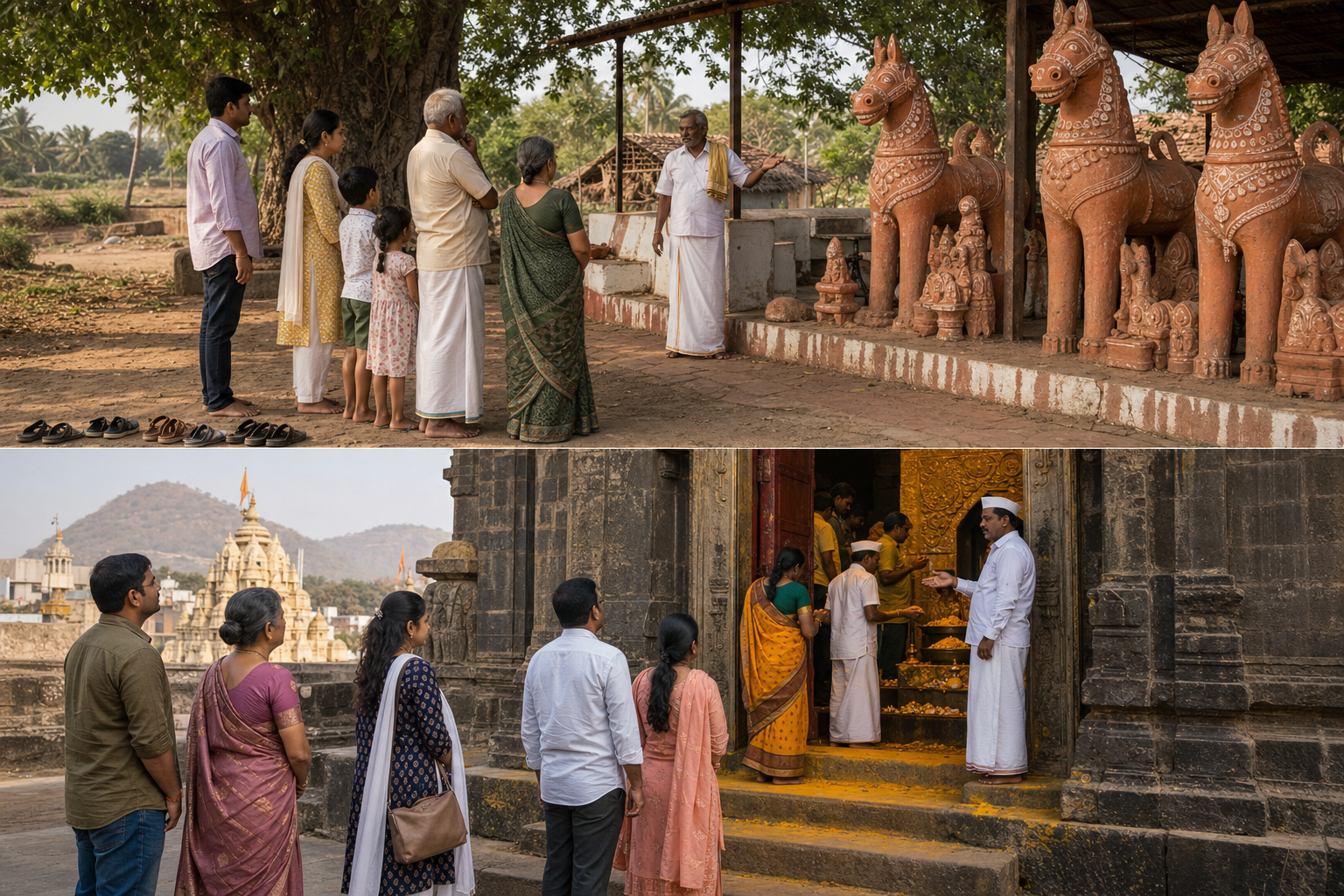
If you are visiting, photographing, teaching, or writing about either deity, a little discipline changes what you will notice. Use this sequence before making any claim about equivalence.
- Name the place first. Record the village, district, and region before interpreting the image. A guardian deity’s location often explains more than a generic iconographic label.
- Ask for the exact local name. Do not supply a name because a horse, sword, moustache, or warrior posture looks familiar. Ask a priest, caretaker, or devotee how the deity is addressed there.
- Study the whole sacred setting. Look at the shrine’s position, associated figures, animals, votive objects, pathways, and surrounding land. Do not identify attendants or companion figures unless local knowledge supports the identification.
- Separate function from identity. Write two different notes: “What does this deity do here?” and “Who do devotees say this deity is?” The first answer may resemble another tradition even when the second does not.
- Observe ritual before participating. Do not touch terracotta figures, move offerings, apply turmeric, enter a restricted area, or stage a photograph without permission. Local custom determines what is appropriate at that shrine.
- Ask who sustains the relationship. Find out whether worship is organized by a village, family, occupational community, temple institution, or a combination of these. The answer reveals the social scale of the deity’s protection.
This method is especially useful when images circulate online without context. A photograph may show a horse and weapon but omit the shrine’s name, location, ritual community, and theological account. Until those elements are known, “warrior guardian” is a reasonable visual description; “Ayyanar,” “Khandoba,” or “the same deity” may not be.
You should also resist the habit of ranking local worship below supposedly more philosophical Hinduism. The guardian at a village edge expresses a serious vision of sacred order. Dharma has cosmic dimensions, but it is tested where people cultivate land, travel roads, maintain relationships, honour vows, and confront disorder. Local protection is one way transcendence becomes responsibility.
Key takeaways
- Ayyanar and Khandoba are distinct deities, not two interchangeable regional names.
- Their strongest similarity is functional: both make divine protection visible through warrior and equine imagery.
- Ayyanar is rooted principally in Tamil village guardianship; Khandoba belongs to the Deccan and is commonly understood as a manifestation of Shiva.
- Terracotta horses are a prominent part of Ayyanar’s sacred landscape, while the mounted warrior and turmeric are especially recognizable in Khandoba worship.
- The right comparison preserves both Dharmic continuity and regional particularity.
- When identifying a shrine, trust local name, place, ritual, and community memory more than visual resemblance alone.
The next time you encounter one of these guardians, begin with a simple pair of questions: “What is being protected here?” and “Who do devotees say the protector is?” Keep the answers separate long enough to hear the local tradition clearly. That is how you will see the unity of Dharma without turning its living diversity into sameness.
References
