
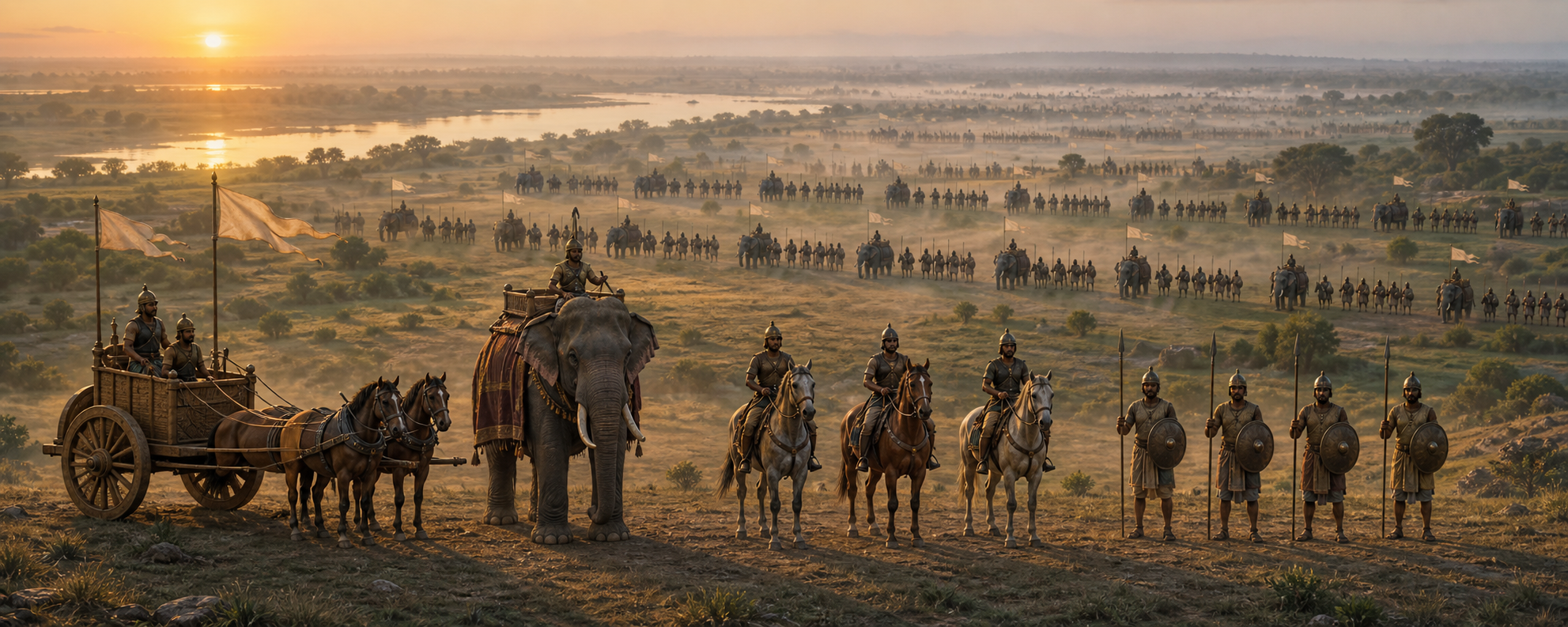
If you have encountered the word Akshauhini and wondered how the Mahabharata turns it into an army, do not begin with a spectacular total. Begin with the categories being counted. Chariots, elephants, horses and foot soldiers are different kinds of military elements, and combining them into one number can create a false impression of precision.
The safest way to understand this organization is to work upward from the patti. Its ratio gives you a practical test for reading larger formation claims while also showing where the arithmetic stops and interpretation begins.
What a patti counts, and what it does not
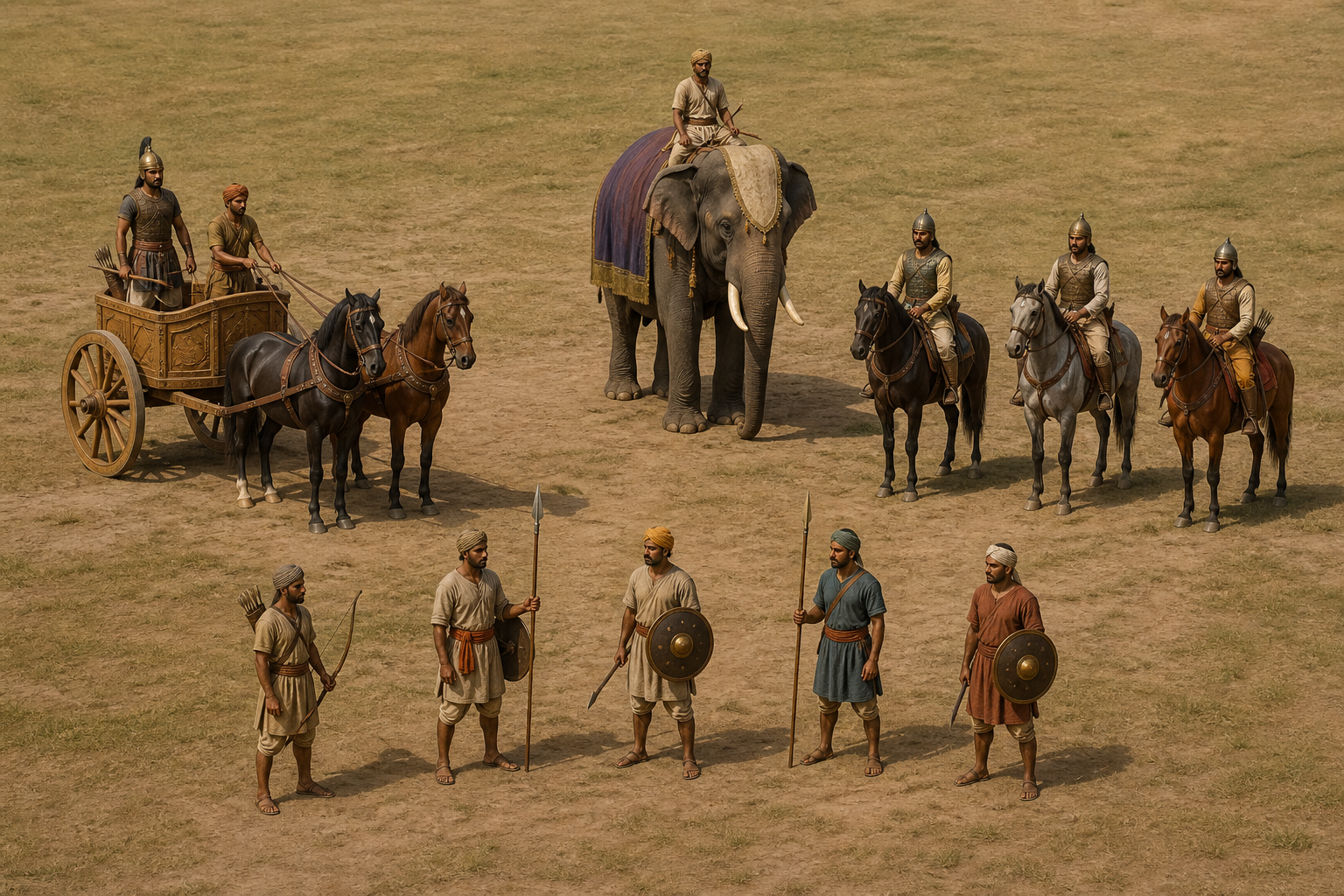
The patti is the foundational military unit in this scheme. It contains one chariot, one elephant, three horses and five foot soldiers. Written as a ratio, its composition is 1:1:3:5.
| Military category | Number in one patti | What the number identifies |
|---|---|---|
| Chariot | 1 | A chariot as a counted military element |
| Elephant | 1 | An elephant as a counted military element |
| Horses | 3 | Three horses, preserving the category as stated |
| Foot soldiers | 5 | Five individual infantrymen |
The entries add up arithmetically to ten, but a patti is not therefore a ten-person squad. A chariot is not a person. Neither is an elephant or a horse. A chariot may require occupants, and an elephant may require human direction, but the patti definition given here does not specify those additional people. You cannot turn the four-category total into an exact human headcount without importing assumptions.
Keep the noun attached to every number. Three horses should remain three horses unless the particular passage, edition or interpretive convention you are using explicitly identifies riders. Replacing horses with cavalrymen may seem harmless, but it changes what is being counted.
The 1:1:3:5 ratio is the organizing key
The patti becomes much easier to use when you treat the number of pattis as a variable. If an army contains P pattis, a direct aggregation gives you:
- P chariots
- P elephants
- 3P horses
- 5P foot soldiers
Two pattis, for example, produce two chariots, two elephants, six horses and ten foot soldiers. Those are twenty listed military elements, but still not twenty human beings. This small example exposes the most common counting error before the same error is magnified inside a much larger formation.
You can also test a claimed aggregate without knowing its dramatic name. Let B be the claimed number of chariots. A formation built by multiplying complete pattis should have B elephants, 3B horses and 5B foot soldiers. In compact form, the totals should be B:B:3B:5B.
This ratio check does not prove that every quoted total is historically or textually correct. It does tell you whether the numbers are internally consistent with the stated patti composition. If the proportions fail, at least one assumption has changed: the base definition, the multiplication, the category labels or the claim itself.
Organization does not automatically mean battlefield formation
The patti presents a composite military bundle from its lowest level. Chariots, elephants, horses and infantry are integrated into one scheme rather than treated as a single undifferentiated mass. That is a meaningful organizational idea because each category creates different demands for movement, space, command and support.
But the word unit can hide three separate claims:
- Counting unit: a standard bundle used to express the composition and scale of an army.
- Tactical unit: a group expected to move and fight together on the battlefield.
- Command unit: a body placed under one defined commander.
The patti definition directly gives you the first meaning. It does not, by itself, establish the other two. You should not picture one chariot, one elephant, three horses and five infantrymen permanently advancing as a compact battlefield team merely because they appear together in the arithmetic.
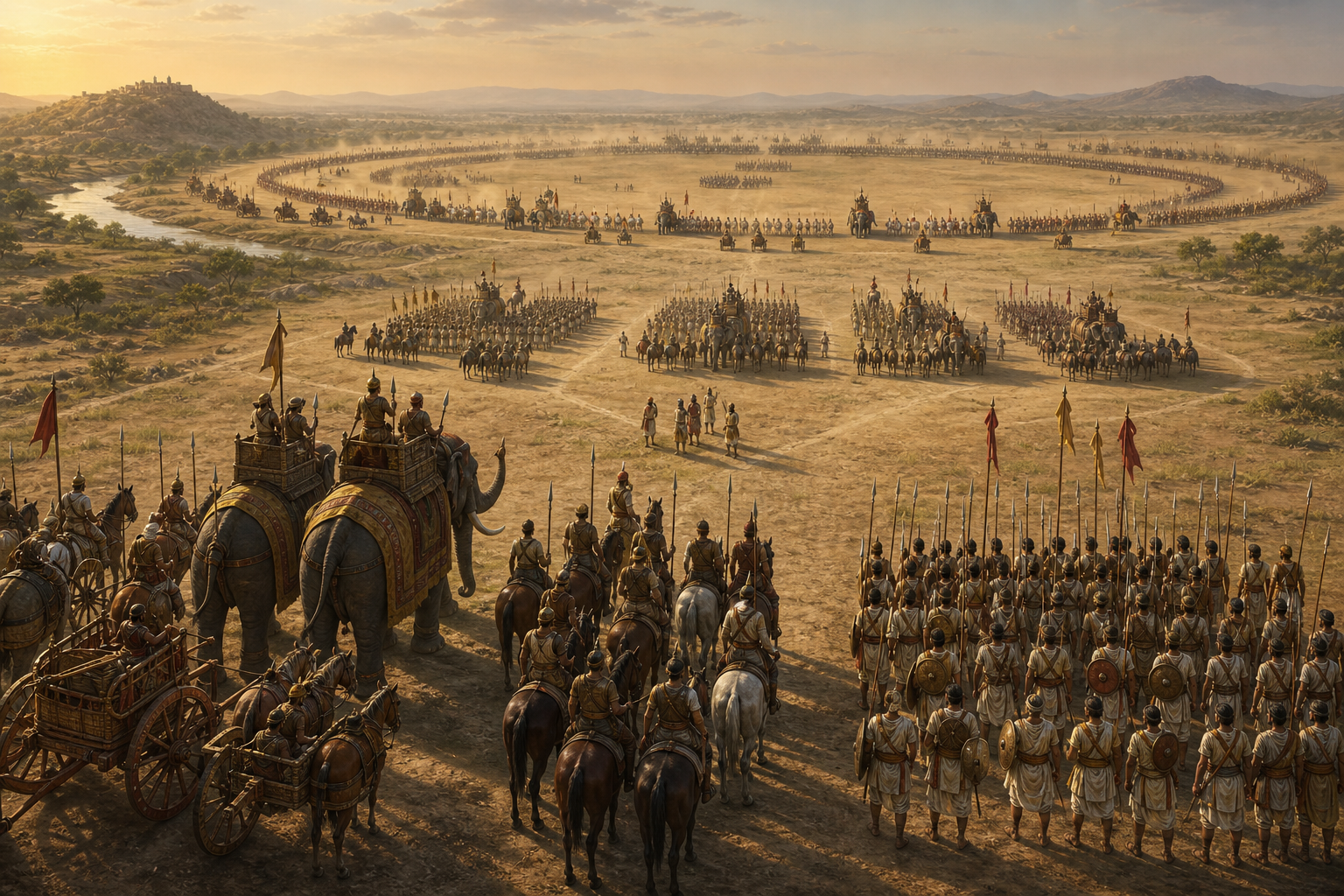
Nor does the ratio specify geometry. It does not tell you whether the elements stood in a line, a column, a defensive arrangement or some other deployment. Army composition and battle formation answer different questions: composition tells you what has been counted; formation tells you how forces were arranged for action.
The same caution applies to historical interpretation. An organized numerical description in an epic is not automatically an archaeological census of troops assembled at one place and moment. The responsible conclusion is narrower and stronger: the Mahabharata expresses military scale through a structured relationship among distinct arms.
How to assess a claim about an Akshauhini
Akshauhini belongs to the larger end of this military vocabulary. When you meet an exact total attached to it, use a short audit before repeating the number:
- Copy the category labels exactly. Keep chariots, elephants, horses and foot soldiers in separate columns. Do not begin with a combined total.
- Identify the base definition. Confirm that the calculation begins with a patti of one chariot, one elephant, three horses and five foot soldiers.
- Find the complete multiplier chain. A named large formation cannot be reconstructed from its name alone. Every step between the patti and the final formation must be stated or otherwise established.
- Check the final proportions. If the larger total is an exact aggregation of pattis, the four categories should preserve the 1:1:3:5 relationship.
- Separate military elements from personnel. Do not label the sum as a number of warriors unless the human occupants, riders and handlers have actually been defined.
- Describe the result precisely. Call it an organizational enumeration within the epic unless you have separate grounds for making a historical headcount claim.
If the multiplier chain is missing, stop at the point the evidence supports. You can still explain the patti ratio and test whether a proposed total preserves it. What you cannot responsibly do is fill the gaps with a remembered number and then present the result as self-evident.
This method also helps when two explanations appear to disagree. Compare their category labels, base patti and multipliers before comparing their final totals. Many apparent disputes begin earlier than the headline number.
Key takeaways
- A patti contains one chariot, one elephant, three horses and five foot soldiers.
- Its defining proportion is 1:1:3:5, which can be scaled as P:P:3P:5P.
- The ten listed elements in one patti do not equal ten human beings.
- The patti securely describes composition and counting; it does not by itself establish battlefield geometry, command structure or an archaeological headcount.
- An Akshauhini total is only as reliable as its base definition, multiplier chain and preservation of categories.
The next time you see a vast Mahabharata army reduced to one impressive figure, write the four categories beside it and test the 1:1:3:5 ratio. That simple check will tell you whether you are looking at disciplined enumeration or a total detached from the system that gives it meaning.
References
