
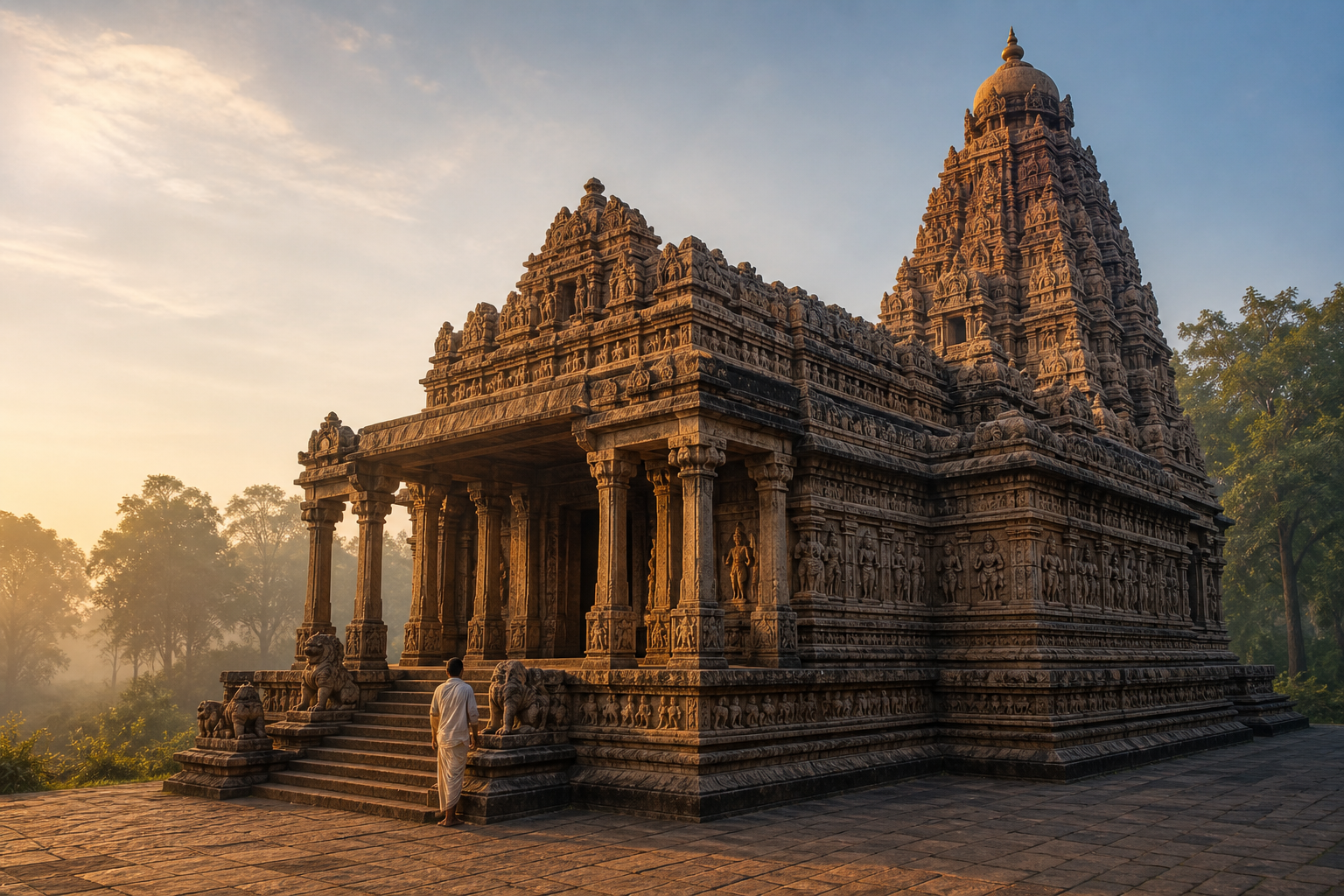
You stand before a Hindu temple wall crowded with deities, guardians, animals, plants, dancers, and unfamiliar beings. The natural impulse is to identify them one by one. That approach often leaves you with a collection of names but no understanding of why the sculptures are there.
Begin with the temple rather than the individual image. Its carvings work with height, direction, enclosure, repetition, and your own movement toward the sacred center. Once you learn to notice those relationships, the apparent crowd becomes an ordered vision of reality.
Read the building before you interpret the figures
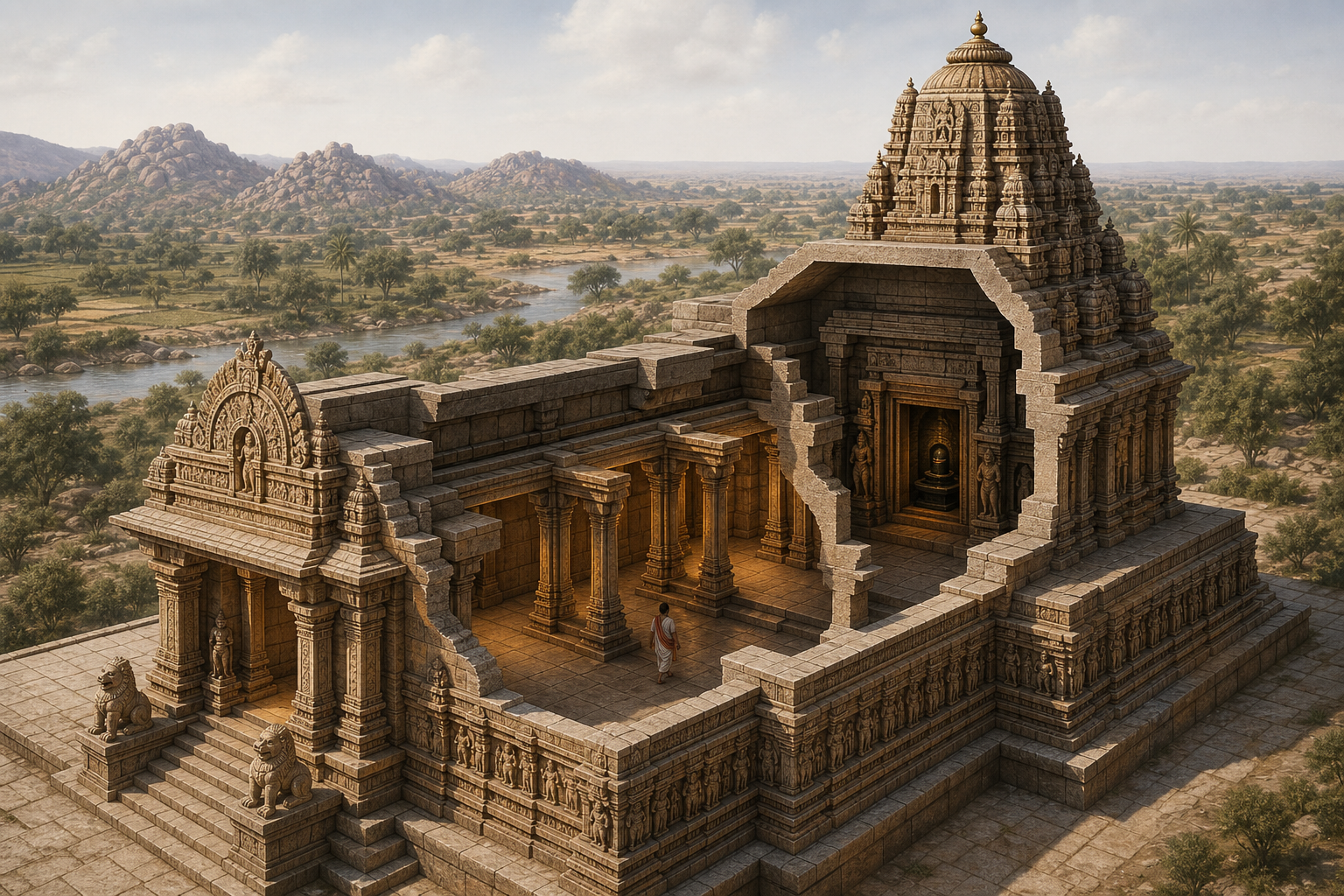
A Hindu temple is not merely a building that contains sacred images. The building itself can be read as a sacred form. Its walls establish boundaries, its doorways mark transitions, its interior draws attention toward a center, and its rising profile directs the eye upward. In this symbolic structure, the shikhara can evoke Mount Meru, the cosmic axis, while even a small carving participates in the larger order.
Here, cosmic does not mean that the temple is a literal astronomical chart. It means that architectural relationships such as center and boundary, height and depth, multiplicity and unity make an ordered universe perceptible. The temple translates those relationships into stone, space, and movement.
Start far enough away to see the whole silhouette. Notice what rises above the structure, where the visual center appears to be, and how the building gathers many smaller forms into one profile. Then move closer. The details you encounter should be understood as parts of that whole, not as unrelated works displayed on a wall.
Three architectural clues will orient your reading:
- Centrality: Ask what the building directs you toward. A sacred center gives the surrounding forms a shared point of reference.
- Verticality: Follow the movement from the lower structure toward the shikhara. Upward movement can express an ascent from the dispersed world toward a unifying principle.
- Transition: Notice gates, doorways, changes in enclosure, and changes in light or scale. These boundaries help turn an ordinary approach into a sacred passage.
This first reading does not require you to identify a single figure. It gives you the structure within which identification will become meaningful.
Many forms can belong to one sacred order
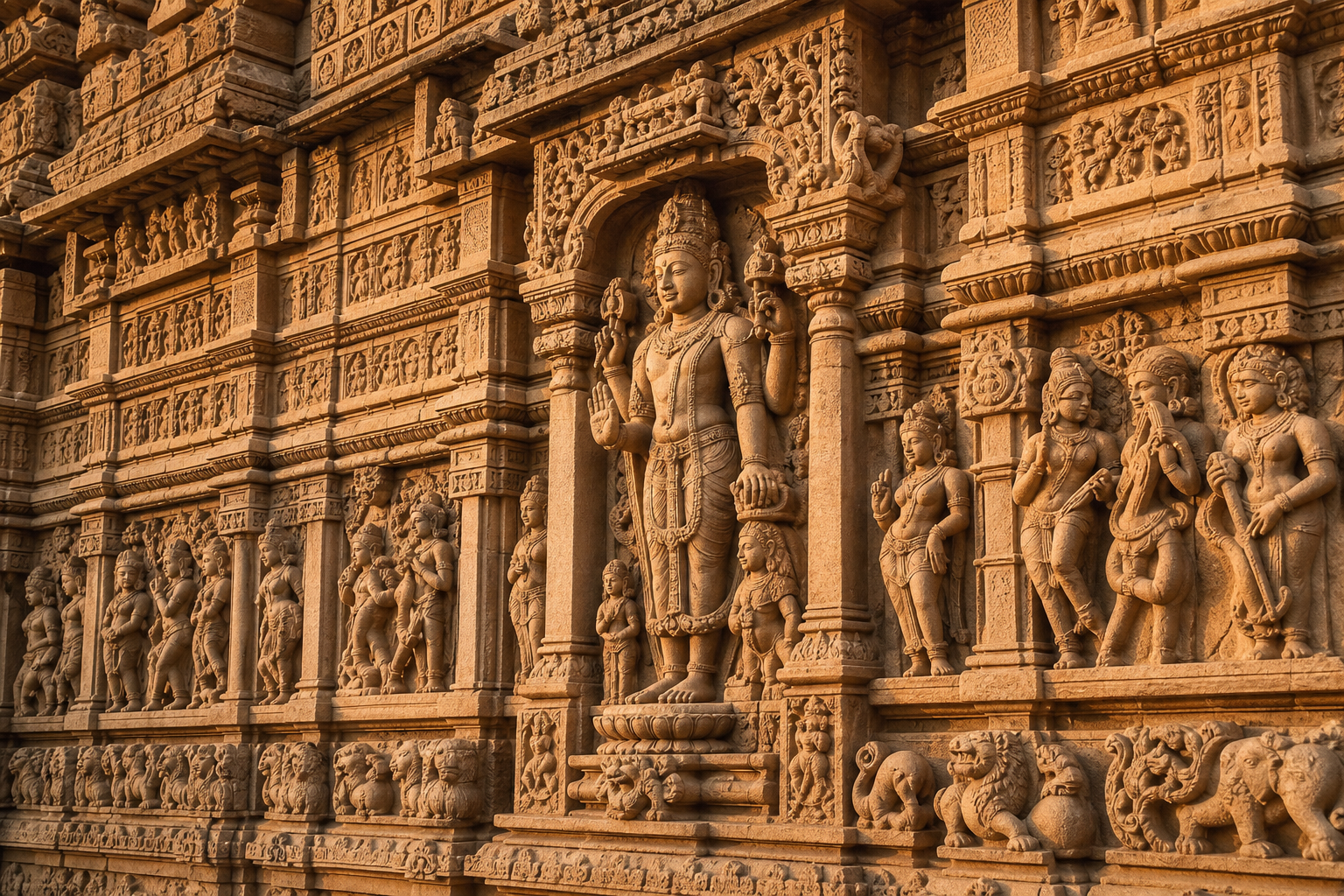
The abundance of temple sculpture can look excessive if you expect sacred art to isolate one subject against an empty background. Hindu sacred architecture often works differently. Divine, human, animal, vegetal, and geometric forms can occupy the same visual world because the temple presents existence in its fullness.
Do not assume that every carved being is another god demanding separate worship. A figure may identify a divine presence, guard a boundary, support an architectural element, embody a quality, recount a sacred episode, establish rhythm, or connect one part of the composition to another. Some carvings perform more than one of these functions.
This is where the relationship between unity and multiplicity becomes visible. Unity need not mean blank sameness, and multiplicity need not mean disorder. The temple can gather different beings, energies, activities, and levels of existence around a sacred center without erasing their differences.
That insight also prevents a common misreading of the exterior. A lively outer wall is not necessarily a catalogue of distractions that must be condemned before you enter a pure interior. The stronger question is how the temple takes the varied world and places it within an ordered sacred whole. A worldly-looking image may still contribute to that ordering through its location, posture, relation to neighboring figures, or architectural role.
At the same time, do not force every sculpture into one grand philosophical explanation. Temple programs differ across communities, regions, periods, and traditions. Cosmic symbolism gives you a framework for seeing relationships; it does not eliminate the need for local knowledge.
Position is part of a sculpture’s meaning
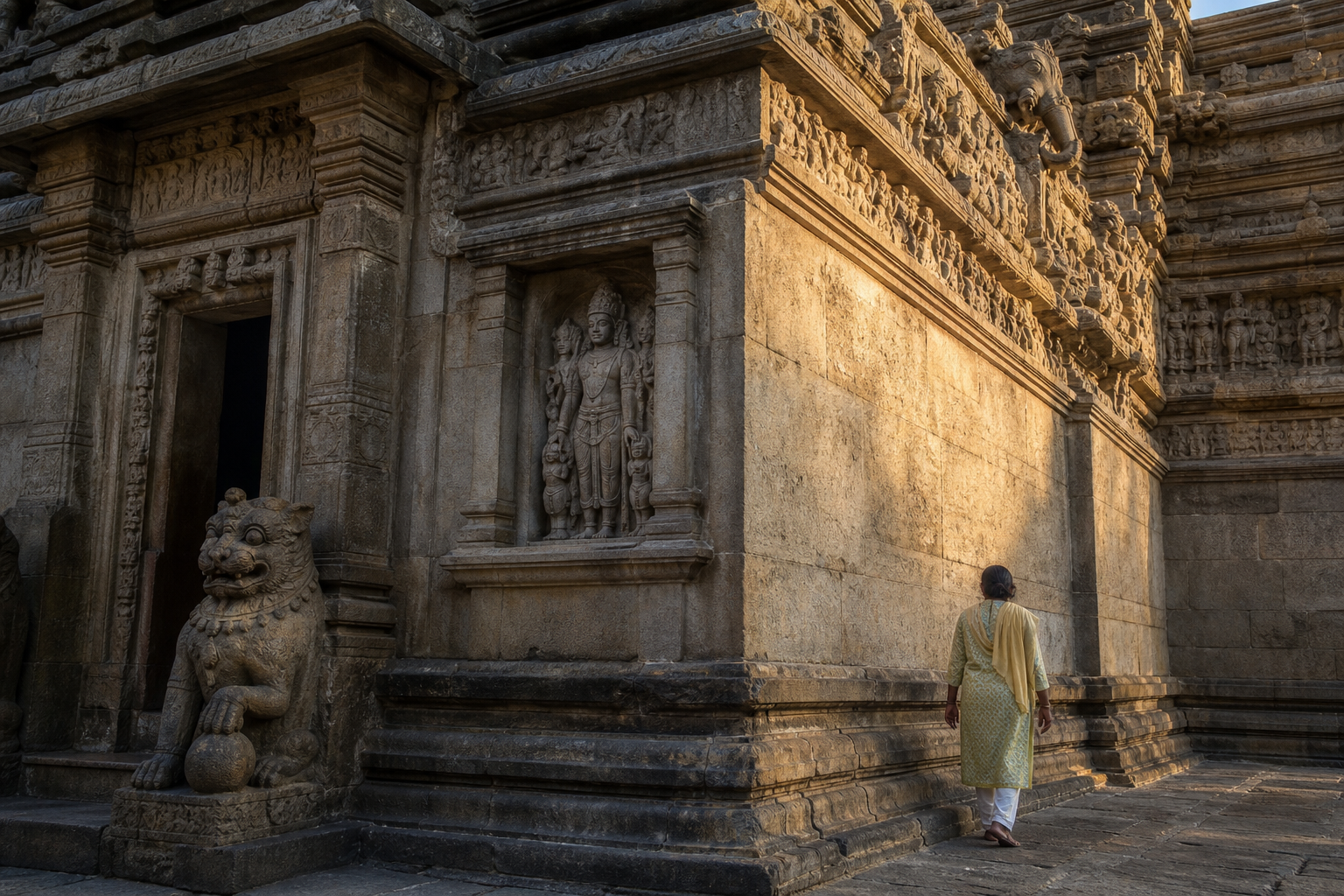
An image removed from its setting loses important information. Before asking who a figure is, ask what it is doing there. Its position may tell you whether it belongs to a threshold, supports a larger form, faces the sacred center, addresses an approaching visitor, or participates in a repeated sequence.
Use this five-question test whenever a carving catches your attention:
- Where is it? Record whether the figure appears near the base, on a wall, beside a doorway, on a pillar, or high above normal eye level. Location is evidence, not background.
- What does it face? Look for a relationship with an entrance, the exterior world, the sacred center, another figure, or the direction of movement through the temple.
- Is it repeated? One unique image may mark a particular identity or event. A repeated form may establish protection, rhythm, direction, or an architectural pattern.
- How does it occupy the structure? Notice whether it appears to stand, guard, carry, frame, emerge, dance, or sit in stillness. The body’s action can echo the work performed by that part of the building.
- What changes around it? Compare scale, visual density, light, enclosure, and neighboring forms. A sculpture’s role often becomes clearer when you compare it with what comes before and after it.
Keep observation separate from interpretation. Write or think, for example, “A similar figure appears beside each major doorway” before concluding, “It may have a protective or transitional role.” The first statement is visible evidence. The second is a hypothesis that can be checked against temple signage, a knowledgeable custodian, community teaching, or a reliable account of that particular temple.
This discipline matters because visual resemblance alone can mislead you. A familiar-looking posture does not guarantee the same identity in every setting. A small figure is not automatically unimportant. An eroded image may have lost the feature that once made its identity clear. Placement and repetition will often tell you more than a hurried guess based on appearance.
Avoid the shortcuts that flatten temple symbolism
Temple sculpture becomes easier to read when you stop asking it to behave like a universal picture dictionary. Four shortcuts cause most of the confusion.
- “Every figure is a separate god.” This mistakes visual abundance for a census of independently worshipped deities. First determine whether a figure is central, attendant, protective, narrative, architectural, or ornamental.
- “Every image has one secret meaning.” Symbols can carry several related meanings, and their role changes with placement. Treat a fixed interpretation copied from elsewhere as a possibility, not a verdict.
- “The outer wall is profane and the inner space is sacred.” This division is too crude. A temple can include the world’s variety within sacred order rather than pretending that the world does not exist.
- “Cosmic meaning makes history irrelevant.” Symbolism does not cancel local tradition, artistic style, patronage, damage, repair, or later alteration. The temple you see is both a sacred design and a structure with a history.
When a generic interpretation conflicts with information preserved by the temple’s living community, begin with the local explanation. It may identify a form that outsiders would otherwise misread. Where no explanation survives, uncertainty is more honest than turning a plausible association into a fact.
You should also resist evaluating every image as though it were a modern statement displayed in isolation. Temple sculpture belongs to an ensemble. Its meaning arises through relationships among image, architecture, ritual use, and the worshipper’s route. Remove any one of those, and the reading becomes thinner.
Use this reading route on your next temple visit
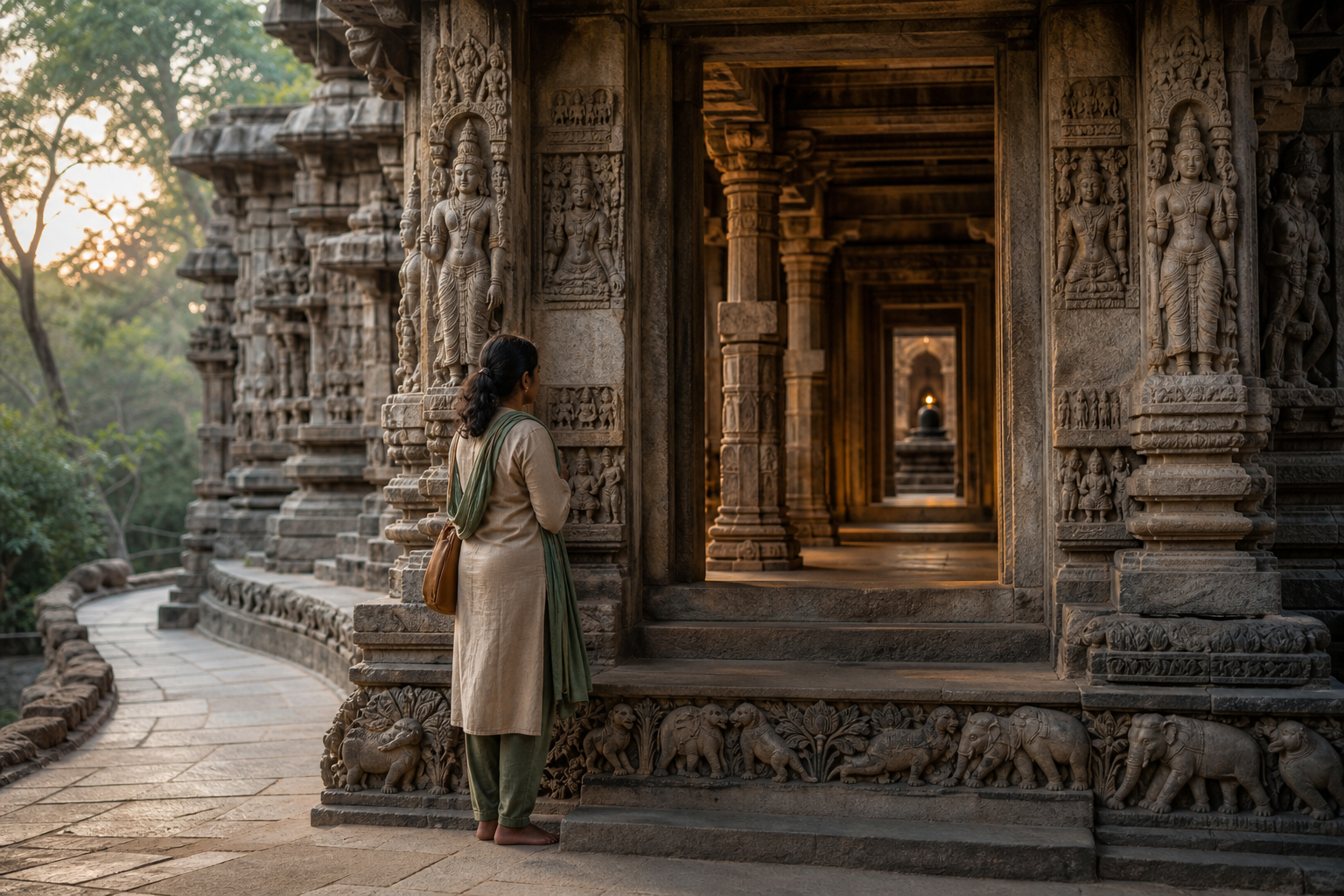
You do not need to decode hundreds of sculptures in one visit. Choose one motif or architectural relationship and follow it carefully. This route turns observation into a manageable practice:
- See the whole temple first. Stand back and locate the dominant center, the upward movement of the shikhara, and the relation between the main mass and its smaller forms.
- Identify the first boundary. Notice what marks the transition from the surrounding space into the temple precinct or building. Look for changes in imagery, enclosure, scale, or atmosphere.
- Select one recurring form. It might be a human figure, animal, plant pattern, geometric design, or architectural motif. Track where it appears instead of trying to name everything around it.
- Compare its placements. Does the form occur only at entrances, along the lower structure, on pillars, near the center, or at several levels? Its distribution may reveal its function.
- Notice how your attention is directed. As you move inward, ask whether the visual field becomes more concentrated, the space more enclosed, or the route more deliberate. Record what actually changes in this temple.
- Check before declaring. Use local explanations to test your reading. If firm identification is unavailable, preserve the distinction between what you observed and what you inferred.
- Return to the whole. Step back again and ask how your chosen motif connects the inhabited world of the carvings with the temple’s sacred center and vertical form.
Follow the temple’s rules while doing this. Do not obstruct worship, touch old surfaces, climb for a photograph, or ignore restrictions on photography and movement. The building remains a place of worship, not merely an object of visual analysis.
Key takeaways
- Read sculpture together with architecture; location is part of iconography.
- Use the shikhara, sacred center, boundaries, and your route through the temple to orient the details.
- Do not mistake many carved forms for many unrelated gods or for random ornament.
- Repetition, direction, posture, and architectural function provide stronger clues than resemblance alone.
- Treat cosmic symbolism as a relational framework, not a universal code that overrides local tradition.
Your goal is not to solve the temple in a single visit. Choose one carving, trace its relationship to the building, and test your interpretation against its placement and local context. If you can explain how that relationship changes what you see, you have moved beyond collecting images and begun to read the temple as a sacred whole.
References
