

You have probably met the Hoysala origin story in its most compressed form: a warrior, a dangerous beast, and the command Hoy, Sala. If you are trying to decide whether this is literal history, sacred memory, or an explanation of the dynasty’s name, do not force it into only one of those boxes.
The legend matters because it turns a moment of commanded action into a statement about legitimate rule. Once you separate that meaning from the question of strict historicity, the story becomes easier to understand and much harder to misuse.
The origin legend in one clear sequence
The traditional account begins with Sala, the remembered ancestral hero of the Hoysalas, in a sacred setting with a spiritual teacher. A fierce beast suddenly threatens them. The teacher calls out Hoy, Sala: strike, Sala. Sala obeys, confronts the animal, and kills it. The command is then remembered as the name Hoysala, while the confrontation becomes the dynasty’s identifying visual motif.
- A sacred place is placed in danger.
- A spiritual authority commands Sala to act.
- Sala confronts the threat instead of retreating.
- His deed restores safety and order.
- The cry Hoy, Sala becomes a traditional explanation of the dynastic name.
This is why the punctuation matters when you first encounter the name. Hoy, Sala is presented as an imperative addressed to a person, not merely as a single unexplained word. The dynasty’s identity is thereby attached to a verb: act, strike, protect.
Retellings do not always identify the animal in the same way. You may see it called a tiger in one version and a lion in another. Unless you are discussing a particular inscription, sculpture, or textual version, beast is the safest general term. The stable core of the tradition is not its zoology. It is the command, Sala’s response, and the deed that gives the dynasty its sacred origin.
Why the story is sacred rather than merely heroic
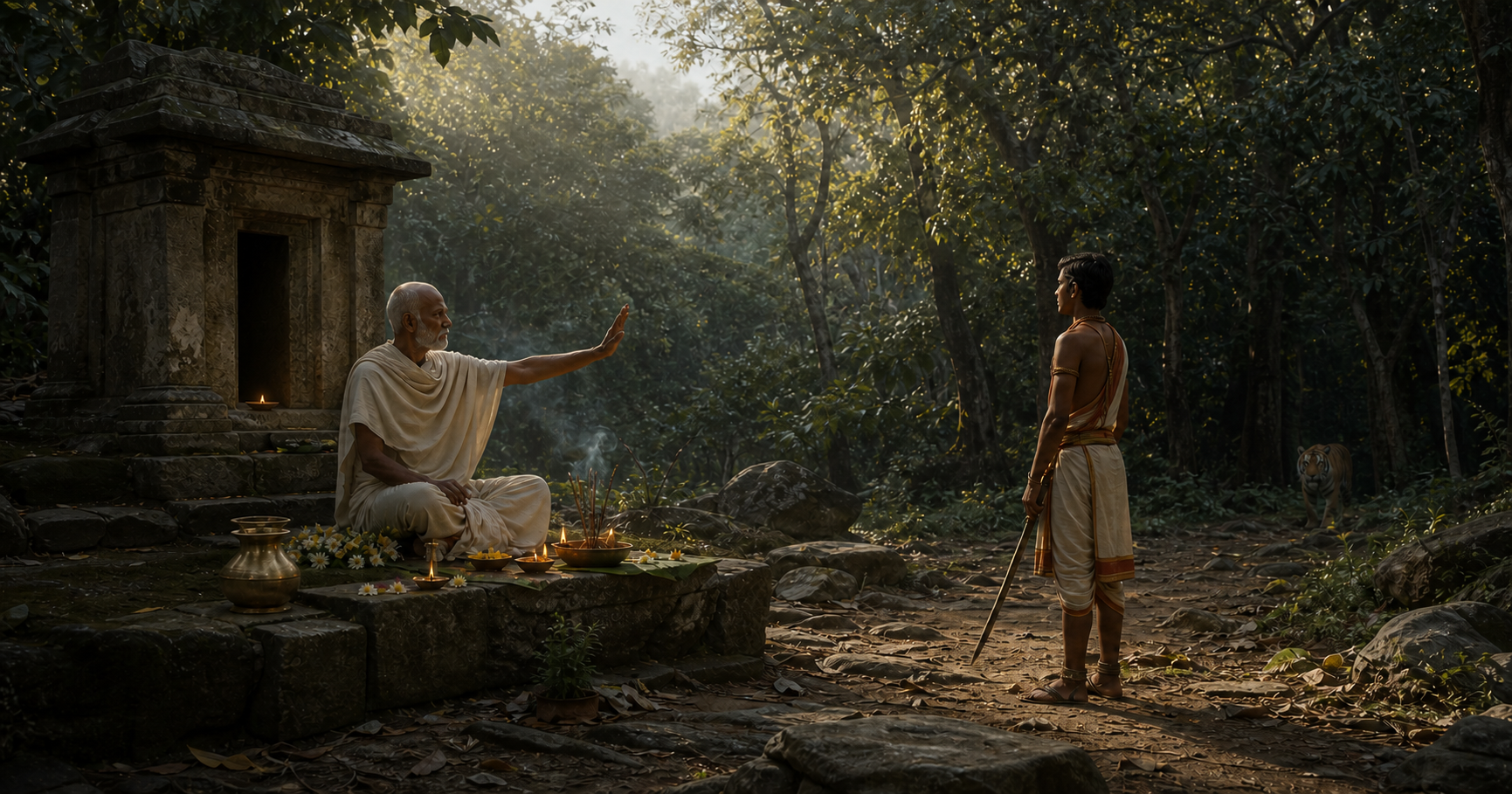
If the legend only described a hunter killing an animal, it would be a tale of personal strength. Its sacred setting changes the meaning. Sala does not seek danger to display his prowess. He acts when a spiritual authority calls upon him and an ordered space is under threat.
That sequence joins courage to dharma. Force is not celebrated as an end in itself. It becomes legitimate because it is directed toward protection, exercised in response to a command, and followed by the restoration of order. The ideal ruler suggested by the story is therefore neither passive nor wantonly violent. He is alert, obedient to higher authority, and prepared to defend what is sacred.
The cry also gives the dynasty a compact moral genealogy. A long list of ancestors is unnecessary when one decisive act can embody the qualities a ruling house wants associated with its name. Sala’s worth is demonstrated at the instant of crisis. The remembered founder becomes a protector before he becomes a political ancestor.
This helps explain why the legend belongs beside the Hoysalas’ religious monuments rather than outside them. The dynasty ruled much of present-day Karnataka between the 10th and 14th centuries and left an exceptional legacy of temple architecture. The temples and the origin story worked in different media, but both connected royal power with sacred responsibility: one through carved and consecrated space, the other through remembered action.
Sacred memory and literal history answer different questions
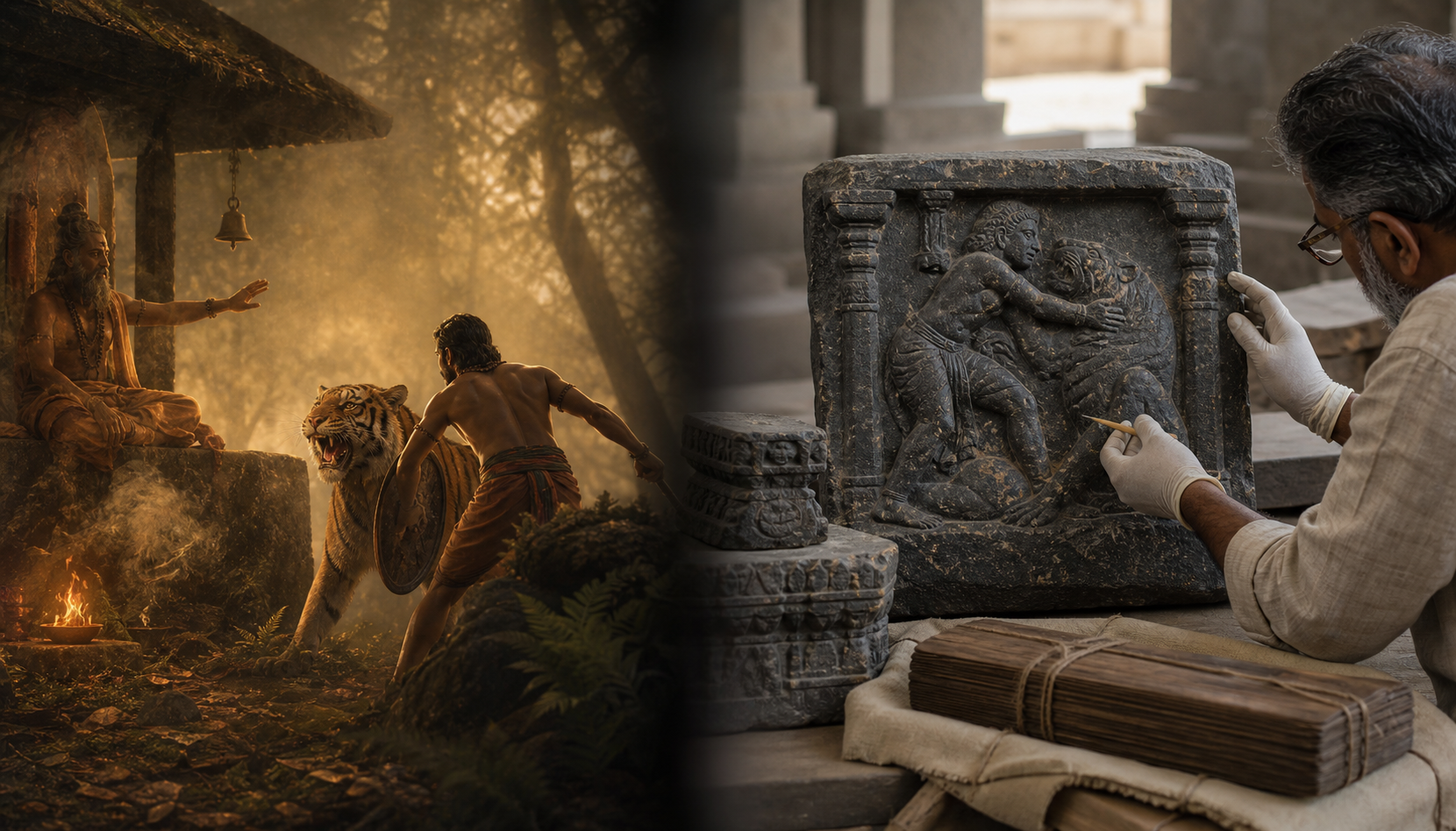
You do not have to choose between believing every detail happened exactly as narrated and dismissing the entire tradition as useless. Those responses ask the legend to do work it was not necessarily designed to do.
A dynastic origin legend explains what a community or ruling house considered meaningful about its beginnings. It can preserve a name, an emblem, an ethical ideal, and a claim to legitimacy. None of those functions, by itself, proves that every reported detail is a contemporary record of an event.
Keep three questions separate:
- What does the tradition claim? Sala acted on the command Hoy, Sala, defeated a threatening beast, and gave the dynasty its remembered name.
- What does the tradition mean? Legitimate power protects sacred order and answers a higher call.
- What can be verified historically? Precise claims about the earliest telling, location, named teacher, deity, date, or species require dated textual, inscriptional, or material evidence.
This distinction protects the story in two directions. It prevents devotional significance from being presented as if it were already archaeological proof. It also prevents uncertainty about a literal encounter from erasing the legend’s real historical role in shaping Hoysala identity.
Be especially cautious when a retelling adds several precise names and circumstances without identifying where they come from. More detail can make a legend sound authoritative while actually concealing the difference between an early record, a later elaboration, and a modern paraphrase. If you cannot trace a detail, omit it or label it as belonging to a particular version.
How to read and retell the legend responsibly
The warrior-and-beast image is easy to treat as a decorative logo. Read it instead as a compressed narrative. The human figure is Sala; the confrontation recalls the commanded deed; and the defeated threat represents the protection of ordered, sacred life. The emblem is memorable because it makes the dynasty’s name visible as an action.
When you encounter the motif at a temple, museum, or in a photograph, use this four-step check:
- Identify before interpreting. Confirm that the image is actually being presented as Hoysala and not merely as a generic combat scene.
- Read the local label. Note whether it identifies the animal, names a textual or inscriptional tradition, or assigns a date to the object.
- Separate the object from the event. A sculpture can prove that the motif was used; it does not automatically prove that the encounter occurred exactly as depicted.
- Preserve variation. If the label says lion while a familiar retelling says tiger, report the difference instead of silently changing one into the other.
For a classroom, temple visit, or family discussion, a responsible short retelling needs only three sentences: In the Hoysala sacred origin legend, a spiritual teacher commands the warrior Sala to strike a threatening beast. Sala kills it, and the cry Hoy, Sala becomes the traditional explanation of the dynasty’s name. The story expresses an ideal of courage placed in the service of sacred protection, although its narrative details should not be treated as verified chronology without supporting evidence.
That wording keeps the devotion, drama, and historical caution together. It does not belittle the tradition, and it does not claim more than the tradition can establish on its own.
Key takeaways
- Hoy, Sala is remembered as a command to Sala to strike a threatening beast.
- The sacred setting turns the encounter into a model of dharmic protection, not simply a celebration of violence.
- The legend explains the Hoysala name and emblem at the level of dynastic memory; it is not automatically a verified account of a founding event.
- Tiger and lion versions should not be flattened into false certainty. Use beast unless you are citing a specific version or object.
- The most useful historical question is not only whether the encounter literally occurred, but why the Hoysalas made this act the image of rightful rule.
The next time you see Sala confronting the beast, look past the animal first. Notice the command, the response, and the protected sacred order. That sequence is where the Hoysala origin legend carries its enduring meaning.
References
