
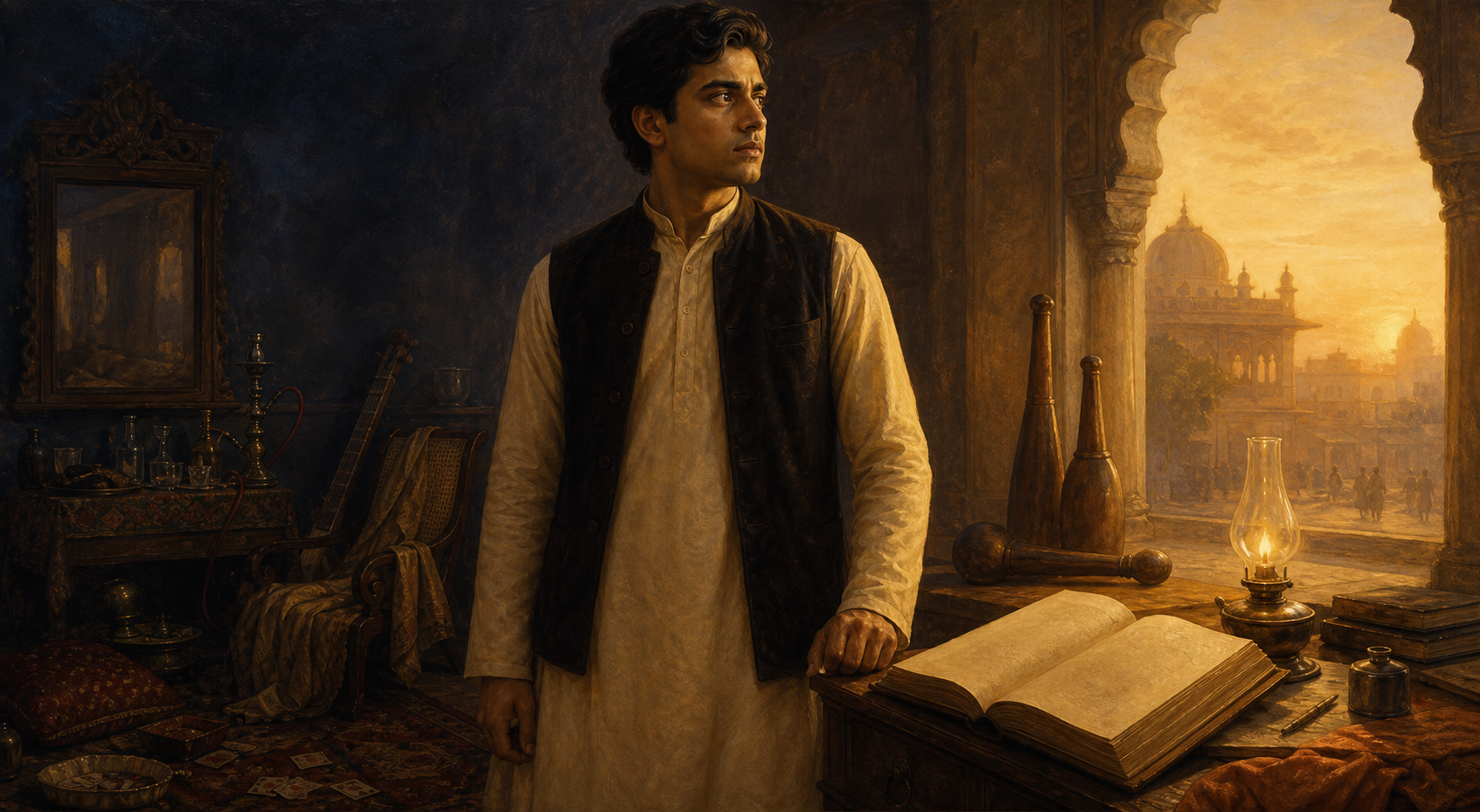
If you want to understand why the Arya revival could change lives, don’t begin with an organization or a slogan. Begin with a gifted young man whose education, physical discipline, family inheritance, and respectable prospects had failed to give his life a governing direction.
Munshi Ram’s transformation matters because it shows what must happen before civilizational renewal becomes credible. A person has to recognize the distance between professed values and actual conduct, encounter a teaching strong enough to survive scrutiny, and accept a decision that costs more than admiration.
Key takeaways
- Munshi Ram did not lack ability. His crisis came from ability without moral direction, which is more difficult to correct than simple ignorance.
- Swami Dayanand Sarasvati impressed him through a combination of disciplined presence, Vedic learning, public reasoning, and private conversation.
- The Bareilly meeting in 1882 was a catalyst, not a magical replacement for personal responsibility. Munshi Ram still had to choose what would govern his conduct.
- His rejection of an arranged administrative path gave the transformation a practical cost. It was no longer merely an emotional response to an inspiring speaker.
- The Arya revival became persuasive when Vedic recovery could be translated into study, self-command, vocation, and public confidence.
The real crisis was ability without direction
Born in 1856 at Talwan in the Jullundar district, Munshi Ram grew up in a religious Hindu household. His father, Lala Nanak Chand, served in the police and worshipped Shiva. His mother was deeply devoted to the Divine Mother in forms including Uma, Durga, and Kali. This background is important: Munshi Ram’s later turn was not a movement from a religionless home into Dharma. It was a reorientation within a Hindu civilizational world.
His early development gave little warning of collapse. He was physically strong, exercised diligently, and applied a naturally bright mind to his education. Yet after entering college at Benares and leaving his mother’s immediate supervision, riotous living damaged both his studies and his well-being. Failure in the First in Arts examination followed.
You should notice what this corrects. Moral drift is not always caused by weakness, lack of intelligence, or an absence of cultural inheritance. A capable person can cultivate the body, sharpen the mind, and still be ruled by appetite. Education increases what you can do; it does not decide what you should do.
Munshi Ram also had a socially acceptable escape from the consequences. Officials favorably disposed toward his father arranged an opening for him as a Naib Tehsildar. He could have entered public service and allowed position to conceal the unresolved disorder underneath. Instead, he eventually chose to resume his studies and pursue the qualification needed for an independent profession recognized by the University and the Chief Court.
That distinction is useful whenever you assess a story of reform. A new position, title, or circle can improve appearances without changing the principle that governs a life. Transformation begins when the person stops asking, “How can I recover my status?” and starts asking, “What has the right to direct me?”
Dayanand gave skepticism a Vedic destination
Swami Dayanand’s own path had begun with dissatisfaction. Born Mulshankar, he came to reject the image he had worshipped as incapable of answering the questions troubling him. He turned toward the Vedas, with particular attention to the Rig Veda and the Upanishads, and formulated his reformist vision in Satyarth Prakash. He then travelled widely, urging Hindus to recover what he understood as the path of their Arya forebears.
In this setting, “Arya” names Dayanand’s Vedic ideal and the ancestral path he believed had been obscured. That is the meaning doing the work here. Reading the word only through later racial categories prevents you from understanding the moral and civilizational claim he was making.
Dayanand’s rejection of murti worship must also be stated accurately. It was a forceful reformist position within the Hindu world, not a neutral description of every Hindu sampradaya. Shaiva, Shakta, Vaishnava, and other traditions do not become unintelligible merely because Dayanand criticized their practices. You can recognize the regenerative force of his appeal to Vedic authority without pretending that all Hindus shared his theology.
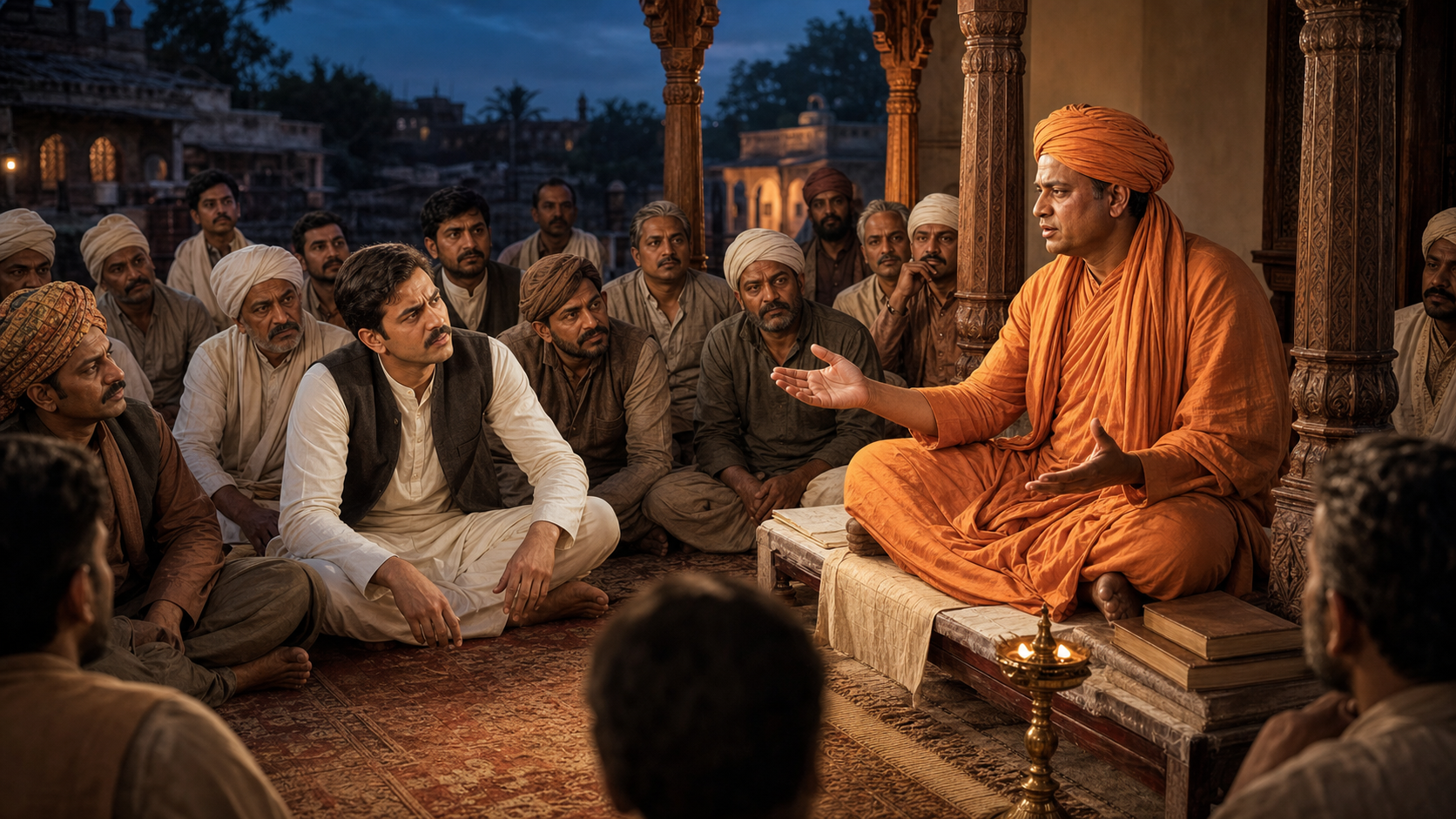
What gave that appeal unusual force was the union of doctrine and bearing. When Dayanand reached Bareilly in 1882, Munshi Ram’s father was assigned by the authorities to observe the meeting and took his son with him. Munshi Ram encountered a tall, powerfully built teacher with a penetrating but controlled voice, precise Vedic recitation, and the ability to answer contentious questions from Hindu, Muslim, Christian, Eastern, and Western interlocutors.
The physical impression was not incidental. Munshi Ram had himself valued strength and exercise. Dayanand embodied a form of strength integrated with intellectual command and spiritual purpose. The young man was not being told to despise vigor. He was shown what vigor looked like when governed by an idea of truth.
Nor did the change end with a successful platform performance. Munshi Ram sought personal conversations with Dayanand and received them. A public address created the opening; direct questioning carried him further. That sequence gives you a sound test for religious authority: charisma may earn attention, but a teacher’s position should become clearer under sustained inquiry rather than depending on distance, mystery, or the silencing of questions.
The decisive step came after the powerful encounter
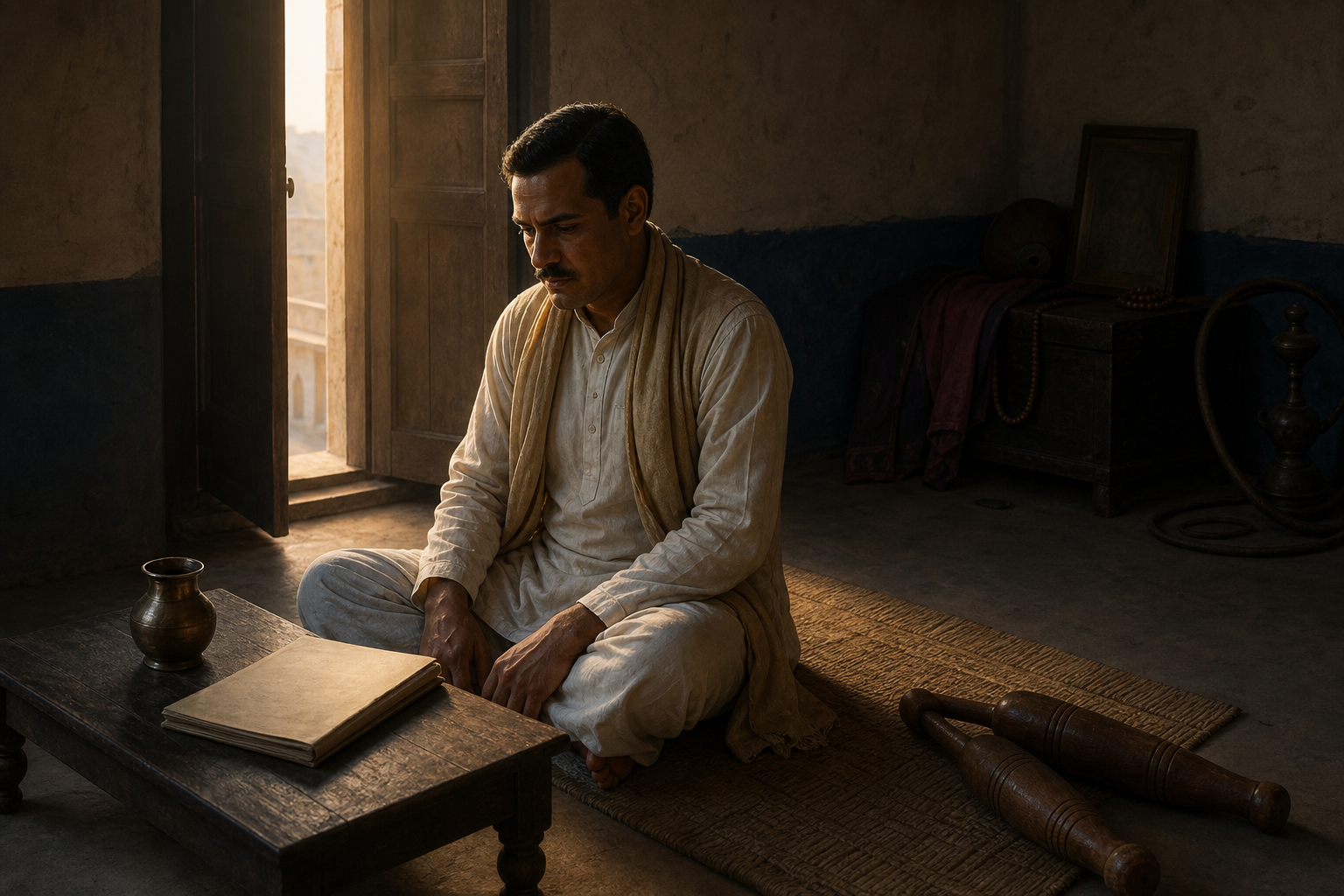
It is tempting to describe Bareilly as an instant conversion scene. That makes the story dramatic but less useful. Munshi Ram already knew the consequences of undirected living. He had seen talent fail to become character, and he had an easy route back to respectability. Dayanand did not create those tensions. He gave them a coherent Vedic direction.
The transformation then crossed several boundaries. Authority shifted from appetite and convenience toward a truth claim that demanded study. Admiration shifted toward conversation and examination. Career became a moral question rather than a ladder prepared by influential connections. Family inheritance became something to engage consciously instead of something merely received.
Munshi Ram’s decision disturbed his domestic circle, yet he remained committed to the Vedic road he believed Dayanand had recovered. The family conflict does not prove that his choice was true; opposition by itself never proves that. It does show that the decision had moved beyond enthusiasm. He was prepared to bear social friction rather than return immediately to the arrangement others preferred.
For you, the practical distinction is between intensity and direction. Intensity is what you feel during a lecture, pilgrimage, debate, or moment of shame. Direction is what changes your study, habits, relationships, and use of opportunity after the feeling subsides. A turning point becomes real only when it rearranges ordinary decisions.
Why a private reform belongs to the Arya revival
A civilizational revival cannot survive as nostalgia. Praise for ancient wisdom is cheap when it asks nothing of the person offering it. Dayanand’s call was demanding because “return to the Veda” implied a change in the location of authority, the quality of education, and the courage with which Hindus answered criticism.
Munshi Ram represented precisely the kind of person a revival had to reach: educated, talented, exposed to official career structures, formed by a Hindu home, yet no longer held together by inheritance alone. Repeating family practices more loudly would not have resolved his crisis. Rejecting his civilization would not have resolved it either. The Arya message offered a third possibility—a reasoned recovery of Vedic foundations joined to disciplined conduct.
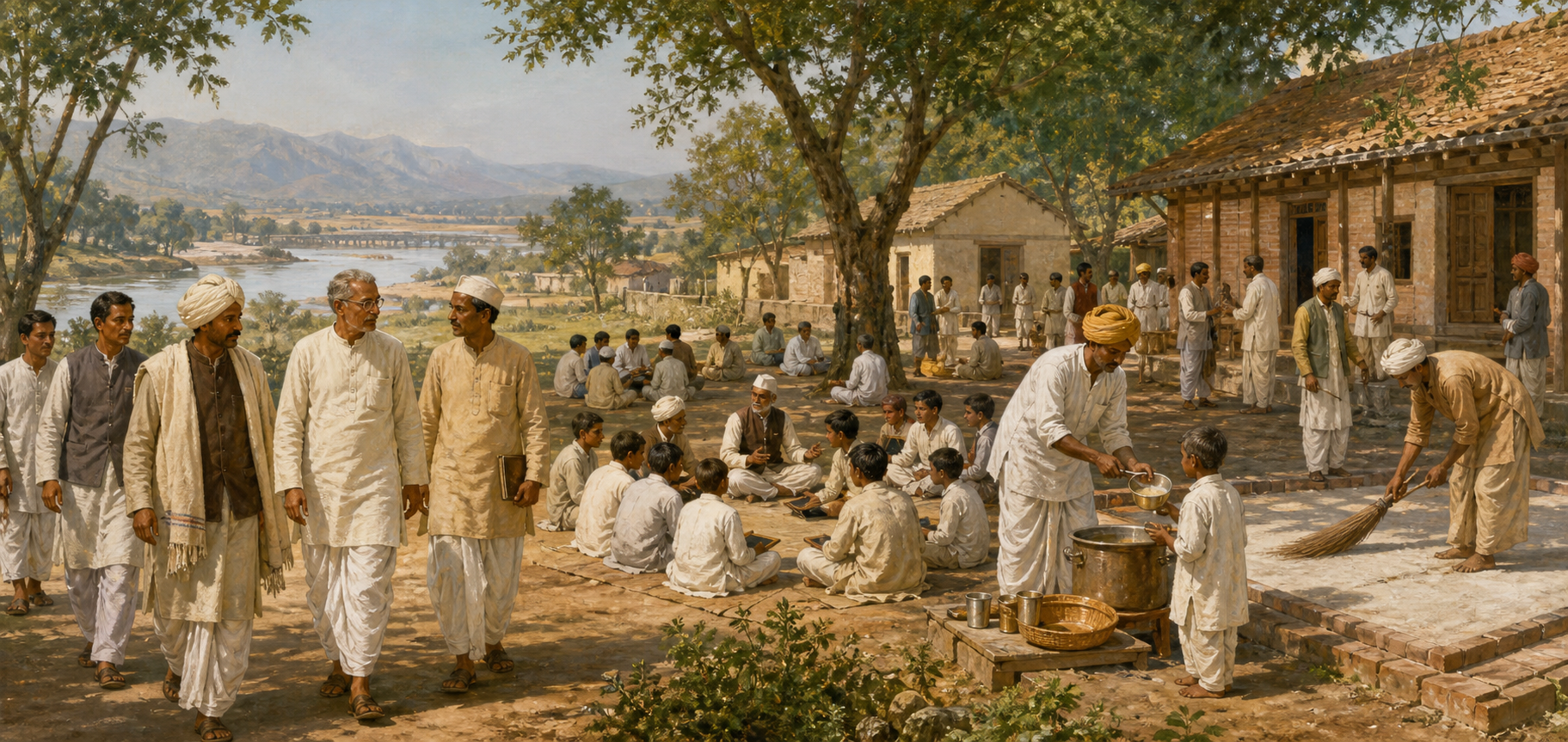
This is where individual transformation and collective renewal meet. A teacher restores confidence in a tradition’s capacity to answer questions. A listener tests that confidence in conversation. The listener then accepts a demanding change. Once this pattern becomes reproducible through teaching and study, revival ceases to depend entirely on the founding teacher’s presence.
The lesson applies beyond agreement with every proposition Dayanand advanced. Hinduism, Buddhism, Jainism, and Sikhism have distinct authorities, disciplines, and accounts of liberation. They should not be flattened into a single theology. They do, however, confront a shared practical challenge: inherited identity remains fragile when it is not joined to knowledge, self-command, and institutions capable of transmitting both.
That is why polemical victory cannot be the final measure of revival. Dayanand’s ability to answer challengers mattered because it broke the assumption that Hindu tradition had to retreat from intellectual confrontation. But a community that learns only to defeat opponents has not yet renewed itself. The harder achievements are disciplined students, serious teachers, responsible households, and people whose conduct makes their claims credible.
A practical test for dharmic renewal now
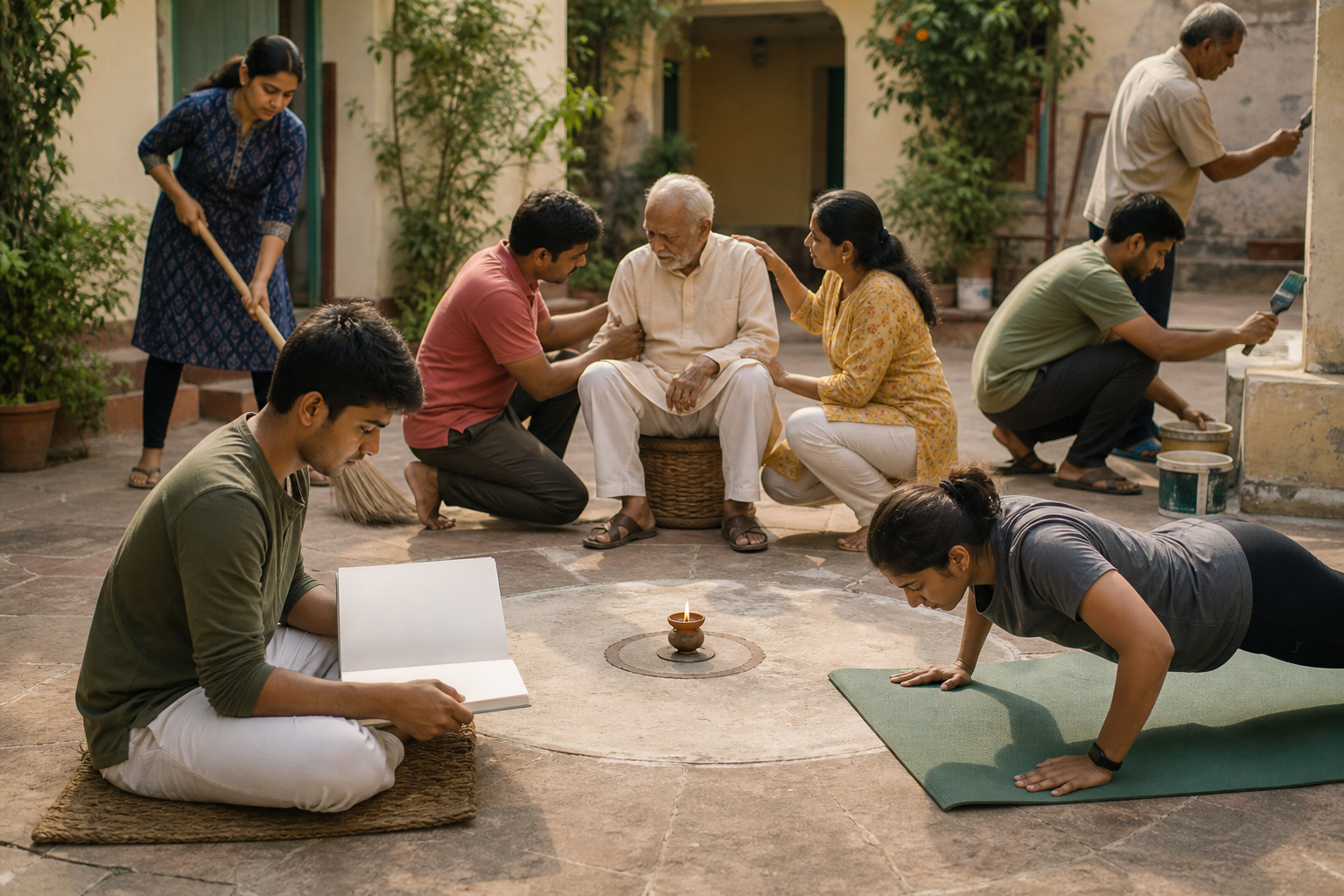
When you encounter a teacher, campaign, institution, or personal call to “return to Dharma,” examine it through the pattern visible in Munshi Ram’s turn. These questions help separate durable renewal from performance.
- What disorder is being named? Look for an honest account of the community’s or individual’s own failures. A movement that can describe only external enemies has not begun the work of self-correction.
- What authority is being recovered? Ask for the text, teaching lineage, interpretation, and reasoning involved. “Ancient” is not an argument, and reverence does not remove the need for careful explanation.
- Can serious questions be asked? Public confidence is useful, but private examination matters too. A sound teacher should help you understand the claim more precisely when you press it.
- What discipline follows assent? Identify the change in study, conduct, time, livelihood, or service. If nothing concrete follows, the supposed awakening may be only aesthetic enthusiasm.
- How will the change be transmitted? Private improvement is valuable, but revival requires forms that outlast a mood: sustained learning, capable teachers, family conversation, educational work, and service shaped by principle.
Do not copy nineteenth-century polemical habits mechanically. Preserve the more durable elements: intellectual fearlessness, access to foundational teachings, willingness to debate without hiding weak reasoning, and congruence between a teacher’s message and way of life. Confidence does not require contempt for other Dharmic paths, and internal reform does not require pretending that Hindu plurality never existed.
You can begin without waiting for a grand movement. Name the dharmic principle you say you value. Identify the habit, incentive, or convenience that contradicts it. Return to the relevant teaching with someone capable of receiving hard questions, and put the answer into your calendar and conduct. Munshi Ram’s example becomes useful at precisely that point: when Vedic admiration stops being a sentiment and starts governing a choice.
References

Leave a Reply
You must be logged in to post a comment.