
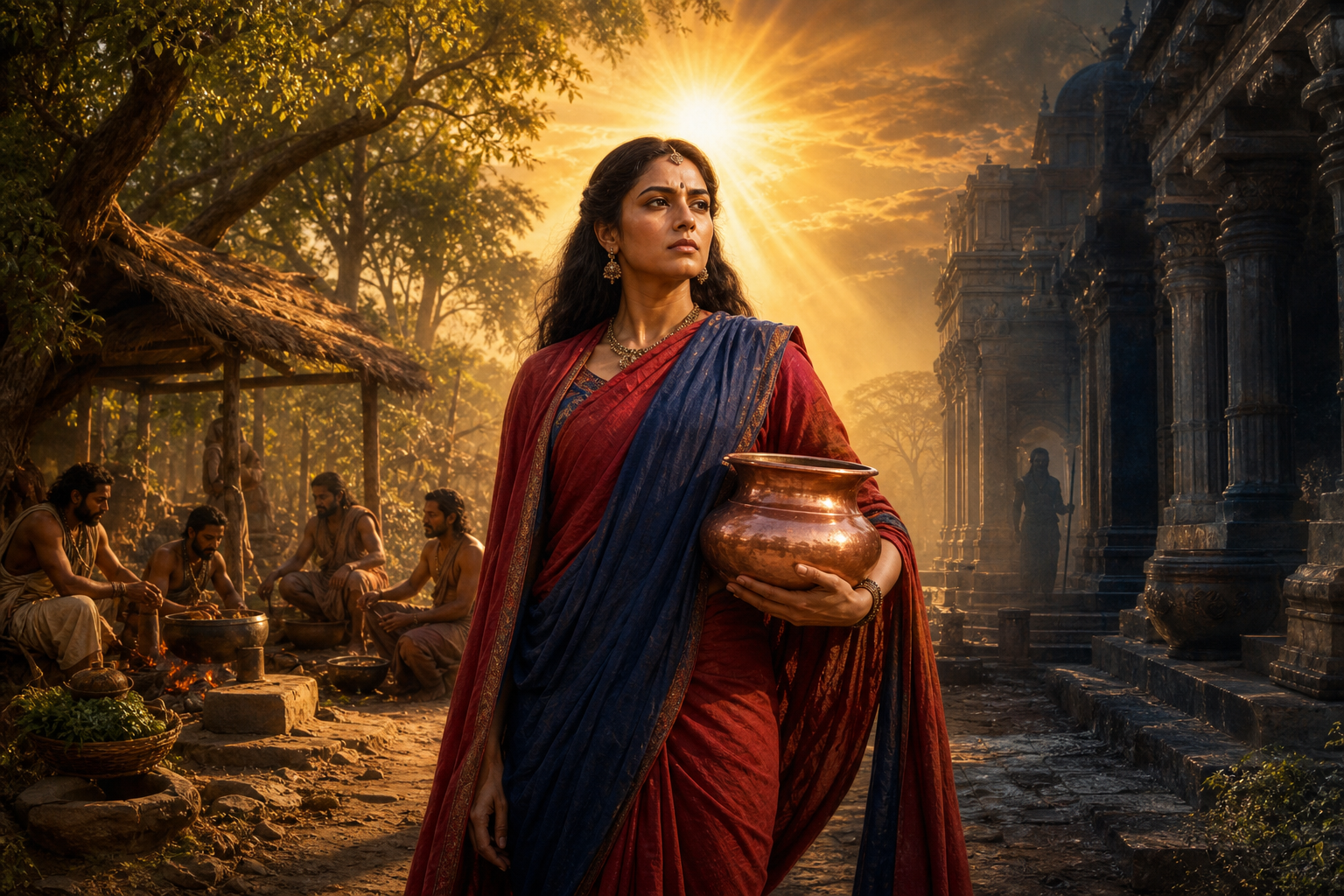
If you remember Draupadi’s deliverance only through Krishna, Surya’s place in her life can seem puzzling. The clearest answer is that Surya does not replace Krishna, Bhima, or Draupadi’s own courage. He protects her at two different pressure points: by making the Pandavas’ life in exile sustainable and by assigning an unseen defender when Kichaka threatens her.
That distinction changes how you read divine protection in the Mahabharata. Protection is not always freedom from danger. It can arrive as provision before a crisis, interruption during an assault, or enough preserved agency for justice to be pursued afterward.
Two episodes reveal the shape of Surya’s protection
The first episode belongs to the Pandavas’ forest exile. Yudhishthira has lost his kingdom, but he has not lost the duties of hospitality. The family must still feed the Brahmanas, guests, and dependants who accompany them. Surya answers this need by granting Yudhishthira the Akshaya Patra, the inexhaustible vessel whose daily abundance continues until Draupadi has eaten.
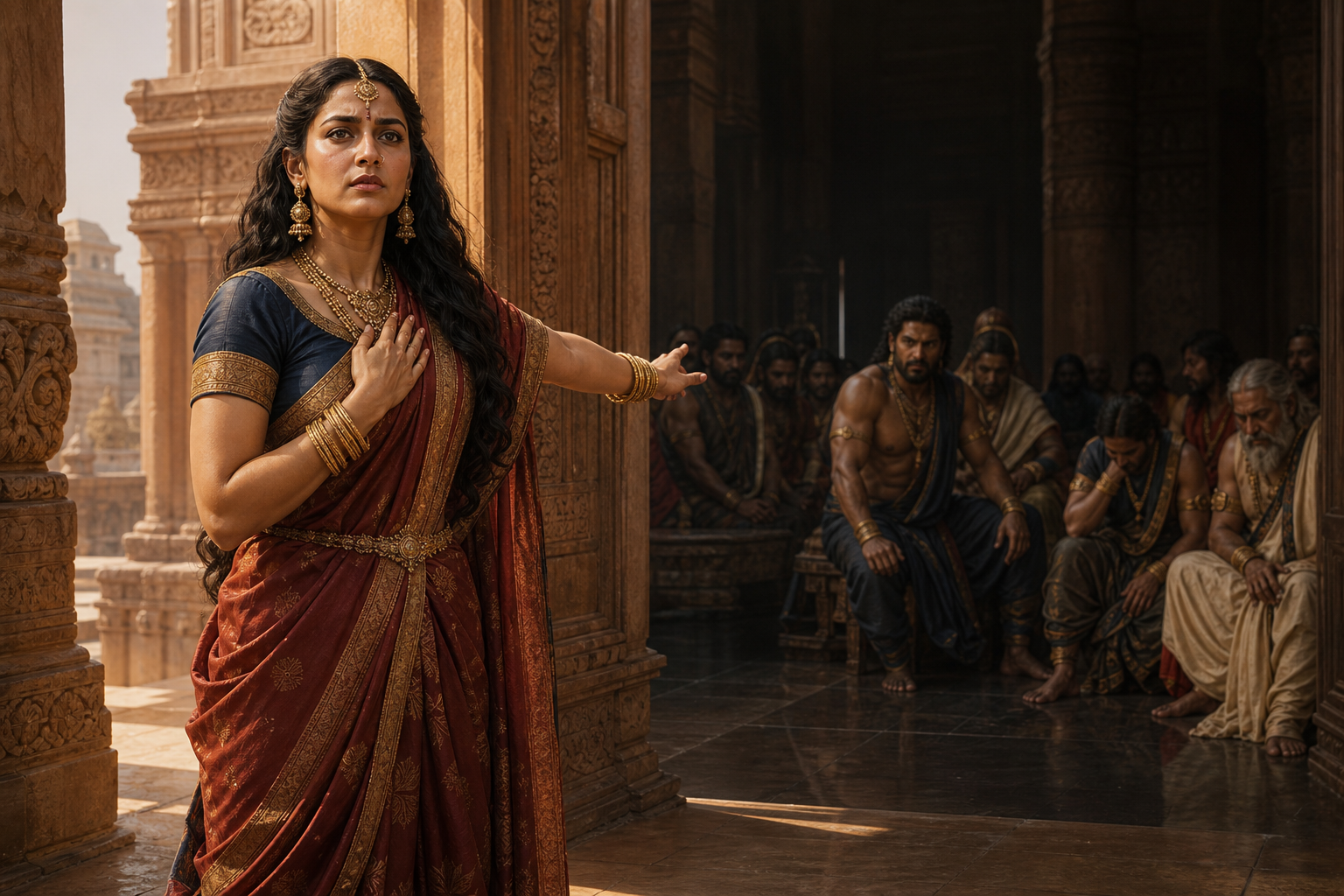
The second episode occurs while the Pandavas live in concealment at King Virata’s court. Draupadi, serving as Sairandhri, becomes the target of Kichaka, a powerful man whose position gives him confidence that he can act without consequence. Draupadi invokes Surya, and an unseen Rakshasa is appointed to protect her. When Kichaka attacks her in the royal assembly, the guardian throws him down.
These interventions are related, but they are not identical. The Akshaya Patra is structural protection: it sustains a household and its dharmic obligations over time. The unseen guardian provides immediate protection: he interrupts a particular act of violence. Reading the episodes separately prevents a vague claim about divine favor from swallowing the actual events.
The Akshaya Patra protects dignity through daily provision

Exile creates more than hunger. It strips a royal family of the material basis through which it once performed its duties. Yudhishthira cannot simply declare that hospitality no longer matters because the kingdom has been taken from him. The Pandavas’ circumstances have changed, but the needs of the people around them remain.
Surya’s gift meets that precise problem. The vessel is not merely a magical object that produces food without limit. It has a daily condition: food remains available until Draupadi takes her meal. Her eating closes the household’s cycle of hospitality for that day.
This detail matters. Draupadi is not a passive beneficiary standing outside the boon. Her place in the household determines how the gift operates. The vessel protects the family from scarcity, but it also protects Draupadi from an otherwise impossible burden: feeding everyone who arrives when the exiled household possesses no ordinary store of royal wealth.
The condition also explains the later crisis involving the sage Durvasa. He and his companions arrive after Draupadi has eaten, when the vessel will produce no more food that day. Draupadi cannot override the boon merely because an urgent guest has appeared. Krishna resolves that emergency by consuming the remaining particle of food associated with the vessel, after which the waiting guests feel no need to demand a meal.
Keeping the sequence clear preserves each role. Surya establishes the daily means of sustenance. Krishna responds when a demand falls outside the vessel’s operating condition. Draupadi recognizes the danger and calls for help. The grace of one deity does not make every later intervention redundant.
When you encounter a boon elsewhere in the Mahabharata, look for its boundary as carefully as its power. Ask who received it, whom it serves, when it operates, and what it does not promise. The Akshaya Patra is inexhaustible within a divinely established rhythm; it is not an object that abolishes every limit.
At Virata’s court, protection becomes immediate and unseen

The Kichaka episode presents a different danger. Draupadi is no longer confronting material scarcity. She is confronting predatory power inside a court that should protect her. Kichaka’s status gives him access, influence, and the expectation that others will tolerate his conduct.
Draupadi’s concealed identity makes the situation harder. Openly summoning the Pandavas as her husbands could expose the family before its period of concealment has been completed. She must resist Kichaka without carelessly destroying the larger purpose that brought them to Virata’s kingdom.
Her prayer to Surya must be read in that setting. It is not a retreat from action. Draupadi tries to escape Kichaka, carries the wrong into the public assembly, challenges those who fail to restrain him, and continues seeking a way to end the threat. Surya’s invisible guardian intervenes at the moment of attack, preserving her from being overpowered then and there.
The guardian does not kill Kichaka, reform the court, or complete the work of justice. He creates an interruption. Draupadi later enlists Bhima, and Bhima destroys Kichaka. Surya’s intervention protects the interval in which Draupadi can continue to think, speak, choose, and act.
This is one of the episode’s most useful insights: timely protection and final justice are different things. Immediate help may stop the next injury without removing the person or system that created the danger. The survivor’s preserved agency, trustworthy allies, and decisive follow-through still matter.
Read grace without erasing agency or accountability
Do not merge all of Draupadi’s rescues into one event
The dice hall, the Akshaya Patra, Durvasa’s arrival, and Kichaka’s assault are distinct episodes. They involve different dangers and different forms of aid. Draupadi challenges the dice-hall outrage through a searching question about dharma. Surya provides the vessel during exile. Krishna resolves the crisis that arises after Draupadi has eaten. Surya’s guardian interrupts Kichaka’s attack, while Bhima later ends Kichaka’s threat.
Assigning every deliverance to a single protector may sound devotional, but it makes the narrative less intelligible. It can also erase Draupadi’s resistance and the duties of the human beings around her. The Mahabharata’s moral world is richer: divine grace, personal resolve, loyal allies, and accountable action meet without becoming interchangeable.
Karna’s solar birth does not transfer his choices to Surya
Karna’s relationship to Surya creates an uncomfortable contrast because Karna participates in Draupadi’s humiliation in the dice hall. Yet divine ancestry does not make every action of a descendant an expression of the deity’s will. Karna remains morally responsible for his conduct. Lineage, however exalted, is not an exemption from dharma.
Nor should karma be turned into a convenient accusation against Draupadi. Her suffering does not authorize the conclusion that she deserved the wrong done to her. Such reasoning moves attention away from those who chose humiliation, violence, and silence. A dharmic reading must retain accountability: wrongdoing belongs to the wrongdoer, even when the larger web of consequences is complex.
Draupadi is protected without being made passive
Draupadi prays, but she also names the wrong, demands an answer from authority, seeks dependable help, and participates in the plan that stops Kichaka. Her example should never be used to tell someone facing harassment or violence merely to pray and endure. If danger is real, movement toward safety and trustworthy help comes first. Spiritual practice can accompany those actions; it does not replace them.
You can apply the same discipline when interpreting divine protection in your own life. Do not ask only, “Was there a miracle?” Ask whether provision appeared before the crisis, whether harm was interrupted, whether clarity survived, whether an ally became available, and what action remained yours. This approach honors grace without using it to excuse inaction.
Key takeaways for reading Surya’s role accurately
- Surya’s two clearest protections of Draupadi are the sustained provision made possible by the Akshaya Patra and the unseen guardian assigned during the Kichaka crisis.
- The Akshaya Patra works according to a daily condition: its abundance lasts until Draupadi has eaten. That condition is essential to understanding both its power and its limit.
- Krishna’s intervention in the Durvasa episode and Bhima’s destruction of Kichaka should not be reassigned to Surya. Each protector has a distinct role.
- Surya’s guardian prevents immediate harm but does not complete justice. Draupadi’s resolve and Bhima’s action remain necessary.
- Protection in the Mahabharata often preserves the capacity to uphold dharma; it does not promise a life untouched by danger, humiliation, or difficult decisions.
The next time you read or teach these episodes, place the Akshaya Patra and Virata’s court side by side. In each scene, ask what Surya’s help makes possible rather than merely asking whether Draupadi is rescued. You will see a more demanding vision of protection: grace supplies what is needed, preserves agency under pressure, and leaves human beings responsible for the next dharmic act.
References
